The Redesign Reflex: Why Most Indian Businesses Fix the Wrong Problem A website is underperforming. The traffic is there—Google Analytics shows thousands of monthly visitors—but the enquiry form is quiet. The sales team says the leads are poor quality. The marketing team says the website needs a refresh.
So the business commissions a redesign. Three months and several lakh rupees later, the new website launches with a cleaner layout, a new colour scheme, and a hero video. Traffic stays the same. Conversions stay the same. The redesign changed how the website looks. It did not change what the visitor does.
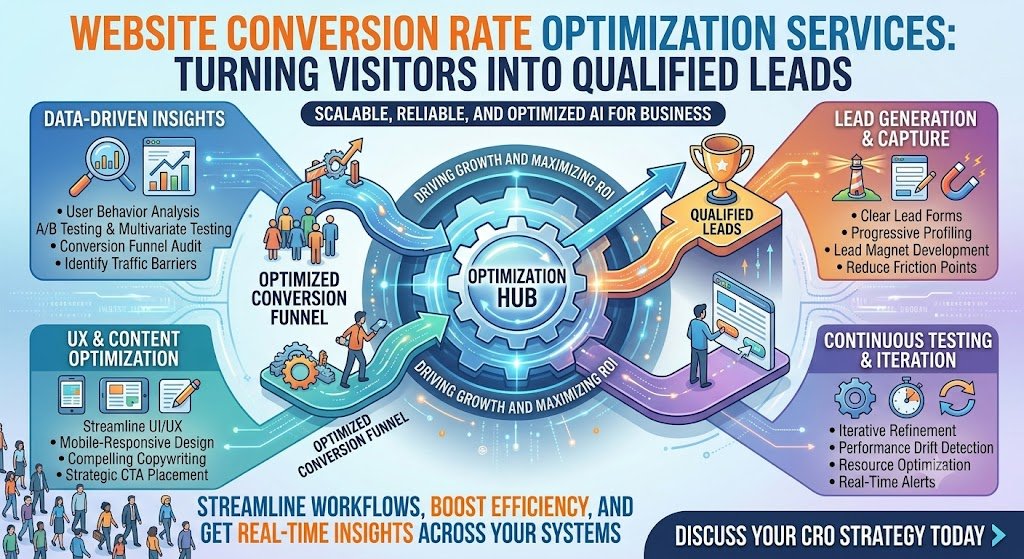
This is the redesign reflex, and it is the most expensive mistake in website optimisation. Conversion Rate Optimisation (CRO) is the discipline that avoids it. CRO is not about making a website prettier. It is about diagnosing why visitors are not converting and systematically fixing the causes—through research, hypothesis, testing, and measurement.
The distinction matters more in 2026 than ever. Acquisition costs are rising. Paid search and social campaigns are more expensive per click. Every visitor who arrives and leaves without converting is a wasted acquisition rupee. Improving conversion rate from 1% to 2% doubles the return on every marketing rupee spent—without spending more on traffic.
But CRO in the Indian market has a specific complication that generic guides ignore: lead quality. A form that generates 500 enquiries per month sounds impressive until the sales team reports that 450 are unqualified. CRO that optimises for raw lead volume can actively harm the business by flooding sales with noise. The goal is qualified leads, not just more leads.
There is also a compliance dimension. Under the DPDP Act, every form that collects personal data must have compliant consent—free, specific, informed, and unambiguous. A CRO programme that increases form submissions by removing the consent checkbox is not optimisation. It is a compliance liability.
This guide is written for Indian business leaders, marketing heads, and founders who need a CRO programme that produces qualified leads. We will cover the diagnostic process, the testing framework, the conversion elements that matter, real costs in rupees and dollars, the DPDPA requirements for lead capture forms, and a phased implementation roadmap with clear KPIs.
What CRO Actually Is (And What It Is Not)
The Definition That Matters
CRO is the systematic process of increasing the percentage of website visitors who take a desired action—filling a form, requesting a demo, making a purchase, subscribing—by understanding visitor behaviour, forming hypotheses about why they are not converting, and testing changes to validate those hypotheses.
The key word is systematic. CRO is not a one-time project. It is an ongoing programme of research, testing, and iteration. The businesses that succeed at CRO are the ones that run a continuous testing cadence, not the ones that commission a single redesign.
What CRO Is Not
CRO is not a redesign. A redesign changes the entire website based on opinion. CRO changes specific elements based on evidence. A redesign is a large, risky, expensive intervention. A CRO test is a small, controlled, measurable experiment. If a CRO programme is run well, it may eventually inform a redesign—but the redesign is the output of evidence, not the starting point.
CRO is not just A/B testing button colours. Button colour tests are the stereotype of CRO, and they are usually low-impact. Meaningful CRO addresses the fundamentals: the clarity of the value proposition, the relevance of the page to the traffic source, the trust signals, the friction in the form, and the speed of the page.
CRO is not just about the form. The form is where the conversion happens, but the reasons visitors do not fill it often originate earlier—in the ad that set the wrong expectation, the landing page that did not answer their question, or the pricing page that created doubt.
CRO vs Redesign vs SEO
| Dimension | CRO | Redesign | SEO |
|---|---|---|---|
| Goal | Increase conversion rate | Change visual design | Increase organic traffic |
| Method | Research, hypothesis, testing | Opinion, creative direction | Keyword targeting, content |
| Risk | Low (controlled tests) | High (full-site change) | Medium (algorithm-dependent) |
| Measurement | A/B tests, statistical significance | Subjective | Rankings, traffic |
| Time to impact | Weeks per test | Months | Months |
| Best for | Existing traffic that is not converting | Outdated brand/UX | Growing traffic |
The most effective sequence for most Indian businesses is: fix the traffic first (SEO/paid), then optimise the conversion (CRO), then consider redesign (if the evidence supports it). Optimising conversion on a site with no traffic is pointless. Redesigning a site without conversion data is guesswork.
For teams building the landing pages and forms that CRO will optimise, our Website Development practice covers the full stack.
The CRO Diagnostic: Finding Out Why Visitors Are Not Converting Before testing anything, you need to understand why the current site is underperforming. The diagnostic phase combines quantitative data (analytics, heatmaps, session recordings) with qualitative research (user surveys, interviews, sales team input).
The Five Diagnostic Lenses
1. Analytics and funnel analysis. Where do visitors drop off? Which pages have high exit rates? Which traffic sources convert best and worst? Google Analytics 4 and Search Console provide the quantitative baseline.
2. Heatmaps and scroll maps. Where do visitors click, and how far do they scroll? A heatmap that shows visitors clicking on a non-clickable element is a signal that the element looks like a button. A scroll map that shows 70% of visitors never reaching the form is a signal that the page is too long or the value proposition is not compelling enough.
3. Session recordings. Watching anonymised recordings of real sessions reveals friction that analytics cannot: rage clicks, confusion, form abandonment, mobile usability issues. Tools like Hotjar, Clarity, and Smartlook provide this.
4. User surveys and exit polls. Asking visitors "What were you looking for today?" or "What stopped you from completing your enquiry?" surfaces objections that no analytics tool can capture.
5. Sales team input. The sales team knows why leads are unqualified and why prospects hesitate. A structured conversation with sales is one of the highest-value diagnostic activities—and one of the most frequently skipped.
The Diagnostic Output
The diagnostic phase should produce:
A prioritised list of conversion problems ranked by impact and ease of fix.
A set of hypotheses for each problem, stated as testable predictions ("If we change X to Y, conversion rate will increase because Z").
A baseline measurement of current conversion rates by page, traffic source, and device.
Diagnostic Tools and India Costs
| Tool | Purpose | Monthly Cost (₹) | Monthly Cost ($ approx.) |
|---|---|---|---|
| Google Analytics 4 | Funnel, traffic, conversion tracking | Free | Free |
| Microsoft Clarity | Heatmaps, session recordings | Free | Free |
| Hotjar | Heatmaps, recordings, surveys | ₹2,500–₹8,000 | $30–$96 |
| Smartlook | Session recordings, funnels | ₹2,000–₹7,000 | $24–$84 |
| VWO / Optimizely | A/B testing platform | ₹8,000–₹50,000+ | $96–$600+ |
| Google Optimize (deprecated) | A/B testing | — | — (migrate to alternatives) |
Note: Microsoft Clarity is free and provides heatmaps and session recordings that are sufficient for most Indian SMEs. A/B testing platforms are the main paid cost.
The Conversion Elements That Actually Matter
CRO testing should focus on the elements that have the largest impact on conversion. These are not button colours.
1. Value Proposition Clarity
The single biggest conversion killer is a value proposition that the visitor does not understand. If a visitor cannot answer "What does this company do, and is it for me?" within five seconds of landing, they leave.
What to test:
Headline clarity (does it state the outcome, not the feature?)
Subheadline specificity (who is it for, what does it do?)
Hero image relevance (does it show the product or the outcome?)
Example: "AI-powered solutions for modern businesses" is unclear. "Cut invoice processing time by 70% with AI document extraction" is clear. The second will convert better.
2. Message Match Between Ad and Landing Page
If a visitor clicks an ad for "invoice automation software" and lands on a page about "AI for digital transformation", the mismatch creates immediate friction. Message match means the landing page headline echoes the ad headline.
What to test:
Dynamic headlines that match the traffic source
Landing pages per campaign/keyword
Consistency of offer between ad and page
3. Trust Signals
Indian B2B buyers are cautious. They need proof before they fill a form. Trust signals include:
Client logos (especially recognisable Indian brands)
Testimonials with names and companies
Case studies with specific metrics
Certifications and compliance badges (ISO, DPDPA readiness)
Security and privacy statements
What to test:
Placement of trust signals (above the fold vs near the form)
Format (logos vs testimonials vs metrics)
Specificity of testimonials
4. Form Friction
Every field in a form is a reason for the visitor to abandon. The form should ask for the minimum necessary to qualify and follow up.
What to test:
Number of fields (fewer is usually better, but not always—see lead quality below)
Field types (dropdowns vs free text)
Progressive profiling (asking for more information over multiple visits)
Form placement and length
The lead quality trade-off: Reducing fields increases submissions but may decrease quality. A form asking for name, email, and company size may produce more leads than one also asking for budget and timeline—but the latter may produce more qualified leads. The right balance depends on the sales process. Test both volume and quality, not just volume.
5. Page Speed
Speed is a conversion factor that is often neglected. Every additional second of load time reduces conversions. For Indian mobile users—many on slower connections—speed matters even more.
What to test:
Image compression and lazy loading
Server response time
Third-party script reduction
Mobile-specific performance
6. Mobile Experience
The majority of Indian web traffic is mobile. A site that converts on desktop but not on mobile is leaving money on the table.
What to test:
Mobile form usability (keyboard type, field size, tap targets)
Mobile page speed
Mobile-specific layout and CTAs
Conversion Element Priority Table
| Element | Typical Impact | Ease of Testing | Priority |
|---|---|---|---|
| Value proposition clarity | Very High | Medium | 1 |
| Message match | High | Medium | 2 |
| Form friction | High | Easy | 3 |
| Trust signals | High | Easy | 4 |
| Page speed | Medium-High | Medium | 5 |
| Mobile experience | High (for mobile traffic) | Medium | 6 |
| CTA copy and placement | Medium | Easy | 7 |
| Button colour | Low | Easy | 8 |
A/B Testing: The Methodology That Produces Reliable Results
A/B testing is the core methodology of CRO. It involves showing two versions of a page (or element) to different segments of traffic and measuring which performs better.
The Testing Process
1. Formulate a hypothesis. State what you will change, why, and what you expect to happen. Example: "If we move the trust logos above the form, form submissions will increase by 10% because visitors will see proof before being asked for information."
2. Calculate sample size. Before running the test, calculate how much traffic you need to detect a meaningful difference. Running a test for too short a time produces unreliable results. A/B testing calculators (free online) provide this.
3. Run the test. Split traffic randomly between control (original) and variant (change). Run for at least one full business cycle (usually 1–2 weeks) to account for day-of-week variation.
4. Analyse the result. Check for statistical significance. A test that shows a 5% improvement but is not statistically significant is not a result—it is noise.
5. Implement and document. If the variant wins, implement it. If it loses, document the learning. Both outcomes are valuable.
Common Testing Mistakes
Stopping the test too early. Checking results daily and stopping when the variant looks good produces false positives. Decide the test duration in advance and stick to it.
Testing too many things at once. A test that changes the headline, the form, and the button colour cannot tell you which change caused the result.
Ignoring segment differences. A variant that wins overall may lose on mobile. Analyse results by device, traffic source, and visitor type.
Testing on insufficient traffic. A site with 500 monthly visitors cannot run statistically valid A/B tests in a reasonable timeframe. For low-traffic sites, focus on qualitative research and best-practice implementation instead of testing.
Testing vs Best Practices
Not every change needs a test. Some changes are well-established best practices—clear headlines, fast pages, minimal form fields, visible trust signals. Implement these without testing. Reserve A/B testing for changes where the outcome is genuinely uncertain.
Test Priority Matrix
| Test Type | Traffic Required | Potential Impact | When to Run |
|---|---|---|---|
| Headline/value proposition | High | Very High | Once baseline is established |
| Form length/fields | Medium | High | Early—quick win potential |
| Trust signal placement | Medium | High | Early |
| Landing page layout | High | High | After initial tests |
| CTA copy | Medium | Medium | Ongoing |
| Button colour | Low | Low | Only if other tests are exhausted |
DPDPA Compliance for Lead Capture Forms
Every form that collects personal data—name, email, phone, company—is subject to the DPDP Act. CRO that increases form submissions by removing consent or obscuring data usage is not optimisation. It is a compliance risk.
Key Requirements
1. Notice. The form must inform the user what data is being collected, why, and how it will be used. A link to the privacy policy is necessary but may not be sufficient—the notice should be specific to the purpose of the form.
2. Consent. Consent must be free, specific, informed, and unambiguous. A pre-ticked checkbox is not valid consent. The user must take a clear affirmative action.
3. Purpose limitation. Data collected for a demo request cannot be used for marketing emails without separate consent. If the form includes a marketing opt-in, it must be separate from the demo request consent.
4. Data minimisation. Collect only what is necessary. A phone number may be necessary for a sales follow-up call; a date of birth is not.
5. Retention. Define how long form data is retained and delete it when no longer needed.
The CRO-Compliance Balance
The tension between CRO and compliance is real. A consent checkbox reduces form submissions. But removing it creates legal liability.
The right approach: Make consent clear and easy to understand, but do not hide or remove it. A well-designed consent statement ("We will use your details to contact you about your enquiry. See our privacy policy.") is compliant and does not significantly reduce conversion. The conversion loss from a clear consent statement is far smaller than the risk of a DPDPA penalty.
Compliance Checklist for Lead Forms
| Requirement | Implementation | Priority |
|---|---|---|
| Specific notice | Form-level notice explaining data use | High |
| Affirmative consent | Unchecked checkbox or clear action | High |
| Separate marketing consent | Distinct from enquiry consent | High |
| Privacy policy link | Visible near the form | High |
| Data minimisation | Only necessary fields | Medium |
| Retention policy | Defined and enforced | Medium |
| Secure transmission | HTTPS, encrypted storage | High |
Real Costs in India (2026)
CRO costs depend on whether you engage an agency, hire in-house, or use freelancers—and on the scope of research, testing, and implementation.
Monthly Retainer Costs
| Engagement Type | Monthly Cost (₹) | Monthly Cost ($ approx.) | What It Covers |
|---|---|---|---|
| Freelance CRO consultant | ₹30,000–₹80,000 | $360–$960 | Audit, test design, analysis |
| Boutique CRO agency (India) | ₹75,000–₹2 lakh | $900–$2,400 | Research, testing, implementation, reporting |
| Full-service CRO agency (India) | ₹2–5 lakh | $2,400–$6,000 | Full programme: research, design, dev, testing |
| In-house CRO specialist | ₹80,000–₹1.5 lakh (salary) | $960–$1,800 | Dedicated resource |
One-Time Costs
| Item | Cost (₹) | Cost ($ approx.) | Notes |
|---|---|---|---|
| CRO audit | ₹50,000–₹1.5 lakh | $600–$1,800 | Analytics, heatmaps, heuristics, prioritised recommendations |
| User research | ₹40,000–₹1.2 lakh | $480–$1,440 | Surveys, interviews, usability testing |
| Landing page design and build | ₹30,000–₹1 lakh | $360–$1,200 | Per page, depends on complexity |
| A/B testing setup | ₹20,000–₹60,000 | $240–$720 | Tool configuration, event tracking |
| Conversion copywriting | ₹15,000–₹50,000 | $180–$600 | Per page |
The Realistic Budget for an Indian Business
For a business with meaningful website traffic (10,000+ monthly visitors) targeting a 20–30% conversion rate improvement within 6 months:
Months 1–2: ₹1–2.5 lakh ($1,200–$3,000) for audit, research, and initial test setup.
Months 3–6: ₹75,000–₹2 lakh/month ($900–$2,400) for ongoing testing, design, and development.
Total first-six-months investment: ₹4–10 lakh ($4,800–$12,000).
Cost vs Return: The Conversion Math
| Metric | Before CRO | After CRO (25% improvement) |
|---|---|---|
| Monthly visitors | 20,000 | 20,000 |
| Conversion rate | 1.0% | 1.25% |
| Monthly leads | 200 | 250 |
| Cost per lead (if ₹2L/month marketing spend) | ₹1,000 | ₹800 |
| Annual additional leads | — | 600 |
The return on CRO investment depends on the value of a lead. For a B2B business with a high average contract value, a 25% improvement in conversion rate can justify the entire CRO programme within a few months.
Implementation Framework: A Phased Approach With KPIs
Phase 1: Audit and Baseline (Month 1)
Objective: Understand the current state and establish a measurement baseline.
Activities:
Analytics audit: verify tracking, set up conversion events, define funnels.
Heuristic review: evaluate pages against CRO best practices.
Heatmap and session recording setup.
Sales team interviews: understand lead quality issues.
Baseline measurement: conversion rate by page, source, device.
Cost: ₹50,000–₹1.5 lakh ($600–$1,800).
KPIs: Tracking verified. Baseline conversion rates documented. Prioritised problem list.
Phase 2: Quick Wins and Hypothesis Backlog (Month 2–3)
Objective: Implement high-confidence fixes and build a testing backlog.
Activities:
Implement best-practice fixes that do not require testing (page speed, form field reduction, trust signal placement).
Conduct user surveys and exit polls.
Build a prioritised hypothesis backlog (using a framework like PIE: Potential, Importance, Ease).
Set up A/B testing tool and run the first test.
Cost: ₹1–2 lakh ($1,200–$2,400).
KPIs: Quick wins implemented. First test live. Hypothesis backlog prioritised.
Phase 3: Testing Cadence (Month 4–9)
Objective: Run a continuous testing programme.
Activities:
Run 2–4 tests per month (depending on traffic).
Analyse results, implement winners, document learnings.
Expand testing to landing pages, forms, and mobile experience.
Monitor lead quality alongside lead volume.
Cost: ₹75,000–₹2 lakh/month ($900–$2,400).
KPIs: Conversion rate improvement. Number of tests run. Win rate. Lead quality maintained or improved.
Phase 4: Scale and Institutionalise (Month 10–12)
Objective: Embed CRO as an ongoing capability.
Activities:
Expand testing to new pages and traffic sources.
Build a testing culture: share learnings across teams.
Integrate CRO with SEO and paid campaigns (message match).
Conduct quarterly CRO reviews.
Cost: Ongoing retainer or in-house resource.
KPIs: Sustained conversion rate improvement. Cost per qualified lead reduction. Testing velocity.
Phase Summary Table
| Phase | Duration | Key Deliverable | Cost (₹) | Primary KPI |
|---|---|---|---|---|
| 1. Audit & Baseline | 1 month | Tracking, baseline, problem list | 50,000–1.5 lakh | Baseline established |
| 2. Quick Wins & Backlog | 2 months | Best-practice fixes, first test | 1–2 lakh | Quick wins live, test running |
| 3. Testing Cadence | 6 months | Continuous A/B testing | 75,000–2 lakh/month | Conversion rate improvement |
| 4. Scale & Institutionalise | 3 months | Embedded CRO capability | Ongoing | Sustained improvement, cost per lead down |
Risks, Pitfalls, and Governance
The Most Common CRO Failures
Redesigning instead of testing. A full redesign based on opinion, without diagnostic data, often produces no conversion improvement and may reduce it. Mitigation: Diagnose first, test changes in controlled experiments.
Optimising for volume, not quality. A form that produces 500 unqualified leads is worse than one that produces 100 qualified leads—because sales wastes time on noise. Mitigation: Track lead quality alongside conversion rate. Test form fields that qualify, not just fields that reduce friction.
Testing without sufficient traffic. A site with 500 monthly visitors cannot run statistically valid tests. Mitigation: For low-traffic sites, focus on best-practice implementation and qualitative research instead of A/B testing.
Ignoring mobile. The majority of Indian traffic is mobile. A desktop-optimised CRO programme misses most of the opportunity. Mitigation: Test on mobile first, or at least analyse results by device.
Removing consent for conversion. A form that removes the consent checkbox may increase submissions but creates DPDPA liability. Mitigation: Design compliant consent that is clear and easy, not hidden or removed.
Risk Summary Table
| Risk | Likelihood | Impact | Mitigation |
|---|---|---|---|
| Redesign without diagnosis | High | High (wasted budget) | Audit first, test changes |
| Volume over quality | High | High (sales noise) | Track lead quality, qualify via form |
| Insufficient traffic for testing | Medium | Medium (unreliable results) | Best practices for low-traffic sites |
| Ignoring mobile | High | High (missed conversions) | Mobile-first testing |
| DPDPA non-compliance | Medium | Critical (penalties) | Compliant consent design |
| Testing too many variables | Medium | Medium (unclear results) | One change per test |
Benchmark Summary and Decision Framework
Decision Matrix: Agency vs In-House vs Freelancer
| Factor | Agency | In-House | Freelancer |
|---|---|---|---|
| Monthly cost | ₹75,000–₹5 lakh | ₹80,000–₹1.5 lakh (salary) | ₹30,000–₹80,000 |
| Expertise | Specialised, multi-client experience | Depends on hire | Variable |
| Control | Medium | Full | Low-Medium |
| Scalability | High | Limited | Limited |
| Best for | Companies needing full programme | Companies with existing marketing team | Companies testing CRO with low budget |
Conversion Improvement Benchmarks
| Metric | Typical Range | What "Good" Looks Like |
|---|---|---|
| Form conversion rate (B2B) | 1–3% | 3–5%+ |
| Demo request rate (B2B SaaS) | 0.5–2% | 2–4%+ |
| E-commerce conversion rate | 1–2% | 2–4%+ |
| Lead-to-qualified-lead rate | 20–40% | 40–60%+ |
| Improvement per test cycle | 5–15% | 15–30%+ |
Note: These are indicative benchmarks for Indian businesses. Actual rates vary widely by industry, traffic quality, and offer.
The One-Paragraph Decision Rule
If your website has meaningful traffic (10,000+ monthly visitors) and a conversion rate below 2%, a CRO programme is likely to deliver positive ROI within 6 months. Start with a diagnostic audit, implement best-practice fixes, then run a continuous testing cadence. Measure qualified leads, not just form submissions. And build consent into the form from day one—compliance is not optional.
Frequently Asked Questions
1. What is conversion rate optimisation (CRO)?
CRO is the systematic process of increasing the percentage of website visitors who take a desired action—filling a form, requesting a demo, making a purchase—by understanding visitor behaviour and testing changes to improve it. It is not a redesign; it is a continuous programme of research and experimentation.
2. How much do CRO services cost in India?
A CRO audit costs ₹50,000–₹1.5 lakh ($600–$1,800). Monthly retainers range from ₹30,000 (freelancer) to ₹5 lakh (full-service agency). A realistic first-six-months budget is ₹4–10 lakh ($4,800–$12,000) for a business with meaningful traffic.
3. How long does it take to see CRO results?
Quick wins (page speed, form field reduction, trust signal placement) can show results within weeks. A/B tests take 1–2 weeks each, and a continuous testing programme typically shows meaningful conversion improvement within 3–6 months.
4. What is the difference between CRO and a website redesign?
A redesign changes the entire website based on opinion. CRO changes specific elements based on evidence from research and testing. A redesign is a large, risky intervention; a CRO test is a small, controlled experiment.
5. How much traffic do I need for A/B testing?
A/B testing requires enough traffic to achieve statistical significance. As a rough guide, you need at least 1,000 conversions per variant to detect a meaningful difference. Sites with fewer than 10,000 monthly visitors may struggle to run valid tests and should focus on best-practice implementation instead.
6. What is the difference between lead volume and lead quality?
Lead volume is the number of form submissions. Lead quality is the percentage of those submissions that are genuinely qualified to buy. CRO that optimises only for volume can flood sales with unqualified leads. The goal is qualified leads, which may mean adding qualifying fields to the form.
7. How does DPDPA affect lead capture forms?
Every form that collects personal data must have compliant consent—free, specific, informed, and unambiguous. The form must inform users what data is collected and why. A pre-ticked checkbox is not valid consent. Data minimisation and retention policies apply.
8. What tools do I need for CRO?
Google Analytics 4 (free), Microsoft Clarity (free heatmaps and recordings), and an A/B testing platform (VWO, Optimizely, or similar) are the core stack. A/B testing platforms cost ₹8,000–₹50,000+ per month depending on traffic and features.
9. Should I test button colours?
Button colour tests are usually low-impact and should be low priority. Focus first on value proposition clarity, message match, form friction, trust signals, and page speed—these have far larger impact.
10. How do I measure CRO success?
Track: conversion rate by page and traffic source, qualified lead volume, cost per qualified lead, and test win rate. Measure lead quality alongside volume—a conversion rate improvement that produces unqualified leads is not success.
11. Can CRO help with SEO?
CRO and SEO are complementary. SEO brings traffic; CRO converts it. Improvements in page speed, mobile experience, and content clarity benefit both. Message match between search intent and landing page content improves both ranking and conversion.
12. How can Innovative AI Solutions help?
Innovative AI Solutions builds high-converting websites and landing pages for Indian businesses—including AI-powered chatbots, lead capture forms with DPDPA-compliant consent, analytics setup, and conversion-focused development. Our Delhi-based team handles design, development, and optimisation. Visit https://innovativeais.com to discuss your requirements.
Contact Innovative AI Solutions
Ready to turn your website traffic into qualified leads—not just visitors?
[One-line supporting sentence.]
Contact Information
Innovative AI Solutions
📍 Netaji Subhash Place, Pitampura, Delhi – 110034
🌐 Website: https://innovativeaislabs.com 📧 Email: info@innovativeais.com
📞 Phone: +91 7464 099 059 / +91 96899 67356
Business Services
AI Automation
AI Development
AI Consulting
Machine Learning Solutions
Deep Learning Solutions
Generative AI Services
NLP Solutions
AI Agents
AI Chatbots
Voice AI
CRM Development
Custom Software Development
Website Development
Mobile App Development
About the Author
Abhishek Kumar
Founder & CEO, Innovative AI Solutions
5+ years building production AI systems for Indian businesses. Based in Delhi, serving clients across India.
Ready to build AI solutions for your business?
Innovative AI Solutions — Delhi's leading AI development company. Free consultation available.
Get Free Consultation →
A practical 2026 guide for Indian businesses running CRO programmes—diagnosis before redesign, qualified leads over raw volume, real rupee costs, and DPDPA-compliant forms that convert without creating liability.
#CRO #ConversionRateOptimisation #WebsiteCRO #QualifiedLeads #ABTesting #LandingPageOptimisation #CROAudit #Heatmaps #SessionRecording #FormOptimisation #DPDPA #MeitY #LeadGeneration #ConversionOptimisation #DelhiNCR #InnovativeAISolutions
Copyright ©️ 2015–2026 Innovative AI Solutions. All Rights Reserved. | Privacy Policy | Terms & Conditions