The EdTech Rebuild: Why Indian Learning Platforms Must Be Designed Differently in 2026 India has one of the largest student populations in the world, and EdTech adoption has moved from novelty to infrastructure. Schools run on student information systems. Coaching centres run on live class platforms. Universities run on learning management systems. Corporate training runs on assessment engines. The category is no longer a single market—it is a set of markets, each with different users, different compliance obligations, and different technical requirements.
This is also a category that has learned hard lessons. The post-pandemic boom produced platforms that scaled video delivery but neglected learning outcomes, ignored low-bandwidth realities, and treated child data casually. Several high-profile failures—funding collapses, layoffs, and regulatory scrutiny—made clear that an EdTech product is not a content business with an app attached. It is a system that must deliver measurable learning, operate reliably on Indian networks, and protect the data of minors.
Three forces define EdTech software development in 2026.
First, the regulatory framework has tightened. The DPDP Act gives special protection to children's data. Verifiable parental consent is required before processing a child's personal data, and tracking or behavioural monitoring of children is restricted. For an EdTech platform whose primary users are school students, this is not a back-office concern—it is a core product requirement. MeitY's AI Governance Guidelines add expectations of transparency and accountability for any AI-driven learning or assessment feature.
Second, the policy context has shifted. NEP 2020 has pushed schools and institutions toward digital infrastructure, competency-based assessment, and multilingual learning. Platforms that align with these priorities—rather than just digitising textbooks—are better positioned for institutional adoption.
Third, the technology expectations have changed. AI tutors, adaptive practice, automated assessment, and voice-based learning in Indian languages are now expected features, not differentiators. Building them requires an architecture that supports AI integration from the start, not a content platform with an AI feature bolted on later.
This guide is written for Indian founders, school groups, coaching institutions, universities, and corporate L&D teams evaluating EdTech software development. We will cover the platform architecture that works, the student portal design that protects children's data, real costs in rupees and dollars, DPDPA and MeitY compliance obligations specific to education, and a phased build framework with clear go/no-go gates.
What an EdTech Platform Actually Consists Of
"EdTech platform" is an umbrella term. The components differ by segment—K-12 school, test prep coaching, higher education, or corporate learning. But most platforms share a common set of modules.
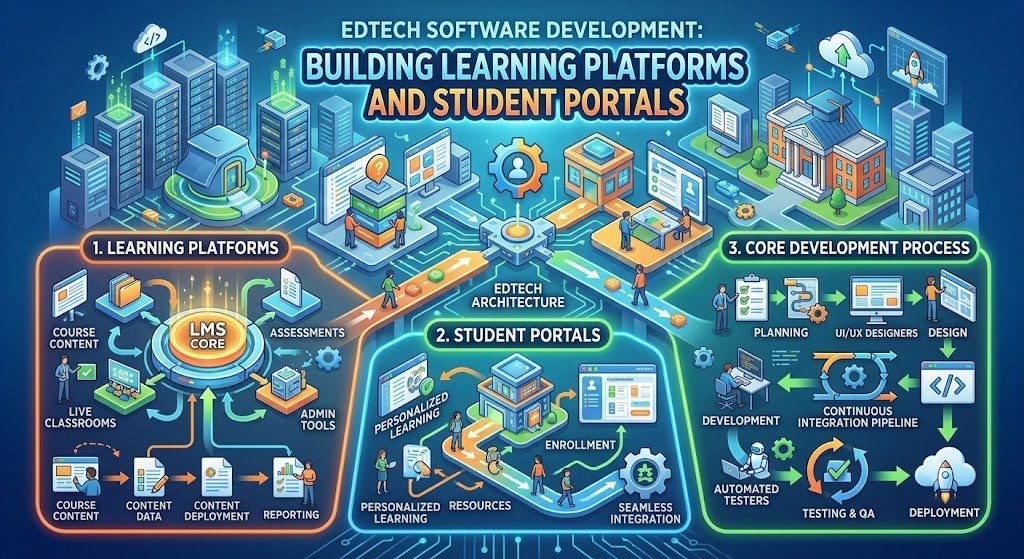
The Core Modules
1. Student portal and identity. The student's entry point: login, profile, enrolled courses, schedule, progress, and results. Identity management is the foundation—every other module depends on knowing who the user is and what they are entitled to access.
2. Content delivery. Lessons in video, text, audio, interactive exercises, and PDFs. Content delivery is where bandwidth reality matters most in India—a platform that streams 1080p video to a student on a 3G connection in a tier-3 city is not delivering content, it is buffering.
3. Live class infrastructure. Video conferencing, whiteboard, screen sharing, chat, and recording. Live classes are technically demanding—they require real-time infrastructure, not just static content hosting.
4. Assessment engine. Quizzes, assignments, timed tests, auto-grading, and result analytics. For test prep, the assessment engine is the product. For schools, it is the assessment and reporting layer.
5. Adaptive learning and AI tutoring. Personalised practice, question recommendation, doubt-solving assistants, and AI-generated explanations. This is where AI integration adds genuine value—but also where compliance obligations intensify, because AI features that assess or track students fall under DPDPA's children's data provisions.
6. Parent and teacher dashboards. Parents need visibility into attendance, progress, and fees. Teachers need tools to assign work, grade, and communicate. These dashboards are often the deciding factor for institutional buyers.
7. Administration and billing. Enrollment, fee collection, batch management, and reporting. For schools, this overlaps with a school ERP. For coaching centres, it is batch and fee management.
8. Communication and notifications. Email, SMS, WhatsApp, and in-app notifications for schedules, results, and reminders.
Module Priority by Segment
| Segment | Primary Users | Must-Have Modules | Differentiating Modules |
|---|---|---|---|
| K-12 school | Students, parents, teachers | Student portal, attendance, assessment, parent dashboard, fees | AI tutoring, adaptive practice |
| Test prep coaching | Students, faculty | Assessment engine, live classes, analytics, doubt-solving | AI question recommendation, performance prediction |
| Higher education | Students, faculty, admin | LMS, assessment, content delivery, gradebook | AI research assistance, plagiarism detection |
| Corporate L&D | Employees, L&D managers | Content delivery, assessment, certification, reporting | Adaptive learning paths, skills mapping |
For teams building the AI features that differentiate these platforms, our AI Development and Generative AI Services practices cover the full stack.
Architecture: Designing for Indian Reality
The Low-Bandwidth Constraint
India's internet is improving, but it is not uniform. A platform designed for a student in South Delhi with fibre broadband will fail for a student in a smaller town on a mobile connection with intermittent coverage.
Architectural implications:
Progressive content delivery: Offer low-resolution video by default, with the option to upgrade. Use adaptive bitrate streaming (HLS/DASH) so quality adjusts to available bandwidth.
Offline-first design: Allow content to be downloaded for offline viewing, with progress synced when the connection returns. This is not a nice-to-have; it is a requirement for reach.
Lightweight web app: Ensure the student portal works as a responsive web app, not just a heavy native app.
Text and audio alternatives: For every video lesson, provide a text summary and an audio version. This serves low-bandwidth users and accessibility needs simultaneously.
CDN with Indian points of presence: Content delivery must be fast across India, not just in metros.
The Multi-Tenancy Decision
Institutional EdTech—schools, coaching chains, universities—almost always requires multi-tenancy: a single platform serving many institutions, each with its own students, teachers, content, and branding.
Multi-tenancy patterns:
Shared database, shared schema (tenant ID on every row): Cheapest, simplest, but requires careful access control.
Shared database, separate schema (one schema per tenant): Better isolation, moderate cost.
Separate database per tenant: Strongest isolation, highest cost, appropriate for large institutions with data residency requirements.
For Indian EdTech, shared database with tenant ID is the pragmatic default, with the ability to move large institutions to separate schemas if required by contract or compliance.
Integration With Government Platforms
India's EdTech ecosystem includes government platforms that schools increasingly expect integration with—DIKSHA (national digital infrastructure for teachers), UDISE+ (school data), and state board systems. An architecture that exposes clean APIs and supports data export makes these integrations feasible.
The Architecture at a Glance
| Layer | Function | India-Specific Consideration |
|---|---|---|
| Identity and access | Authentication, roles, permissions | Parent-student linked accounts, teacher roles |
| Content delivery | Video, text, audio, interactive | Adaptive bitrate, offline download, CDN |
| Live class | Video, whiteboard, chat | Low-bandwidth mode, recording |
| Assessment | Quizzes, tests, auto-grading | Timed tests, offline test mode |
| AI layer | Tutoring, recommendation, analytics | Compliance with children's data rules |
| Dashboards | Student, parent, teacher, admin | Role-based visibility |
| Compliance | Consent, audit, retention | DPDPA children's data, verifiable parental consent |
The Student Portal: Designing for Children's Data
The student portal is the most sensitive part of an EdTech platform because it collects and displays data about minors. Under the DPDP Act, this is not ordinary personal data—it carries specific obligations.
DPDPA Requirements for Children's Data
1. Verifiable parental consent. Before processing a child's personal data, the platform must obtain verifiable consent from a parent or guardian. The mechanism must be genuine—a checkbox that a child can tick themselves is not verifiable consent.
2. No behavioural monitoring of children. The DPDP Act restricts tracking, behavioural monitoring, and targeted advertising directed at children. For an EdTech platform, this means no profiling children for advertising, no tracking beyond what is necessary for learning, and no use of student data for purposes unrelated to education.
3. Children's data protections are being phased. The DPDP Rules notified in November 2025 phase in obligations: consent and notice from Phase I, and children's data verification from Phase II (November 2026). Platforms built now must be ready for enforcement, not retrofitted later.
4. Data minimisation. Collect only what the learning function requires. A platform does not need a child's full address, photograph, or family details to teach mathematics. Every additional field is a compliance liability.
5. Retention and erasure. Define retention periods for student data and build erasure workflows. When a student leaves an institution, their data should be deleted or anonymised according to the contract.
Designing the Portal for Minors
Beyond compliance, designing for children requires UX judgment:
Age-appropriate interfaces: Younger students need simpler navigation, larger tap targets, and clearer instructions.
Parent visibility: Parents should be able to see their child's activity, progress, and data. This is both a product feature and a compliance safeguard.
No dark patterns: No manipulative prompts, no gamified pressure that exploits children's psychology.
Safe communication: If the platform enables student-teacher or student-student messaging, moderation and safety controls are mandatory.
Accessibility: Support for screen readers, captions, and keyboard navigation—not just as compliance, but as learning inclusion.
Student Portal Feature Table
| Feature | Student View | Parent View | Compliance Note |
|---|---|---|---|
| Profile | Name, class, enrolled courses | Linked child profile | Minimal data only |
| Schedule | Classes, tests, deadlines | Child's schedule | No third-party sharing |
| Progress | Completed lessons, scores | Child's progress | No advertising use |
| Attendance | Own attendance | Child's attendance | Retained per policy |
| Fees | — | Fee status, payment | Payment gateway compliance |
| Communication | Teacher messages | Teacher communications | Moderation required |
| Consent | — | Parental consent management | Verifiable, withdrawable |
Real Costs in India (2026)
EdTech development costs depend on the segment, the number of modules, whether live classes are included, and the extent of AI features.
Build Costs by Platform Type
| Platform Type | Build Cost (₹) | Build Cost ($ approx.) | Timeline | Scope |
|---|---|---|---|---|
| MVP student portal | ₹8–20 lakh | $9,600–$24,000 | 8–14 weeks | Portal, content delivery, basic assessment |
| Full LMS (school/college) | ₹20–50 lakh | $24,000–$60,000 | 16–28 weeks | Portal, content, assessment, dashboards, admin |
| Live class platform | ₹25–60 lakh | $30,000–$72,000 | 20–32 weeks | Live video, whiteboard, recording, multi-tenancy |
| AI-powered learning platform | ₹40–90 lakh | $48,000–$1,08,000 | 24–36 weeks | Full LMS + AI tutor, adaptive practice, analytics |
Note: USD conversions at ₹83/$. These ranges are indicative for Indian development teams and include design, development, and basic testing. They exclude third-party video infrastructure costs, content production, and compliance audits.
Feature Add-On Costs
| Feature | Additional Cost (₹) | Additional Cost ($ approx.) |
|---|---|---|
| Live video classes (WebRTC infrastructure) | ₹5–15 lakh | $6,000–$18,000 |
| AI doubt-solving tutor (RAG-based) | ₹3–8 lakh | $3,600–$9,600 |
| Adaptive practice engine | ₹5–12 lakh | $6,000–$14,400 |
| Offline download and sync | ₹2–5 lakh | $2,400–$6,000 |
| Multi-language support | ₹3–8 lakh | $3,600–$9,600 |
| Payment and fee management | ₹1–3 lakh | $1,200–$3,600 |
| Parent mobile app | ₹4–10 lakh | $4,800–$12,000 |
| Content authoring tool | ₹3–8 lakh | $3,600–$9,600 |
Running Costs
| Cost Component | Monthly Range (₹) | Monthly Range ($ approx.) | Notes |
|---|---|---|---|
| Hosting and CDN | ₹20,000–₹1,50,000 | $240–$1,800 | Scales with video traffic |
| Live video infrastructure | ₹15,000–₹1,00,000 | $180–$1,200 | Per concurrent user pricing |
| LLM API (AI features) | ₹10,000–₹80,000 | $120–$960 | Scales with AI usage |
| Payment gateway fees | 2–3% of transactions | — | Per transaction |
| Maintenance (15–25% annually) | ₹3–12 lakh/year | $3,600–$14,400/year | Updates, bug fixes, OS changes |
The Hidden Costs
Content production. Software is the platform. Content is the product. Producing video lessons, assessments, and practice questions is a separate cost—often larger than the software build.
Compliance review. Children's data processing requires legal review, consent mechanism design, and data protection impact assessment. Budget ₹1–5 lakh ($1,200–$6,000) for compliance work.
Device and bandwidth testing. Testing on low-end Android devices and slow connections is essential but time-consuming.
India-Specific Compliance: DPDPA, NEP 2020 and MeitY
DPDPA and the Education Sector
Education is one of the most sensitive data categories in the DPDP framework. The Act gives children special protection, and education platforms process children's data at scale.
Key obligations:
Verifiable parental consent before processing children's data.
No behavioural monitoring or targeted advertising directed at children.
Data minimisation: collect only what learning requires.
Retention and erasure: defined policies, enforced technically.
Breach notification: to CERT-In within six hours and to affected individuals.
NEP 2020 Alignment
NEP 2020 is not a statute that imposes compliance obligations, but it shapes institutional procurement. Platforms that align with NEP priorities are better positioned for school and university adoption:
Competency-based assessment rather than rote memorisation.
Multilingual learning in Indian languages.
Digital infrastructure integration with DIKSHA and state systems.
Teacher enablement through dashboards and content tools.
MeitY AI Governance Guidelines
If the platform includes AI features—tutoring, assessment, recommendation—MeitY's seven Sutras apply: safety, equality, inclusivity, privacy, transparency, accountability, and protection of societal values. In practice, for EdTech:
Transparency: students and parents should know when they are interacting with an AI.
Accountability: a named owner for AI behaviour.
Human oversight: AI assessment should be reviewable by teachers for consequential decisions.
Non-discrimination: AI tutoring should not disadvantage students based on language, region, or background.
Compliance Checklist for EdTech Platforms
| Requirement | Implementation | Priority |
|---|---|---|
| Verifiable parental consent | Parent-linked account, verification mechanism | High |
| No child behavioural tracking | Audit analytics, remove ad tech | High |
| Data minimisation | Audit every field collected | High |
| Retention and erasure | Policy + technical workflow | High |
| Breach notification | Incident response plan | High |
| AI transparency | Disclose AI features to students/parents | Medium |
| Accessibility | WCAG compliance for learning content | Medium |
| Safe communication | Moderation for student messaging | High |
Implementation Framework: A Phased Approach With Cost Gates
Phase 1: Segment and Scope Definition (Week 1–2)
Objective: Define the target segment, the core learning outcome, and the compliance scope.
Activities:
Choose the segment: K-12 school, test prep, higher education, or corporate. Each has different requirements.
Define the core learning outcome the platform must deliver. If it cannot be measured, it cannot be improved.
Map the modules required for v1. Resist the urge to build everything.
Assess DPDPA exposure: will the platform process children's data? If yes, consent design is a v1 requirement.
Decide build vs buy for commodity components (video infrastructure, payment gateway).
Cost: ₹50,000–₹1.5 lakh ($600–$1,800) for discovery and scoping.
Go/No-Go: Clear segment, measurable learning outcome, compliance scope understood.
Phase 2: Core Platform Build (Week 3–10)
Objective: Build the student portal, content delivery, and basic assessment.
Activities:
Identity and access management with parent-student linked accounts.
Content delivery with adaptive bitrate and offline download.
Basic assessment engine (quizzes, auto-grading).
Student dashboard and progress tracking.
Parental consent mechanism.
Cost: ₹8–20 lakh ($9,600–$24,000) for the MVP.
Go/No-Go: Students can log in, access content, take assessments, and see progress. Parental consent works.
Phase 3: Institutional Features and Dashboards (Week 11–18)
Objective: Add teacher, parent, and admin features for institutional adoption.
Activities:
Teacher dashboard: assign work, grade, communicate.
Parent dashboard: attendance, progress, fees.
Admin: batch management, user management, reporting.
Multi-tenancy if serving multiple institutions.
Communication and notifications.
Cost: ₹10–25 lakh ($12,000–$30,000) depending on scope.
Go/No-Go: Institution can onboard, manage users, and report on outcomes.
Phase 4: Live Classes and AI Features (Week 19–28)
Objective: Add differentiating capabilities.
Activities:
Live class infrastructure (WebRTC, whiteboard, recording).
AI doubt-solving tutor (RAG-based, grounded in curriculum content).
Adaptive practice engine.
Analytics and learning outcome reporting.
Cost: ₹15–40 lakh ($18,000–$48,000) depending on AI and live class scope.
Go/No-Go: Live classes work reliably on Indian networks. AI features meet accuracy and compliance requirements.
Phase 5: Pilot and Scale (Month 7–12)
Objective: Pilot with real students and institutions, then scale.
Activities:
Pilot with one institution or a limited student cohort.
Measure learning outcomes, engagement, and technical reliability.
Conduct DPDPA compliance review.
Scale to additional institutions.
Cost: Running costs plus governance review.
Go/No-Go: Learning outcomes measurable, compliance review passes, reliability acceptable.
Phase Summary Table
| Phase | Duration | Key Deliverable | Cost (₹) | Go/No-Go Criteria |
|---|---|---|---|---|
| 1. Scope | 2 weeks | Segment, outcome, compliance scope | 50,000–1.5 lakh | Clear segment, measurable outcome |
| 2. Core Platform | 8 weeks | Portal, content, assessment | 8–20 lakh | Portal works, consent works |
| 3. Institutional | 8 weeks | Teacher/parent dashboards, multi-tenancy | 10–25 lakh | Institution can onboard |
| 4. Live & AI | 10 weeks | Live classes, AI tutor, adaptive practice | 15–40 lakh | Live reliable, AI compliant |
| 5. Pilot & Scale | 6 months | Pilot results, compliance review | Running costs | Outcomes measurable |
Risks, Pitfalls, and Governance
The Most Common EdTech Failures
Building for metros only. A platform that works only on fast connections and high-end devices excludes most of the addressable market. Mitigation: Offline-first, adaptive bitrate, lightweight web app, device testing on low-end Android.
Treating children's data as ordinary data. DPDPA imposes specific obligations for minors. Retrofitting consent and tracking restrictions after launch is expensive and risky. Mitigation: Build verifiable parental consent, data minimisation, and no-tracking defaults into v1.
Content without assessment. A video library is not a learning platform. Without assessment and progress tracking, there is no evidence of learning. Mitigation: Build the assessment engine early, not as an afterthought.
Ignoring learning outcomes. Platforms that cannot demonstrate learning outcomes struggle with institutional buyers and renewal. Mitigation: Define measurable outcomes and instrument the platform to report them.
AI features without governance. An AI tutor that gives wrong answers or an AI assessment that is opaque creates both learning and compliance risks. Mitigation: Ground AI in curriculum content, require human review for consequential assessments, disclose AI use.
Risk Summary Table
| Risk | Likelihood | Impact | Mitigation |
|---|---|---|---|
| Metro-only design | High | High (limited reach) | Offline-first, low-bandwidth testing |
| Children's data non-compliance | Medium | Critical (penalties) | Verifiable consent, data minimisation |
| Content without assessment | High | High (no learning evidence) | Build assessment early |
| No measurable outcomes | High | High (renewal risk) | Define and instrument outcomes |
| AI without governance | Medium | High (trust, compliance) | Grounding, human review, disclosure |
| Live class reliability | Medium | High (student frustration) | Low-bandwidth mode, testing |
Benchmark Summary and Decision Framework
Decision Matrix: Build vs Buy
| Factor | Build Custom | Buy Platform (LMS SaaS) |
|---|---|---|
| Differentiation | Core to product value | Commodity LMS |
| Custom learning model | Unique pedagogy or assessment | Standard LMS features |
| Institutional branding | Multi-tenancy with custom branding | Limited branding |
| AI features | Custom AI integration | Vendor's AI features only |
| Time to market | 4–9 months | Days–weeks |
| Cost | ₹8–90 lakh | Subscription |
| Best for | EdTech companies, large institutions | Schools needing standard LMS |
Platform Type Selection Table
| Your Situation | Recommended Platform Type | Why |
|---|---|---|
| New EdTech startup | MVP student portal + assessment | Fastest to market, validates learning outcome |
| School group | Multi-tenant LMS + parent portal | Institutional management needs |
| Coaching centre | Assessment engine + live classes | Test prep is assessment-heavy |
| University | LMS + gradebook + content delivery | Standard academic requirements |
| Corporate L&D | Content delivery + certification | Employee skill development |
The One-Paragraph Decision Rule
If you are building an EdTech product, start with the student portal and assessment engine—not live video. Assessment is the evidence of learning, and it is what institutions pay for. Design for low-bandwidth users from day one. Build verifiable parental consent and data minimisation into v1, because children's data is the most sensitive category in the DPDP framework. Add live classes and AI features only after the core learning loop works.
Frequently Asked Questions
1. How much does it cost to build an EdTech platform in India?
An MVP student portal costs ₹8–20 lakh ($9,600–$24,000). A full LMS costs ₹20–50 lakh ($24,000–$60,000). A live class platform costs ₹25–60 lakh ($30,000–$72,000). An AI-powered learning platform costs ₹40–90 lakh ($48,000–$1,08,000).
2. What DPDPA requirements apply to EdTech platforms?
If the platform processes children's data, verifiable parental consent is required. Behavioural monitoring and targeted advertising directed at children are restricted. Data minimisation, retention, and erasure obligations apply. Breach notification to CERT-In within six hours is required.
3. How do I get verifiable parental consent?
Link the child's account to a parent's account and require the parent to complete a verification step (OTP to parent's phone, parent email verification, or a signed consent form for institutional onboarding). A checkbox the child can tick is not verifiable consent.
4. What is the difference between an LMS and a student portal?
An LMS (Learning Management System) manages courses, content, and assessments. A student portal is the student's view of the platform—schedule, progress, results, and communication. The portal is part of the LMS.
5. Should I build a mobile app or a web app?
Both. A responsive web app is essential for reach and low-bandwidth users. A mobile app provides better offline support and notifications. Start with the web app and add the mobile app after the core works.
6. How do I handle low-bandwidth students?
Adaptive bitrate streaming, offline download, text and audio alternatives for video lessons, lightweight web app, and a CDN with Indian points of presence. Test on real low-end devices and slow connections.
7. Can I use AI for tutoring and assessment?
Yes, but with governance. Ground AI tutoring in curriculum content (RAG), disclose AI use to students and parents, and require human review for consequential assessments. MeitY's AI Governance Guidelines apply.
8. How do I align with NEP 2020?
Support competency-based assessment, multilingual learning, DIKSHA integration, and teacher enablement dashboards. NEP alignment is not a compliance requirement but improves institutional adoption.
9. How long does it take to build an EdTech platform?
An MVP takes 8–14 weeks. A full LMS takes 16–28 weeks. A live class platform takes 20–32 weeks. An AI-powered platform takes 24–36 weeks. Timeline depends on modules and integrations.
10. What are the biggest risks in EdTech development?
Metro-only design, children's data non-compliance, content without assessment, no measurable outcomes, and AI without governance. All are preventable with proper architecture and compliance design.
11. How do I measure learning outcomes?
Define measurable outcomes (assessment scores, completion rates, skill mastery) and instrument the platform to track them. Report outcomes to institutions as part of renewal conversations.
12. How can Innovative AI Solutions help?
Innovative AI Solutions builds production-grade EdTech platforms for Indian institutions and companies—student portals, LMS, assessment engines, live classes, and AI tutoring with DPDPA-compliant children's data handling. Our Delhi-based team handles architecture, development, compliance, and scaling. Visit https://innovativeais.com to discuss your requirements.
Contact Innovative AI Solutions
Ready to build a learning platform that protects students and proves outcomes?
[One-line supporting sentence.]
Contact Information
Innovative AI Solutions
📍 Netaji Subhash Place, Pitampura, Delhi – 110034
🌐 Website: https://innovativeaislabs.com 📧 Email: info@innovativeais.com
📞 Phone: +91 7464 099 059 / +91 96899 67356
Business Services
AI Automation
AI Development
AI Consulting
Machine Learning Solutions
Deep Learning Solutions
Generative AI Services
NLP Solutions
AI Agents
AI Chatbots
Voice AI
CRM Development
Custom Software Development
Website Development
Mobile App Development
About the Author
Abhishek Kumar
Founder & CEO, Innovative AI Solutions
5+ years building production AI systems for Indian businesses. Based in Delhi, serving clients across India.
Ready to build AI solutions for your business?
Innovative AI Solutions — Delhi's leading AI development company. Free consultation available.
Get Free Consultation →
A practical 2026 guide for Indian EdTech builders—platform architecture for low-bandwidth reality, student portals that protect children's data, DPDPA and MeitY compliance, real rupee costs, and a phased build framework that prioritises learning outcomes.
#EdTech #EdTechDevelopment #LearningPlatform #StudentPortal #LMS #EdTechIndia #DPDPA #ChildrensData #MeitY #NEP2020 #DIKSHA #AI Tutor #AdaptiveLearning #AssessmentEngine #LiveClasses #DelhiNCR #InnovativeAISolutions
Copyright ©️ 2015–2026 Innovative AI Solutions. All Rights Reserved. | Privacy Policy | Terms & Conditions