The ₹Lakh Gap Between the Shop Floor and the ERP
Walk through a mid-sized Indian manufacturing unit in 2026 and you will see a familiar pattern. The production supervisor tracks output on a whiteboard or a WhatsApp group. The stores team maintains inventory in a Tally or Excel sheet. The accounts team runs billing in the ERP. The quality team has its own register. And the owner receives a monthly report that reconciles all four—a report that is already a month out of date by the time it lands.
This is not a technology failure. It is an integration failure. The systems exist. They just do not talk to each other. The result is measurable: inventory that is over-ordered because production does not see the stores position, production that is delayed because the Bill of Materials (BOM) is inaccurate, dispatch that is held up because the quality clearance is on paper, and billing that is delayed because the goods receipt note never reached accounts.
For Indian manufacturers, the stakes are rising. GST e-invoicing has made transactional accuracy mandatory. Customers—especially OEMs and export buyers—increasingly demand real-time order status and traceability. Labour costs are rising, making manual data entry harder to justify. And the availability of affordable sensors, cloud infrastructure, and AI tooling has made what was once "enterprise-only" automation accessible to mid-sized units.
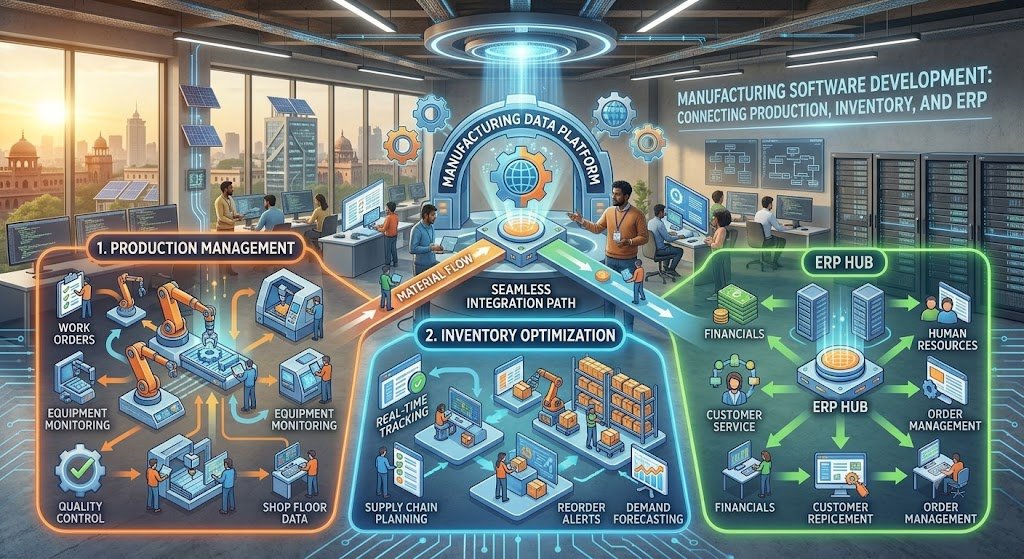
Manufacturing software development is the discipline of building the systems that connect production, inventory, and ERP into a single operational truth. It is not about replacing your ERP. It is about connecting the shop floor to the ERP, so that the data flowing through your business reflects what is actually happening on the ground—in real time.
This guide is written for Indian manufacturing business owners, plant heads, operations managers, and CTOs evaluating manufacturing software. We will cover the architecture that connects production, inventory, and ERP; the modules that matter; real costs in rupees and dollars; India-specific compliance (GST, e-invoicing, DPDPA); and a phased implementation framework with clear go/no-go gates.
What "Connecting Production, Inventory and ERP" Actually Means The phrase sounds simple. The reality is a set of specific data flows, each of which must work reliably for the system to be trustworthy.
The Core Data Flows
1. Sales order to production order. When a sales order is confirmed, the ERP must trigger a production order with the correct BOM, routing, and due date. If this is manual, production starts late and priorities are set by whoever shouts loudest.
2. Production order to material issue. When production begins, the required raw materials must be issued from stores and recorded against the production order. If this is manual, inventory records drift from reality.
3. Shop floor to production tracking. As operations are completed (cutting, machining, assembly, inspection), the completion must be recorded against the production order. If this is manual and delayed, the ERP shows a status that is hours or days old.
4. Production completion to finished goods. When production is complete, finished goods must be received into inventory and the production order closed. If this is manual, finished goods sit unrecorded while sales teams promise stock that the system does not know exists.
5. Quality to dispatch. Quality inspection results must gate dispatch. If quality clearance is on paper, dispatch either waits unnecessarily or ships defective goods.
6. Dispatch to invoice. The goods receipt or dispatch note must trigger the GST invoice. If this is manual, billing is delayed and GST filing is at risk.
The Integration Gap Table
| Data Flow | Typical Current State | Consequence of Disconnection | Integrated State |
|---|---|---|---|
| Sales → Production | Manual entry, phone calls | Late starts, wrong priorities | Auto-triggered production orders |
| Production → Material issue | Paper requisitions | Inventory drift, shortages | Real-time material issue |
| Shop floor → Tracking | Whiteboard, end-of-shift entry | Stale status, poor visibility | Real-time operation tracking |
| Completion → Finished goods | Delayed entry | Phantom stock, missed sales | Auto-receipt to inventory |
| Quality → Dispatch | Paper clearance | Delays or defects shipped | Digital quality gate |
| Dispatch → Invoice | Manual billing | Delayed billing, GST risk | Auto-invoice on dispatch |
For teams building the ERP integration layer that connects these flows, our Custom Software Development and AI Automation practices cover the full stack.
The Architecture: MES, Inventory, and ERP Working Together
The manufacturing software stack has three layers. Understanding what belongs in each layer prevents the common mistake of trying to make the ERP do everything.
Layer 1: The ERP (Business Layer)
The ERP is the system of record for financial and commercial data: sales orders, purchase orders, invoices, payments, general ledger, and statutory compliance (GST, e-invoicing). It answers the question: what does the business owe and what is owed to it?
Most Indian manufacturers already have an ERP—SAP, Oracle, Tally, Zoho Books, Marg, or a custom system. The goal is not to replace it. The goal is to feed it accurate, timely data from the shop floor.
Layer 2: Inventory and Warehouse Management (Stock Layer)
The inventory system tracks raw materials, work-in-progress (WIP), and finished goods: quantities, locations, batches, and movements. It answers the question: what do we have, where is it, and what is it worth?
In many Indian units, inventory lives in the ERP or in a separate spreadsheet. Neither is ideal. The ERP inventory module is often too coarse for shop-floor reality, and the spreadsheet is not connected to anything. A dedicated inventory layer—or a well-configured ERP inventory module—provides the stock truth that production and sales depend on.
Layer 3: Manufacturing Execution System (Shop Floor Layer)
The MES tracks what is happening on the shop floor in real time: which production orders are running, which operations are complete, which machines are down, what quality results were recorded, and what is the overall equipment effectiveness (OEE). It answers the question: what is actually happening right now?
This is the layer most Indian mid-sized manufacturers lack. Without it, the ERP is fed by manual updates that are hours or days old.
The Three-Layer Architecture Table
| Layer | System | Primary Data | Update Frequency | Typical Indian State |
|---|---|---|---|---|
| Business | ERP | Orders, invoices, payments, GST | Daily/monthly | Exists, often underutilised |
| Stock | Inventory/WMS | Materials, WIP, finished goods | Real-time to daily | Spreadsheet or ERP module |
| Shop floor | MES | Production orders, operations, OEE, quality | Real-time | Often missing (paper/whiteboard) |
Integration Patterns
Real-time API integration: The MES calls the ERP API to update production status, material issue, and finished goods receipt. This is the ideal pattern for time-sensitive flows.
Event-driven integration: The MES publishes events ("operation completed", "quality passed") and the ERP subscribes. This is more resilient but more complex to operate.
Batch integration: The MES exports data periodically (hourly, end of shift) and the ERP imports it. This is simpler but introduces latency.
Hybrid: Real-time for critical flows (dispatch, quality gate) and batch for less time-sensitive flows (OEE reporting, analytics).
For most Indian mid-sized manufacturers, a hybrid pattern is the pragmatic starting point: real-time integration for dispatch and billing, batch integration for production reporting.
Modules That Matter: What to Build First
Not every manufacturing software module delivers equal value. The priority depends on the manufacturer's pain points, but the sequence below reflects the order in which most Indian units see return.
Module Priority
| Module | Business Value | Complexity | Recommended Order |
|---|---|---|---|
| Production order tracking | High (visibility) | Medium | 1 |
| Material issue and inventory sync | High (accuracy) | Medium | 2 |
| Quality gate and dispatch | High (compliance) | Medium | 3 |
| BOM management | High (accuracy) | High | 4 |
| Production scheduling | Medium-High | High | 5 |
| OEE and downtime tracking | Medium | Medium | 6 |
| Predictive maintenance | Medium (long-term) | High | 7 |
| Shop floor data collection (barcode/RFID) | High (enabler) | Medium | 1 (enabler) |
The BOM: The Foundation of Everything
The Bill of Materials is the foundation of manufacturing software. If the BOM is inaccurate, every downstream calculation—material requirement planning, costing, production scheduling—is wrong. Indian manufacturers often have BOMs in Excel that are out of date or incomplete.
A BOM module should support:
Multi-level BOMs (finished goods → sub-assemblies → components → raw materials)
Version control (engineering changes)
Alternate materials and substitutes
By-products and scrap
Integration with the ERP for costing and MRP
The AI opportunity: AI can help with BOM validation (flagging inconsistencies), BOM generation from drawings (using vision models), and BOM comparison across products. These are emerging capabilities, not yet mature, but worth evaluating for large BOM volumes.
Production Scheduling
Scheduling determines what runs when, on which machine, with which materials. For job shops and discrete manufacturers with many products, scheduling is a complex optimisation problem.
Scheduling approaches:
Manual/Gantt: The planner drags and drops on a Gantt chart. Simple but limited.
Finite capacity scheduling: The system accounts for machine capacity, changeover times, and material availability.
AI-assisted scheduling: Machine learning models predict changeover times, flag likely delays, and propose schedules that optimise for throughput or due-date adherence.
For most Indian mid-sized manufacturers, finite capacity scheduling is the right starting point. AI-assisted scheduling is an advanced capability that requires clean data on changeover times and machine performance.
Quality Management
Quality gates ensure that defective goods do not reach the customer and that quality data is recorded for compliance and improvement.
A quality module should support:
Incoming inspection (raw materials)
In-process inspection (during production)
Final inspection (before dispatch)
Non-conformance reporting (NCR) and corrective action (CAPA)
Quality certificates and traceability
OEE and Downtime Tracking
Overall Equipment Effectiveness (OEE) is the standard metric for manufacturing productivity: availability × performance × quality. Tracking OEE requires recording downtime reasons, production counts, and quality results in real time.
The AI opportunity: Predictive maintenance uses sensor data and historical failure data to predict equipment failures before they happen. This requires IoT sensors on machines and a data pipeline—a significant investment that is justified for critical equipment with high downtime costs.
Module Build vs Buy Table
| Module | Build Custom | Buy Standard | Notes |
|---|---|---|---|
| Production tracking | If unique workflow | If standard | Most mid-sized units can use standard |
| Inventory | If complex WIP/batch | If standard | ERP inventory module may suffice |
| BOM | If complex products | If standard | ERP BOM module often adequate |
| Scheduling | If job shop complexity | If discrete/repetitive | Advanced scheduling often needs custom |
| Quality | If regulatory requirements | If standard | QMS software is mature |
| OEE/MES | If unique machines | If standard | MES platforms are mature |
| Predictive maintenance | Usually custom | Emerging | Requires IoT + ML capability |
Real Costs in India (2026)
Manufacturing software costs depend on the number of modules, the depth of ERP integration, whether shop-floor hardware is needed, and the extent of AI features.
Build Costs by Scope
| Scope | Build Cost (₹) | Build Cost ($ approx.) | Timeline | What It Covers |
|---|---|---|---|---|
| Production tracking MVP | ₹5–12 lakh | $6,000–$14,400 | 8–12 weeks | Production orders, status tracking, basic dashboard |
| Inventory integration | ₹8–20 lakh | $9,600–$24,000 | 10–16 weeks | Material issue, stock sync, barcode scanning |
| Full MES (production + quality + OEE) | ₹20–50 lakh | $24,000–$60,000 | 16–28 weeks | Shop floor tracking, quality gates, OEE |
| Manufacturing platform (MES + scheduling + analytics) | ₹40–90 lakh | $48,000–$1,08,000 | 24–36 weeks | Full integration, advanced scheduling, dashboards |
Note: USD conversions at ₹83/$. These ranges are indicative for Indian development teams and include design, development, and basic testing. They exclude ERP licence costs, hardware (barcode scanners, sensors), and integration with legacy ERP systems that may require custom connectors.
Hardware and Infrastructure Costs
| Item | Cost (₹) | Cost ($ approx.) | Notes |
|---|---|---|---|
| Barcode scanners (per unit) | ₹2,000–₹10,000 | $24–$120 | Shop floor rugged models cost more |
| Industrial tablets (per station) | ₹15,000–₹40,000 | $180–$480 | For shop floor data entry |
| IoT sensors (per machine) | ₹5,000–₹25,000 | $60–$300 | Vibration, temperature, current |
| Edge gateway | ₹15,000–₹50,000 | $180–$600 | For sensor data aggregation |
| Server/cloud infrastructure | ₹10,000–₹50,000/month | $120–$600/month | Depends on scale |
Running Costs
| Cost Component | Monthly Range (₹) | Monthly Range ($ approx.) | Notes |
|---|---|---|---|
| Hosting and infrastructure | ₹10,000–₹60,000 | $120–$720 | Cloud or on-premise |
| ERP integration maintenance | ₹10,000–₹40,000 | $120–$480 | API changes, monitoring |
| Support and maintenance | ₹15,000–₹75,000 | $180–$900 | 15–25% of build annually |
| AI/ML costs (if applicable) | ₹5,000–₹40,000 | $60–$480 | Predictive maintenance, scheduling |
The Hidden Costs
Legacy ERP integration. Older ERP systems (especially on-premise Tally or custom systems) may not have modern APIs. Integration may require middleware or custom connectors, adding cost and time.
Data cleanup. BOMs, item masters, and inventory records are often inconsistent. Cleaning them is necessary before integration and is time-consuming.
Shop floor training. Operators and supervisors need training on the new system. This is a change management cost, not a software cost, but it is essential for adoption.
Change management. Manufacturing software changes how people work. Resistance is common. A phased rollout with visible benefits reduces resistance.
India-Specific Compliance: GST, E-Invoicing and DPDPA
GST and E-Invoicing
GST e-invoicing is mandatory for businesses above a turnover threshold, and the threshold has been progressively lowered. For manufacturers, this means every invoice must be generated in the GST e-invoice format and reported to the Invoice Registration Portal (IRP).
Software implications:
The ERP or billing module must generate e-invoices in the correct schema (INV-01).
The dispatch flow must trigger the e-invoice before goods leave the premises.
The e-way bill must be generated for goods movement above the threshold.
The system must handle e-invoice errors and retries.
Integration pattern: The dispatch module calls the e-invoice API, receives the IRN (Invoice Reference Number), and prints the e-invoice QR code on the dispatch document.
DPDPA: Employee and Vendor Data
Manufacturing software processes personal data: employee attendance, shift records, payroll inputs, and vendor contact details. Under the DPDP Act, this data is subject to consent, purpose limitation, and security obligations.
Key considerations:
Employee data: Attendance and shift data are personal data. Consent and purpose limitation apply. Data should be used only for the purposes it was collected for (attendance, payroll, compliance).
Vendor data: Contact details of vendor representatives are personal data. Data minimisation applies—collect only what is needed.
Access control: Shop floor systems should have role-based access. A supervisor should not see payroll data; an accounts user should not see production formulas.
Audit logging: Changes to production data, quality results, and inventory should be logged for traceability and accountability.
MeitY AI Governance Guidelines
If the manufacturing software includes AI features—predictive maintenance, AI scheduling, quality prediction—MeitY's seven Sutras apply. In practice:
Transparency: operators should know when a recommendation comes from AI.
Accountability: a named owner for AI-driven decisions.
Human oversight: AI scheduling recommendations should be reviewable and overridable by the planner.
Compliance Checklist
| Requirement | Implementation | Priority |
|---|---|---|
| GST e-invoice generation | ERP/billing module in INV-01 schema | High |
| E-way bill integration | Dispatch flow triggers e-way bill | High |
| Employee data consent | HR module with consent capture | Medium |
| Role-based access | Shop floor, accounts, admin roles | High |
| Audit logging | Production, quality, inventory changes logged | High |
| AI transparency | Disclose AI recommendations to operators | Medium |
Implementation Framework: A Phased Approach With Cost Gates
Phase 1: Process Audit and Data Cleanup (Week 1–3)
Objective: Understand current processes and clean the data that integration depends on.
Activities:
Map current data flows: how does a sales order become a production order, a material issue, a finished good, and an invoice?
Identify the biggest pain points: inventory accuracy, production visibility, dispatch delays, billing errors.
Audit item masters, BOMs, and inventory records for consistency.
Clean the data: standardise item codes, correct BOMs, reconcile inventory.
Assess ERP integration capabilities: does the ERP have APIs? What data can be read and written?
Cost: ₹50,000–₹1.5 lakh ($600–$1,800) for process audit; data cleanup cost depends on data quality.
Go/No-Go: Data is clean enough for integration. ERP integration path is understood. Priority pain point identified.
Phase 2: Production Tracking MVP (Week 4–11)
Objective: Build real-time production tracking connected to the ERP.
Activities:
Production order dashboard: which orders are running, what is the status.
Shop floor data entry: barcode scanning or tablet entry for operation completion.
Real-time status update to the ERP.
Basic reporting: production vs plan, on-time completion.
Cost: ₹5–12 lakh ($6,000–$14,400).
Go/No-Go: Production status in the system reflects reality within minutes. Supervisors use it daily.
Phase 3: Inventory Integration (Week 12–19)
Objective: Connect material issue and finished goods receipt to inventory.
Activities:
Material issue against production orders, with barcode scanning.
Real-time inventory update on issue and receipt.
Finished goods receipt on production completion.
Inventory visibility dashboard.
Cost: ₹8–20 lakh ($9,600–$24,000).
Go/No-Go: Inventory records match physical stock within acceptable tolerance. Material shortages are visible before they stop production.
Phase 4: Quality and Dispatch (Week 20–27)
Objective: Add quality gates and dispatch-to-invoice integration.
Activities:
Quality inspection recording (incoming, in-process, final).
Quality gate: dispatch blocked until quality clearance.
Dispatch note triggers GST e-invoice.
E-way bill generation.
Cost: ₹10–25 lakh ($12,000–$30,000).
Go/No-Go: Quality clearance is digital. Dispatch triggers e-invoice automatically. GST filing is accurate.
Phase 5: Advanced Modules and AI (Month 7–12)
Objective: Add scheduling, OEE, and AI features where justified.
Activities:
Production scheduling (finite capacity or AI-assisted).
OEE and downtime tracking.
Predictive maintenance (if critical equipment justifies it).
Analytics dashboards for management.
Cost: ₹15–40 lakh ($18,000–$48,000) depending on scope.
Go/No-Go: Advanced modules deliver measurable improvement in throughput, downtime, or on-time delivery.
Phase Summary Table
| Phase | Duration | Key Deliverable | Cost (₹) | Go/No-Go Criteria |
|---|---|---|---|---|
| 1. Process Audit | 2–3 weeks | Data cleanup, integration path | 50,000–1.5 lakh | Data clean, ERP path clear |
| 2. Production Tracking | 8 weeks | Real-time production status | 5–12 lakh | Status reflects reality |
| 3. Inventory Integration | 8 weeks | Material issue, stock sync | 8–20 lakh | Inventory accurate |
| 4. Quality & Dispatch | 8 weeks | Quality gates, e-invoice | 10–25 lakh | Digital quality, auto e-invoice |
| 5. Advanced & AI | 6 months | Scheduling, OEE, predictive maintenance | 15–40 lakh | Measurable improvement |
Risks, Pitfalls, and Governance
The Most Common Manufacturing Software Failures
Dirty data. Integration on top of inconsistent item masters and BOMs produces unreliable output. Mitigation: Clean data before building. This is not optional.
Shop floor resistance. Operators and supervisors resist systems that feel like surveillance or add work. Mitigation: Involve them in design, show benefits (less paperwork, fewer queries), and start with a module that makes their job easier.
ERP integration complexity. Legacy ERPs without APIs require custom connectors. Mitigation: Assess ERP integration capability in phase one. Budget for custom connectors if needed.
Over-engineering. Building a full MES with AI before the basics work. Mitigation: Start with production tracking. Add modules only when the previous phase is stable.
Ignoring change management. A technically successful system that people do not use is a failure. Mitigation: Train users, communicate benefits, and measure adoption.
Risk Summary Table
| Risk | Likelihood | Impact | Mitigation |
|---|---|---|---|
| Dirty data | High | High (unreliable output) | Clean data before building |
| Shop floor resistance | High | High (low adoption) | Involve users, show benefits |
| ERP integration complexity | Medium | High (delay) | Assess capability in phase one |
| Over-engineering | Medium | High (wasted budget) | Phased approach, start simple |
| No change management | High | High (system unused) | Training, communication, adoption metrics |
Benchmark Summary and Decision Framework
Decision Matrix: Build vs Buy
| Factor | Build Custom | Buy Standard MES/ERP Module |
|---|---|---|
| Unique process | Complex, non-standard workflows | Standard discrete/repetitive |
| ERP integration | Custom ERP, complex data flows | Standard ERP with APIs |
| Cost | Higher upfront, lower per-user | Subscription, per-user pricing |
| Time to market | 8–36 weeks | Weeks |
| Control | Full | Limited to vendor features |
| Best for | Large units, unique processes | Mid-sized units, standard processes |
Module Priority Table for Indian Manufacturers
| Pain Point | First Module to Build | Why |
|---|---|---|
| Production visibility | Production tracking | Fastest to value, builds adoption |
| Inventory inaccuracy | Material issue and stock sync | Direct impact on working capital |
| Dispatch delays | Quality gate and dispatch | Direct impact on billing and customer satisfaction |
| Billing errors | Dispatch-to-invoice integration | GST compliance, cash flow |
| Machine downtime | OEE tracking, then predictive maintenance | Requires sensor investment, longer payback |
The One-Paragraph Decision Rule
If your biggest pain is not knowing what is happening on the shop floor, build production tracking first. If it is inventory accuracy, build material issue and stock sync. If it is dispatch delays, build quality gates and dispatch-to-invoice. Do not start with AI or predictive maintenance—start with the data flows that connect production, inventory, and ERP. Clean your data before you build. Involve the shop floor in design. And measure adoption, not just technical completion.
Frequently Asked Questions
1. What is manufacturing software development?
It is the development of software that connects production, inventory, and ERP systems—tracking production orders, material issue, quality, dispatch, and billing in a unified system. It typically includes a Manufacturing Execution System (MES), inventory management, and ERP integration.
2. How much does manufacturing software cost in India?
A production tracking MVP costs ₹5–12 lakh ($6,000–$14,400). Inventory integration costs ₹8–20 lakh ($9,600–$24,000). A full MES costs ₹20–50 lakh ($24,000–$60,000). A manufacturing platform with scheduling and AI costs ₹40–90 lakh ($48,000–$1,08,000).
3. Do I need to replace my ERP?
Usually not. The goal is to connect the shop floor to the ERP, not replace it. Most Indian manufacturers have an ERP that works for financial and commercial data. Manufacturing software feeds it accurate, timely data from production.
4. What is the difference between MES and ERP?
ERP is the business layer (orders, invoices, payments, GST). MES is the shop floor layer (production orders, operations, quality, OEE). MES tracks what is happening in real time; ERP records the business consequences.
5. What is a Bill of Materials and why does it matter?
A BOM lists the materials, components, and quantities required to manufacture a product. It is the foundation of material planning, costing, and production scheduling. If the BOM is inaccurate, every downstream calculation is wrong.
6. How do I integrate with Tally or a legacy ERP?
Tally and some legacy ERPs have limited APIs. Integration may require middleware, ODBC/XML interfaces, or custom connectors. Assess the ERP's integration capability in phase one and budget for custom work if needed.
7. What is OEE and how do I track it?
OEE (Overall Equipment Effectiveness) is availability × performance × quality. Tracking it requires recording downtime reasons, production counts, and quality results in real time. It is typically part of an MES or OEE module.
8. Can AI help with predictive maintenance?
Yes, but it requires IoT sensors on machines and historical failure data. It is justified for critical equipment with high downtime costs. It is an advanced capability, not a starting point.
9. What GST compliance requirements apply to manufacturing software?
E-invoice generation in the INV-01 schema, e-way bill generation for goods movement, and accurate GST reporting. The dispatch flow should trigger the e-invoice before goods leave the premises.
10. How does DPDPA affect manufacturing software?
Employee attendance and shift data, vendor contact details, and payroll inputs are personal data. Consent, purpose limitation, access control, and audit logging apply. Role-based access ensures users see only what they need.
11. How long does it take to implement manufacturing software?
A production tracking MVP takes 8–12 weeks. Full MES takes 16–28 weeks. A manufacturing platform with scheduling and AI takes 24–36 weeks. Timeline depends on ERP integration complexity and data quality.
12. How can Innovative AI Solutions help?
Innovative AI Solutions builds manufacturing software for Indian units—production tracking, inventory integration, MES, quality gates, ERP integration, and AI features like predictive maintenance and scheduling. Our Delhi-based team handles process audit, development, GST compliance, and phased rollout. Visit https://innovativeais.com to discuss your requirements.
Contact Innovative AI Solutions
Ready to connect your shop floor, inventory and ERP into one operational truth?
[One-line supporting sentence.]
Contact Information
Innovative AI Solutions
📍 Netaji Subhash Place, Pitampura, Delhi – 110034
🌐 Website: https://innovativeaislabs.com 📧 Email: info@innovativeais.com
📞 Phone: +91 7464 099 059 / +91 96899 67356
Business Services
AI Automation
AI Development
AI Consulting
Machine Learning Solutions
Deep Learning Solutions
Generative AI Services
NLP Solutions
AI Agents
AI Chatbots
Voice AI
CRM Development
Custom Software Development
Website Development
Mobile App Development
About the Author
Abhishek Kumar
Founder & CEO, Innovative AI Solutions
5+ years building production AI systems for Indian businesses. Based in Delhi, serving clients across India.
Ready to build AI solutions for your business?
Innovative AI Solutions — Delhi's leading AI development company. Free consultation available.
Get Free Consultation →
A practical 2026 guide for Indian manufacturers connecting production, inventory and ERP—data flows that eliminate the integration gap, real rupee costs, GST and DPDPA compliance, and a phased rollout that starts with production tracking and earns its way to AI.
#ManufacturingSoftware #MES #ERPIntegration #ProductionPlanning #InventoryManagement #BOM #OEE #Industry40 #SmartFactory #GST #EInvoicing #DPDPA #MeitY #MakeInIndia #DigitalIndia #DelhiNCR #InnovativeAISolutions
Copyright ©️ 2015–2026 Innovative AI Solutions. All Rights Reserved. | Privacy Policy | Terms & Conditions