The Billing Bug That Cost a Quarter of Revenue
An Indian SaaS company launches a usage-based plan. Customers are billed monthly based on API calls. The billing logic works for the first three months. Then, in month four, a customer exceeds their plan limit by a small margin. The proration calculation is wrong. The invoice shows a charge that is 10x the expected amount. The customer disputes it. The finance team investigates and finds that the same bug has affected 40 other customers. Refunds are issued. Trust is damaged. Two enterprise customers churn.
This is the cost of a billing system that was treated as an afterthought. Billing is not a feature you add at the end. It is the mechanism by which the business earns revenue, and it must be correct, auditable, and compliant from day one.
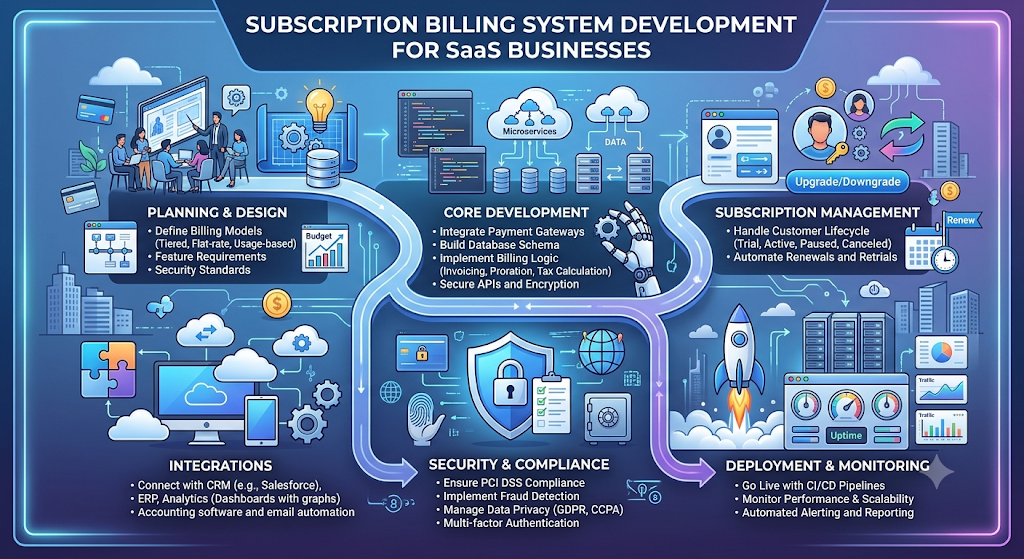
Subscription billing system development is the discipline of building the system that manages recurring revenue: pricing plans, subscriptions, invoices, payments, dunning, and revenue recognition. It is not a simple cron job that charges a card every month. It is a system that handles proration, upgrades, downgrades, trials, coupons, taxes, and failures—across payment methods, currencies, and regulatory regimes.
For Indian SaaS businesses, this matters because the billing landscape is more complex than in many markets. GST requires specific invoice formats and e-invoicing above thresholds. RBI's e-mandate rules govern how recurring payments can be set up and charged. Payment methods span UPI, cards, net banking, and wallets, each with different failure modes. And DPDPA applies to the personal data in billing records.
India adds specific considerations beyond compliance. Revenue recognition under Ind AS 115 requires treating subscription revenue correctly—deferred over the service period. Multi-currency billing is increasingly common for Indian SaaS selling globally. Dunning must be localized for Indian customers, where WhatsApp is more effective than email. And pricing flexibility—usage-based, seat-based, tiered, hybrid—is increasingly expected by customers.
This guide is written for Indian SaaS founders, finance leaders, and engineering managers building subscription billing. We will cover the pricing models, the core billing engine, the dunning system, the India-specific compliance (GST, e-invoicing, RBI e-mandates), real costs in rupees and dollars, DPDPA compliance, and a phased implementation framework with clear go/no-go gates.
The Pricing Models: What the Billing System Must Support
The billing system's complexity is determined by the pricing models the business offers. Simple models are easy to bill. Complex models are not.
The Pricing Models
1. Flat-rate. One price per period, regardless of usage. Simplest to bill. Example: ₹5,000/month for unlimited access.
2. Per-seat. Price per user per period. Requires tracking seat count. Example: ₹500/user/month.
3. Tiered. Price changes based on volume. Example: first 100 API calls free, next 1,000 at ₹1 each, beyond that at ₹0.50 each.
4. Usage-based (metered). Price per unit of usage. Requires usage metering and aggregation. Example: ₹0.10 per API call.
5. Credit-based. Customers buy credits and consume them. Requires credit balance tracking. Example: buy 1,000 credits for ₹5,000, consume per action.
6. Hybrid. Combination of the above. Example: ₹2,000 base fee + ₹0.10 per API call above 10,000.
The Billing Complexity Table
| Model | Billing Complexity | Data Required |
|---|---|---|
| Flat-rate | Low | Subscription state |
| Per-seat | Medium | Seat count |
| Tiered | Medium | Usage + tier rules |
| Usage-based | High | Metered usage |
| Credit-based | High | Credit balance |
| Hybrid | Very High | All of the above |
The design principle: Build the billing engine to support the models you offer today plus the one you plan to offer next year. Do not build for every model—that creates complexity you do not need. But do not build for only flat-rate if you plan to launch usage-based.
For teams building the billing system and integrations, our Custom Software Development and AI Development practices cover the full stack.
The Core Billing Engine
The billing engine is the heart of the system. It determines what to charge, when, and how.
The Billing Cycle
1. Subscription creation. The customer selects a plan and subscribes. The system records the plan, the billing cycle, the start date, and the payment method.
2. Usage metering. For usage-based plans, the system records usage events throughout the period.
3. Invoice generation. At the end of the period (or at the start, for prepaid), the system generates an invoice: line items, quantities, prices, taxes, and total.
4. Payment attempt. The system charges the payment method on file.
5. Payment result. Success or failure. On failure, the dunning process begins.
6. Revenue recognition. The revenue is recognized according to accounting rules (deferred over the service period).
Proration
Proration is the calculation of charges when a customer changes plans mid-cycle. An upgrade mid-month means charging the difference for the remaining days. A downgrade means issuing a credit.
The proration rules:
Upgrade: charge the difference between the new and old plan for the remaining days.
Downgrade: credit the difference, or apply it to the next invoice.
Cancellation: credit the unused portion, or charge until the end of the period (per the plan terms).
Proration is a common source of billing bugs. It must be tested thoroughly.
Trials
Trials are free periods before billing begins. The system must:
Track the trial start and end dates.
Convert to paid at the end (if the customer does not cancel).
Handle trial extensions.
Handle multiple trials (prevent abuse).
Coupons and Discounts
Coupons and discounts reduce the invoice amount. The system must support:
Percentage discounts: 20% off.
Fixed discounts: ₹1,000 off.
Free trials: extended trial.
Duration: one-time, first month, or recurring.
Stacking rules: can multiple coupons be combined?
The Billing Engine Table
| Component | Function | Complexity |
|---|---|---|
| Subscription | Plan, cycle, state | Medium |
| Usage metering | Track usage events | High |
| Invoice | Line items, taxes | Medium |
| Proration | Mid-cycle changes | High |
| Trials | Free periods | Medium |
| Coupons | Discounts | Medium |
Dunning: Recovering Failed Payments
Dunning is the process of recovering failed payments. It is where many SaaS businesses lose revenue—not because customers do not want to pay, but because the payment failed and nobody followed up.
Why Payments Fail
Insufficient funds.
Expired card.
Card declined by bank.
Authentication failure (for RBI e-mandates).
Network issues.
The Dunning Sequence
A good dunning sequence combines retries, notifications, and escalation:
1. Immediate retry. Some failures are transient. Retry after a short delay.
2. Notification. Notify the customer of the failure via email and WhatsApp.
3. Retry schedule. Retry on day 1, day 3, day 7. Retries should be timed to coincide with salary cycles (for Indian customers, the 1st and 7th of the month are common).
4. Escalation. After multiple failures, restrict access or escalate to human follow-up.
5. Cancellation. After a defined period, cancel the subscription.
Dunning Localisation for India
Indian customers respond to WhatsApp far better than email. A WhatsApp message that says "Your payment of ₹5,000 for your subscription failed. Click here to update your payment method" is far more effective than an email that may be missed.
The Dunning Table
| Stage | Timing | Action |
|---|---|---|
| Immediate retry | Same day | Retry payment |
| Notification | Day 1 | Email + WhatsApp |
| Retry | Day 3 | Retry payment |
| Retry | Day 7 | Retry payment |
| Escalation | Day 14 | Restrict access |
| Cancellation | Day 30 | Cancel subscription |
India-Specific Compliance: GST, E-Invoicing, RBI E-Mandates
GST
GST compliance is mandatory for Indian SaaS businesses. The billing system must:
Generate tax invoices with GSTIN, HSN/SAC codes, and tax breakdown.
Determine place of supply (intra-state vs inter-state, India vs export).
Apply the correct rate (18% for most SaaS services).
Handle B2B vs B2C (B2B invoices require GSTIN).
Handle exports (zero-rated with LUT).
E-Invoicing
For businesses above the turnover threshold, e-invoicing is mandatory. The billing system must:
Generate e-invoices in the INV-01 schema.
Report to the IRP (Invoice Registration Portal).
Capture the IRN (Invoice Reference Number).
Print the QR code on the invoice.
RBI E-Mandates
RBI's e-mandate rules govern recurring card and UPI payments. Key requirements:
Registration: the customer must register the mandate with their bank (via OTP or app).
Pre-debit notification: the merchant must send a notification at least 24 hours before the charge.
Additional factor authentication (AFA): for charges above ₹15,000, the customer must authenticate.
Mandate limits: customers can set maximum amounts and frequencies.
The implication: The billing system must integrate with a payment gateway that supports RBI e-mandates—Razorpay, Cashfree, PayU, and Stripe India all do. The system must send pre-debit notifications and handle AFA.
The India Compliance Table
| Requirement | Implementation | Priority |
|---|---|---|
| GST invoice | GSTIN, HSN, tax breakdown | High |
| Place of supply | Intra/inter-state logic | High |
| E-invoicing | IRP integration | High (above threshold) |
| RBI e-mandate | Gateway integration | High |
| Pre-debit notification | 24-hour notification | High |
| AFA | For charges > ₹15,000 | High |
Build vs Buy: The Billing Platform Decision
SaaS businesses can build their own billing system or use a billing platform. The decision depends on complexity, control, and cost.
The Platforms
Razorpay Subscriptions. Indian payment gateway with subscription billing. Best for India-focused SaaS. Supports UPI, cards, net banking, e-mandates. Pricing: 2% + GST on transactions.
Chargebee. Full-featured subscription management platform. Supports complex pricing, dunning, revenue recognition. Pricing: percentage of revenue (typically 0.5–1%), with a minimum.
Stripe Billing. Global billing platform. Best for SaaS selling internationally. Supports complex pricing, dunning, tax. Pricing: 0.5–0.7% of billing volume.
Zoho Billing. India-focused, part of Zoho suite. Supports GST, e-invoicing, subscriptions.
The Build vs Buy Table
| Factor | Build Custom | Buy Platform |
|---|---|---|
| Complexity | Unique pricing, complex rules | Standard pricing |
| Cost | Higher upfront, lower per-transaction | Subscription + per-transaction |
| Control | Full | Limited to platform |
| Time to market | 3–6 months | Weeks |
| GST/e-invoicing | Build yourself | Platform handles |
| Best for | Large SaaS, unique models | Most SaaS |
The recommendation for most Indian SaaS: Start with a platform. Razorpay or Chargebee handles GST, e-invoicing, and e-mandates—the parts that are hardest to build. Build custom only when the pricing model is genuinely unique or the platform cost becomes significant at scale.
Real Costs in India (2026)
Subscription billing costs depend on whether you build or buy, and the complexity of the pricing model.
Build Costs
| Scope | Build Cost (₹) | Build Cost ($ approx.) | Timeline |
|---|---|---|---|
| Simple billing (flat-rate, GST invoice) | ₹3–8 lakh | $3,600–$9,600 | 8–14 weeks |
| Full billing (proration, trials, coupons, dunning) | ₹10–25 lakh | $12,000–$30,000 | 16–28 weeks |
| Complex billing (usage-based, credits, multi-currency) | ₹25–60 lakh | $30,000–$72,000 | 24–36 weeks |
Platform Costs
| Platform | Pricing | Notes |
|---|---|---|
| Razorpay Subscriptions | 2% + GST per transaction | India-focused |
| Chargebee | ~0.5–1% of revenue | Full-featured |
| Stripe Billing | 0.5–0.7% of billing volume | Global |
| Zoho Billing | Subscription tiers | India-focused |
The Cost Trade-off
For a SaaS with ₹5 crore annual revenue, a Chargebee at 0.75% costs ₹37.5 lakh/year. A custom build at ₹25 lakh pays back in under a year. But the custom build requires ongoing maintenance and compliance updates (GST changes, RBI rule changes). For most SaaS under ₹10 crore revenue, the platform is cheaper and lower risk.
Implementation Framework: A Phased Approach With Cost Gates
Phase 1: Pricing and Compliance Design (Week 1–3)
Objective: Define the pricing models and compliance requirements.
Activities:
Define pricing plans and models.
Define proration, trial, and coupon rules.
Define dunning sequence.
Assess GST, e-invoicing, and e-mandate requirements.
Decide build vs buy.
Cost: ₹50,000–₹1.5 lakh ($600–$1,800).
Go/No-Go: Pricing defined. Compliance understood. Build/buy decided.
Phase 2: Core Billing (Week 4–12)
Objective: Build or configure the core billing engine.
Activities:
Implement subscription management.
Implement invoice generation with GST.
Implement payment integration.
Implement e-invoicing (if required).
Implement basic dunning.
Cost: ₹3–10 lakh ($3,600–$12,000).
Go/No-Go: Invoices generate correctly. Payments process. GST compliant.
Phase 3: Advanced Billing (Week 13–20)
Objective: Add proration, trials, coupons, and usage metering.
Activities:
Implement proration.
Implement trials.
Implement coupons.
Implement usage metering (if needed).
Implement dunning sequence with WhatsApp.
Cost: ₹5–15 lakh ($6,000–$18,000).
Go/No-Go: Proration correct. Dunning works.
Phase 4: Revenue Recognition and Reporting (Week 21–28)
Objective: Add accounting and reporting.
Activities:
Implement revenue recognition (Ind AS 115).
Implement deferred revenue tracking.
Build finance dashboards.
Integrate with accounting system.
Cost: ₹3–10 lakh ($3,600–$12,000).
Go/No-Go: Revenue recognition correct. Reports used.
Phase Summary Table
| Phase | Duration | Key Deliverable | Cost (₹) | Go/No-Go Criteria |
|---|---|---|---|---|
| 1. Design | 3 weeks | Pricing, compliance | 50,000–1.5 lakh | Defined |
| 2. Core Billing | 9 weeks | Subscriptions, invoices, payments | 3–10 lakh | GST compliant |
| 3. Advanced | 8 weeks | Proration, dunning, usage | 5–15 lakh | Correct |
| 4. Revenue | 8 weeks | Revenue recognition | 3–10 lakh | Reports work |
Risks, Pitfalls, and Governance
The Most Common Billing Failures
Proration bugs. Wrong charges on plan changes. Mitigation: Thorough testing, edge case coverage.
GST errors. Incorrect tax calculation or invoice format. Mitigation: GST validation, accountant review.
E-mandate failures. Recurring payments fail due to missing pre-debit notification or AFA. Mitigation: Gateway integration, notification testing.
Dunning gaps. Failed payments are not recovered. Mitigation: Multi-channel dunning, retry schedule.
Revenue recognition errors. Revenue booked in the wrong period. Mitigation: Ind AS 115 compliance, accountant review.
DPDPA violations. Billing data stored without consent. Mitigation: Consent, data minimisation, retention.
Risk Summary Table
| Risk | Likelihood | Impact | Mitigation |
|---|---|---|---|
| Proration bugs | High | High | Testing |
| GST errors | Medium | High | Validation |
| E-mandate failures | High | High | Gateway integration |
| Dunning gaps | High | Medium | Multi-channel |
| Revenue recognition | Medium | High | Accountant review |
| DPDPA violations | Medium | High | Consent, retention |
Benchmark Summary and Decision Framework
Decision Matrix: Build vs Buy
| Your Situation | Recommended Path |
|---|---|
| Standard pricing, India-focused | Razorpay or Zoho Billing |
| Complex pricing, global | Chargebee or Stripe Billing |
| Unique model, high volume | Build custom |
| Early stage | Platform |
Billing Priority Table
| Priority | Capability | Why |
|---|---|---|
| 1 | GST invoice | Compliance |
| 2 | Payment integration | Revenue |
| 3 | Dunning | Recovery |
| 4 | Proration | Accuracy |
| 5 | Revenue recognition | Accounting |
The One-Paragraph Decision Rule
If you are building subscription billing, start with a platform unless your pricing model is genuinely unique. Ensure GST invoicing and e-invoicing are correct. Integrate a gateway that supports RBI e-mandates and send pre-debit notifications. Build dunning with WhatsApp. And ensure revenue recognition follows Ind AS 115. Billing is not a feature—it is the revenue engine.
Frequently Asked Questions
1. How much does subscription billing system development cost in India? Simple billing costs ₹3–8 lakh ($3,600–$9,600). Full billing with proration and dunning costs ₹10–25 lakh ($12,000–$30,000). Complex billing with usage-based pricing costs ₹25–60 lakh ($30,000–$72,000).
2. Should I build or buy subscription billing?
Buy a platform (Razorpay, Chargebee, Stripe, Zoho) unless your pricing model is unique or the platform cost becomes significant at scale. Platforms handle GST, e-invoicing, and e-mandates.
3. What are RBI e-mandates?
RBI rules for recurring card and UPI payments. They require registration, 24-hour pre-debit notification, and additional factor authentication for charges above ₹15,000.
4. How does GST affect subscription billing?
GST requires tax invoices with GSTIN, HSN/SAC codes, and tax breakdown. Place of supply determines intra-state vs inter-state. SaaS is typically 18%.
5. What is e-invoicing and do I need it?
E-invoicing is mandatory above the turnover threshold. The billing system must generate INV-01 e-invoices and report to the IRP.
6. What is dunning?
Dunning is the process of recovering failed payments through retries, notifications, and escalation. WhatsApp is more effective than email for Indian customers.
7. What is proration?
Proration calculates charges when a customer changes plans mid-cycle. Upgrades charge the difference; downgrades credit it.
8. How does DPDPA affect billing?
Billing data contains personal data. Consent, data minimisation, retention policies, and access control apply.
9. How do I handle usage-based billing?
Track usage events, aggregate them per billing period, apply tiered pricing, and generate invoices. Usage metering is the hardest part.
10. What is revenue recognition for subscriptions?
Under Ind AS 115, subscription revenue is recognized over the service period, not when invoiced. Deferred revenue must be tracked.
11. How long does billing system development take?
Simple billing takes 8–14 weeks. Full billing takes 16–28 weeks. Complex billing takes 24–36 weeks.
12. How can Innovative AI Solutions help?
Innovative AI Solutions builds subscription billing systems for Indian SaaS—GST invoicing, e-invoicing, RBI e-mandate integration, dunning, and revenue recognition. Our Delhi-based team handles design, implementation, and compliance. Visit https://innovativeais.com to discuss your requirements.
Contact Innovative AI Solutions
Ready to build a billing system that collects revenue reliably?
[One-line supporting sentence.]
Contact Information
Innovative AI Solutions
📍 Netaji Subhash Place, Pitampura, Delhi – 110034
🌐 Website: https://innovativeaislabs.com 📧 Email: info@innovativeais.com
📞 Phone: +91 7464 099 059 / +91 96899 67356
Business Services
AI Automation
AI Development
AI Consulting
Machine Learning Solutions
Deep Learning Solutions
Generative AI Services
NLP Solutions
AI Agents
AI Chatbots
Voice AI
CRM Development
Custom Software Development
Website Development
Mobile App Development
About the Author
Abhishek Kumar
Founder & CEO, Innovative AI Solutions
5+ years building production AI systems for Indian businesses. Based in Delhi, serving clients across India.
Ready to build AI solutions for your business?
Innovative AI Solutions — Delhi's leading AI development company. Free consultation available.
Get Free Consultation →
A practical 2026 guide for Indian SaaS teams building subscription billing—pricing models, proration, dunning, GST and e-invoicing, RBI e-mandates, real rupee costs, and DPDPA compliance.
#SubscriptionBilling #SaaSBilling #RecurringBilling #SubscriptionManagement #GSTEInvoicing #RBIEMandate #Dunning #UsageBasedBilling #MeteredBilling #Proration #Razorpay #Stripe #Chargebee #RevenueRecognition #DPDPA #MeitY #DelhiNCR #InnovativeAISolutions
Copyright ©️ 2015–2026 Innovative AI Solutions. All Rights Reserved. | Privacy Policy | Terms & Conditions