


The Query That Showed Another Company's Data
An Indian SaaS company runs a shared database for all its tenants. Each table has a tenant_id column, and every query filters by tenant. It works well for two years. Then a new engineer writes a report query and forgets the tenant_id filter. The report runs. It returns data from every tenant on the platform—customer names, invoices, and support tickets—to a user from one company.
The bug is fixed within hours. The damage is not. The affected tenants must be notified. Under DPDPA, this is a personal data breach, and notification obligations apply. The company's reputation takes a hit it may not recover from.
This is the defining risk of multi-tenant SaaS architecture. Multi-tenancy is not a database configuration. It is an architectural commitment to isolating tenants from each other—at the data layer, the application layer, the compute layer, and the operational layer. Getting it wrong is not a performance issue. It is a security and compliance failure.
Multi-tenancy is also the defining economic advantage of SaaS. A single application instance serves many customers, sharing infrastructure and reducing per-customer cost. The businesses that get multi-tenancy right can serve thousands of tenants profitably. The ones that get it wrong either leak data or over-provision infrastructure until the economics collapse.
For Indian SaaS companies, this matters because the market is competitive and price-sensitive. Multi-tenancy is how you serve SMBs profitably. But Indian enterprises—especially in BFSI and healthcare—demand strong isolation, and some require dedicated infrastructure. The architecture must support both.
India adds specific considerations. DPDPA applies to tenant data, and the SaaS company is typically a Data Processor for its customers' data. Data localisation may require Indian data centres for regulated tenants. MeitY AI governance applies if the SaaS product includes AI features. And tenant expectations vary—an SMB accepts shared infrastructure, while a bank may require dedicated database instances.
This guide is written for Indian SaaS founders, CTOs, and engineering leaders building multi-tenant products. We will cover the isolation models, the tenant security architecture, the noisy neighbour problem, real costs in rupees and dollars, DPDPA compliance, and a phased implementation framework with clear go/no-go gates.
The Isolation Models: Shared, Schema, Database
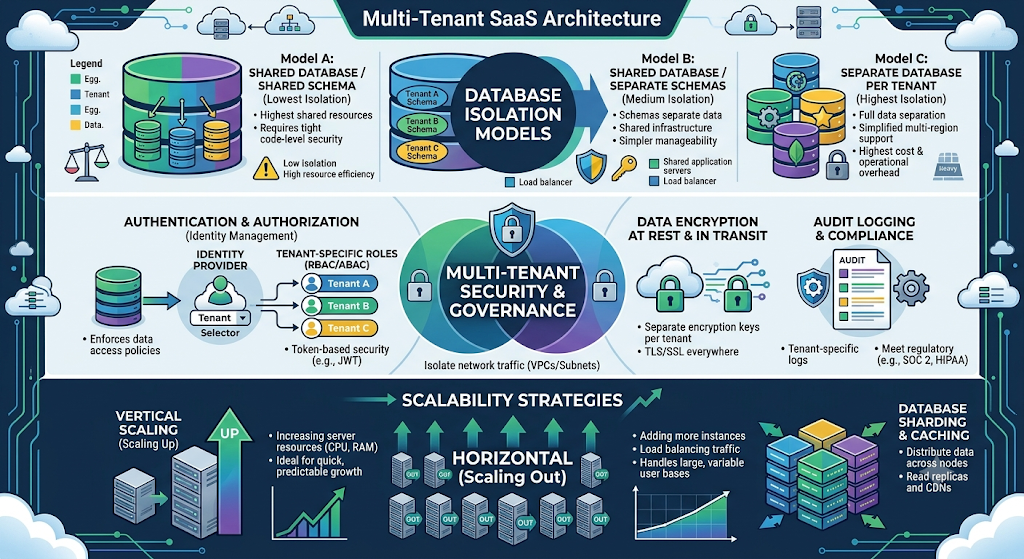
The database isolation model is the most consequential architectural decision in multi-tenant SaaS. It determines security, cost, scalability, and operational complexity.
Model 1: Shared Database, Shared Schema (Pooled)
All tenants share the same database and the same tables. Each row has a tenant_id column, and every query filters by it. Row-level security (RLS) enforces the filter at the database level.
Pros: Lowest cost, simplest operations, efficient resource utilisation.
Cons: Highest risk of data leakage if a query forgets the filter, noisier neighbours (one tenant's heavy queries affect others), harder to meet strict compliance requirements.
When to use: SMB-focused SaaS, high tenant count, cost-sensitive market.
Model 2: Shared Database, Schema-per-Tenant (Bridge)
All tenants share the same database instance, but each tenant has its own schema. Tables are duplicated per schema.
Pros: Better isolation than shared schema, easier to migrate a tenant to a dedicated database later, moderate cost.
Cons: Schema proliferation at high tenant counts, migration complexity, still shares database resources.
When to use: Mid-market SaaS, moderate tenant count, tenants that need more isolation than pooled but not full dedication.
Model 3: Database-per-Tenant (Silo)
Each tenant has its own database instance. Complete isolation of data.
Pros: Strongest isolation, easiest compliance (data residency per tenant), no noisy neighbours, easy to migrate or delete a tenant.
Cons: Highest cost, complex provisioning, operational overhead at scale.
When to use: Enterprise SaaS, regulated industries (BFSI, healthcare), tenants that require dedicated infrastructure.
The Isolation Model Table
| Model | Isolation | Cost | Scalability | Best For |
|---|---|---|---|---|
| Pooled | Low-Medium | Lowest | Highest | SMB, high volume |
| Schema-per-tenant | Medium | Medium | Medium | Mid-market |
| Database-per-tenant | High | Highest | Lower | Enterprise, regulated |
The Hybrid Approach
Most mature SaaS companies use a hybrid model: pooled for SMB tenants, schema or database-per-tenant for enterprise tenants. The architecture must support all models, with tenant provisioning that places each tenant in the right tier based on their plan and requirements.
Tenant Security: The Non-Negotiable
Tenant isolation is a security requirement, not a performance optimisation. A leak between tenants is a data breach.
Row-Level Security (RLS)
For pooled models, RLS is the enforcement mechanism. The database enforces the tenant filter, not the application.
How it works:
Every table has a tenant_id column.
RLS policies define which rows a user can see based on their tenant.
The application sets the tenant context on each connection.
The database enforces the filter automatically.
Why it matters: Even if the application forgets the filter, the database does not. RLS is defence in depth.
The caveat: RLS is not free. It adds a small query overhead. And it must be configured correctly—a misconfigured RLS policy is worse than no RLS because it creates false confidence.
Application-Layer Enforcement
RLS is necessary but not sufficient. The application must also enforce tenant context:
Every request carries a tenant identifier (from the JWT or session).
Every database connection is scoped to the tenant.
Middleware validates that the tenant in the request matches the tenant in the data.
Tenant-Aware Caching
Caching is a common source of cross-tenant leaks. If a cache key does not include the tenant, one tenant's cached data can be served to another.
The fix: Cache keys must include the tenant: tenant:{tenantId}:user:{userId}:resource. Cache invalidation must also be tenant-scoped.
Tenant-Aware Logging
Logs must include the tenant identifier so that issues can be traced per tenant. But logs must also respect tenant isolation—a tenant's logs should not be visible to another tenant's administrators.
The Security Checklist
| Control | Implementation | Priority |
|---|---|---|
| Row-level security | Database RLS policies | High |
| Tenant context | JWT/session tenant ID | High |
| Application validation | Middleware checks tenant match | High |
| Tenant-aware caching | Tenant in cache keys | High |
| Tenant-scoped logging | Tenant in log context | High |
| Penetration testing | Cross-tenant access testing | High |
The Noisy Neighbour Problem
In a shared infrastructure, one tenant's heavy usage can degrade performance for others. This is the noisy neighbour problem, and it is the most common operational complaint in multi-tenant SaaS.
The Symptoms
One tenant runs a large report that slows the shared database for everyone.
One tenant's API calls saturate the shared rate limit.
One tenant's storage growth fills the shared disk.
The Mitigations
1. Resource quotas. Limit each tenant's database connections, API calls, and storage.
2. Rate limiting. Per-tenant rate limits prevent one tenant from monopolising resources.
3. Query isolation. For pooled models, use separate connection pools per tenant tier. For schema models, use separate schemas.
4. Workload isolation. Run heavy workloads (reports, exports) on separate infrastructure or at off-peak times.
5. Tenant tiering. Place high-volume tenants in higher isolation tiers.
The Noisy Neighbour Table
| Symptom | Mitigation |
|---|---|
| Slow queries | Query timeouts, separate pools |
| API saturation | Per-tenant rate limits |
| Storage growth | Storage quotas |
| Heavy reports | Async processing, off-peak scheduling |
Real Costs in India (2026)
Multi-tenant SaaS architecture costs depend on the isolation model, the tenant count, and the operational complexity.
Build Costs
| Scope | Cost (₹) | Cost ($ approx.) | Timeline |
|---|---|---|---|
| Pooled architecture (shared DB, RLS) | ₹5–15 lakh | $6,000–$18,000 | 8–14 weeks |
| Hybrid architecture (pooled + schema) | ₹15–35 lakh | $18,000–$42,000 | 14–24 weeks |
| Full multi-tier (pooled + schema + database) | ₹35–80 lakh | $42,000–$96,000 | 24–36 weeks |
| Enterprise multi-tenant (provisioning, billing, compliance) | ₹80 lakh–₹2 crore+ | $96,000–$2,40,000+ | 36–52 weeks |
Running Costs
| Component | Monthly Cost (₹) | Monthly Cost ($ approx.) | Notes |
|---|---|---|---|
| Database infrastructure | ₹30,000–₹3,00,000+ | $360–$3,600+ | Scales with isolation model |
| Application hosting | ₹20,000–₹1,50,000 | $240–$1,800 | Shared or per-tenant |
| Monitoring | ₹10,000–₹50,000 | $120–$600 | Per-tenant observability |
| Maintenance | 15–25% of build annually | — | Updates, security patches |
The Cost Trade-off
Pooled architecture is cheapest to run but riskiest. Database-per-tenant is safest but most expensive. Most SaaS companies find the right balance in a hybrid model: pooled for the long tail of SMB tenants, database-per-tenant for enterprise tenants who pay for the isolation.
Example: A SaaS with 1,000 SMB tenants and 20 enterprise tenants. Pooled database for the 1,000 SMBs costs ₹50,000/month. Database-per-tenant for the 20 enterprises costs ₹20,000/month each = ₹4,00,000/month. Total: ₹4.5 lakh/month. The enterprise tenants pay premium pricing that covers the cost.
India-Specific Compliance: DPDPA and Data Localisation
DPDPA: SaaS as Data Processor
In most SaaS arrangements, the SaaS company is a Data Processor and the customer is the Data Fiduciary. The DPDP Act imposes obligations on processors:
Process only on instructions: The SaaS company processes tenant data only as instructed by the tenant.
Security safeguards: Implement reasonable security to prevent breaches.
Breach notification: Notify the tenant of breaches.
Assistance: Assist the tenant with erasure and rights requests.
Data Localisation
For regulated tenants (BFSI, healthcare), data localisation may require the SaaS company to offer Indian data centres. A multi-tenant architecture must support tenant-specific data residency—a tenant's data must stay in the region they require.
The implication: The isolation model must allow per-tenant region placement. Database-per-tenant makes this straightforward. Pooled models may require regional sharding.
MeitY AI Governance
If the SaaS product includes AI features, MeitY's guidelines apply. Transparency about AI use, accountability for AI decisions, and human oversight for consequential actions.
The Compliance Checklist
| Requirement | Implementation | Priority |
|---|---|---|
| Processor obligations | DPA with tenants | High |
| Security safeguards | Encryption, RLS, access control | High |
| Breach notification | Incident response | High |
| Data localisation | Per-tenant region placement | High (regulated) |
| Erasure support | Tenant data deletion | High |
Implementation Framework: A Phased Approach With Cost Gates
Phase 1: Architecture Decision (Week 1–2)
Objective: Choose the isolation model and tenant tiering.
Activities:
Assess target market (SMB vs enterprise).
Assess compliance requirements.
Choose isolation model (pooled, hybrid, full).
Define tenant tiers and pricing.
Design tenant provisioning.
Cost: ₹50,000–₹1.5 lakh ($600–$1,800).
Go/No-Go: Architecture decision made. Tiers defined.
Phase 2: Pooled Foundation (Week 3–12)
Objective: Build the pooled architecture with RLS.
Activities:
Implement tenant-aware data model.
Implement RLS policies.
Implement tenant context propagation.
Implement tenant-aware caching and logging.
Test cross-tenant isolation.
Cost: ₹5–15 lakh ($6,000–$18,000).
Go/No-Go: RLS works. No cross-tenant leaks. Performance acceptable.
Phase 3: Hybrid Tiering (Week 13–24)
Objective: Add schema and database isolation for enterprise tenants.
Activities:
Implement schema-per-tenant provisioning.
Implement database-per-tenant provisioning.
Implement tenant migration between tiers.
Implement per-tenant region placement.
Cost: ₹10–25 lakh ($12,000–$30,000).
Go/No-Go: Tiers work. Migration works. Region placement works.
Phase 4: Noisy Neighbour Controls (Week 25–32)
Objective: Add resource isolation and quotas.
Activities:
Implement per-tenant rate limits.
Implement connection pool isolation.
Implement query timeouts.
Implement async processing for heavy workloads.
Cost: ₹5–15 lakh ($6,000–$18,000).
Go/No-Go: Noisy neighbours controlled. Performance stable.
Phase 5: Compliance and Scale (Ongoing)
Objective: Ensure compliance and scale.
Activities:
Implement DPAs with tenants.
Implement breach notification.
Implement erasure workflows.
Monitor per-tenant metrics.
Scale infrastructure.
Cost: ₹20,000–₹1,00,000/month ($240–$1,200).
Phase Summary Table
| Phase | Duration | Key Deliverable | Cost (₹) | Go/No-Go Criteria |
|---|---|---|---|---|
| 1. Architecture | 2 weeks | Model, tiers | 50,000–1.5 lakh | Decision made |
| 2. Pooled Foundation | 10 weeks | RLS, tenant context | 5–15 lakh | No leaks |
| 3. Hybrid Tiering | 12 weeks | Schema/DB isolation | 10–25 lakh | Tiers work |
| 4. Noisy Neighbour | 8 weeks | Quotas, limits | 5–15 lakh | Stable performance |
| 5. Compliance | Ongoing | DPAs, erasure | 20,000–1,00,000/month | Compliant |
Risks, Pitfalls, and Governance
The Most Common Multi-Tenancy Failures
Missing tenant filter. A query returns another tenant's data. Mitigation: RLS, middleware validation, testing.
Tenant in cache key missing. Cached data served across tenants. Mitigation: Tenant in every cache key.
Noisy neighbour. One tenant degrades performance for all. Mitigation: Quotas, rate limits, isolation.
Provisioning drift. Tenants get inconsistent configurations. Mitigation: Automated provisioning.
No per-tenant observability. Cannot diagnose tenant-specific issues. Mitigation: Tenant-aware metrics and logs.
DPDPA gaps. No DPA, no breach notification, no erasure. Mitigation: Compliance built in.
Risk Summary Table
| Risk | Likelihood | Impact | Mitigation |
|---|---|---|---|
| Missing tenant filter | High | Critical (breach) | RLS, testing |
| Cache cross-tenant | High | Critical | Tenant in cache keys |
| Noisy neighbour | High | High (performance) | Quotas, limits |
| Provisioning drift | Medium | Medium | Automation |
| No tenant observability | High | Medium | Tenant-aware metrics |
| DPDPA gaps | Medium | Critical | Compliance built in |
Benchmark Summary and Decision Framework
Decision Matrix: Isolation Model Selection
| Your Market | Recommended Model |
|---|---|
| SMB, high volume | Pooled |
| Mid-market | Hybrid (pooled + schema) |
| Enterprise, regulated | Database-per-tenant |
| Mixed | Hybrid with tiering |
Multi-Tenancy Priority Table
| Priority | Capability | Why |
|---|---|---|
| 1 | Row-level security | Prevents leaks |
| 2 | Tenant context propagation | Enables RLS |
| 3 | Tenant-aware caching | Prevents cache leaks |
| 4 | Resource quotas | Prevents noisy neighbours |
| 5 | Per-tenant observability | Diagnoses issues |
The One-Paragraph Decision Rule
If you are building multi-tenant SaaS, start with a pooled architecture and RLS. Enforce tenant context in every request. Include the tenant in every cache key. Add quotas and rate limits before you have noisy neighbour complaints. Offer database-per-tenant for enterprise tenants who need it. And build DPDPA compliance—DPAs, breach notification, erasure—into the architecture from day one.
Frequently Asked Questions
1. What is multi-tenant SaaS architecture?
It is an architecture where a single application instance serves multiple customers (tenants), sharing infrastructure while isolating each tenant's data and configuration.
2. Which database isolation model should I use?
Pooled for SMB and high volume. Hybrid for mid-market. Database-per-tenant for enterprise and regulated industries.
3. What is row-level security?
A database feature that enforces tenant filtering at the database level, so even if the application forgets the filter, the data is isolated.
4. What is the noisy neighbour problem?
When one tenant's heavy usage degrades performance for other tenants. It is mitigated with quotas, rate limits, and workload isolation.
5. How does DPDPA affect multi-tenant SaaS?
The SaaS company is typically a Data Processor. It must process only on instructions, implement security safeguards, notify breaches, and assist with erasure.
6. How do I prevent cross-tenant data leaks?
RLS, tenant context propagation, tenant-aware caching, application validation, and regular penetration testing.
7. How do I handle data localisation for regulated tenants?
Database-per-tenant allows per-tenant region placement. Pooled models may require regional sharding.
8. How much does multi-tenant SaaS architecture cost in India?
Pooled architecture costs ₹5–15 lakh to build. Hybrid costs ₹15–35 lakh. Full multi-tier costs ₹35–80 lakh. Enterprise multi-tenant costs ₹80 lakh–₹2 crore+.
9. How do I provision tenants?
Automate provisioning: create the schema or database, configure access, seed data, and set quotas. Manual provisioning leads to drift.
10. How do I monitor per-tenant performance?
Include the tenant identifier in every metric and log. Build dashboards that show per-tenant latency, errors, and cost.
11. What is the biggest risk in multi-tenancy?
Cross-tenant data leaks. They are security breaches and DPDPA violations.
12. How can Innovative AI Solutions help?
Innovative AI Solutions builds multi-tenant SaaS architectures for Indian companies—isolation models, RLS, tenant provisioning, noisy neighbour controls, and DPDPA-compliant security. Our Delhi-based team handles architecture, implementation, and security testing. Visit https://innovativeais.com to discuss your requirements.
Contact Innovative AI Solutions
Ready to build multi-tenant SaaS that scales without leaking?
[One-line supporting sentence.]
Contact Information
Innovative AI Solutions
📍 Netaji Subhash Place, Pitampura, Delhi – 110034
🌐 Website: https://innovativeaislabs.com 📧 Email: info@innovativeais.com
📞 Phone: +91 7464 099 059 / +91 96899 67356
Business Services
AI Automation
AI Development
AI Consulting
Machine Learning Solutions
Deep Learning Solutions
Generative AI Services
NLP Solutions
AI Agents
AI Chatbots
Voice AI
CRM Development
Custom Software Development
Website Development
Mobile App Development
About the Author
Abhishek Kumar
Founder & CEO, Innovative AI Solutions
5+ years building production AI systems for Indian businesses. Based in Delhi, serving clients across India.
Ready to build AI solutions for your business?
Innovative AI Solutions — Delhi's leading AI development company. Free consultation available.
Get Free Consultation →
A practical 2026 guide for Indian SaaS teams building multi-tenant architecture—isolation models, RLS, tenant security, noisy neighbour controls, real rupee costs, and DPDPA-compliant data localisation.
#MultiTenantSaaS #DatabaseIsolation #TenantSecurity #RowLevelSecurity #SchemaPerTenant #DatabasePerTenant #NoisyNeighbour #TenantIsolation #DPDPA #MeitY #SaaSArchitecture #TenantProvisioning #RLS #Postgres #ScalingSaaS #DelhiNCR #InnovativeAISolutions
Copyright ©️ 2015–2026 Innovative AI Solutions. All Rights Reserved. | Privacy Policy | Terms & Conditions