The MVP That Was Actually a Full Product
An Indian founder raises a seed round and hires a development company to build an MVP. Six months and ₹40 lakh later, the "MVP" launches with user profiles, notifications, analytics dashboards, an admin panel, a referral programme, and a payment gateway. It is a complete product. It is also a product nobody asked for. The core assumption—that customers would pay for the service—was never tested before the build. When the launch happens, sign-ups are low, retention is lower, and the runway is half gone.
This is the most expensive mistake in startup product development: treating the MVP as a smaller version of the full product rather than as a test of the riskiest assumption.
A Minimum Viable Product (MVP) is the smallest thing you can build to learn whether your core business hypothesis is true. It is not a prototype (which tests feasibility), and it is not a beta (which tests a nearly complete product). It is a deliberate experiment with a defined hypothesis, a defined success metric, and a defined decision rule: if the metric is met, build more; if not, pivot or stop.
Choosing an MVP development company is therefore not just a vendor selection. It is a decision about whether the partner understands validation or just takes a feature list and builds it. The right partner will push back on scope, insist on defining the hypothesis, and help you measure the right things. The wrong partner will happily build everything you ask for and invoice you for it.
For Indian startups, this matters because capital is finite and the market is competitive. A startup that validates in 8–10 weeks with ₹5–10 lakh has runway to iterate. A startup that spends ₹40 lakh and six months on an unvalidated build has neither.
India adds specific considerations. DPDPA applies even to MVPs that collect personal data—consent and data minimisation cannot be deferred. MeitY AI governance applies if the MVP includes AI features. The Indian startup ecosystem offers grants, incubators, and government schemes that can fund validation. And the talent market means the difference between a good and a bad development partner is significant.
This guide is written for Indian founders, product managers, and early-stage teams evaluating MVP development. We will cover the validation framework, the scope discipline, the MVP development process, real costs in rupees and dollars, DPDPA compliance, and a phased implementation framework with clear go/no-go gates.
What an MVP Actually Is (And What It Is Not)
The term MVP has been stretched to mean almost anything. It is worth restoring the original definition.
The Definition
An MVP is the smallest build that allows you to test your riskiest assumption with real users, and to learn whether to proceed, pivot, or stop.
The key words are riskiest assumption. Every startup has multiple assumptions: that customers have the problem, that they will pay for a solution, that the solution can be built, that the channel can reach them, that the economics work. The MVP should test the assumption that, if wrong, would kill the business—not the easiest one to test.
What an MVP Is Not
It is not a prototype. A prototype tests whether something can be built. An MVP tests whether anyone wants it.
It is not a beta. A beta is a nearly complete product being polished. An MVP is a deliberate experiment.
It is not a smaller version of the full product. It is a different artefact—designed to learn, not to scale.
It is not a demo. A demo shows what the product could be. An MVP shows what real users do with what exists.
The MVP Comparison Table
| Artefact | Purpose | Success Metric |
|---|---|---|
| Prototype | Test feasibility | It works |
| Demo | Show vision | It impresses |
| MVP | Test demand | Users take the action |
| Beta | Polish product | Bugs are fixed |
For teams building the MVP and the product after validation, our Custom Software Development and AI Development practices cover the full stack.
The Validation Framework: What to Test and How
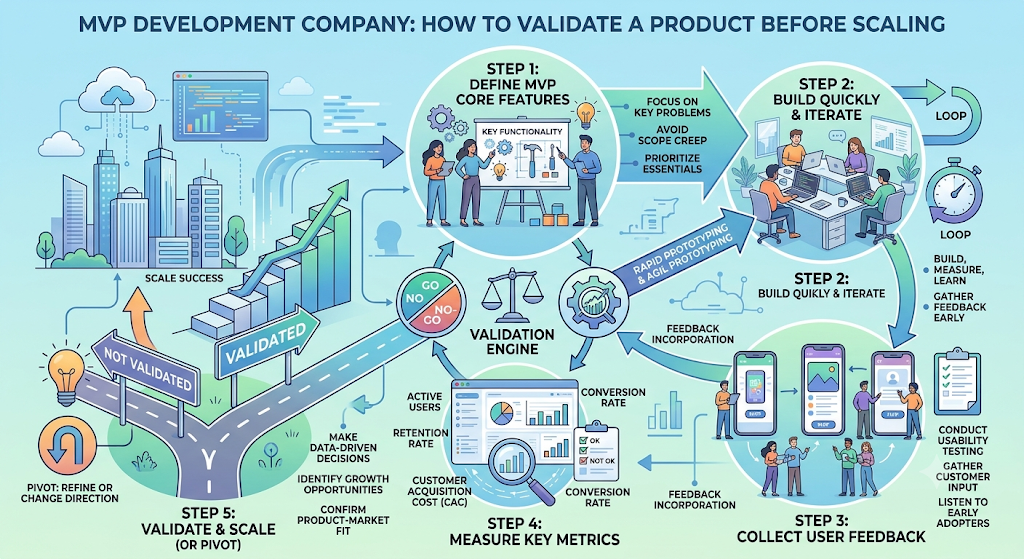
Validation is not a single test. It is a sequence of experiments, each designed to reduce uncertainty.
Step 1: Define the Hypothesis
A hypothesis is a testable statement about the business. It has three parts:
The assumption: what you believe to be true.
The test: how you will check it.
The threshold: what result would confirm or refute it.
Example: "We believe that Indian SMEs will pay ₹5,000/month for an AI-powered invoice processing tool. We will test this by offering a paid pilot to 20 SMEs. If 8 or more pay, the hypothesis is confirmed."
Step 2: Identify the Riskiest Assumption
Not all assumptions are equal. The riskiest assumption is the one that, if wrong, invalidates the business. Common categories:
Problem: does the customer have the problem?
Solution: does our solution solve it?
Willingness to pay: will they pay?
Channel: can we reach them?
Economics: do the unit economics work?
Step 3: Choose the Test
Different assumptions require different tests. Not all require building software.
| Assumption | Test | Build Required? |
|---|---|---|
| Problem exists | Customer interviews | No |
| Solution works | Prototype, concierge test | Minimal |
| Willingness to pay | Pre-sales, landing page | Minimal |
| Channel works | Ad campaign, outreach | No |
| Product works | MVP | Yes |
The key insight: Many assumptions can be tested before building anything. A landing page with a "pay now" button tests willingness to pay. A concierge test (manually delivering the service) tests whether the solution works. Only after these tests pass should you build the MVP.
Step 4: Define the Success Metric
The MVP must have a clear, measurable success metric. Common metrics:
Activation: percentage of users who complete the core action.
Retention: percentage of users who return.
Conversion: percentage of users who pay.
Engagement: frequency of use.
The metric must be defined before the build, not after.
Step 5: Build the MVP
Only after the hypothesis, the assumption, the test, and the metric are defined should the MVP be built. The build is the smallest thing that allows the test to run.
Step 6: Measure and Decide
After the MVP launches, measure the metric against the threshold. The outcome is one of three:
Proceed: the hypothesis is confirmed; build more.
Pivot: the hypothesis is refuted; change the approach.
Stop: the hypothesis is refuted and no viable pivot exists.
The Validation Framework Table
| Step | Output | Decision |
|---|---|---|
| Hypothesis | Testable statement | — |
| Riskiest assumption | The one that matters | — |
| Test | Experiment design | — |
| Metric | Success threshold | — |
| Build | MVP | — |
| Measure | Result | Proceed/pivot/stop |
Scope Discipline: What Goes In and What Stays Out
The most common cause of MVP failure is scope creep. The founder adds features, the development company builds them, and the MVP becomes a full product before validation.
The Scope Framework
The MVP should contain only what is required to run the test. Everything else is deferred.
In scope:
The core action that the hypothesis requires.
The minimum data collection needed for the metric.
Authentication (if needed to test).
Payment (if the hypothesis is about willingness to pay).
Basic analytics to measure the metric.
Out of scope:
Admin panels (use direct database access for the pilot).
Notifications (use email for the pilot).
Social features (defer until the core works).
Settings and preferences (defer).
Polish and design (functional is enough).
Scalability infrastructure (defer until validated).
The "One Core Action" Rule
The MVP should have one core action. If a user can complete the core action, the MVP works. If the MVP requires multiple actions to be meaningful, the scope is too broad.
Example: For a booking MVP, the core action is "book a slot." Everything else—profile, reviews, favourites, notifications—is out of scope.
The Scope Table
| Category | In MVP | Deferred |
|---|---|---|
| Core action | Yes | — |
| Authentication | If needed | — |
| Payment | If testing willingness | — |
| Analytics | Basic | Advanced |
| Admin | Direct DB access | Admin panel |
| Notifications | Email only | Push, SMS, WhatsApp |
| Design | Functional | Polished |
| Scalability | Basic | Full |
Choosing an MVP Development Company
The right partner makes the difference between a validated startup and a burned runway. The wrong partner builds what you ask for and disappears.
What to Look For
1. Validation mindset. The partner asks about your hypothesis and success metric before discussing features. If they start with a feature list, they are not a validation partner.
2. Scope discipline. The partner pushes back on scope. They help you identify what to defer. They are comfortable saying "not yet."
3. Speed. The partner can ship a focused MVP in 6–10 weeks, not 6 months.
4. Technology fit. The partner has experience with the stack that fits your product—web, mobile, AI.
5. Compliance awareness. The partner builds DPDPA compliance into the MVP from day one.
6. Post-MVP path. The partner can scale with you after validation, or hand over cleanly.
Red Flags
Fixed price before discovery. They quote without understanding the hypothesis.
Feature-list enthusiasm. They agree to build everything without asking why.
No mention of metrics. They do not ask how you will measure success.
Long timelines. They propose 4–6 months for an MVP.
No compliance awareness. They do not mention DPDPA.
The Partner Selection Table
| Factor | Good Partner | Bad Partner |
|---|---|---|
| Validation | Asks about hypothesis | Asks about features |
| Scope | Pushes back | Agrees to everything |
| Timeline | 6–10 weeks | 4–6 months |
| Compliance | DPDPA aware | Ignorant |
| Post-MVP | Clear path | No plan |
Real Costs in India (2026)
MVP development costs depend on the scope, the technology, and the partner. The good news is that a focused MVP costs far less than a full product.
Cost by MVP Type
| MVP Type | Build Cost (₹) | Build Cost ($ approx.) | Timeline |
|---|---|---|---|
| Landing page validation | ₹50,000–₹2 lakh | $600–$2,400 | 1–3 weeks |
| Concierge MVP (manual service) | ₹1–3 lakh | $1,200–$3,600 | 2–4 weeks |
| Web MVP (core action only) | ₹3–8 lakh | $3,600–$9,600 | 6–10 weeks |
| Mobile MVP (cross-platform) | ₹5–12 lakh | $6,000–$14,400 | 8–12 weeks |
| AI-enabled MVP (RAG, agent) | ₹8–20 lakh | $9,600–$24,000 | 10–16 weeks |
Note: USD conversions at ₹83/$. Ranges are indicative for Indian development partners.
Running Costs
| Component | Monthly Cost (₹) | Monthly Cost ($ approx.) | Notes |
|---|---|---|---|
| Hosting | ₹5,000–₹25,000 | $60–$300 | Cloud infrastructure |
| LLM API (if AI) | ₹5,000–₹40,000 | $60–$480 | Scales with usage |
| Payment gateway | 2% of transactions | — | Per transaction |
| Analytics | Free–₹5,000 | Free–$60 | Basic tools |
The MVP Economics
A validated MVP at ₹5–10 lakh leaves runway for iteration. An unvalidated "MVP" at ₹40 lakh consumes the runway and produces no learning. The difference is scope discipline.
The rule: Spend no more than 10–15% of your runway on the MVP. If the MVP costs more than that, the scope is too broad.
India-Specific Compliance: DPDPA and MeitY
DPDPA for MVPs
Even an MVP that collects personal data is subject to the DPDP Act:
Consent: free, specific, informed, unambiguous.
Privacy policy: even a simple one.
Data minimisation: collect only what is needed.
Erasure: support account deletion.
Building these into the MVP costs little. Retrofitting them after launch costs much more.
MeitY AI Governance
If the MVP includes AI features:
Transparency: disclose AI use.
Accountability: named owner.
Human oversight: for consequential decisions.
The Compliance Checklist
| Requirement | MVP Implementation | Priority |
|---|---|---|
| Consent | Sign-up consent screen | High |
| Privacy policy | Simple page | High |
| Data minimisation | Only necessary fields | Medium |
| Erasure | Account deletion | High |
| AI disclosure | If AI used | Medium |
Implementation Framework: A Phased Approach With Cost Gates
Phase 1: Validation Design (Week 1–2)
Objective: Define the hypothesis, assumption, test, and metric.
Activities:
Write the hypothesis.
Identify the riskiest assumption.
Design the test.
Define the success metric and threshold.
Decide what to build and what to defer.
Cost: ₹0–₹50,000 ($0–$600) for internal workshop.
Go/No-Go: Hypothesis defined. Metric set. Scope agreed.
Phase 2: Pre-Build Tests (Week 3–4)
Objective: Test assumptions that do not require building.
Activities:
Customer interviews.
Landing page test (if willingness to pay).
Concierge test (if solution feasibility).
Channel test.
Cost: ₹50,000–₹2 lakh ($600–$2,400).
Go/No-Go: Assumption confirmed. Proceed to build.
Phase 3: MVP Build (Week 5–12)
Objective: Build the smallest thing that runs the test.
Activities:
Build the core action.
Implement authentication and payment (if needed).
Implement basic analytics.
Build DPDPA compliance.
Cost: ₹3–12 lakh ($3,600–$14,400).
Go/No-Go: Core action works. Analytics measures the metric.
Phase 4: Launch and Measure (Week 13–16)
Objective: Launch to real users and measure.
Activities:
Launch to a limited audience.
Monitor the metric.
Collect qualitative feedback.
Analyze results.
Cost: Running costs plus analysis.
Go/No-Go: Metric measured. Decision made (proceed/pivot/stop).
Phase Summary Table
| Phase | Duration | Key Deliverable | Cost (₹) | Go/No-Go Criteria |
|---|---|---|---|---|
| 1. Validation Design | 2 weeks | Hypothesis, metric | 0–50,000 | Defined |
| 2. Pre-Build Tests | 2 weeks | Assumption tested | 50,000–2 lakh | Confirmed |
| 3. MVP Build | 8 weeks | Working MVP | 3–12 lakh | Core action works |
| 4. Launch & Measure | 4 weeks | Result | Running costs | Decision made |
Risks, Pitfalls, and Governance
The Most Common MVP Failures
Scope creep. The MVP becomes a full product. Mitigation: One core action, defer everything else.
No hypothesis. Building without a testable assumption. Mitigation: Define hypothesis first.
No metric. Cannot measure success. Mitigation: Define metric before build.
Skipping pre-build tests. Building when a landing page would have answered the question. Mitigation: Test cheaply first.
Wrong partner. The development company builds what you ask, not what you need. Mitigation: Validation-minded partner.
Ignoring compliance. DPDPA retrofitted after launch. Mitigation: Build compliance in.
Risk Summary Table
| Risk | Likelihood | Impact | Mitigation |
|---|---|---|---|
| Scope creep | High | High (runway) | One core action |
| No hypothesis | High | High (no learning) | Define first |
| No metric | High | Medium | Define before build |
| Skipping tests | High | Medium | Cheap tests first |
| Wrong partner | High | High | Validation mindset |
| Compliance gaps | Medium | High | Build in |
Benchmark Summary and Decision Framework
Decision Matrix: What to Build First
| Riskiest Assumption | Test | Build? |
|---|---|---|
| Problem exists | Interviews | No |
| Willingness to pay | Landing page, pre-sales | Minimal |
| Solution works | Concierge | Minimal |
| Channel works | Ad campaign | No |
| Product works | MVP | Yes |
MVP Scope Priority Table
| Priority | Component | Why |
|---|---|---|
| 1 | Core action | Tests the hypothesis |
| 2 | Analytics | Measures the metric |
| 3 | Authentication | If needed for test |
| 4 | Payment | If testing willingness |
| 5 | Compliance | DPDPA obligation |
The One-Paragraph Decision Rule
If you are building an MVP, start with the hypothesis, not the feature list. Identify the riskiest assumption. Test it as cheaply as possible—often without building anything. If you must build, build only the core action. Define the success metric before the build. Choose a partner who pushes back on scope. And build DPDPA compliance into the MVP from day one.
Frequently Asked Questions
1. What is an MVP?
A Minimum Viable Product is the smallest build that allows you to test your riskiest business assumption with real users and decide whether to proceed, pivot, or stop.
2. How much does MVP development cost in India?
A landing page validation costs ₹50,000–₹2 lakh. A concierge MVP costs ₹1–3 lakh. A web MVP costs ₹3–8 lakh. A mobile MVP costs ₹5–12 lakh. An AI-enabled MVP costs ₹8–20 lakh.
3. How long does MVP development take?
A focused MVP takes 6–10 weeks. AI-enabled MVPs take 10–16 weeks. Anything longer suggests scope creep.
4. What should be in an MVP?
Only the core action that tests the hypothesis, plus basic analytics and compliance. Everything else is deferred.
5. How do I choose an MVP development company?
Look for a validation mindset: they ask about your hypothesis and metric before features. They push back on scope. They ship in weeks, not months. They are DPDPA-aware.
6. What is the difference between an MVP and a prototype?
A prototype tests feasibility (can it be built?). An MVP tests demand (will anyone use or pay for it?).
7. How does DPDPA affect MVPs?
Even MVPs that collect personal data need consent, a privacy policy, data minimisation, and erasure support. Build these in from day one.
8. What metrics should I track in an MVP?
Activation (core action completion), retention (return rate), conversion (payment rate), and engagement. Define the metric before the build.
9. Can I test without building anything?
Yes. Customer interviews, landing pages, concierge tests, and ad campaigns can test many assumptions before any software is built.
10. What is a concierge MVP?
A concierge MVP delivers the service manually to a small number of users, testing whether the solution works before automating it.
11. What if the MVP fails?
A failed MVP is a successful learning. If the metric is not met, pivot or stop—before spending more runway.
12. How can Innovative AI Solutions help?
Innovative AI Solutions builds focused MVPs for Indian startups—validation design, core action build, analytics, and DPDPA-compliant implementation. Our Delhi-based team pushes back on scope and ships in weeks. Visit https://innovativeais.com to discuss your requirements.
Contact Innovative AI Solutions
Ready to validate your product before you scale it?
[One-line supporting sentence.]
Contact Information
Innovative AI Solutions
📍 Netaji Subhash Place, Pitampura, Delhi – 110034
🌐 Website: https://innovativeaislabs.com 📧 Email: info@innovativeais.com
📞 Phone: +91 7464 099 059 / +91 96899 67356
Business Services
AI Automation
AI Development
AI Consulting
Machine Learning Solutions
Deep Learning Solutions
Generative AI Services
NLP Solutions
AI Agents
AI Chatbots
Voice AI
CRM Development
Custom Software Development
Website Development
Mobile App Development
About the Author
Abhishek Kumar
Founder & CEO, Innovative AI Solutions
5+ years building production AI systems for Indian businesses. Based in Delhi, serving clients across India.
Ready to build AI solutions for your business?
Innovative AI Solutions — Delhi's leading AI development company. Free consultation available.
Get Free Consultation →
A practical 2026 guide for Indian founders building an MVP—validation frameworks, scope discipline, pre-build tests, real rupee costs, and choosing a development partner who pushes back on scope instead of invoicing for it. #MVPDevelopment #MinimumViableProduct #ProductValidation #StartupMVP #MVPCost #ProductMarketFit #LeanStartup #MVPDevelopmentCompany #StartupValidation #PrototypeVsMVP #MVPMetrics #DPDPA #MeitY #StartupIndia #DelhiNCR #InnovativeAISolutions
Copyright ©️ 2015–2026 Innovative AI Solutions. All Rights Reserved. | Privacy Policy | Terms & Conditions