The 1 Million User Question
"Can our application handle a million users?" is a question every startup eventually asks. The answer depends less on the target number than on the process of getting there.
Most applications do not fail at a million users. They fail at 10,000, or 50,000, or 200,000 — because they scaled in the wrong order. They added microservices before they needed them. They sharded databases before indexing. They bought Kubernetes before they had traffic.
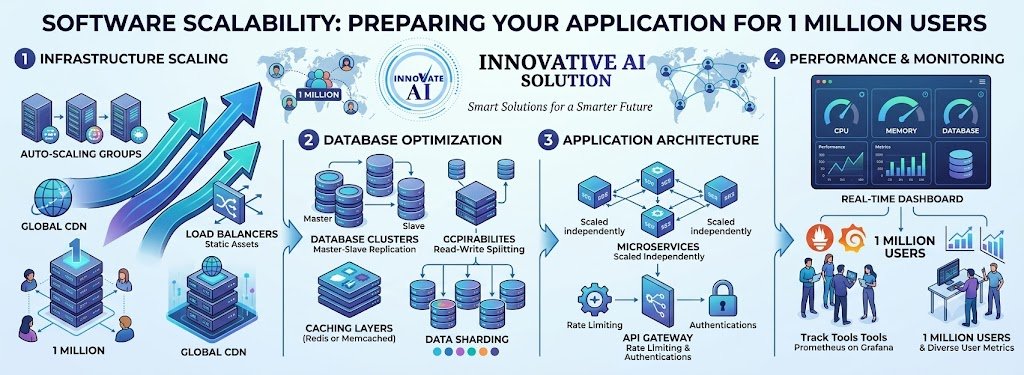
Scaling to a million users is not a single architectural decision. It is a sequence of decisions, each solving the bottleneck the previous stage created. Done in order, each stage is manageable. Done out of order, the complexity becomes unmanageable before the scale arrives.
This guide explains how to prepare your application for 1 million users in 2026. It covers the stages, the patterns, the costs in India, and the mistakes that break applications before they reach scale.
For organisations building scalable applications, Innovative AI Solutions provides custom software development and cloud architecture consulting.
The Scaling Stages
Stage 1: Single Server (0–1,000 users)
text
Users → Single Server → Database
Everything runs on one machine. Simple, cheap, adequate for early growth.
| Aspect | Detail |
|---|---|
| Cost | ₹5,000–₹20,000/month |
| Capacity | Hundreds to low thousands |
| Complexity | Minimal |
Bottleneck that ends this stage: CPU, memory, or database connections.
Stage 2: Separated Application and Database (1,000–10,000 users) text
Users → Load Balancer → App Servers → Database Server
Application and database on separate machines.
| Aspect | Detail |
|---|---|
| Cost | ₹20,000–₹80,000/month |
| Capacity | Thousands to tens of thousands |
| Complexity | Low |
Bottleneck that ends this stage: Database queries, repeated reads.
Stage 3: Caching and Read Replicas (10,000–100,000 users)
text
Users → Load Balancer → App Servers → Cache
→ Database (primary + replicas) Caching layer and database read replicas. Static assets from CDN.
| Aspect | Detail |
|---|---|
| Cost | ₹80,000–₹3,00,000/month |
| Capacity | Hundreds of thousands |
| Complexity | Moderate |
Bottleneck that ends this stage: Write volume, synchronous processing.
Stage 4: Async Processing and Auto-Scaling (100,000–500,000 users) text
Users → CDN → Load Balancer → Auto-Scaling App Cluster
↓
Message Queue → Workers
↓
Database Cluster + Cache
Auto-scaling, message queues for async work, database clustering.
| Aspect | Detail |
|---|---|
| Cost | ₹3,00,000–₹10,00,000/month |
| Capacity | Hundreds of thousands to a million |
| Complexity | High |
Bottleneck that ends this stage: Single-region latency, database write limits.
Stage 5: Multi-Region and Sharding (500,000–1,000,000+ users) text
Global Users → CDN (multi-region) → Regional Load Balancers
↓
Regional App Clusters
↓
Sharded Database + Global Cache
↓
Message Queues
Multi-region deployment, database sharding, global caching.
| Aspect | Detail |
|---|---|
| Cost | ₹10,00,000–₹50,00,000+/month |
| Capacity | Millions and beyond |
| Complexity | Very high |
The Patterns That Enable Scale
Pattern 1: Stateless Application Servers
Application servers must not store session state. State goes in shared storage.
| With State | Stateless |
|---|---|
| Sessions on server | Sessions in Redis |
| Cannot scale horizontally | Scales horizontally |
| Server failure loses sessions | Session survives |
| Load balancer needs sticky sessions | Any server can handle any request |
Pattern 2: Load Balancing
Distribute traffic across multiple servers.
| Type | When to Use |
|---|---|
| Round robin | Even distribution |
| Least connections | Variable request durations |
| IP hash | Session affinity (avoid if stateless) |
Pattern 3: Caching Layers
| Cache Type | Purpose |
|---|---|
| CDN | Static assets at edge |
| Application cache | Frequently accessed data in Redis |
| Database query cache | Repeated query results |
| Browser cache | Client-side assets |
Pattern 4: Database Scaling
| Technique | When to Use |
|---|---|
| Indexing | Slow queries |
| Connection pooling | Connection overhead |
| Read replicas | Read-heavy workloads |
| Partitioning | Large tables |
| Sharding | Very large datasets, write limits |
Pattern 5: Asynchronous Processing
text
Request → Queue → Immediate Response
↓
Background Worker → Process
| Use Case | Benefit |
|---|---|
| Email sending | Fast response |
| Report generation | Non-blocking |
| Image processing | Parallel work |
| Third-party API calls | Decoupled |
| Payment processing | Reliable retry |
Pattern 6: Content Delivery Network
| Benefit | Impact |
|---|---|
| Global performance | Edge delivery |
| Reduced origin load | Offload traffic |
| Cost efficiency | Cheaper bandwidth |
| DDoS protection | Absorption |
Pattern 7: Auto-Scaling
| Metric | Scaling Trigger |
|---|---|
| CPU utilisation | High CPU → scale up |
| Request count | High traffic → scale up |
| Queue depth | Backlog → scale workers |
| Custom metrics | Business-specific |
What Actually Breaks at Each Stage
Breaking Point 1: The N+1 Query
Symptom: Response times increase as data grows.
Cause: Code that queries the database once per item instead of once for all items.
Fix: Eager loading, batch queries, joins.
Breaking Point 2: The Missing Index
Symptom: Queries slow dramatically as tables grow.
Cause: Queries scanning full tables.
Fix: Add indexes on queried columns.
Breaking Point 3: The Synchronous Bottleneck
Symptom: Requests time out under load.
Cause: Long-running work in the request path.
Fix: Move to background queue.
Breaking Point 4: The Session Affinity Trap
Symptom: Cannot add servers without losing sessions.
Cause: Session state stored on servers.
Fix: Move sessions to Redis.
Breaking Point 5: The Database Write Limit
Symptom: Write performance degrades under load.
Cause: Single database cannot handle write volume.
Fix: Sharding, write-optimised databases.
Breaking Point 6: The Cache Stampede
Symptom: Database spikes when cache expires.
Cause: Many requests hit database simultaneously on cache miss.
Fix: Cache locking, staggered expiry, warm caches.
Breaking Point 7: The Cross-Region Latency
Symptom: Users far from servers experience slow responses.
Cause: All traffic to one region.
Fix: Multi-region deployment, CDN, edge caching.
What It Costs in India
Infrastructure Cost by Stage
| Stage | Users | Monthly Cost (INR) | Monthly Cost (USD) |
|---|---|---|---|
| Single server | 1,000 | ₹5,000–₹20,000 | $60–$240 |
| Separated | 10,000 | ₹20,000–₹80,000 | $240–$960 |
| Caching + replicas | 100,000 | ₹80,000–₹3,00,000 | $960–$3,600 |
| Async + auto-scaling | 500,000 | ₹3,00,000–₹10,00,000 | $3,600–$12,000 |
| Multi-region | 1,000,000+ | ₹10,00,000–₹50,00,000+ | $12,000–$60,000+ |
Cost Per User at Scale
| Users | Cost Per User (INR/month) |
|---|---|
| 1,000 | ₹20–₹80 |
| 10,000 | ₹8–₹30 |
| 100,000 | ₹3–₹15 |
| 1,000,000 | ₹1–₹5 |
Costs decrease at scale due to shared infrastructure and caching.
Development Cost Impact
| Pattern | Cost Impact |
|---|---|
| Stateless design | Minimal |
| Caching layer | 5–10% extra |
| Database replicas | 10–15% extra |
| Queue integration | 10–20% extra |
| Sharding | 20–40% extra |
| Multi-region | 40–60% extra |
| Microservices | 30–50% extra |
The Right Order to Scale
What to Do First
| Priority | Action | Impact |
|---|---|---|
| 1 | Index your database | Immediate speed |
| 2 | Fix N+1 queries | Immediate speed |
| 3 | Add caching | Reduced database load |
| 4 | Make app stateless | Enables horizontal scaling |
| 5 | Add load balancer | Enables multiple servers |
| 6 | Add read replicas | Scale reads |
| 7 | Add CDN | Global performance |
| 8 | Add message queue | Async processing |
| 9 | Add auto-scaling | Handle peaks |
| 10 | Shard database | Handle write scale |
| 11 | Multi-region | Global latency |
| 12 | Microservices | Team autonomy |
What Not to Do First
| Anti-Pattern | Why It Fails |
|---|---|
| Microservices first | Complexity without benefit |
| Kubernetes for 100 users | Operational overhead |
| Sharding before indexing | Premature complexity |
| Multi-region too early | Cost without users |
| Custom infrastructure | Maintenance burden |
India-Specific Considerations
Indian Traffic Patterns
| Pattern | Implication |
|---|---|
| Evening peaks | Auto-scaling helps |
| Festival spikes | Capacity planning |
| Regional variation | Multi-region beneficial |
| Mobile-first | Optimise for mobile |
Indian Infrastructure
| Factor | Consideration |
|---|---|
| Cloud regions | Mumbai, Hyderabad, Pune, Chennai |
| CDN presence | Major providers have India PoPs |
| Network variability | Design for variable connectivity |
| Data costs | Optimise data usage |
Compliance
| Requirement | Implementation |
|---|---|
| DPDPA | Data protection, consent |
| RBI | Financial data localisation |
| Data residency | Where data stored |
Decision Framework: Scaling Readiness
When to Scale
| Signal | Action |
|---|---|
| Response time increasing | Index, cache, optimise queries |
| CPU consistently high | Add application servers |
| Database read bottleneck | Add read replicas |
| Write bottleneck | Queue, sharding |
| Geographic latency | CDN, multi-region |
| Deployment coupling | Consider service extraction |
Scaling Readiness Scorecard
| Criteria | Weight | Score (1–5) | Weighted Score |
|---|---|---|---|
| Current traffic | 20% | ||
| Growth trajectory | 20% | ||
| Current bottlenecks identified | 20% | ||
| Team capability | 15% | ||
| Budget for scaling | 15% | ||
| Compliance requirements | 10% | ||
| Total | 100% | /5 |
Implementation Roadmap
| Phase | What to Build | Timeline | Cost Impact |
|---|---|---|---|
| Phase 1 | Indexing, N+1 fixes, caching | 2–4 weeks | Minimal |
| Phase 2 | Stateless design, load balancing | 3–6 weeks | 10–15% |
| Phase 3 | Read replicas, CDN, queues | 4–8 weeks | 15–25% |
| Phase 4 | Auto-scaling, sharding | 6–12 weeks | 25–40% |
| Phase 5 | Multi-region, services | 12–24 weeks | 40–60% |
Frequently Asked Questions
1. How do I prepare my application for 1 million users?
Scale in stages: single server, separated app/database, caching and read replicas, async processing and auto-scaling, then multi-region and sharding. Each stage solves the bottleneck the previous stage created.
2. What breaks first when scaling?
N+1 queries and missing indexes. These cause immediate performance problems as data grows and are fixed with database optimisation.
3. Should I use microservices to scale?
No, not initially. Microservices solve organisational problems, not scaling problems. Start with a monolith or modular monolith. Extract services only when teams are blocked.
4. How much does it cost to scale to 1 million users?
Infrastructure costs ₹10,00,000–₹50,00,000+ monthly ($12,000–$60,000+) at 1 million users. Costs decrease per user at scale due to shared infrastructure.
5. When should I add caching?
When database queries are slow or repeated. Add application-level caching (Redis) for data and CDN for static assets.
6. When should I add read replicas?
When read traffic overwhelms the primary database. Read replicas offload read queries.
7. What is the right order to scale?
Index first, fix queries, add caching, make stateless, add load balancing, add read replicas, add CDN, add queues, add auto-scaling, then shard, then multi-region.
8. Do I need Kubernetes to scale?
Not necessarily. Auto-scaling groups and managed services handle most scaling needs. Kubernetes adds operational overhead that is justified only at significant scale.
9. How do I handle traffic spikes?
Auto-scaling, queue-based processing, caching, and capacity planning. Indian festival spikes require pre-scaling.
10. How does DPDPA affect scaling?
DPDPA requires data protection and potentially data residency. Multi-region scaling must maintain compliance.
11. What is database sharding?
Sharding splits data across multiple databases. It is used when a single database cannot handle the volume — typically at very high write scale.
12. How can Innovative AI Solutions help?
Innovative AI Solutions is a Delhi-based software development company that builds scalable applications. We design stateless architectures, implement caching, load balancing, database scaling, and multi-region deployment — designed for Indian requirements and DPDPA compliance. Explore our custom software development.
Contact Innovative AI Solutions
Ready to scale your application?
We help Indian engineering teams prepare applications for scale — in the right order, without over-engineering.
Contact Information
Innovative AI Solutions
📍 Netaji Subhash Place, Pitampura, Delhi – 110034
🌐 Website: https://innovativeais.com 📧 Email: info@innovativeais.com
📞 Phone: +91 7464 099 059 / +91 96899 67356
Business Services
• AI Automation • AI Development • AI Consulting • Machine Learning Solutions • Deep Learning Solutions • Generative AI Services • NLP Solutions • AI Agents • AI Chatbots • Voice AI • CRM Development • Custom Software Development • Website Development • Mobile App Development
About the Author
Abhishek Kumar
Founder & CEO, Innovative AI Solutions
5+ years building production AI systems for Indian businesses. Based in Delhi, serving clients across India.
Ready to build AI solutions for your business?
Innovative AI Solutions — Delhi's leading AI development company. Free consultation available.
Get Free Consultation →
A practical 2026 guide to scaling software to 1 million users — architecture stages, database scaling, caching, queues, CDN, costs in India, and the right order to scale.
#SoftwareScalability #1MillionUsers #2026 #Architecture #HorizontalScaling #VerticalScaling #DatabaseScaling #Caching #LoadBalancing #CDN #MessageQueues #Sharding #ReadReplicas #AutoScaling #Costs #India #DelhiNCRTech #EnterpriseApps #StartupApps #SystemDesign #TechIndia #DigitalProducts #HighTraffic #BackendArchitecture #InnovativeAISolutions
Copyright © 2015–2026 Innovative AI Solutions. All Rights Reserved. | Privacy Policy | Terms & Conditions