What the SDLC Actually Is
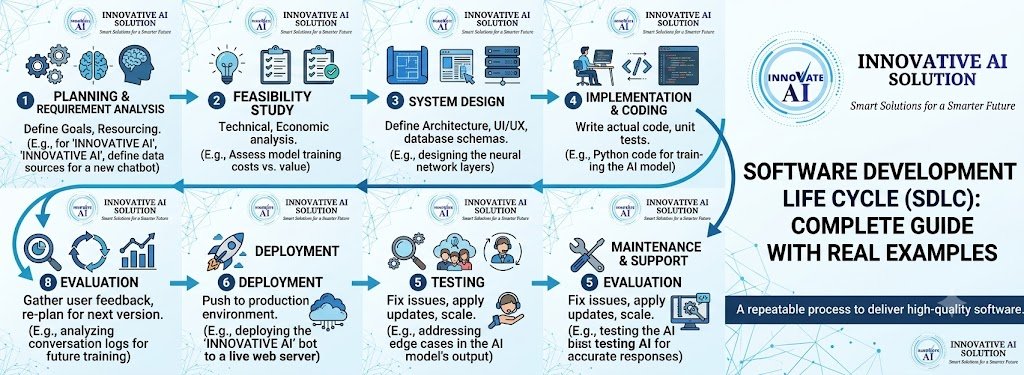
The Software Development Life Cycle is the structured process for building software. It defines the phases a project goes through from initial idea to ongoing maintenance.
Without an SDLC, software development becomes chaotic. Requirements are unclear. Design is skipped. Testing happens at the end — if at all. Deployment is improvised. Maintenance is reactive.
With an SDLC, development follows a defined path. Each phase has clear inputs, outputs, and success criteria. Problems are caught early. Quality is built in rather than tested in. And the process is repeatable, so teams improve over time.
The SDLC is not a specific methodology. It is a framework. Agile, Waterfall, DevOps, and other approaches are all implementations of the SDLC with different emphases and sequences.
This guide covers the SDLC in 2026. It explains each phase, compares common models, provides real examples, and addresses how AI is changing software development.
For organisations building software with structured processes, Innovative AI Solutions provides custom software development and AI development services.
The Six Phases of the SDLC
Phase 1: Requirements Gathering and Analysis
The foundation of any project. This phase defines what the software must do.
| Activity | Purpose |
|---|---|
| Stakeholder interviews | Understand needs |
| Requirement documentation | Capture requirements |
| Feasibility analysis | Assess viability |
| Scope definition | Define boundaries |
| Priority setting | Rank requirements |
Outputs: Requirements document, scope definition, feasibility report.
Real example: An e-commerce company documents that customers need order tracking, returns processing, and multiple payment options. Each requirement is prioritised and scoped.
Cost: ₹50,000–₹2,00,000 ($600–$2,400) | Timeline: 1–3 weeks
Phase 2: System Design
Requirements are translated into technical architecture.
| Activity | Purpose |
|---|---|
| Architecture design | Define system structure |
| Database design | Define data model |
| Interface design | Define user experience |
| Component design | Define modules |
| Technology selection | Choose stack |
Outputs: Architecture document, design specifications, technology stack.
Real example: For the e-commerce app, designers define a microservices architecture, PostgreSQL database schema, React frontend, and payment gateway integration.
Cost: ₹75,000–₹3,00,000 ($900–$3,600) | Timeline: 2–4 weeks
Phase 3: Development (Implementation)
Code is written based on the design.
| Activity | Purpose |
|---|---|
| Environment setup | Configure development |
| Frontend development | Build user interface |
| Backend development | Build business logic |
| Integration | Connect components |
| Code review | Ensure quality |
Outputs: Working software, source code, documentation.
Real example: Developers build the e-commerce app in two-week sprints — first authentication and product catalogue, then cart and checkout, then order tracking.
Cost: ₹2,00,000–₹15,00,000+ ($2,400–$18,000+) | Timeline: 6–20 weeks
Phase 4: Testing
The software is validated against requirements.
| Testing Type | Purpose |
|---|---|
| Unit testing | Test individual components |
| Integration testing | Test component interactions |
| System testing | Test complete system |
| User acceptance testing | Validate with users |
| Performance testing | Test under load |
Outputs: Test reports, bug reports, validated software.
Real example: The e-commerce app is tested for functionality, payment processing, order accuracy, and performance under peak load during festival sales.
Cost: ₹50,000–₹3,00,000 ($600–$3,600) | Timeline: 2–6 weeks
Phase 5: Deployment
The software is released to users.
| Activity | Purpose |
|---|---|
| Environment preparation | Production readiness |
| Deployment | Release software |
| Verification | Confirm success |
| Documentation | User and admin guides |
| Training | Enable users |
Outputs: Deployed software, documentation, trained users.
Real example: The e-commerce app is deployed to cloud infrastructure, app stores, and made available to customers with monitoring and support in place.
Cost: ₹25,000–₹1,00,000 ($300–$1,200) | Timeline: 1–2 weeks
Phase 6: Maintenance
The software is maintained and evolved.
| Activity | Purpose |
|---|---|
| Bug fixes | Resolve issues |
| Updates | Security and compatibility |
| Enhancements | New features |
| Monitoring | Performance and health |
| Optimisation | Improve efficiency |
Outputs: Updated software, enhanced features, ongoing support.
Real example: The e-commerce app receives monthly updates for security patches, new features like wishlists, and performance improvements during peak seasons.
Cost: 15–30% of build cost annually | Timeline: Ongoing
SDLC Models Compared
Waterfall
Sequential phases, each completed before the next begins.
| Aspect | Detail |
|---|---|
| Approach | Linear, sequential |
| Flexibility | Low |
| Documentation | Heavy |
| Testing | At the end |
| Best for | Fixed requirements |
Agile
Iterative development in short cycles.
| Aspect | Detail |
|---|---|
| Approach | Iterative, incremental |
| Flexibility | High |
| Documentation | Light |
| Testing | Continuous |
| Best for | Evolving requirements |
DevOps
Development and operations integrated.
| Aspect | Detail |
|---|---|
| Approach | Continuous delivery |
| Flexibility | High |
| Documentation | Automated |
| Testing | Automated, continuous |
| Best for | Fast delivery |
Hybrid
Combining elements of multiple models.
| Aspect | Detail |
|---|---|
| Approach | Mixed |
| Flexibility | Moderate-High |
| Documentation | Tailored |
| Testing | Phase-appropriate |
| Best for | Complex projects |
Model Comparison
| Factor | Waterfall | Agile | DevOps | Hybrid |
|---|---|---|---|---|
| Flexibility | Low | High | High | Moderate |
| Speed | Slow | Fast | Fastest | Moderate |
| Risk | High | Low | Low | Moderate |
| Documentation | Heavy | Light | Automated | Tailored |
| Best for | Fixed scope | Evolving scope | Continuous delivery | Complex projects |
When to Use Each
| Situation | Recommended Model |
|---|---|
| Regulated industry, fixed scope | Waterfall |
| Startup, evolving product | Agile |
| Continuous delivery team | DevOps |
| Enterprise transformation | Hybrid |
Real SDLC Example: E-commerce Platform
Project Overview
| Aspect | Detail |
|---|---|
| Product | E-commerce platform |
| Scope | Web + mobile apps |
| Timeline | 20 weeks |
| Budget | ₹15,00,000 ($18,000) |
Phase-by-Phase Breakdown
| Phase | Duration | Cost (INR) | Key Activities |
|---|---|---|---|
| Requirements | 3 weeks | ₹1,00,000 | Stakeholder interviews, scope definition |
| Design | 3 weeks | ₹2,00,000 | Architecture, UI/UX design |
| Development | 10 weeks | ₹8,00,000 | Frontend, backend, integrations |
| Testing | 3 weeks | ₹2,00,000 | Functional, performance, UAT |
| Deployment | 1 week | ₹50,000 | Production launch |
| Maintenance | Ongoing | ₹2,50,000/year | Updates, features, support |
What Went Well
Clear requirements from start
Regular stakeholder feedback
Continuous testing
Phased rollout
What Could Have Gone Better
Payment gateway integration took longer than expected
Third-party API documentation was incomplete
More time needed for performance testing
AI's Impact on the SDLC
AI in Requirements
| Traditional | AI-Assisted |
|---|---|
| Manual analysis | AI summarises and structures |
| Human estimation | AI-assisted estimation |
| Manual research | AI researches approaches |
AI in Design
| Traditional | AI-Assisted |
|---|---|
| Manual architecture | AI suggests architectures |
| Manual design | AI generates designs |
| Manual prototyping | AI-assisted prototyping |
AI in Development
| Traditional | AI-Assisted |
|---|---|
| Manual coding | AI coding assistants |
| Manual boilerplate | AI generates |
| Manual debugging | AI-assisted diagnosis |
AI in Testing
| Traditional | AI-Assisted |
|---|---|
| Manual test writing | AI generates tests |
| Manual edge cases | AI suggests edge cases |
| Manual regression | AI-assisted regression |
AI in Deployment
| Traditional | AI-Assisted |
|---|---|
| Manual pipeline config | AI-assisted configuration |
| Manual monitoring | AI anomaly detection |
| Manual runbooks | AI-generated runbooks |
AI in Maintenance
| Traditional | AI-Assisted |
|---|---|
| Manual bug fixes | AI-assisted diagnosis |
| Manual refactoring | AI suggests refactoring |
| Manual documentation | AI generates docs |
SDLC Costs in India
Total Cost by Project Type
| Project Type | SDLC Cost (INR) | SDLC Cost (USD) | Timeline |
|---|---|---|---|
| Simple application | ₹3,00,000–₹8,00,000 | $3,600–$9,600 | 8–14 weeks |
| Standard application | ₹8,00,000–₹20,00,000 | $9,600–$24,000 | 14–24 weeks |
| Complex platform | ₹20,00,000–₹50,00,000 | $24,000–$60,000 | 24–40 weeks |
| Enterprise system | ₹50,00,000–₹1,50,00,000+ | $60,000–$180,000+ | 40–78 weeks |
Cost by Phase
| Phase | % of Total Cost |
|---|---|
| Requirements | 5–10% |
| Design | 10–20% |
| Development | 40–55% |
| Testing | 15–25% |
| Deployment | 3–5% |
| Maintenance (annual) | 15–30% |
India-Specific Considerations
Indian Development Context
| Factor | Implication |
|---|---|
| Talent | Strong in Delhi NCR, Bangalore |
| Cost | 40–60% below Western markets |
| Process maturity | Varies widely |
| AI adoption | Rapid, especially startups |
Compliance in SDLC
| Requirement | SDLC Phase |
|---|---|
| DPDPA | Requirements, Design, Testing |
| Security | Design, Development, Testing |
| Audit trails | Development, Maintenance |
| Data residency | Design, Deployment |
Decision Framework: SDLC Readiness
SDLC Maturity Assessment
| Level | Characteristics |
|---|---|
| Level 1: Ad hoc | No defined process |
| Level 2: Defined | Basic process exists |
| Level 3: Managed | Process measured |
| Level 4: Optimised | Continuous improvement |
Readiness Scorecard
| Criteria | Weight | Score (1–5) | Weighted Score |
|---|---|---|---|
| Requirements clarity | 20% | ||
| Design process | 20% | ||
| Development practices | 20% | ||
| Testing rigour | 15% | ||
| Deployment automation | 15% | ||
| Maintenance planning | 10% | ||
| Total | 100% | /5 |
Model Selection Matrix
| Your Situation | Recommended Model |
|---|---|
| Fixed scope, regulated | Waterfall |
| Evolving requirements | Agile |
| Continuous delivery | DevOps |
| Complex enterprise | Hybrid |
| Startup MVP | Agile |
Frequently Asked Questions
1. What is the Software Development Life Cycle (SDLC)?
The SDLC is the structured process for building software — from requirements gathering through design, development, testing, deployment, and maintenance.
2. What are the six phases of the SDLC?
Requirements gathering, system design, development, testing, deployment, and maintenance. Each phase has defined inputs, outputs, and success criteria.
3. What is the difference between Waterfall and Agile?
Waterfall is sequential — each phase completes before the next begins. Agile is iterative — development happens in short cycles with continuous feedback.
4. Which SDLC model should I use?
Waterfall for fixed scope and regulated industries. Agile for evolving requirements. DevOps for continuous delivery. Hybrid for complex enterprise projects.
5. How much does SDLC cost in India?
Simple applications cost ₹3,00,000–₹8,00,000 ($3,600–$9,600). Standard applications cost ₹8,00,000–₹20,00,000 ($9,600–$24,000). Complex platforms cost ₹20,00,000–₹50,00,000 ($24,000–$60,000).
6. How does AI affect the SDLC?
AI assists at every phase — requirements analysis, design suggestions, coding assistants, test generation, deployment automation, and maintenance. AI improves productivity and quality.
7. What is the most important SDLC phase?
Requirements. Poor requirements cause the most project failures. Clear requirements prevent expensive rework later.
8. How long does the SDLC take?
Simple applications take 8–14 weeks. Standard applications take 14–24 weeks. Complex platforms take 24–40 weeks. Timelines depend on scope and complexity.
9. What is DevOps and how does it fit the SDLC?
DevOps integrates development and operations for continuous delivery. It automates testing, deployment, and monitoring, reducing the time from code to production.
10. How does DPDPA affect the SDLC?
DPDPA requires data protection, consent, and audit trails. These requirements affect requirements gathering, design, development, testing, and maintenance phases.
11. What documentation is needed for the SDLC?
Requirements document, design specifications, test plans, deployment guides, and user documentation. The level of documentation depends on the model and project.
12. How can Innovative AI Solutions help?
Innovative AI Solutions is a Delhi-based software development company that follows structured SDLC processes. We help businesses build software with clear requirements, proper design, rigorous testing, and reliable deployment — designed for Indian requirements and DPDPA compliance. Explore our custom software development.
Contact Innovative AI Solutions
Ready to build software with a structured process?
We help Indian businesses follow a clear SDLC — from requirements through maintenance — with quality built in at every phase.
Contact Information
Innovative AI Solutions
📍 Netaji Subhash Place, Pitampura, Delhi – 110034
🌐 Website: https://innovativeais.com 📧 Email: info@innovativeais.com
📞 Phone: +91 7464 099 059 / +91 96899 67356
Business Services
• AI Automation • AI Development • AI Consulting • Machine Learning Solutions • Deep Learning Solutions • Generative AI Services • NLP Solutions • AI Agents • AI Chatbots • Voice AI • CRM Development • Custom Software Development • Website Development • Mobile App Development
About the Author
Abhishek Kumar
Founder & CEO, Innovative AI Solutions
5+ years building production AI systems for Indian businesses. Based in Delhi, serving clients across India.
Ready to build AI solutions for your business?
Innovative AI Solutions — Delhi's leading AI development company. Free consultation available.
Get Free Consultation →
A complete 2026 guide to the Software Development Life Cycle (SDLC) — phases, models, real examples, costs in India, and AI's impact on each stage.
#SDLC #SoftwareDevelopmentLifeCycle #CompleteGuide #2026 #Phases #Models #Agile #Waterfall #DevOps #AIinSDLC #Requirements #Design #Development #Testing #Deployment #Maintenance #RealExamples #Costs #India #DelhiNCRTech #EnterpriseApps #StartupApps #SoftwareDevelopment #TechIndia #DigitalProducts #EngineeringProcess #BusinessSoftware #InnovativeAISolutions
Copyright © 2015–2026 Innovative AI Solutions. All Rights Reserved. | Privacy Policy | Terms & Conditions