The Enterprise AI Approach Question
Every enterprise building with AI eventually faces the same question: should we use RAG, fine-tuning, or both?
The question sounds technical, but it is a business decision. It affects cost, timeline, accuracy, data control, and compliance. Getting it wrong wastes money and delays delivery.
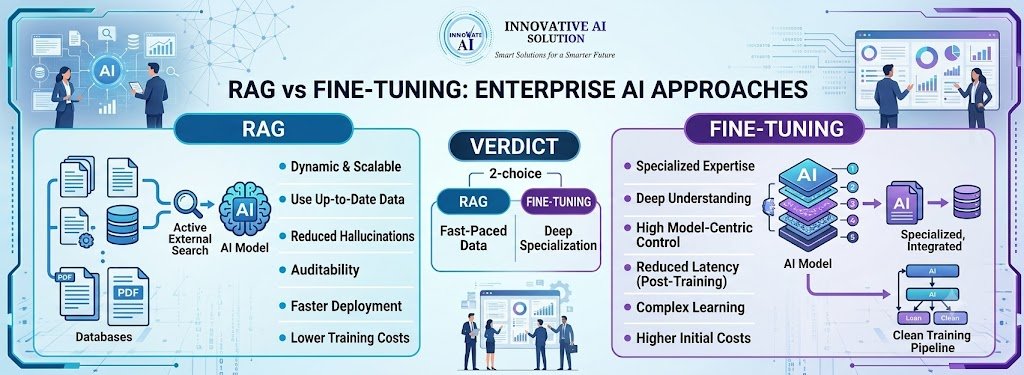
RAG retrieves relevant information at query time and provides it to the model. Fine-tuning adjusts the model's weights by training it further on your data. RAG changes what the model knows in the moment. Fine-tuning changes what the model has learned permanently.
The two approaches are not competitors. They solve different problems. But choosing the wrong one — or assuming you must choose only one — creates systems that are more expensive, slower, or less accurate than they need to be.
This guide compares RAG and fine-tuning for enterprise AI in 2026. It covers how each works, their costs in India, trade-offs, and how to choose.
For organisations building enterprise AI systems, Innovative AI Solutions provides AI development services and AI consulting.
What RAG Actually Does
The Mechanism
RAG retrieves relevant documents from your knowledge base and provides them to the model as context before generating a response.
text User question ↓
Convert to embedding
↓ Search vector database ↓ Retrieve relevant documents ↓
Provide context to LLM
↓ Generate grounded response
What RAG Is Good At
| Strength | Why It Matters |
|---|---|
| Factual accuracy | Answers grounded in documents |
| Updatability | Change documents, not models |
| Source attribution | Cite where answers came from |
| No training required | Fast to implement |
| Access control | Filter by user permission |
| Auditability | Track what was retrieved |
What RAG Struggles With
| Limitation | Why It Matters |
|---|---|
| Retrieval quality | Bad retrieval produces bad answers |
| Context limits | Cannot retrieve everything |
| Format learning | Cannot teach new output styles |
| Latency | Retrieval adds time |
| Cost per query | Every query retrieves context |
When RAG Is the Right Choice
| Use Case | Why RAG |
|---|---|
| Document Q&A | Knowledge from documents |
| Policy queries | Updatable, auditable |
| Customer support | Grounded answers |
| Internal knowledge | Company information |
| Compliance Q&A | Source attribution |
What Fine-Tuning Actually Does
The Mechanism
Fine-tuning continues training a pre-trained model on your data, adjusting its weights to better perform your task.
text Base model (pre-trained) ↓ Your training data (input-output pairs) ↓ Training process (adjusts weights) ↓ Fine-tuned model ↓
Deployed for inference
What Fine-Tuning Is Good At
| Strength | Why It Matters |
|---|---|
| Format consistency | Learned output structures |
| Style adaptation | Matches brand voice |
| Task specialisation | Better at specific tasks |
| Reduced prompt length | No lengthy instructions |
| Lower inference cost | Shorter prompts |
| Domain vocabulary | Specialised terminology |
What Fine-Tuning Struggles With
| Limitation | Why It Matters |
|---|---|
| Updating knowledge | Requires retraining |
| Training cost | Expensive to train |
| Data requirements | Needs quality examples |
| Time | Weeks to months |
| Hallucination | Still can invent information |
| Deletion rights | Hard to remove specific data |
When Fine-Tuning Is the Right Choice
| Use Case | Why Fine-Tuning |
|---|---|
| Structured output | Consistent format |
| Brand voice | Style consistency |
| Domain-specific tasks | Specialised behaviour |
| High volume | Lower per-query cost |
| Classification | Learned patterns |
Head-to-Head Comparison
The Full Comparison
| Dimension | RAG | Fine-Tuning |
|---|---|---|
| Knowledge updates | Change documents | Retrain model |
| Implementation time | Weeks | Weeks to months |
| Upfront cost | Lower | Higher |
| Ongoing cost | Per-query retrieval | Lower per-query |
| Data required | Documents | Labelled examples |
| Accuracy on facts | High (if retrieval good) | Moderate |
| Format control | Prompt-based | Learned |
| Source attribution | Yes | No |
| Latency | Higher | Lower |
| Access control | Per-user filtering | Not applicable |
| Deletion rights | Remove documents | Retrain model |
| DPDPA compliance | Easier | Harder |
Accuracy by Task Type
| Task Type | RAG | Fine-Tuning | Best Choice |
|---|---|---|---|
| Factual Q&A | High | Moderate | RAG |
| Policy queries | High | Moderate | RAG |
| Classification | Moderate | High | Fine-Tuning |
| Structured output | Moderate | High | Fine-Tuning |
| Brand voice | Moderate | High | Fine-Tuning |
| Multi-document reasoning | High | Low | RAG |
| Current information | High | None | RAG |
Cost Comparison in India
Implementation Costs
| Approach | Cost Range (INR) | Cost Range (USD) | Timeline |
|---|---|---|---|
| Basic RAG | ₹2,00,000–₹5,00,000 | $2,400–$6,000 | 4–8 weeks |
| Standard RAG | ₹5,00,000–₹12,00,000 | $6,000–$14,400 | 8–16 weeks |
| Fine-tuning (small model) | ₹1,50,000–₹4,00,000 | $1,800–$4,800 | 4–8 weeks |
| Fine-tuning (large model) | ₹4,00,000–₹12,00,000 | $4,800–$14,400 | 8–16 weeks |
| Hybrid (RAG + fine-tuning) | ₹8,00,000–₹20,00,000 | $9,600–$24,000 | 12–24 weeks |
Ongoing Costs
| Cost Category | RAG (Monthly INR) | Fine-Tuning (Monthly INR) |
|---|---|---|
| LLM API usage | ₹5,000–₹60,000 | ₹3,000–₹40,000 |
| Vector database | ₹3,000–₹20,000 | Not applicable |
| Retraining | Not applicable | ₹25,000–₹1,00,000 quarterly |
| Infrastructure | ₹5,000–₹30,000 | ₹5,000–₹30,000 |
Cost Per Query
| Approach | Cost Per Query (INR) |
|---|---|
| Basic RAG | ₹1–₹5 |
| Fine-tuned model | ₹0.50–₹3 |
| Hybrid | ₹2–₹8 |
Fine-tuning has lower per-query cost at high volume. RAG has lower upfront cost.
Break-Even Analysis
| Monthly Volume | Cheaper Approach |
|---|---|
| Under 20,000 queries | RAG |
| 20,000–50,000 queries | Depends |
| Over 50,000 queries | Fine-tuning |
Data Control and Compliance
DPDPA Comparison
| Requirement | RAG | Fine-Tuning |
|---|---|---|
| Consent for training | Not required | Required |
| Data minimisation | Easier | Harder |
| Deletion rights | Remove documents | Retrain model |
| Purpose limitation | Easier to enforce | Harder |
| Audit trails | Retrieval logs | Training logs |
RAG has a significant compliance advantage: deleting user data means removing documents from the knowledge base, not retraining a model.
Data Security
| Aspect | RAG | Fine-Tuning |
|---|---|---|
| Data location | Vector database | Model weights |
| Data exposure | Retrieved content | Learned patterns |
| Access control | Per-user filtering | Not applicable |
| Leakage risk | Retrieval errors | Model memorisation |
The Deletion Challenge
| Approach | Deletion Process |
|---|---|
| RAG | Delete document, rebuild index |
| Fine-tuning | Retrain model without data |
For enterprises with strict deletion requirements, RAG is significantly easier to comply with.
The Hybrid Approach
Why Hybrid Often Wins
Many production systems use both. Fine-tuning teaches the model format, style, and domain vocabulary. RAG provides current facts and source attribution.
| Problem | Solution |
|---|---|
| Model needs your format | Fine-tuning |
| Model needs current facts | RAG |
| Model needs your tone | Fine-tuning |
| Model needs specific instructions | RAG |
| Model needs domain terms | Fine-tuning |
| Model needs source attribution | RAG |
The Hybrid Architecture
text Fine-tuned model (understands domain, format, tone) ↓ RAG retrieval (fetches current, specific facts) ↓ Generated response in correct format, with current facts
When Hybrid Makes Sense
| Situation | Why Hybrid |
|---|---|
| Complex customer support | Format consistency + accurate facts |
| Regulated industries | Tone control + source attribution |
| Domain-specific assistants | Terminology + current information |
| High-volume production | Lower per-query cost + accuracy |
Decision Framework: RAG vs Fine-Tuning
The Decision Tree
Question 1: What is the primary problem?
| Problem | Approach |
|---|---|
| Model does not know our facts | RAG |
| Model does not follow our format | Fine-tuning |
| Model does not sound like us | Fine-tuning |
| Model needs current information | RAG |
| Model needs source attribution | RAG |
| Both facts and format | Hybrid |
Question 2: What data do you have?
| Data Available | Approach |
|---|---|
| Documents and knowledge base | RAG |
| Labelled input-output examples | Fine-tuning |
| Both | Hybrid |
Question 3: What is your volume?
| Query Volume | Cost Favours |
|---|---|
| Low (<20,000/month) | RAG |
| Medium (20,000–50,000/month) | Depends |
| High (>50,000/month) | Fine-tuning |
Question 4: What are your compliance requirements?
| Requirement | Approach |
|---|---|
| Strict deletion rights | RAG |
| Source attribution required | RAG |
| Format consistency critical | Fine-tuning |
| Both | Hybrid |
Decision Matrix
| Your Situation | Recommended Approach |
|---|---|
| Customer support with KB | RAG |
| Compliance and policy queries | RAG |
| Document Q&A | RAG |
| Classification and routing | Fine-tuning |
| Structured output generation | Fine-tuning |
| Brand voice consistency | Fine-tuning |
| Domain-specific assistant | Hybrid |
| High-volume production | Hybrid or fine-tuning |
Readiness Scorecard
| Criteria | Weight | RAG Score | Fine-Tuning Score |
|---|---|---|---|
| Knowledge base available | 20% | ||
| Labelled training data available | 20% | ||
| Knowledge changes frequently | 15% | ||
| Format consistency required | 15% | ||
| Source attribution required | 10% | ||
| Query volume | 10% | ||
| Compliance requirements | 10% | ||
| Total | 100% |
India-Specific Considerations
Indian Enterprise Context
| Factor | Implication |
|---|---|
| Data sensitivity | RAG easier to comply |
| Cost sensitivity | RAG lower upfront |
| Regulatory requirements | DPDPA favours RAG |
| Talent availability | RAG skills more common |
Indian Language Support
| Language | RAG | Fine-Tuning |
|---|---|---|
| English | Excellent | Excellent |
| Hindi | Good | Depends on base model |
| Hinglish | Moderate | Requires training data |
| Regional languages | Variable | Requires training data |
Compliance
| Requirement | RAG | Fine-Tuning |
|---|---|---|
| DPDPA consent | Document-level | Training-level |
| Deletion rights | Easy | Hard |
| Audit trails | Retrieval logs | Training logs |
| Data residency | Vector DB location | Model location |
Frequently Asked Questions
1. What is the difference between RAG and fine-tuning?
RAG retrieves information at query time and provides it to the model. Fine-tuning adjusts model weights by training on your data. RAG changes what the model sees; fine-tuning changes what it learned.
2. Which is better for enterprise AI: RAG or fine-tuning?
It depends on the problem. RAG for facts, knowledge, and source attribution. Fine-tuning for format, style, and domain-specific tasks. Many enterprises use both.
3. How much does RAG cost in India?
Basic RAG costs ₹2,00,000–₹5,00,000 ($2,400–$6,000). Standard RAG costs ₹5,00,000–₹12,00,000 ($6,000–$14,400). Ongoing costs run ₹8,000–₹1,10,000 monthly.
4. How much does fine-tuning cost in India?
Fine-tuning costs ₹1,50,000–₹12,00,000 ($1,800–$14,400) depending on model size. Ongoing costs include quarterly retraining of ₹25,000–₹1,00,000.
5. Which approach is cheaper?
RAG is cheaper upfront. Fine-tuning is cheaper per-query at high volume. Break-even is typically around 20,000–50,000 queries monthly.
6. Which is better for DPDPA compliance?
RAG. Deleting user data means removing documents from the knowledge base, not retraining a model. RAG also supports source attribution and audit trails more easily.
7. Can I use RAG and fine-tuning together?
Yes, and many production systems do. Fine-tuning teaches format and style. RAG provides current facts and source attribution.
8. Which approach reduces hallucination better?
RAG. Answers are grounded in retrieved documents and can cite sources. Fine-tuning changes style and format but does not prevent hallucination.
9. What data do I need for fine-tuning?
Labelled input-output examples — typically hundreds to thousands. Quality matters more than quantity.
10. Which is faster to implement?
RAG. Basic RAG can be implemented in 4–8 weeks. Fine-tuning takes 4–16 weeks plus data preparation time.
11. Which approach is better for Indian languages?
Both depend on underlying models. RAG depends on embedding quality. Fine-tuning depends on base model capability and training data. Domestic models like Sarvam AI may perform better.
12. How can Innovative AI Solutions help?
Innovative AI Solutions is a Delhi-based AI development company that builds RAG systems, fine-tuned models, and hybrid architectures. We help enterprises choose the right approach and implement production systems with DPDPA compliance. Explore our AI development services and AI consulting.
Contact Innovative AI Solutions
Choosing between RAG and fine-tuning?
We help Indian enterprises evaluate both approaches, build production systems, and combine them where hybrid delivers the best results.
Contact Information
Innovative AI Solutions
📍 Netaji Subhash Place, Pitampura, Delhi – 110034
🌐 Website: https://innovativeais.com 📧 Email: info@innovativeais.com
📞 Phone: +91 7464 099 059 / +91 96899 67356
Business Services
• AI Automation • AI Development • AI Consulting • Machine Learning Solutions • Deep Learning Solutions • Generative AI Services • NLP Solutions • AI Agents • AI Chatbots • Voice AI • CRM Development • Custom Software Development • Website Development • Mobile App Development
About the Author
Abhishek Kumar
Founder & CEO, Innovative AI Solutions
5+ years building production AI systems for Indian businesses. Based in Delhi, serving clients across India.
Ready to build AI solutions for your business?
Innovative AI Solutions — Delhi's leading AI development company. Free consultation available.
Get Free Consultation →
A practical 2026 comparison of RAG vs fine-tuning for enterprise AI — accuracy, cost, data control, DPDPA compliance, and a decision framework for Indian businesses.
#RAG #FineTuning #EnterpriseAI #Comparison #2026 #RetrievalAugmentedGeneration #LLM #Customisation #Accuracy #Cost #DataControl #DPDPA #Compliance #VectorDatabase #TrainingData #HybridApproach #DecisionFramework #India #DelhiNCRTech #EnterpriseApps #StartupApps #AIStrategy #TechIndia #DigitalProducts #AIImplementation #BusinessAI #InnovativeAISolutions
Copyright © 2015–2026 Innovative AI Solutions. All Rights Reserved. | Privacy Policy | Terms & Conditions