The Problem DevOps Created
DevOps was a genuine revolution. It broke down the wall between development and operations. It brought deployment, infrastructure, and monitoring into the hands of the teams building software. It made continuous delivery possible.
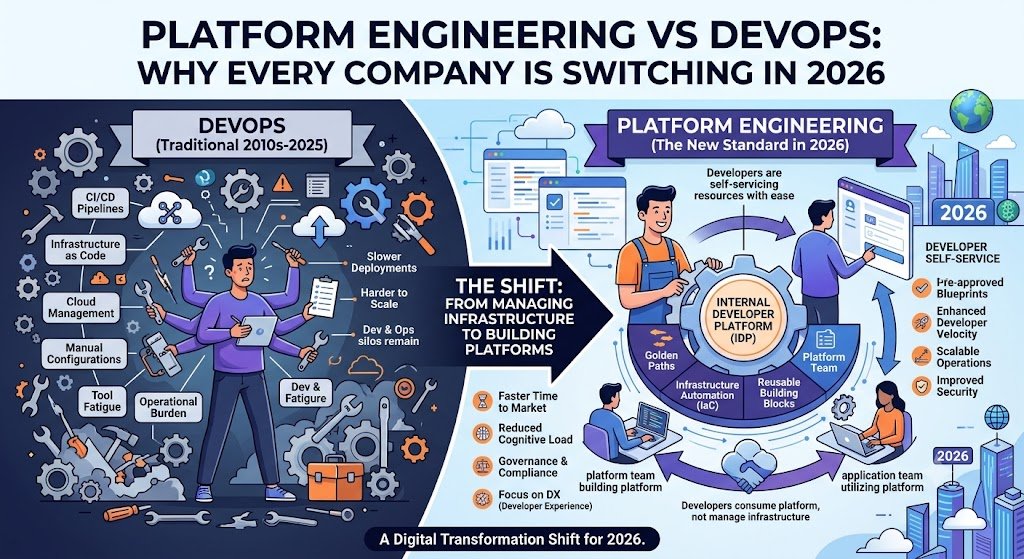
But DevOps created a new problem. It assumed every developer would become fluent in infrastructure, pipelines, Kubernetes, cloud services, observability, and security. In practice, most developers did not want to become DevOps experts. They wanted to write application code.
The result was predictable. Organisations hired platform teams, DevOps engineers, and SREs to build the infrastructure. But every application team still had to configure their own pipelines, learn Kubernetes, manage their own cloud resources, and interpret their own alerts. The cognitive load grew with every new tool.
Platform engineering addresses this by treating the internal infrastructure as a product. Instead of every team assembling their own toolchain, a platform team builds a self-service platform with golden paths — opinionated, supported ways to build, deploy, and operate software.
This guide explains platform engineering vs DevOps in 2026. It covers what each is, why the shift is happening, what changes in practice, what it costs in India, and how to approach the transition.
What DevOps Actually Is
The DevOps Principles
| Principle | What It Means |
|---|
| Collaboration | Dev and ops work together |
| Automation | Automate build, test, deploy |
| Continuous delivery | Deploy frequently, reliably |
| Shared responsibility | Teams own what they build |
| Measurement | Measure and improve |
What DevOps Delivered
| Benefit | Impact |
|---|
| Faster deployments | From months to days |
| Better reliability | Automation reduces errors |
| Shared ownership | Teams own production |
| Continuous improvement | Feedback loops |
Where DevOps Struggled
| Challenge | Why It Happened |
|---|
| Cognitive overload | Every developer must know infrastructure |
| Tool sprawl | Teams assembled different toolchains |
| Inconsistent practices | Every team did things differently |
| Duplicated effort | Each team solved the same problems |
| Expertise gap | Not everyone wants to be a DevOps engineer |
| Scaling difficulty | What worked for 5 teams failed for 50 |
The DevOps Paradox
DevOps gave teams autonomy but also gave them responsibility for everything. The result was that developers spent increasing time on infrastructure rather than product. Autonomy became burden.
What Platform Engineering Actually Is
The Definition
Platform engineering is the discipline of building and operating internal developer platforms — self-service tools and workflows that let application teams deliver software without managing infrastructure.
| Aspect | Detail |
|---|
| Focus | Developer experience and productivity |
| Deliverable | Internal developer platform |
| Approach | Platform as a product |
| Goal | Reduce cognitive load |
Platform as a Product
The platform team treats developers as customers. The platform is a product with users, requirements, and a roadmap.
| Product Principle | Application |
|---|
| User research | Understand developer needs |
| Usability | Platform must be easy to use |
| Documentation | Clear guidance |
| Support | Help when things break |
| Roadmap | Continuous improvement |
Golden Paths
A golden path is an opinionated, supported way to accomplish a common task.
| Golden Path | Purpose |
|---|
| New service | Scaffold a new microservice |
| Deployment | Deploy to production |
| Database migration | Safe schema changes |
| Observability | Set up logging and monitoring |
| Secret management | Handle credentials securely |
Golden paths are not mandates. They are the easiest path. Teams can deviate, but the supported path is the default.
Self-Service Infrastructure
Developers provision what they need without waiting for a platform team.
| Self-Service Capability | What It Enables |
|---|
| Environment provisioning | Spin up dev environments |
| Database creation | Get a database without tickets |
| Service deployment | Deploy without DevOps help |
| Monitoring setup | Automatic observability |
| Access management | Request and receive access |
Platform Engineering vs DevOps: The Real Difference
They Are Not Opposites
Platform engineering does not replace DevOps. It evolves it.
| Aspect | DevOps | Platform Engineering |
|---|
| Focus | Culture and practices | Developer experience |
| Deliverable | Working software | Internal platform |
| Who does infrastructure | Every team | Platform team |
| Approach | Everyone learns DevOps | Platform abstracts DevOps |
| Scaling model | Hire more DevOps engineers | Build better platform |
The Division of Responsibility
| Responsibility | DevOps Model | Platform Model |
|---|
| Application code | Dev teams | Dev teams |
| Pipelines | Dev teams | Platform team |
| Infrastructure | Dev teams | Platform team |
| Kubernetes | Dev teams learn it | Platform abstracts it |
| Observability | Dev teams set up | Platform provides |
| Security | Dev teams implement | Platform embeds |
What Changes for Developers
| Before (DevOps) | After (Platform Engineering) |
|---|
| Configure own CI/CD | Use golden path pipeline |
| Learn Kubernetes | Deploy with simple commands |
| Manage cloud resources | Self-service provisioning |
| Set up monitoring | Automatic observability |
| Handle secrets manually | Managed secret store |
| Debug infrastructure | Platform handles it |
What Does Not Change
| Principle | Status |
|---|
| Team ownership | Dev teams own their services |
| You build it, you run it | Still true |
| Automation | Still essential |
| Continuous delivery | Still the goal |
Why Companies Are Switching
Reason 1: Developer Cognitive Load
| Problem | Platform Solution |
|---|
| Too many tools to learn | Unified platform |
| Infrastructure complexity | Abstracted away |
| Context switching | Single workflow |
| Onboarding difficulty | Golden paths |
Reason 2: Scaling Challenges
| Problem | Platform Solution |
|---|
| Every team reinvents | Shared platform |
| Inconsistent practices | Opinionated paths |
| Duplicated effort | Centralised capability |
| Expertise bottleneck | Platform team scales |
Reason 3: Developer Retention
| Problem | Platform Solution |
|---|
| Developers doing ops work | Focus on product |
| Frustrating tooling | Good developer experience |
| Slow onboarding | Faster time to productivity |
| Low job satisfaction | Better workflows |
Reason 4: Security and Compliance
| Problem | Platform Solution |
|---|
| Inconsistent security | Embedded in platform |
| Compliance gaps | Built-in controls |
| Audit difficulty | Centralised logging |
| Secret sprawl | Managed secrets |
Reason 5: Cost Efficiency
| Problem | Platform Solution |
|---|
| Cloud waste | Optimised defaults |
| Tool sprawl | Consolidated tooling |
| Duplicated infrastructure | Shared resources |
| Manual effort | Automation |
What a Platform Team Does
Core Responsibilities
| Responsibility | What It Involves |
|---|
| Platform development | Build the internal platform |
| Golden paths | Create supported workflows |
| Developer experience | Improve usability |
| Platform operations | Run the platform reliably |
| Support | Help developers use the platform |
| Advocacy | Promote platform adoption |
Platform Team Structure
| Role | Responsibility |
|---|
| Platform lead | Strategy and roadmap |
| Platform engineers | Build and operate platform |
| Developer experience | Usability and documentation |
| SRE | Platform reliability |
| Security | Embedded security |
What Platform Teams Should Not Do
| Anti-Pattern | Why It Fails |
|---|
| Ticket-driven | Becomes bottleneck |
| Build everything | Loses focus |
| Ignore developers | Platform unused |
| Mandate usage | Resentment |
| No product thinking | Poor experience |
What Platform Engineering Costs in India
Implementation Costs
| Scope | Cost Range (INR) | Cost Range (USD) | Timeline |
|---|
| Basic platform (CI/CD, deployment) | ₹8,00,000–₹20,00,000 | $9,600–$24,000 | 3–6 months |
| Standard platform (self-service, observability) | ₹20,00,000–₹50,00,000 | $24,000–$60,000 | 6–12 months |
| Advanced platform (full IDP) | ₹50,00,000–₹1,50,00,000+ | $60,000–$180,000+ | 12–24 months |
Platform Team Costs
| Role | Annual Cost (INR) | Annual Cost (USD) |
|---|
| Platform lead | ₹30,00,000–₹50,00,000 | $36,000–$60,000 |
| Senior platform engineer | ₹20,00,000–₹35,00,000 | $24,000–$42,000 |
| Platform engineer | ₹12,00,000–₹22,00,000 | $14,400–$26,400 |
| SRE | ₹15,00,000–₹30,00,000 | $18,000–$36,000 |
Team Size by Organisation
| Organisation Size | Platform Team Size |
|---|
| 10–20 developers | 1–2 platform engineers |
| 20–50 developers | 2–4 platform engineers |
| 50–100 developers | 4–8 platform engineers |
| 100+ developers | 8–15+ platform engineers |
Tooling Costs
| Tool Category | Monthly Range (INR) | Monthly Range (USD) |
|---|
| CI/CD platform | ₹10,000–₹60,000 | $120–$720 |
| Developer portal | ₹15,000–₹80,000 | $180–$960 |
| Observability | ₹20,000–₹1,00,000 | $240–$1,200 |
| Infrastructure | ₹50,000–₹3,00,000 | $600–$3,600 |
The ROI Calculation
| Factor | Value |
|---|
| Developer time saved | 10–20% of engineering time |
| For 50 developers | 5–10 developers' worth of time |
| Value | ₹60,00,000–₹2,00,00,000 annually |
| Platform cost | ₹50,00,000–₹1,20,00,000 annually |
| Net benefit | Positive at scale |
Platform engineering pays off at scale. Below 20 developers, the overhead may not justify the investment.
India-Specific Considerations
Talent Availability
| Role | Availability in India |
|---|
| Platform engineers | Growing, competitive |
| Kubernetes expertise | Strong |
| DevOps engineers | Strong |
| Developer experience | Limited |
Common Indian Challenges
| Challenge | Consideration |
|---|
| Tool sprawl | Many teams, many tools |
| Cloud complexity | Multi-cloud, hybrid |
| Cost sensitivity | Cloud costs matter |
| Talent retention | Developers value good tooling |
Adoption Patterns
| Organisation Type | Platform Approach |
|---|
| Startups (<20 devs) | Minimal platform, focus on product |
| Growth (20–100 devs) | Platform team forming |
| Enterprise (100+ devs) | Full platform organisation |
| IT services | Platform for delivery consistency |
Implementation Framework
Phase 1: Assessment (Weeks 1–4)
| Activity | Purpose |
|---|
| Survey developer pain points | Understand needs |
| Inventory current tooling | What exists |
| Measure developer experience | Baseline metrics |
| Assess team capacity | Who will build the platform |
Phase 2: Foundation (Months 1–3)
| Activity | Purpose |
|---|
| Establish platform team | Dedicated capacity |
| Build first golden path | Prove the model |
| Consolidate tooling | Reduce sprawl |
| Set up platform infrastructure | Foundation |
Phase 3: Expansion (Months 3–9)
| Activity | Purpose |
|---|
| Add golden paths | More workflows |
| Build self-service capabilities | Reduce tickets |
| Improve developer experience | Usability |
| Drive adoption | Platform usage |
Phase 4: Maturity (Months 9–24)
| Activity | Purpose |
|---|
| Full internal developer platform | Complete platform |
| Continuous improvement | Product mindset |
| Measure impact | Prove value |
| Scale platform organisation | More platform engineers |
Decision Framework: Platform Engineering Readiness
Should You Adopt Platform Engineering?
| Factor | Favours Adoption | Favours Waiting |
|---|
| Developer count | 20+ | Under 20 |
| Tool sprawl | High | Low |
| Developer frustration | High | Low |
| Deployment frequency | Increasing | Stable |
| Cloud complexity | High | Simple |
| Budget | Available | Constrained |
Readiness Scorecard
| Criteria | Weight | Score (1–5) | Weighted Score |
|---|
| Developer count justifies investment | 25% |
| Developer pain points are clear | 20% |
| Team capacity available | 20% |
| Executive support | 15% |
| Budget for platform | 10% |
| Tooling maturity | 10% |
| Total | 100% | /5 |
Platform vs DevOps Decision Matrix
| Your Situation | Recommended Approach |
|---|
| Small team, simple infra | DevOps basics |
| Growing team, tool sprawl | Platform engineering emerging |
| Large team, complex infra | Platform engineering |
| Multiple teams, consistency needed | Platform engineering |
| Regulated industry | Platform with embedded compliance |
Frequently Asked Questions
1. What is platform engineering?
Platform engineering is building and operating an internal developer platform — self-service tools and workflows that let application teams deliver software without managing infrastructure. It treats the platform as a product.
2. How is platform engineering different from DevOps?
DevOps is a culture and set of practices. Platform engineering productises those practices into a self-service platform. DevOps expects everyone to learn infrastructure; platform engineering abstracts it away.
3. Does platform engineering replace DevOps?
No. Platform engineering evolves DevOps. The principles remain — automation, continuous delivery, team ownership. The implementation changes: a platform team builds the infrastructure, and developers consume it self-service.
4. Why are companies switching to platform engineering?
Developer cognitive load, scaling challenges, developer retention, security consistency, and cost efficiency. DevOps gave teams autonomy but also burden. Platform engineering removes the burden.
5. What is a golden path?
A golden path is an opinionated, supported way to accomplish a common task — deploying a service, setting up observability, running a database migration. It is the easiest path, not a mandate.
6. What is an internal developer platform (IDP)?
An IDP is the collection of self-service tools and workflows that platform engineering delivers. It includes CI/CD, environment provisioning, observability, secret management, and developer portal capabilities.
7. How big should a platform team be?
For 10–20 developers, 1–2 platform engineers. For 20–50 developers, 2–4. For 50–100 developers, 4–8. For 100+ developers, 8–15+.
8. How much does platform engineering cost in India?
Implementation costs ₹8,00,000–₹1,50,00,000+ ($9,600–$180,000+) depending on scope. Platform team costs ₹12,00,000–₹50,00,000 annually per engineer. Tooling costs ₹95,000–₹5,40,000 monthly.
9. When should I adopt platform engineering?
Adopt when you have 20+ developers, significant tool sprawl, developer frustration, or growing cloud complexity. Below 20 developers, the overhead may not justify the investment.
10. What is platform as a product?
Treating the internal platform as a product with developers as customers. It means user research, usability focus, documentation, support, and continuous improvement.
11. What tools are used in platform engineering?
CI/CD: GitHub Actions, GitLab CI, Jenkins. Developer portals: Backstage, Port. Observability: Datadog, Grafana. Infrastructure: Kubernetes, Terraform, Crossplane.
12. How can Innovative AI Solutions help?
Innovative AI Solutions is a Delhi-based technology company that builds software with modern engineering practices. We help organisations assess platform engineering readiness, design internal developer platforms, and implement golden paths. Explore our custom software development services.
Contact Innovative AI Solutions
Ready to build an internal developer platform?
We help Indian engineering organisations assess platform engineering readiness and build internal developer platforms.
Contact Information
Innovative AI Solutions
📍 Netaji Subhash Place, Pitampura, Delhi – 110034
🌐 Website: https://innovativeais.com 📧 Email: info@innovativeais.com
📞 Phone: +91 7464 099 059 / +91 96899 67356
Business Services
• AI Automation • AI Development • AI Consulting • Machine Learning Solutions • Deep Learning Solutions • Generative AI Services • NLP Solutions • AI Agents • AI Chatbots • Voice AI • CRM Development • Custom Software Development • Website Development • Mobile App Development
About the Author
Abhishek Kumar
Founder & CEO, Innovative AI Solutions
5+ years building production AI systems for Indian businesses. Based in Delhi, serving clients across India.
Ready to build AI solutions for your business?
Innovative AI Solutions — Delhi's leading AI development company. Free consultation available.
Get Free Consultation →
Platform engineering vs DevOps explained for 2026 — why companies are switching to internal developer platforms, what changes, costs, and India-specific insights.
#PlatformEngineering #DevOps #2026 #InternalDeveloperPlatform #IDP #GoldenPaths #DeveloperExperience #SelfServiceInfrastructure #PlatformAsAProduct #DevOpsEvolution #TeamTopologies #CloudNative #Kubernetes #CICD #DeveloperProductivity #India #DelhiNCRTech #EnterpriseEngineering #StartupEngineering #TechIndia #DigitalProducts #PlatformTeams #EngineeringManagement #DevOpsIndia #SoftwareDelivery #InnovativeAISolutions
Copyright © 2015–2026 Innovative AI Solutions. All Rights Reserved. | Privacy Policy | Terms & Conditions