


When OCR Becomes an Engineering Problem
Processing a few hundred documents with OCR is straightforward. You use an API or desktop software, and the documents get processed.
Processing millions of documents is different. It is no longer about the OCR engine. It is about architecture. How do documents flow through the system? How do you handle failures? How do you manage queues? How do you maintain accuracy across millions of documents? How do you control costs?
These are engineering problems, and they determine whether large-scale OCR succeeds or fails. An excellent OCR engine in a poorly designed pipeline produces worse results than an adequate engine in a well-designed pipeline.
Indian businesses increasingly face large-scale document processing requirements. Banks processing millions of cheques. Insurance companies processing claims. Government agencies digitising archives. Healthcare organisations processing patient records. Logistics companies processing shipping documents.
This guide covers OCR for large-scale document processing in 2026. It addresses pipeline architecture, throughput, accuracy management, exception handling, and costs for Indian organisations.
Defining "Large-Scale"
Volume Tiers
| Tier | Daily Volume | Monthly Volume |
|---|---|---|
| Small | Under 1,000 | Under 30,000 |
| Medium | 1,000–10,000 | 30,000–300,000 |
| Large | 10,000–100,000 | 300,000–3,000,000 |
| Very large | 100,000+ | 3,000,000+ |
At "large" and above, architectural decisions matter more than OCR engine selection.
What Changes at Scale
| Factor | Small Scale | Large Scale |
|---|---|---|
| Processing | Sequential | Parallel |
| Failure handling | Manual retry | Automated retry |
| Quality control | Manual review | Statistical sampling |
| Cost management | Per-document | Infrastructure optimisation |
| Monitoring | Basic | Comprehensive |
Pipeline Architecture
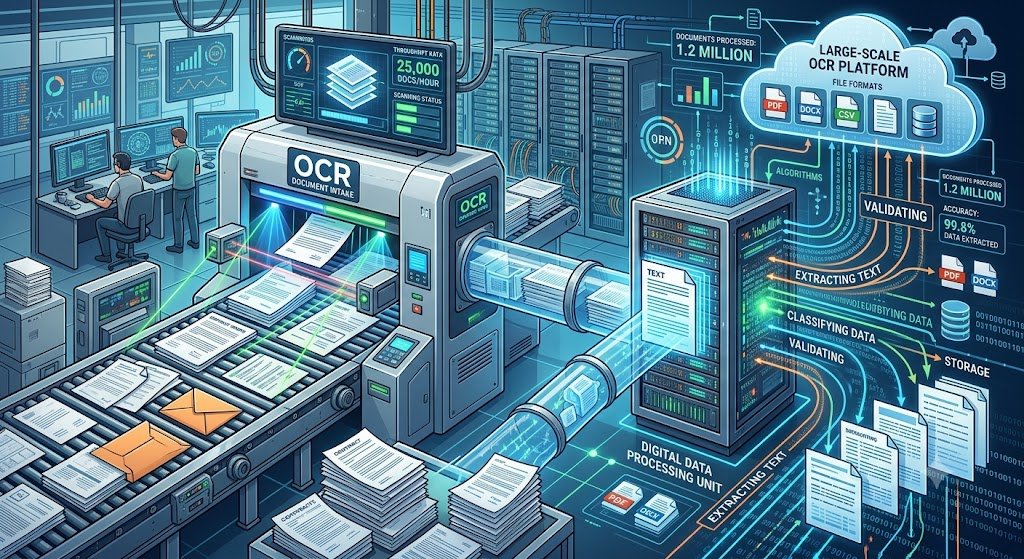
The Large-Scale Pipeline
text Document ingestion (multiple sources) ↓ Document classification (identify type) ↓ Queue management (prioritisation) ↓ Parallel OCR workers (horizontal scaling) ↓ Validation layer (automated checks) ↓ Exception handling (low confidence, failures) ↓ Human review queue (exceptions) ↓ Output distribution (systems, storage) ↓
Monitoring and analytics
Component 1: Document Ingestion
| Ingestion Source | Consideration |
|---|---|
| Email attachments | Parsing, deduplication |
| Scan folders | Batch monitoring |
| API uploads | Rate limiting |
| Mobile capture | Variable quality |
| Cloud storage | Event triggers |
Ingestion must handle high volume, deduplicate documents, and route to appropriate processing.
Component 2: Document Classification
| Classification | Purpose |
|---|---|
| Document type | Route to appropriate OCR config |
| Priority | Queue ordering |
| Quality assessment | Pre-emptive handling |
| Duplicate detection | Avoid reprocessing |
Component 3: Queue Management
| Queue Aspect | Implementation |
|---|---|
| Priority queues | High-priority documents first |
| Rate limiting | Respect API limits |
| Retry queues | Failed documents |
| Dead letter queues | Permanent failures |
Component 4: Parallel OCR Workers
| Scaling Approach | Characteristics |
|---|---|
| Horizontal scaling | Add workers as volume increases |
| Cloud functions | Auto-scaling, pay per use |
| Container orchestration | Consistent performance |
| Hybrid | Balance of cost and control |
Component 5: Validation Layer
| Validation Type | Purpose |
|---|---|
| Format validation | Field formats |
| Cross-field validation | Consistency |
| Business rules | Domain logic |
| Confidence thresholds | Route low-confidence |
Component 6: Exception Handling
| Exception Type | Handling |
|---|---|
| Low confidence | Human review queue |
| Validation failure | Human review queue |
| OCR failure | Retry, then review |
| Unusual format | Manual handling |
Component 7: Output Distribution
| Output Target | Purpose |
|---|---|
| Databases | Structured data storage |
| Document management | Searchable PDFs |
| ERP/CRM | Business systems |
| Data warehouse | Analytics |
Throughput Optimisation
What Determines Throughput
| Factor | Impact |
|---|---|
| OCR engine speed | Base processing rate |
| Parallelism | Multiple documents simultaneously |
| Document size | Pages per document |
| Image quality | Higher quality, slower |
| API rate limits | External constraint |
Throughput Benchmarks
| Configuration | Documents Per Hour |
|---|---|
| Single worker | 200–1,000 |
| 10 workers | 2,000–10,000 |
| 100 workers | 20,000–100,000 |
| 1,000 workers | 200,000–1,000,000 |
Optimisation Techniques
| Technique | Impact |
|---|---|
| Parallel processing | Linear scaling with workers |
| Batch API calls | Reduced overhead |
| Caching | Avoid reprocessing |
| Preprocessing optimisation | Faster image handling |
| Document prioritisation | Process important first |
Accuracy Management at Scale
The Scale Challenge
At small scale, you can manually review every document. At large scale, manual review of every document is impossible.
| Scale | Review Approach |
|---|---|
| Small | Review all |
| Medium | Review exceptions |
| Large | Statistical sampling |
| Very large | Automated validation + sampling |
Validation at Scale
| Validation Type | Coverage |
|---|---|
| Format validation | 100% of documents |
| Cross-field validation | 100% of documents |
| Database validation | Where applicable |
| Confidence thresholds | 100% of documents |
Exception Rate Management
| Exception Rate | Review Burden (1M documents/month) |
|---|---|
| 1% | 10,000 documents |
| 2% | 20,000 documents |
| 5% | 50,000 documents |
| 10% | 100,000 documents |
Every percentage point of exception rate adds significant review burden. Reducing exceptions is a key optimisation.
Quality Monitoring
| Monitoring Type | Purpose |
|---|---|
| Accuracy sampling | Verify ongoing accuracy |
| Error pattern analysis | Identify systematic issues |
| Confidence distribution | Track OCR certainty |
| Exception rate tracking | Monitor review burden |
Cost Management at Scale
Cost Components
| Component | Typical Share |
|---|---|
| OCR API/software | 30–50% |
| Infrastructure | 15–25% |
| Human review | 20–35% |
| Development and maintenance | 10–20% |
Cost Per Document at Scale
| Volume | Cost Per Document (INR) | Cost Per Document (USD) |
|---|---|---|
| 10,000/month | ₹5–₹20 | $0.06–$0.24 |
| 100,000/month | ₹3–₹12 | $0.036–$0.14 |
| 1,000,000/month | ₹2–₹8 | $0.024–$0.096 |
| 10,000,000/month | ₹1–₹5 | $0.012–$0.06 |
Costs decrease at scale due to volume discounts, infrastructure efficiency, and amortisation of development.
Cost Optimisation Strategies
| Strategy | Impact |
|---|---|
| Volume commitments | 20–40% reduction |
| On-premise for high volume | Lower per-document cost |
| Tiered processing | Simple documents faster/cheaper |
| Exception reduction | Lower review cost |
| Caching | Avoid reprocessing |
The Human Review Cost
| Review Volume | Monthly Cost (INR) | Monthly Cost (USD) |
|---|---|---|
| 1,000 documents | ₹30,000–₹80,000 | $360–$960 |
| 10,000 documents | ₹3,00,000–₹8,00,000 | $3,600–$9,600 |
| 50,000 documents | ₹15,00,000–₹40,00,000 | $18,000–$48,000 |
| 100,000 documents | ₹30,00,000–₹80,00,000 | $36,000–$96,000 |
Human review is often the largest cost component at scale. Reducing exceptions directly reduces cost.
Infrastructure Options
Cloud-Based Processing
| Approach | Characteristics |
|---|---|
| Cloud OCR APIs | Managed, pay per use |
| Cloud functions | Auto-scaling, serverless |
| Container orchestration | Consistent performance |
| Managed document AI | End-to-end platform |
On-Premise Processing
| Approach | Characteristics |
|---|---|
| Self-hosted OCR | Full control, high upfront |
| GPU infrastructure | For deep learning models |
| Hybrid | Cloud burst for peaks |
Build vs Buy at Scale
| Factor | Cloud APIs | On-Premise |
|---|---|---|
| Upfront cost | Low | High |
| Per-document cost | Higher | Lower |
| Scaling | Automatic | Manual |
| Maintenance | Vendor | You |
| Best for | Variable volume | High steady volume |
At very high volume (10M+ documents monthly), on-premise often becomes cheaper. At lower volume, cloud APIs are more cost-effective.
India-Specific Considerations
Common Large-Scale Use Cases
| Industry | Document Type | Volume |
|---|---|---|
| Banking | Cheques, statements | Millions monthly |
| Insurance | Claims, policies | Hundreds of thousands |
| Government | Records, applications | Millions |
| Healthcare | Patient records | Hundreds of thousands |
| Logistics | Shipping documents | Millions |
| Telecom | Applications, KYC | Millions |
Data Residency Requirements
| Requirement | Implication |
|---|---|
| DPDPA | Data protection obligations |
| RBI | Financial data localisation |
| IRDAI | Insurance data requirements |
| Government | Indian infrastructure |
Indian Language Processing
| Language | Scale Consideration |
|---|---|
| English | Well-supported at scale |
| Hindi | Good support |
| Regional languages | Variable support |
| Mixed scripts | Requires specialised handling |
Decision Framework: Large-Scale OCR Readiness
Readiness Scorecard
| Criteria | Weight | Score (1–5) | Weighted Score |
|---|---|---|---|
| Document volume | 25% | ||
| Document standardisation | 20% | ||
| Accuracy requirements | 20% | ||
| Infrastructure capability | 15% | ||
| Budget | 10% | ||
| Compliance requirements | 10% | ||
| Total | 100% | /5 |
Infrastructure Selection Matrix
| Your Volume | Recommended Infrastructure |
|---|---|
| Under 100,000/month | Cloud OCR APIs |
| 100,000–1,000,000/month | Cloud APIs with batch processing |
| 1,000,000–10,000,000/month | Hybrid or on-premise |
| Over 10,000,000/month | On-premise |
Implementation Roadmap
| Phase | What to Build | Timeline |
|---|---|---|
| Phase 1 | Basic pipeline, cloud OCR | 4–8 weeks |
| Phase 2 | Queue management, parallel processing | 4–6 weeks |
| Phase 3 | Validation, exception handling | 4–6 weeks |
| Phase 4 | Optimisation, monitoring | Ongoing |
Frequently Asked Questions
1. What is large-scale OCR document processing?
Large-scale OCR processes hundreds of thousands to millions of documents monthly. At this scale, pipeline architecture, throughput, accuracy management, and cost optimisation matter more than the OCR engine itself.
2. What architecture is needed for large-scale OCR?
A pipeline with document ingestion, classification, queue management, parallel OCR workers, validation, exception handling, human review, output distribution, and monitoring. Each component must handle high volume.
3. How fast can large-scale OCR process documents?
Throughput depends on worker count. Single worker: 200–1,000 documents/hour. 100 workers: 20,000–100,000 documents/hour. 1,000 workers: 200,000–1,000,000 documents/hour.
4. How much does large-scale OCR cost in India?
Cost per document decreases with volume. At 100,000 documents/month: ₹3–₹12 ($0.036–$0.14). At 1,000,000/month: ₹2–₹8 ($0.024–$0.096). At 10,000,000/month: ₹1–₹5 ($0.012–$0.06).
5. Should I use cloud OCR or on-premise for large scale?
Cloud APIs for under 1 million documents monthly. On-premise for over 10 million monthly. Hybrid for volumes in between. On-premise becomes cheaper at very high steady volume.
6. How do I manage accuracy at scale?
Implement automated validation (100% coverage), use confidence thresholds to route low-confidence documents, monitor accuracy through sampling, and analyse error patterns.
7. What is an acceptable exception rate at scale?
1–2% exception rate is typical for well-designed systems. Every percentage point adds significant review burden — at 1M documents/month, 1% is 10,000 documents to review.
8. How do I reduce human review costs at scale?
Reduce exception rate through better OCR models, comprehensive validation, and systematic error analysis. Human review is often the largest cost component at scale.
9. How does DPDPA affect large-scale OCR?
DPDPA requires data protection for personal data, audit trails, and potentially data residency. For sensitive documents, on-premise processing may be required.
10. Can large-scale OCR handle Indian languages?
English is well-supported at scale. Hindi support is good. Regional language support varies. Mixed-script documents require specialised handling.
11. How long does it take to implement large-scale OCR?
Basic pipeline: 4–8 weeks. Queue management and parallel processing: additional 4–6 weeks. Validation and exception handling: additional 4–6 weeks. Full system: 3–6 months.
12. How can Innovative AI Solutions help?
Innovative AI Solutions is a Delhi-based AI development company specialising in large-scale document processing. We build OCR pipelines with parallel processing, queue management, validation, and exception handling for millions of documents monthly — designed for Indian languages and DPDPA compliance. Learn more at https://innovativeais.com.
Contact Innovative AI Solutions
Ready to process documents at scale?
We help Indian organisations build large-scale OCR pipelines with throughput, accuracy, and cost management.
Contact Information
Innovative AI Solutions
📍 Netaji Subhash Place, Pitampura, Delhi – 110034
🌐 Website: https://innovativeais.com 📧 Email: info@innovativeais.com
📞 Phone: +91 7464 099 059 / +91 96899 67356
Business Services
• AI Automation • AI Development • AI Consulting • Machine Learning Solutions • Deep Learning Solutions • Generative AI Services • NLP Solutions • AI Agents • AI Chatbots • Voice AI • CRM Development • Custom Software Development • Website Development • Mobile App Development
About the Author
Abhishek Kumar
Founder & CEO, Innovative AI Solutions
5+ years building production AI systems for Indian businesses. Based in Delhi, serving clients across India.
Ready to build AI solutions for your business?
Innovative AI Solutions — Delhi's leading AI development company. Free consultation available.
Get Free Consultation →
A practical 2026 guide to large-scale OCR document processing — architecture, throughput, accuracy management, and costs for Indian organisations.
#OCR #LargeScale #DocumentProcessing #2026 #BatchProcessing #PipelineArchitecture #HighVolume #DocumentAutomation #EnterpriseOCR #Throughput #ParallelProcessing #QueueManagement #AccuracyManagement #CostOptimisation #India #DelhiNCRTech #EnterpriseApps #BusinessAutomation #TechIndia #DigitalProducts #DocumentAI #Scalability #Infrastructure #CloudOCR #InnovativeAISolutions
Copyright © 2015–2026 Innovative AI Solutions. All Rights Reserved. | Privacy Policy | Terms & Conditions