The Outsourcing Decision US Companies Face
American companies outsource software development for one reason: cost. A senior developer in the United States costs $150,000–$250,000 per year fully loaded. The same capability costs a fraction elsewhere.
But "elsewhere" is not one place. It is two distinct models with different trade-offs.
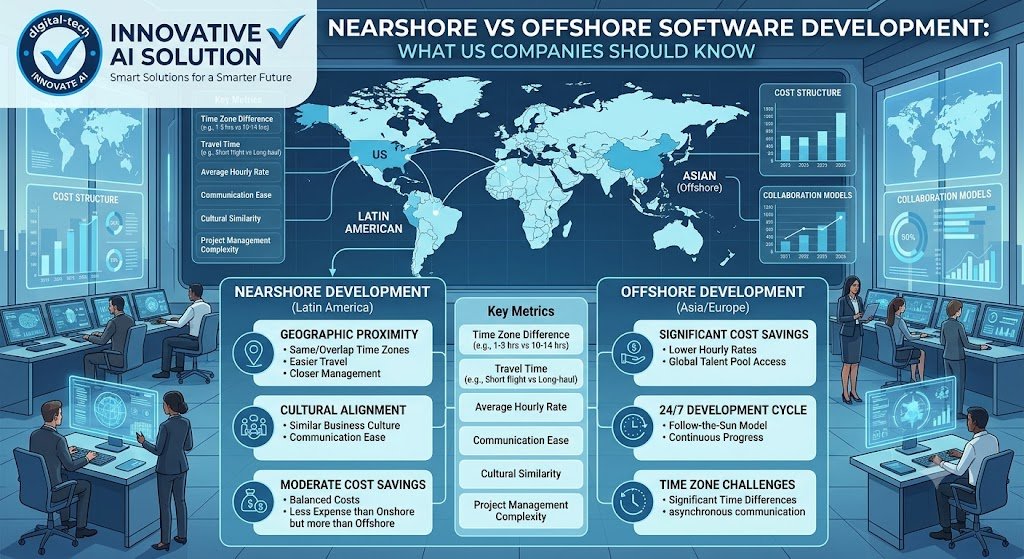
Nearshore means countries close to the US — primarily Latin America (Mexico, Colombia, Argentina, Brazil). Time zones align. Travel is easy. Cultural similarity is high. Costs are lower than the US but higher than offshore.
Offshore means countries farther away — primarily India, and also Eastern Europe and Southeast Asia. Costs are lowest. Talent depth is greatest. But time zones differ significantly, and cultural distance is larger.
US companies choosing between these models face a real trade-off. This guide compares nearshore and offshore software development in 2026. It covers cost, time zones, talent, quality, IP protection, and how to decide.
For US companies looking to build software cost-effectively, Innovative AI Solutions provides custom software development and AI development services.
What Nearshore and Offshore Mean
Nearshore
Development partners in countries geographically close to the US, primarily Latin America.
| Characteristic | Detail |
|---|---|
| Locations | Mexico, Colombia, Argentina, Brazil, Costa Rica |
| Time zones | Same or close to US |
| Travel | 2–6 hours flight |
| Language | Spanish/Portuguese, English proficiency varies |
| Cost | Lower than US, higher than offshore |
Offshore
Development partners in distant countries, primarily India.
| Characteristic | Detail |
|---|---|
| Locations | India, Eastern Europe, Southeast Asia |
| Time zones | 8.5–12 hours difference (India) |
| Travel | 14–20 hours flight |
| Language | English proficiency high (India) |
| Cost | Lowest |
The Core Trade-Off
| Factor | Nearshore | Offshore |
|---|---|---|
| Cost | Higher | Lower |
| Time zone | Aligned | Misaligned |
| Travel | Easy | Difficult |
| Talent depth | Moderate | Deep |
| Cultural fit | High | Moderate |
Cost Comparison
Hourly Rates (2026)
| Role | US | Nearshore (LATAM) | Offshore (India) |
|---|---|---|---|
| Junior developer | $60–$90 | $25–$40 | $12–$20 |
| Mid-level developer | $90–$150 | $35–$60 | $18–$32 |
| Senior developer | $120–$200 | $50–$85 | $28–$50 |
| Lead / Architect | $150–$250 | $70–$110 | $45–$70 |
| AI/ML specialist | $150–$300 | $80–$130 | $45–$95 |
Annual Fully Loaded Cost
| Role | US | Nearshore | Offshore |
|---|---|---|---|
| Mid-level developer | $130,000–$220,000 | $60,000–$100,000 | $30,000–$55,000 |
| Senior developer | $180,000–$280,000 | $85,000–$140,000 | $48,000–$85,000 |
| Lead / Architect | $220,000–$350,000 | $120,000–$180,000 | $75,000–$120,000 |
Team Cost Comparison (10 developers)
| Model | Annual Cost (USD) | Saving vs US |
|---|---|---|
| US in-house | $1,300,000–$2,200,000 | Baseline |
| Nearshore | $600,000–$1,000,000 | 50–55% |
| Offshore (India) | $300,000–$550,000 | 70–77% |
Offshore (India) delivers 70–77% savings versus US in-house. Nearshore delivers 50–55%.
The Savings Difference
| Team Size | Nearshore Cost | Offshore Cost | Annual Difference |
|---|---|---|---|
| 5 developers | $300,000–$500,000 | $150,000–$275,000 | $150,000–$225,000 |
| 10 developers | $600,000–$1,000,000 | $300,000–$550,000 | $300,000–$450,000 |
| 25 developers | $1,500,000–$2,500,000 | $750,000–$1,375,000 | $750,000–$1,125,000 |
For a 10-developer team, offshore saves $300,000–$450,000 more per year than nearshore.
Time Zone Comparison
Working Hours Overlap
| Model | Overlap with US EST | Effective Collaboration |
|---|---|---|
| Nearshore (Mexico) | 6–8 hours | Full day |
| Nearshore (Colombia) | 5–7 hours | Most of day |
| Nearshore (Argentina) | 3–5 hours | Half day |
| Offshore (India) | 0–3 hours | Limited |
What Time Zone Alignment Enables
| Capability | Nearshore | Offshore |
|---|---|---|
| Real-time collaboration | Yes | Limited |
| Same-day feedback | Yes | Next day |
| Urgent issue resolution | Yes | Delayed |
| Daily standups | Yes | Early/late |
| Pair programming | Yes | Difficult |
India Time Zone Reality
| IST Time | US EST Time | Overlap |
|---|---|---|
| 9:30 AM IST | 12:00 AM EST | 0 hours |
| 6:30 PM IST | 9:00 AM EST | 0 hours |
| 9:30 PM IST | 12:00 PM EST | 2.5 hours |
| 12:30 AM IST | 3:00 PM EST | 3.5 hours |
Indian teams can overlap with US East Coast from approximately 6:30 PM–10:30 PM IST (9:00 AM–1:00 PM EST) if they shift schedules. Many Indian teams do this for US clients.
Managing Time Zone Differences
| Strategy | Purpose |
|---|---|
| Shifted schedules | Indian teams work US hours |
| Overlap hours | Designated collaboration time |
| Async communication | Documentation, written updates |
| Clear handoffs | End-of-day summaries |
| Recorded meetings | For async viewing |
Talent and Quality
Talent Depth
| Factor | Nearshore | Offshore (India) |
|---|---|---|
| Total developers | Moderate | Very large |
| Senior talent | Limited | Deep |
| AI/ML specialists | Limited | Growing rapidly |
| Specialised skills | Limited | Broad |
| Scalability | Limited | High |
India has one of the world's largest software developer populations. Nearshore markets have smaller talent pools, which limits scalability and specialised skill availability.
Quality Comparison
| Factor | Nearshore | Offshore (India) |
|---|---|---|
| Technical quality | High | High (with vetting) |
| Process maturity | Moderate | High |
| English proficiency | Variable | High |
| Cultural fit | High | Moderate |
| Communication | Easy | Requires effort |
Quality depends more on the specific partner than the location. Both nearshore and offshore have excellent and poor providers.
English Proficiency
| Region | English Proficiency |
|---|---|
| India | High (business fluency common) |
| Mexico | Moderate |
| Colombia | Moderate |
| Argentina | Moderate-High |
| Brazil | Moderate |
India has a significant advantage in English proficiency, which matters for US companies.
IP Protection and Compliance
IP Protection
| Factor | Nearshore | Offshore (India) |
|---|---|---|
| Legal framework | Strong | Strong |
| Enforcement | Reliable | Reliable |
| Contract enforceability | High | High |
| Practical risk | Low | Low |
Both nearshore and offshore countries have legal frameworks for IP protection. The practical risk is low in both when working with reputable partners and proper contracts.
Data Protection
| Requirement | Nearshore | Offshore (India) |
|---|---|---|
| GDPR | Applicable if EU data | Applicable if EU data |
| US state laws | Applicable | Applicable |
| India DPDPA | Not applicable | Applicable |
| Data residency | Easier | Requires planning |
Contract Protections
| Clause | Purpose |
|---|---|
| IP assignment | All work product assigned to client |
| Confidentiality | Protect sensitive information |
| Data protection | Compliance obligations |
| Non-solicitation | Prevent poaching |
| Dispute resolution | Jurisdiction and process |
When to Choose Nearshore
Nearshore Makes Sense When
| Situation | Why Nearshore |
|---|---|
| Real-time collaboration critical | Time zone alignment |
| Frequent travel needed | Short flights |
| Cultural fit important | Similar work culture |
| Small team | Cost difference smaller |
| Agile with daily standups | Same-day feedback |
| Customer-facing work | Real-time interaction |
Nearshore Limitations
| Limitation | Impact |
|---|---|
| Higher cost | 50–55% savings vs 70–77% |
| Smaller talent pool | Harder to scale |
| Fewer specialists | Limited AI/ML depth |
| Limited scalability | Cannot scale rapidly |
When to Choose Offshore
Offshore Makes Sense When
| Situation | Why Offshore |
|---|---|
| Cost is primary driver | 70–77% savings |
| Large team needed | Deep talent pool |
| Specialised skills needed | AI/ML, specific tech |
| Long-term project | Scalability |
| Async work acceptable | Documentation-driven |
| Time zone manageable | Shifted schedules |
Offshore Limitations
| Limitation | Impact |
|---|---|
| Time zone misalignment | Delayed feedback |
| Travel difficulty | 14–20 hour flights |
| Cultural distance | Requires effort |
| Communication overhead | More documentation |
The Hybrid Model
Why Hybrid Often Works Best
Many US companies use both nearshore and offshore teams.
| Role | Location | Rationale |
|---|---|---|
| Product owner | US | Business context |
| Architect | US or nearshore | Real-time collaboration |
| Senior developers | Nearshore | Real-time collaboration |
| Mid-level developers | Offshore | Cost efficiency |
| QA | Offshore | Cost efficiency |
Hybrid Benefits
| Benefit | Explanation |
|---|---|
| Time zone coverage | Nearshore for real-time, offshore for depth |
| Cost optimisation | Offshore for volume work |
| Scalability | Offshore for rapid scaling |
| Quality | Nearshore for critical work |
Hybrid Cost
| Model | Blended Cost (10 developers) |
|---|---|
| All nearshore | $600,000–$1,000,000 |
| All offshore | $300,000–$550,000 |
| Hybrid (30% nearshore, 70% offshore) | $400,000–$700,000 |
Decision Framework
The Decision Tree
Question 1: Is real-time collaboration critical?
| Answer | Action |
|---|---|
| Yes | Nearshore |
| No | Continue |
Question 2: Is cost the primary driver?
| Answer | Action |
|---|---|
| Yes | Offshore |
| No | Continue |
Question 3: Do you need specialised skills (AI/ML)?
| Answer | Action |
|---|---|
| Yes | Offshore (India) |
| No | Continue |
Question 4: Do you need to scale rapidly?
| Answer | Action |
|---|---|
| Yes | Offshore |
| No | Nearshore or hybrid |
Decision Matrix
| Your Situation | Recommended Model |
|---|---|
| Small team, real-time needed | Nearshore |
| Large team, cost-driven | Offshore |
| AI/ML development | Offshore (India) |
| Customer-facing, agile | Nearshore |
| Long-term, scalable | Offshore |
| Mixed requirements | Hybrid |
| Startup, limited budget | Offshore |
| Enterprise, compliance-heavy | Hybrid |
Readiness Scorecard
| Criteria | Weight | Nearshore Score | Offshore Score |
|---|---|---|---|
| Cost sensitivity | 25% | ||
| Time zone importance | 20% | ||
| Talent requirements | 20% | ||
| Scalability needs | 15% | ||
| Travel requirements | 10% | ||
| Cultural fit | 10% | ||
| Total | 100% |
India-Specific Considerations
Why India for US Companies
| Factor | Advantage |
|---|---|
| Cost | 70–77% below US |
| Talent depth | Largest developer pool |
| English | High proficiency |
| AI/ML | Growing expertise |
| Process maturity | Strong |
| Scalability | High |
Time Zone Management for US Clients
| Practice | Purpose |
|---|---|
| Shifted schedules | Indian teams work US hours |
| Overlap hours | 6:30 PM–10:30 PM IST |
| Async documentation | Compensate for time zone |
| Recorded meetings | For async viewing |
US-India Collaboration Best Practices
| Practice | Purpose |
|---|---|
| Clear requirements | Reduce rework |
| Documentation culture | Async communication |
| Regular syncs | Alignment |
| Cultural awareness | Effective collaboration |
| Quality standards | Shared expectations |
Common US-India Engagement Models
| Model | Best For |
|---|---|
| Staff augmentation | Extending existing team |
| Dedicated team | Long-term projects |
| Fixed-price project | Well-defined scope |
| Build-operate-transfer | Building offshore capability |
Frequently Asked Questions
1. What is the difference between nearshore and offshore software development?
Nearshore means countries close to the US (Latin America) with time zone alignment. Offshore means distant countries (India) with lower costs and deeper talent.
2. Which is cheaper: nearshore or offshore?
Offshore is cheaper. India delivers 70–77% savings vs US in-house. Nearshore delivers 50–55% savings.
3. Which has better quality: nearshore or offshore?
Quality depends on the specific partner, not the location. Both have excellent and poor providers. India has deeper talent and higher English proficiency.
4. How do time zones affect nearshore vs offshore?
Nearshore (Mexico, Colombia) aligns with US time zones, enabling real-time collaboration. India has 8.5–12 hour difference, requiring shifted schedules or async work.
5. What is the hybrid model?
Using both nearshore and offshore teams. Nearshore for real-time collaboration and critical work. Offshore for cost efficiency and scalability.
6. Is IP protected in offshore development?
Yes, with proper contracts. Both India and Latin American countries have strong legal frameworks for IP protection. Practical risk is low with reputable partners.
7. Should US companies choose India or Latin America?
Choose India for cost, talent depth, AI/ML, and scalability. Choose Latin America for time zone alignment and real-time collaboration. Many companies use both.
8. How much can US companies save with offshore development?
70–77% savings vs US in-house for India. 50–55% for nearshore. For a 10-developer team, offshore saves $300,000–$450,000 more per year than nearshore.
9. What is the time zone overlap with India?
India overlaps with US East Coast from approximately 6:30 PM–10:30 PM IST (9:00 AM–1:00 PM EST). Many Indian teams shift schedules for US clients.
10. How do I manage an offshore team across time zones?
Shifted schedules, designated overlap hours, async documentation, recorded meetings, and clear handoffs.
11. Which model is better for startups?
Offshore (India) for cost efficiency and scalability. Startups have limited budgets and need to maximise runway.
12. How can Innovative AI Solutions help?
Innovative AI Solutions is a Delhi-based software development company that works with US companies. We provide dedicated teams, maintain quality standards, and manage time zone collaboration effectively. Explore our custom software development and AI development services.
Contact Innovative AI Solutions
Ready to build software with an offshore team?
We help US companies build software cost-effectively with dedicated teams in India, quality safeguards, and effective time zone collaboration.
Contact Information
Innovative AI Solutions
📍 Netaji Subhash Place, Pitampura, Delhi – 110034
🌐 Website: https://innovativeais.com 📧 Email: info@innovativeais.com
📞 Phone: +91 7464 099 059 / +91 96899 67356
Business Services
• AI Automation • AI Development • AI Consulting • Machine Learning Solutions • Deep Learning Solutions • Generative AI Services • NLP Solutions • AI Agents • AI Chatbots • Voice AI • CRM Development • Custom Software Development • Website Development • Mobile App Development
About the Author
Abhishek Kumar
Founder & CEO, Innovative AI Solutions
5+ years building production AI systems for Indian businesses and international clients. Based in Delhi, serving clients across India and the US.
Ready to build AI solutions for your business?
Innovative AI Solutions — Delhi's leading AI development company. Free consultation available.
Get Free Consultation →
A practical 2026 guide for US companies comparing nearshore vs offshore software development — cost, time zones, quality, IP protection, and India vs Latin America.
#Nearshore #Offshore #SoftwareDevelopment #USCompanies #2026 #Comparison #Outsourcing #India #LatinAmerica #Cost #TimeZones #Quality #IPProtection #GDPR #Compliance #Rates #Strategy #DecisionFramework #EnterpriseApps #StartupApps #TechIndia #DigitalProducts #SoftwareEngineering #BusinessSoftware #Offshoring #ITOutsourcing #InnovativeAISolutions
Copyright © 2015–2026 Innovative AI Solutions. All Rights Reserved. | Privacy Policy | Terms & Conditions