


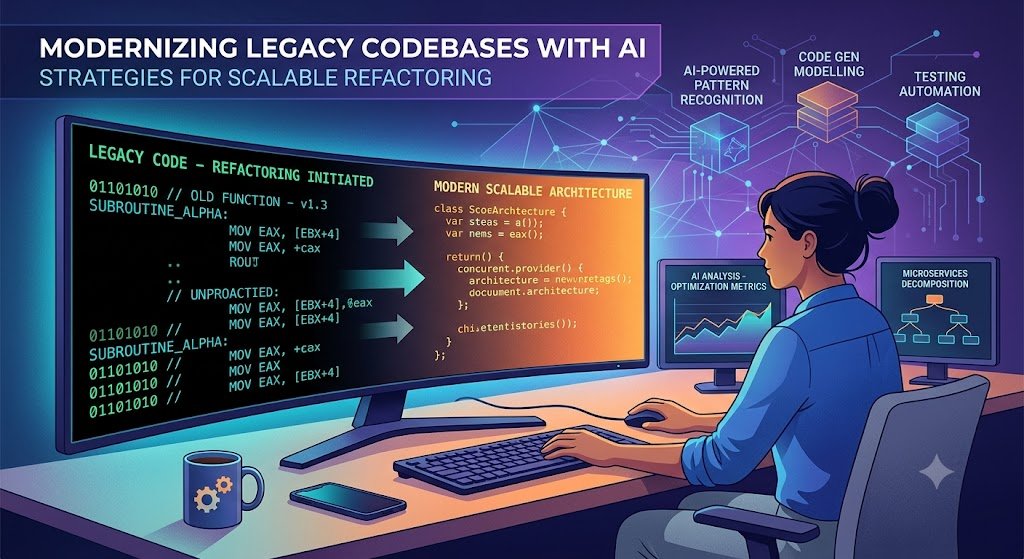
The Legacy Code Problem Every Indian Enterprise Has
Every established Indian business has legacy code. A core banking system written in COBOL. An ERP customised over fifteen years. A customer portal built on a framework that stopped being maintained in 2015. Internal tools written by developers who left the company years ago.
This code runs the business. It processes transactions, manages customers, and supports operations. It cannot simply be replaced. But it also cannot be maintained efficiently. Documentation is missing or outdated. Original authors are gone. Dependencies are obsolete and vulnerable. Changes are risky because nobody fully understands what the system does.
The cost is measurable. Engineering teams spend disproportionate time understanding legacy code before making changes. New features take longer to build because they must integrate with systems nobody fully understands. Security vulnerabilities accumulate because dependencies are not updated. And the risk of breaking something critical makes teams avoid changes they should make.
AI is changing how modernisation happens. Not by automating the entire process — legacy modernisation remains difficult — but by making legacy code understandable, refactoring tractable, and migration measurable.
This guide covers modernising legacy codebases with AI in 2026. It addresses code understanding, refactoring strategies, migration patterns, costs in India, and risk management.
Why Legacy Modernisation Is Hard
The Seven Challenges
| Challenge | Why It Matters |
|---|---|
| Missing documentation | Nobody knows what the system does |
| Lost knowledge | Original developers are gone |
| Tight coupling | Everything depends on everything |
| Obsolete dependencies | Security vulnerabilities accumulate |
| No tests | Changes are risky |
| Business criticality | Downtime has serious consequences |
| Incremental changes | The system evolved unpredictably |
The Cost of Doing Nothing
| Cost Category | Impact |
|---|---|
| Development velocity | Slower feature delivery |
| Security risk | Unpatched vulnerabilities |
| Talent retention | Engineers avoid legacy work |
| Integration difficulty | Hard to connect to modern systems |
| Operational cost | Expensive to maintain and run |
| Opportunity cost | Cannot pursue new capabilities |
How AI Changes Legacy Modernisation
What AI Does Well
| AI Capability | Application |
|---|---|
| Code understanding | Explain what legacy code does |
| Dependency analysis | Map dependencies and coupling |
| Documentation generation | Create documentation from code |
| Test generation | Generate tests for existing code |
| Refactoring suggestions | Identify improvement opportunities |
| Code translation | Translate between languages/frameworks |
| Pattern detection | Identify anti-patterns |
| Impact analysis | Predict effects of changes |
What AI Does Not Do
| Limitation | Why Human Judgment Is Required |
|---|---|
| Business logic validation | AI does not know what the code should do |
| Architectural decisions | Requires strategic judgment |
| Risk assessment | Requires business context |
| Prioritisation | Requires understanding of business value |
| Edge case handling | Requires domain knowledge |
The AI Advantage
AI makes the invisible visible. Legacy code that was opaque becomes analysable. Dependencies that were unknown become mapped. Behaviour that was guessed becomes documented. This does not eliminate modernisation risk, but it makes the risk visible and the work tractable.
Strategy 1: AI-Assisted Code Understanding
The Foundation
Before modernising anything, you must understand what exists. AI accelerates this understanding dramatically.
Code Understanding Activities
| Activity | AI Application |
|---|---|
| System overview | Generate high-level architecture description |
| Module analysis | Explain what each module does |
| Data flow analysis | Map how data moves through the system |
| Dependency mapping | Identify what depends on what |
| Business logic extraction | Document business rules encoded in code |
| Documentation generation | Create missing documentation |
Code Understanding Workflow
text Legacy codebase ↓ AI analysis: structure, dependencies, patterns ↓ Generated documentation: modules, functions, data flows ↓ Human review: validate AI understanding ↓ Knowledge base: documented system understanding
What This Enables
| Before | After |
|---|---|
| Guessing what code does | Documented understanding |
| Unknown dependencies | Mapped dependencies |
| Lost business logic | Extracted business rules |
| Tribal knowledge | Shared documentation |
Strategy 2: AI-Generated Test Coverage
Why Tests Come First
You cannot safely refactor code without tests. Tests are the safety net that catches regressions. Most legacy codebases have inadequate test coverage.
AI Test Generation
| Approach | What It Does |
|---|---|
| Characterisation tests | Capture current behaviour as tests |
| Unit test generation | Generate tests for functions |
| Integration test generation | Generate tests for workflows |
| Edge case generation | Identify and test edge cases |
The Characterisation Test Approach
Characterisation tests capture what the code currently does — not what it should do. This is essential for legacy code because behaviour may include bugs that other systems depend on.
text Legacy function ↓ AI analyses function behaviour ↓ Generates tests that capture current behaviour ↓ Human reviews tests for correctness ↓ Tests become safety net for refactoring
Test Generation Caveats
| Caveat | Why It Matters |
|---|---|
| AI may capture bugs as expected behaviour | Human review required |
| Edge cases may be missed | Supplement with manual analysis |
| Tests may be brittle | Review for maintainability |
| Coverage may be uneven | Prioritise critical paths |
Strategy 3: Incremental Refactoring
Why Incremental Beats Big Bang
Big-bang rewrites fail. The rewritten system takes longer than expected, the old system continues to evolve, and the new system does not match requirements by the time it launches.
Incremental modernisation changes the system in small, safe steps.
| Approach | Risk | Success Rate |
|---|---|---|
| Big-bang rewrite | Very high | Low |
| Incremental refactoring | Low | High |
| Strangler fig | Low | High |
| Parallel run | Moderate | High |
The Strangler Fig Pattern
The strangler fig pattern incrementally replaces legacy functionality with new implementation, routing traffic gradually until the legacy system can be retired.
text
Phase 1: New system handles 10% of traffic
↓
Phase 2: New system handles 50% of traffic
↓
Phase 3: New system handles 90% of traffic
↓
Phase 4: Legacy system retired
AI's Role in Incremental Refactoring
| Activity | AI Application |
|---|---|
| Identify candidates | Find modules safe to refactor |
| Generate refactored code | Produce modern implementations |
| Translate patterns | Convert old patterns to modern equivalents |
| Verify behaviour | Compare old and new behaviour |
| Update tests | Adapt tests to refactored code |
Strategy 4: AI-Assisted Migration
Migration Types
| Migration Type | Description |
|---|---|
| Language migration | COBOL to Java, PHP to Python |
| Framework migration | AngularJS to React, old framework to new |
| Architecture migration | Monolith to services |
| Platform migration | On-premise to cloud |
| Database migration | Legacy DB to modern DB |
AI Migration Capabilities
| Capability | Application |
|---|---|
| Code translation | Convert code between languages |
| Pattern mapping | Map old patterns to modern equivalents |
| Framework adaptation | Convert framework-specific code |
| API modernisation | Update API patterns |
| Schema migration | Convert database schemas |
Migration Validation
AI-generated migration code must be validated.
| Validation Type | Method |
|---|---|
| Behavioural equivalence | Compare old and new outputs |
| Test coverage | Run existing tests |
| Performance comparison | Benchmark old vs new |
| Security review | Validate security properties |
| Human review | Expert validation of critical paths |
Strategy 5: Dependency Modernisation
The Dependency Problem
Legacy systems accumulate obsolete dependencies. Each is a potential security vulnerability and a maintenance burden.
| Dependency Issue | Risk |
|---|---|
| Unmaintained packages | No security updates |
| Known vulnerabilities | Exploitable weaknesses |
| Version conflicts | Cannot upgrade safely |
| Abandoned libraries | No support or fixes |
AI-Assisted Dependency Modernisation
| Activity | AI Application |
|---|---|
| Dependency audit | Identify all dependencies and versions |
| Vulnerability mapping | Match dependencies to known CVEs |
| Upgrade path analysis | Determine safe upgrade sequences |
| Breaking change detection | Identify what breaks on upgrade |
| Alternative suggestions | Recommend maintained alternatives |
Risk Management for Legacy Modernisation
The Risk Framework
| Risk | Mitigation |
|---|---|
| Breaking critical functionality | Comprehensive testing, gradual rollout |
| Data corruption | Backups, validation, rollback plans |
| Performance regression | Benchmarking, monitoring |
| Security gaps | Security review, penetration testing |
| Scope creep | Clear scope, phased approach |
| Team burnout | Realistic timelines, mix of work |
The Non-Negotiables
Comprehensive tests before refactoring — No safe refactoring without tests
Gradual rollout — Never big-bang cutover
Rollback capability — Always have a way back
Monitoring — Know immediately when something breaks
Human review — AI output must be validated
When to Stop
Some legacy systems should not be modernised. The cost may exceed the benefit.
| Situation | Recommendation |
|---|---|
| System to be retired soon | Maintain, do not modernise |
| Low business value | Leave alone |
| Stable and working | Do not fix what is not broken |
| High risk, low reward | Evaluate carefully |
What Legacy Modernisation Costs in India
Implementation Cost by Scope
| Scope | Cost Range (INR) | Cost Range (USD) | Timeline |
|---|---|---|---|
| Code understanding and documentation | ₹2,00,000–₹6,00,000 | $2,400–$7,200 | 4–8 weeks |
| Test coverage generation | ₹3,00,000–₹10,00,000 | $3,600–$12,000 | 6–12 weeks |
| Incremental refactoring (one module) | ₹4,00,000–₹12,00,000 | $4,800–$14,400 | 8–16 weeks |
| Language/framework migration | ₹8,00,000–₹25,00,000 | $9,600–$30,000 | 12–24 weeks |
| Full modernisation programme | ₹20,00,000–₹75,00,000+ | $24,000–$90,000+ | 6–18 months |
Cost by Activity
| Activity | Cost Range (INR) | Cost Range (USD) |
|---|---|---|
| AI code analysis and documentation | ₹1,50,000–₹5,00,000 | $1,800–$6,000 |
| Test generation and validation | ₹2,00,000–₹8,00,000 | $2,400–$9,600 |
| Refactoring and migration | ₹3,00,000–₹15,00,000 | $3,600–$18,000 |
| Validation and testing | ₹1,50,000–₹6,00,000 | $1,800–$7,200 |
Ongoing Costs
| Cost Category | Monthly Range (INR) | Monthly Range (USD) |
|---|---|---|
| AI tooling | ₹10,000–₹50,000 | $120–$600 |
| Engineering time | ₹3,00,000–₹15,00,000 | $3,600–$18,000 |
| Infrastructure (parallel systems) | ₹20,000–₹1,00,000 | $240–$1,200 |
| Monitoring and validation | ₹10,000–₹40,000 | $120–$480 |
The Business Case
| Benefit | Typical Impact |
|---|---|
| Development velocity | 20–50% faster feature delivery |
| Security posture | Eliminated vulnerabilities |
| Operational cost | 20–40% reduction |
| Talent retention | Improved engineer satisfaction |
| Integration capability | Modern systems connect easily |
Decision Framework: Modernisation Readiness
Readiness Scorecard
| Criteria | Weight | Score (1–5) | Weighted Score |
|---|---|---|---|
| Business criticality understood | 20% | ||
| Code understanding available | 20% | ||
| Test coverage (existing or generatable) | 20% | ||
| Team capability | 15% | ||
| Budget for phased approach | 15% | ||
| Risk tolerance | 10% | ||
| Total | 100% | /5 |
Modernisation Priority Matrix
| System Type | Priority | Approach |
|---|---|---|
| Business-critical, high change rate | High | Incremental refactoring |
| Business-critical, low change rate | Moderate | Maintain, modernise selectively |
| Non-critical, high change rate | Moderate | Refactor as needed |
| Non-critical, low change rate | Low | Leave alone |
| To be retired | None | Maintain only |
Phased Implementation Plan
| Phase | What to Do | Timeline | Cost (INR) |
|---|---|---|---|
| Phase 1 | Code understanding, documentation | 4–8 weeks | ₹2,00,000–₹6,00,000 |
| Phase 2 | Test coverage generation | 6–12 weeks | ₹3,00,000–₹10,00,000 |
| Phase 3 | Incremental refactoring | 8–16 weeks | ₹4,00,000–₹12,00,000 |
| Phase 4 | Migration and validation | 12–24 weeks | ₹8,00,000–₹25,00,000 |
Frequently Asked Questions
1. Can AI fully automate legacy code modernisation?
No. AI accelerates understanding, test generation, and refactoring, but human judgment is required for business logic validation, architectural decisions, risk assessment, and prioritisation. AI makes modernisation tractable, not automatic.
2. What is the first step in modernising legacy code?
Code understanding. Before changing anything, you must understand what exists. AI can generate documentation, map dependencies, and explain behaviour, creating the foundation for modernisation.
3. Why do tests need to come before refactoring?
Tests are the safety net that catches regressions. Without tests, you cannot know whether refactoring broke something. AI can generate characterisation tests that capture current behaviour, including bugs other systems may depend on.
4. What is the strangler fig pattern?
An incremental modernisation approach where new implementation gradually replaces legacy functionality. Traffic is routed progressively until the legacy system can be retired. It is low-risk compared to big-bang rewrites.
5. How much does legacy modernisation cost in India?
Code understanding costs ₹2,00,000–₹6,00,000 ($2,400–$7,200). Test generation costs ₹3,00,000–₹10,00,000 ($3,600–$12,000). Incremental refactoring costs ₹4,00,000–₹12,00,000 ($4,800–$14,400). Full programmes cost ₹20,00,000–₹75,00,000+ ($24,000–$90,000+).
6. When should I not modernise legacy code?
When the system will be retired soon, has low business value, is stable and working, or has high risk and low reward. Not everything needs modernising. Maintain what works.
7. Can AI translate legacy code to modern languages?
Yes, with limitations. AI can translate between languages and frameworks, but output must be validated for behavioural equivalence, performance, and security. Human review of critical paths is essential.
8. How does AI help with dependency modernisation?
AI audits dependencies, maps them to known vulnerabilities, analyses upgrade paths, detects breaking changes, and suggests maintained alternatives. This makes dependency modernisation systematic rather than ad hoc.
9. What are the biggest risks in legacy modernisation?
Breaking critical functionality, data corruption, performance regression, and security gaps. Mitigate with comprehensive testing, gradual rollout, rollback capability, monitoring, and human review.
10. How long does legacy modernisation take?
Code understanding takes 4–8 weeks. Test generation takes 6–12 weeks. Incremental refactoring takes 8–16 weeks per major module. Full programmes take 6–18 months. Incremental approaches take longer overall but with lower risk.
11. Should I rewrite or refactor legacy code?
Refactor incrementally. Big-bang rewrites fail because the rewritten system takes longer than expected, the old system continues to evolve, and the new system does not match requirements at launch. Incremental refactoring changes the system in small, safe steps.
12. How can Innovative AI Solutions help?
Innovative AI Solutions is a Delhi-based AI development company specialising in legacy modernisation. We use AI for code understanding, test generation, refactoring, and migration — combined with human expertise for validation and risk management. Our approach prioritises incremental, low-risk modernisation over big-bang rewrites. Learn more at https://innovativeais.com.
Contact Innovative AI Solutions
Ready to modernise your legacy codebase?
We help Indian businesses understand, refactor, and migrate legacy systems using AI-assisted approaches with proper risk management.
Contact Information
Innovative AI Solutions
📍 Netaji Subhash Place, Pitampura, Delhi – 110034
🌐 Website: https://innovativeais.com 📧 Email: info@innovativeais.com
📞 Phone: +91 7464 099 059 / +91 96899 67356
Business Services
• AI Automation • AI Development • AI Consulting • Machine Learning Solutions • Deep Learning Solutions • Generative AI Services • NLP Solutions • AI Agents • AI Chatbots • Voice AI • CRM Development • Custom Software Development • Website Development • Mobile App Development
About the Author
Abhishek Kumar
Founder & CEO, Innovative AI Solutions
5+ years building production AI systems for Indian businesses. Based in Delhi, serving clients across India.
Ready to build AI solutions for your business?
Innovative AI Solutions — Delhi's leading AI development company. Free consultation available.
Get Free Consultation →
A practical 2026 guide to modernising legacy codebases with AI — code understanding, test generation, incremental refactoring, migration, and risk management for Indian teams.
#LegacyCode #Modernization #AIRefactoring #2026 #TechnicalDebt #CodeMigration #StranglerFig #MonolithToMicroservices #AICodeAnalysis #LegacySystems #RefactoringStrategies #ModernizationCost #India #DelhiNCRTech #StartupEngineering #EnterpriseEngineering #CodeUnderstanding #IncrementalModernization #RiskManagement #TechIndia #DigitalProducts #SoftwareArchitecture #EngineeringProductivity #LegacyMigration #InnovativeAISolutions
Copyright ©️ 2015–2026 Innovative AI Solutions. All Rights Reserved. | Privacy Policy | Terms & Conditions