


The Architecture Question That Refuses to Die
Every few years, the software industry declares a winner in the microservices versus monolith debate. Microservices were going to replace monoliths. Then monoliths were going to replace microservices. Neither happened, because the debate was always framed incorrectly.
The real question is not which architecture is better. It is where complexity should live, and who should pay for it.
Microservices distribute complexity across infrastructure and operations. Monoliths concentrate complexity within a well-structured codebase. Both can work. Both can fail.
This guide provides an honest comparison of microservices and monolithic architecture in 2026. It covers the trade-offs, costs in India, team size considerations, and a decision framework for making the right choice.
For organisations designing software architecture, Innovative AI Solutions provides custom software development and AI development services.
What Each Architecture Actually Is
Monolithic Architecture
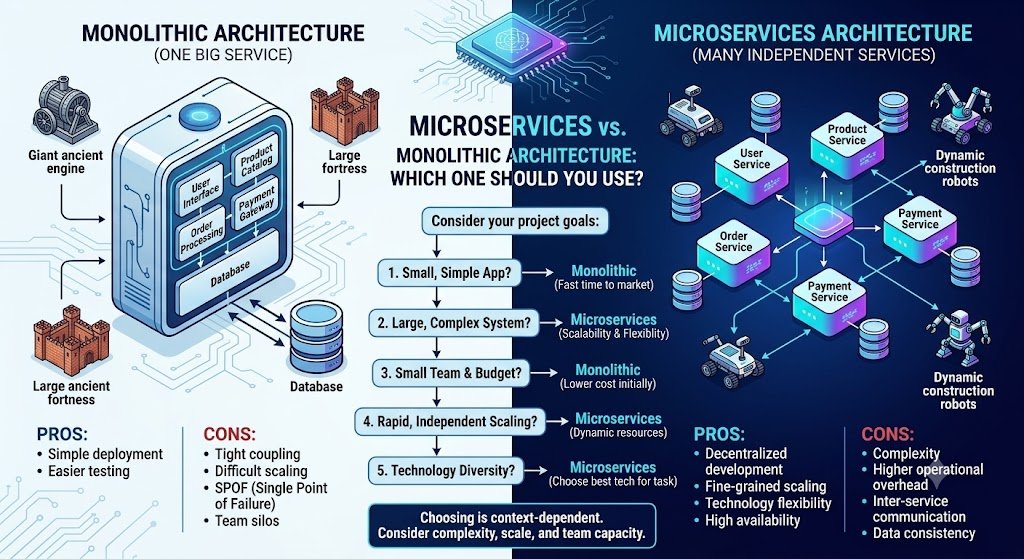
A single deployable unit containing all application functionality.
text
Single Application
├── User module ├── Order module ├── Payment module ├── Notification module └── Shared database
| Characteristic | Detail |
|---|---|
| Deployment | Single unit |
| Communication | In-process calls |
| Data | Typically shared database |
| Scaling | Scale entire application |
| Complexity | In the codebase |
Microservices Architecture
Independently deployable services that communicate over a network.
text
User Service ←→ Order Service ←→ Payment Service
↓ ↓ ↓
User DB Order DB Payment DB
| Characteristic | Detail |
|---|---|
| Deployment | Independent services |
| Communication | Network calls |
| Data | Database per service |
| Scaling | Scale individual services |
| Complexity | In the infrastructure |
The Modular Monolith
A middle ground — a single deployable unit with clearly defined internal modules.
text
Single Application
├── User module (own data, public interface) ├── Order module (own data, public interface) ├── Payment module (own data, public interface) └── Notification module (own data, public interface)
| Characteristic | Detail |
|---|---|
| Deployment | Single unit |
| Communication | In-process through interfaces |
| Data | Separate schemas per module |
| Scaling | Scale entire application |
| Complexity | Disciplined codebase |
Head-to-Head Comparison
Development Complexity
| Aspect | Monolith | Microservices |
|---|---|---|
| Initial development | Simpler | More complex |
| Local development | Easy | Difficult |
| Debugging | Stack trace | Distributed trace |
| Testing | Local tests | Contract tests |
| Onboarding | Learn one codebase | Learn many services |
Operational Complexity
| Aspect | Monolith | Microservices |
|---|---|---|
| Deployment | One pipeline | Many pipelines |
| Infrastructure | Simpler | Complex |
| Monitoring | One application | Many services |
| Service discovery | Not needed | Required |
| Load balancing | Simple | Complex |
Scaling
| Aspect | Monolith | Microservices |
|---|---|---|
| Scaling model | Scale entire app | Scale services individually |
| Efficiency | May over-provision | Right-size per service |
| Complexity | Simple | Complex |
| Best for | Uniform load | Variable load per component |
Data Management
| Aspect | Monolith | Microservices |
|---|---|---|
| Transactions | Local, simple | Distributed, complex |
| Consistency | Strong | Eventual |
| Queries | Joins across tables | Cannot join across services |
| Reporting | Simple | Requires data aggregation |
Reliability
| Aspect | Monolith | Microservices |
|---|---|---|
| Failure mode | All or nothing | Partial |
| Blast radius | Entire application | Individual service |
| Cascading failures | Not applicable | Possible |
| Recovery | Restart application | Restart service |
The Honest Trade-Offs
What Monoliths Do Well
| Strength | Why It Matters |
|---|---|
| Simple development | Faster initial velocity |
| Easy debugging | Single stack trace |
| Simple deployment | One pipeline |
| Local transactions | Data consistency |
| Lower operational cost | Less infrastructure |
| Easier onboarding | One codebase |
What Monoliths Do Poorly
| Limitation | Impact |
|---|---|
| Team coordination | Multiple teams block each other |
| Deployment coupling | One change deploys everything |
| Scaling granularity | Cannot scale parts independently |
| Technology diversity | One stack for everything |
| Blast radius | One bug affects everything |
What Microservices Do Well
| Strength | Why It Matters |
|---|---|
| Team autonomy | Independent deployment |
| Independent scaling | Scale what needs scaling |
| Fault isolation | Failures contained |
| Technology flexibility | Different stacks per service |
| Smaller codebases | Easier to understand |
What Microservices Do Poorly
| Limitation | Impact |
|---|---|
| Operational overhead | More infrastructure |
| Distributed complexity | Network, transactions, debugging |
| Data consistency | Eventual consistency |
| Development friction | Harder local development |
| Cost | Higher infrastructure and ops |
When Each Architecture Makes Sense
When Monoliths Win
| Situation | Why Monolith |
|---|---|
| Small team (1–5 developers) | Coordination not a problem |
| Early-stage product | Requirements changing |
| Simple domain | No need for service boundaries |
| Limited ops capability | No platform team |
| Cost sensitivity | Lower infrastructure cost |
| Fast iteration needed | Single deployment |
When Microservices Win
| Situation | Why Microservices |
|---|---|
| Multiple teams (5+) | Independent deployment needed |
| Large, complex domain | Clear service boundaries |
| Independent scaling needs | Components scale differently |
| Technology diversity | Different stacks needed |
| Fault isolation critical | Failures must not cascade |
| Mature ops capability | Platform team exists |
The Decision Tree
Question 1: How many teams work on this system?
| Answer | Action |
|---|---|
| 1–3 teams | Monolith |
| 4–6 teams | Consider modular monolith |
| 7+ teams | Consider microservices |
Question 2: Are teams blocked by each other's deployments?
| Answer | Action |
|---|---|
| No | Monolith |
| Yes | Continue |
Question 3: Do you have platform engineering capability?
| Answer | Action |
|---|---|
| No | Build capability first |
| Yes | Continue |
Question 4: Do components have genuinely different scaling needs?
| Answer | Action |
|---|---|
| No | Modular monolith |
| Yes | Selective microservices |
Decision Matrix
| Your Situation | Recommended Architecture |
|---|---|
| Startup, small team | Monolith |
| Growth stage, 3–5 teams | Modular monolith |
| Scale-up, 5–10 teams | Modular monolith + selective services |
| Large, 10+ teams, platform team | Microservices |
| Variable scaling needs | Selective microservices |
| Regulated industry | Modular monolith or hybrid |
What Each Architecture Costs in India
Development Cost
| Factor | Monolith | Microservices |
|---|---|---|
| Initial development | Lower | 30–50% higher |
| Infrastructure setup | Simple | Complex |
| CI/CD setup | Simple | Complex |
| Monitoring setup | Simple | Complex |
Operational Cost
| Factor | Monolith | Microservices |
|---|---|---|
| Infrastructure | Lower | 2–3x higher |
| Operational staff | Fewer | More |
| Monitoring tools | Simpler | Complex |
| Total cost | Lower | Higher |
Cost Comparison
| Scale | Monolith (Monthly INR) | Microservices (Monthly INR) |
|---|---|---|
| Small | ₹20,000–₹50,000 | ₹50,000–₹1,50,000 |
| Medium | ₹50,000–₹1,50,000 | ₹1,50,000–₹4,00,000 |
| Large | ₹1,50,000–₹5,00,000 | ₹4,00,000–₹12,00,000 |
Microservices cost 2–3x more to operate at equivalent scale.
When Microservices Become Cost-Effective
| Factor | Consideration |
|---|---|
| Scale | At very high scale, granular scaling saves money |
| Team size | Larger teams benefit more from autonomy |
| Domain complexity | Complex domains benefit from boundaries |
| Ops maturity | Mature ops reduces overhead |
Common Mistakes
Mistake 1: Premature Microservices
Adopting microservices before you have the organisational problem they solve. This creates complexity without benefit.
Mistake 2: Distributed Monolith
Adopting microservices without proper boundaries. Services share databases, deployments are coordinated, and changes span multiple services. This is worse than a monolith.
Mistake 3: Ignoring Operational Cost
Underestimating the infrastructure and operational cost of microservices. The overhead is real and significant.
Mistake 4: Skipping the Modular Monolith
Jumping from monolith to microservices without first building a modular monolith. The modular monolith provides a migration path.
Mistake 5: Copying Big Tech
Adopting microservices because Google or Netflix do. Their scale and organisational structure are different from yours.
India-Specific Considerations
Indian Team Context
| Factor | Implication |
|---|---|
| Team sizes | Often smaller than Western counterparts |
| Ops capability | Varies widely |
| Cost sensitivity | High |
| Talent availability | Strong in major cities |
Common Indian Scenarios
| Scenario | Recommendation |
|---|---|
| Early-stage startup | Monolith |
| Growing startup | Modular monolith |
| Scale-up | Modular monolith + selective services |
| Enterprise | Microservices (with platform team) |
Compliance
| Requirement | Implication |
|---|---|
| DPDPA | Data protection across services |
| Audit trails | Distributed logging |
| Data residency | Service deployment locations |
Decision Framework: Architecture Readiness
Readiness Scorecard
| Criteria | Weight | Score (1–5) | Weighted Score |
|---|---|---|---|
| Team count justifies independence | 25% | ||
| Teams blocked by deployments | 20% | ||
| Platform engineering capability | 20% | ||
| Observability maturity | 15% | ||
| Distributed systems expertise | 10% | ||
| Budget for operational overhead | 10% | ||
| Total | 100% | /5 |
Migration Path
| From | To | Approach |
|---|---|---|
| Monolith | Modular monolith | Refactor internal boundaries |
| Modular monolith | Selective services | Extract modules |
| Selective services | Full microservices | Extract more services |
Implementation Roadmap
| Phase | What to Do | Timeline |
|---|---|---|
| Phase 1 | Start with modular monolith | Initial development |
| Phase 2 | Extract services when justified | As needed |
| Phase 3 | Build platform capability | Continuous |
| Phase 4 | Scale architecture | As team grows |
Frequently Asked Questions
1. Should I use microservices or monolithic architecture?
Start with a modular monolith. Move to microservices only when you have 5+ teams, teams are blocked by deployments, and you have platform engineering capability. Most companies should not use microservices.
2. Do monoliths scale?
Yes. Shopify, GitHub, and Stack Overflow run monoliths at massive scale. Scale is not the reason to adopt microservices. Team coordination is.
3. What is a distributed monolith?
A distributed monolith has microservices' complexity and a monolith's coupling. Services share databases, deployments are coordinated, and changes span multiple services. It is worse than a monolith.
4. What are the hidden costs of microservices?
Operational overhead (more infrastructure, deployments, monitoring), development friction (harder debugging, testing, onboarding), data complexity (distributed transactions), and higher infrastructure cost (2–3x).
5. When do microservices actually make sense?
When you have multiple teams that need independent deployment, different components have different scaling needs, or you need fault isolation.
6. What is a modular monolith?
A single deployable unit with clearly defined internal modules that communicate through well-defined interfaces. It provides a migration path to microservices.
7. Can I migrate from a modular monolith to microservices later?
Yes. A well-structured modular monolith can be migrated incrementally. Extract modules as services when they need independent scaling or deployment.
8. How many teams justify microservices?
Typically 5+ teams. The number is not the point — the point is whether teams are blocked by each other's deployments.
9. What capabilities do I need for microservices?
CI/CD maturity, distributed tracing, 24/7 on-call, platform engineering, and distributed systems expertise.
10. Why do companies adopt microservices prematurely?
Fashion, resume-driven development, misunderstanding of what microservices solve, and vendor marketing.
11. What is the biggest mistake in microservices adoption?
Adopting microservices without proper service boundaries. This creates a distributed monolith.
12. How can Innovative AI Solutions help?
Innovative AI Solutions is a Delhi-based software development company that builds software with appropriate architecture. We help organisations choose between monoliths and microservices, design module boundaries, and migrate incrementally. Explore our custom software development.
Contact Innovative AI Solutions
Choosing an architecture for your system?
We help Indian engineering teams design modular monoliths, extract services when justified, and avoid distributed monoliths.
Contact Information
Innovative AI Solutions
📍 Netaji Subhash Place, Pitampura, Delhi – 110034
🌐 Website: https://innovativeais.com 📧 Email: info@innovativeais.com
📞 Phone: +91 7464 099 059 / +91 96899 67356
Business Services
• AI Automation • AI Development • AI Consulting • Machine Learning Solutions • Deep Learning Solutions • Generative AI Services • NLP Solutions • AI Agents • AI Chatbots • Voice AI • CRM Development • Custom Software Development • Website Development • Mobile App Development
About the Author
Abhishek Kumar
Founder & CEO, Innovative AI Solutions
5+ years building production AI systems for Indian businesses. Based in Delhi, serving clients across India.
Ready to build AI solutions for your business?
Innovative AI Solutions — Delhi's leading AI development company. Free consultation available.
Get Free Consultation →
A practical 2026 comparison of microservices vs monolithic architecture — trade-offs, costs, team size, and when each is the right choice for Indian engineering teams.
#Microservices #MonolithicArchitecture #Comparison #2026 #SoftwareArchitecture #ModularMonolith #ServiceBoundaries #DistributedSystems #Scalability #TeamStructure #Costs #DecisionFramework #India #DelhiNCRTech #EnterpriseApps #StartupApps #SoftwareEngineering #SystemDesign #CloudNative #TechIndia #DigitalProducts #BackendArchitecture #MicroservicesChallenges #MonolithBenefits #InnovativeAISolutions
Copyright © 2015–2026 Innovative AI Solutions. All Rights Reserved. | Privacy Policy | Terms & Conditions