The Microservices Migration That Made Everything Worse
An Indian SaaS company with 15 engineers decides to migrate from a monolith to microservices. The motivation is familiar: the monolith is "hard to scale," "hard to change," and "not modern." Eighteen months and ₹1.5 crore later, the company has 40 microservices, a service mesh, a Kubernetes cluster, and a platform team it did not plan to hire. Deployments now require coordinating five services. Debugging a failed request means tracing across eight logs. The monolith, which still handles 60% of the traffic, has not been touched. The team is exhausted, and the product velocity is lower than before.
This is not an argument against microservices. It is an argument against adopting microservices for the wrong reasons, at the wrong time, with the wrong team.
Microservices vs monolith is not a binary choice between "modern" and "legacy." It is an architectural decision with real trade-offs in complexity, cost, team structure, and operational burden. The right choice depends on the product, the team, and the stage of the business.
For Indian businesses, this matters because the microservices narrative has become a status symbol. Founders and CTOs are told that monoliths are technical debt and microservices are maturity. The result is premature complexity: distributed systems built by teams that do not have the operational capability to run them, solving scaling problems they do not yet have.
India adds specific considerations. Team structure matters because microservices require more engineers per service. Operational capability matters because distributed systems need observability, CI/CD, and on-call. DPDPA applies regardless of architecture, but distributed systems make data mapping and erasure harder. And cost matters because microservices typically increase infrastructure and operational spend.
This guide is written for Indian CTOs, engineering leaders, founders, and architects deciding on architecture. We will cover the real trade-offs, the modular monolith option, the migration patterns, real costs in rupees and dollars, DPDPA compliance, and a decision framework with clear go/no-go gates.
The Real Trade-offs: What Each Architecture Optimises For
The microservices vs monolith debate is often framed as a choice between good and bad. It is actually a choice between different optimisations.
What a Monolith Optimises For
1. Development speed (small teams). A single codebase means changes are made in one place. No cross-service coordination.
2. Simplicity. One deployment, one database, one log stream. Debugging is straightforward.
3. Transactional consistency. Database transactions work across the entire application. No distributed transactions.
4. Cost. One application, one database, one set of infrastructure.
What Microservices Optimise For
1. Independent deployment. Services can be deployed independently. A change to one service does not require redeploying everything.
2. Team autonomy. Teams own services end-to-end. No coordination across teams for every change.
3. Independent scaling. Services can be scaled independently based on their load.
4. Technology heterogeneity. Different services can use different technologies.
5. Fault isolation. A failure in one service does not bring down the entire application.
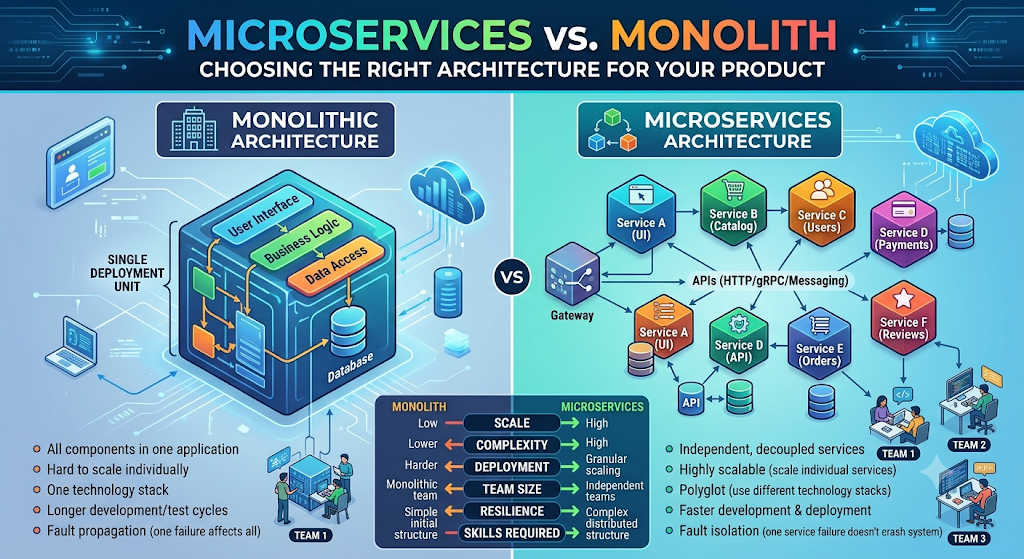
The Trade-off Table
| Dimension | Monolith | Microservices |
|---|---|---|
| Development speed (small team) | High | Low |
| Development speed (large team) | Low | High |
| Deployment complexity | Low | High |
| Operational complexity | Low | High |
| Scaling granularity | Coarse | Fine |
| Fault isolation | Low | High |
| Transactional consistency | Easy | Hard |
| Infrastructure cost | Lower | Higher |
The key insight: Microservices are an optimisation for large teams and high scale. If you have neither, they add complexity without delivering the benefit.
For teams building or refactoring the applications, our Custom Software Development and AI Development practices cover the full stack.
The Modular Monolith: The Option Most Teams Should Choose
The debate has a third option that is often overlooked: the modular monolith. It is a single deployable unit with clearly separated internal modules.
What It Is
A modular monolith is a monolith with strong internal boundaries:
Modules are separated by clear interfaces.
Dependencies between modules are explicit and controlled.
Data is owned by modules, not shared freely.
It looks like a monolith from the outside (one deployment) but has the discipline of microservices inside (clear boundaries).
Why It Works
1. You get modularity without distributed complexity. Modules can be developed independently within the same codebase.
2. You can extract services later. If a module needs to become a service, the boundaries are already in place. Extraction is easier.
3. You avoid the distributed monolith. The worst outcome is a "distributed monolith"—microservices that are tightly coupled, requiring coordinated deployments. A modular monolith avoids this.
4. You can scale the team before scaling the architecture. A modular monolith supports teams of 10–50 engineers. When you outgrow that, you extract services.
The Modular Monolith Table
| Aspect | Modular Monolith |
|---|---|
| Deployment | Single unit |
| Internal boundaries | Clear modules |
| Team scale | 10–50 engineers |
| Extraction path | Module → service |
| Complexity | Moderate |
The recommendation for most Indian SaaS companies: Start with a modular monolith. Extract services only when a module has a genuine need—different scaling, different team, different technology, or different release cadence.
When Microservices Are Actually Justified
Microservices are the right choice in specific situations. Recognising them prevents both premature adoption and unnecessary delay.
The Justification Criteria
1. Team scale. You have multiple teams (typically 5+ teams, 30+ engineers) that need to deploy independently.
2. Scale heterogeneity. Different parts of the application have vastly different scaling needs. The payment service needs 100x the capacity of the admin service.
3. Fault isolation. A failure in one part must not bring down the whole system.
4. Technology heterogeneity. Different parts genuinely need different technologies (e.g., a Python ML service alongside a Java core).
5. Release cadence. Different parts need different release cadences.
The Justification Table
| Criterion | Monolith Fine | Microservices Justified |
|---|---|---|
| Team size | < 30 engineers | > 30 engineers |
| Scaling needs | Uniform | Heterogeneous |
| Fault tolerance | Acceptable downtime | Must isolate failures |
| Technology | Uniform stack | Heterogeneous needs |
| Release cadence | Uniform | Different per domain |
The honest test: If you cannot name the specific service that needs to scale differently, or the specific team that needs to deploy independently, you probably do not need microservices.
Migration: If You Must, Do It Incrementally
If the decision is to migrate from monolith to microservices, the migration must be incremental. Big-bang rewrites fail.
The Strangler Fig Migration
The strangler fig pattern is the standard approach:
Place a facade (API gateway) in front of the monolith.
Extract one capability at a time as a new service.
Route traffic for that capability to the new service.
Repeat.
This allows the monolith to shrink gradually while the business continues to operate.
The Extraction Criteria
Not every module should be extracted. Extract modules that:
Have clear boundaries.
Have different scaling needs.
Have a dedicated team.
Change frequently.
Have a clear API.
The Migration Table
| Phase | Action | Risk |
|---|---|---|
| Facade | Add API gateway | Low |
| First extraction | Extract one capability | Medium |
| Expansion | Extract more capabilities | Medium |
| Decommission | Retire monolith modules | Low |
Real Costs in India (2026)
The cost difference between monolith and microservices is significant—not in development cost, but in operational cost.
Build Costs
| Architecture | Build Cost (₹) | Build Cost ($ approx.) | Timeline |
|---|---|---|---|
| Monolith | ₹5–20 lakh | $6,000–$24,000 | 8–20 weeks |
| Modular monolith | ₹8–25 lakh | $9,600–$30,000 | 10–24 weeks |
| Microservices | ₹20–80 lakh+ | $24,000–$96,000+ | 20–40 weeks |
Operational Costs
| Component | Monolith (₹/month) | Microservices (₹/month) |
|---|---|---|
| Infrastructure | ₹20,000–₹1,00,000 | ₹1,00,000–₹5,00,000+ |
| Observability | ₹10,000–₹30,000 | ₹50,000–₹2,00,000 |
| Platform team | Not required | ₹3–10 lakh (1–2 engineers) |
| CI/CD | ₹5,000–₹20,000 | ₹30,000–₹1,00,000 |
The Cost Reality
Microservices typically cost 2–5x more to operate than a monolith at the same scale, primarily due to infrastructure and platform team costs. The investment is justified only when the team scale and scale heterogeneity require it.
India-Specific Compliance: DPDPA and Architecture
DPDPA and Data Mapping
DPDPA requires knowing where personal data is stored and processed. In a monolith, this is straightforward—one database, one codebase. In microservices, personal data is spread across services, databases, and event streams.
The implication: Microservices require more rigorous data mapping, access control, and erasure workflows.
Data Localisation
For regulated sectors, data localisation may require all services and databases to be in India. Microservices with many databases increase the complexity of ensuring localisation.
The Compliance Checklist
| Requirement | Monolith | Microservices |
|---|---|---|
| Data mapping | Simple | Complex |
| Erasure | One database | Multiple databases |
| Access control | Centralised | Per-service |
| Audit logging | Centralised | Distributed |
Implementation Framework: A Phased Approach With Cost Gates
Phase 1: Architecture Assessment (Week 1–2)
Objective: Assess team scale, scaling needs, and operational capability.
Activities:
Assess team size and structure.
Assess scaling heterogeneity.
Assess operational capability (CI/CD, observability, on-call).
Assess compliance complexity.
Choose architecture.
Cost: ₹50,000–₹1.5 lakh ($600–$1,800).
Go/No-Go: Architecture decision made.
Phase 2: Foundation (Week 3–8)
Objective: Build the foundation for the chosen architecture.
Activities:
For monolith: set up modular structure, CI/CD.
For microservices: set up API gateway, service mesh, observability.
For modular monolith: define module boundaries.
Cost: ₹2–10 lakh ($2,400–$12,000).
Go/No-Go: Foundation works.
Phase 3: Build or Migrate (Week 9–24)
Objective: Build the application or migrate modules.
Activities:
Build the application with chosen architecture.
Or extract modules from the monolith.
Test and deploy.
Cost: Depends on scope.
Go/No-Go: Application works. Performance acceptable.
Phase Summary Table
| Phase | Duration | Key Deliverable | Cost (₹) | Go/No-Go Criteria |
|---|---|---|---|---|
| 1. Assessment | 2 weeks | Architecture decision | 50,000–1.5 lakh | Decision made |
| 2. Foundation | 6 weeks | Modular structure or platform | 2–10 lakh | Foundation works |
| 3. Build/Migrate | 16 weeks | Application | Depends | Works |
Risks, Pitfalls, and Governance
The Most Common Architecture Failures
Premature microservices. Adopting microservices before the team and scale justify it. Mitigation: Modular monolith first.
Distributed monolith. Microservices that are tightly coupled. Mitigation: Clear boundaries, independent deployment.
No observability. Cannot debug distributed systems. Mitigation: Tracing, logging from day one.
No platform team. Microservices without the people to operate them. Mitigation: Plan the team before the architecture.
Big-bang rewrite. Rewriting everything at once. Mitigation: Strangler fig, incremental.
DPDPA gaps. Data spread across services without mapping. Mitigation: Data mapping, access control.
Risk Summary Table
| Risk | Likelihood | Impact | Mitigation |
|---|---|---|---|
| Premature microservices | High | High (complexity) | Modular monolith |
| Distributed monolith | High | High (coupling) | Clear boundaries |
| No observability | High | High | Tracing, logging |
| No platform team | High | High | Plan team |
| Big-bang rewrite | High | High | Incremental |
| DPDPA gaps | Medium | Critical | Data mapping |
Benchmark Summary and Decision Framework
Decision Matrix: Architecture Selection
| Team Size | Scaling Needs | Recommended |
|---|---|---|
| < 10 engineers | Uniform | Monolith |
| 10–30 engineers | Uniform | Modular monolith |
| 30–50 engineers | Some heterogeneity | Modular monolith or selective extraction |
| 50+ engineers | Heterogeneous | Microservices |
Architecture Priority Table
| Priority | Capability | Why |
|---|---|---|
| 1 | Team scale assessment | Determines architecture |
| 2 | Modular boundaries | Enables future extraction |
| 3 | Observability | Required for distributed |
| 4 | CI/CD | Deployment velocity |
| 5 | Data mapping | DPDPA compliance |
The One-Paragraph Decision Rule
If you are a small team with uniform scaling needs, build a monolith—ideally a modular monolith. If you are a large team with heterogeneous scaling needs, microservices are justified. If you are unsure, start with a modular monolith and extract services only when a specific module needs it. Do not adopt microservices because it is fashionable. Adopt it because your team and scale require it.
Frequently Asked Questions
1. Should I use microservices or a monolith?
It depends on team size and scaling needs. Small teams with uniform scaling should use a monolith (or modular monolith). Large teams with heterogeneous scaling needs should use microservices.
2. What is a modular monolith?
A single deployable unit with clearly separated internal modules. It provides modularity without distributed complexity, and enables future extraction of services.
3. When are microservices justified?
When you have multiple teams (30+ engineers) that need independent deployment, heterogeneous scaling needs, fault isolation requirements, or technology heterogeneity.
4. What is a distributed monolith?
Microservices that are tightly coupled, requiring coordinated deployments. It is the worst of both worlds—distributed complexity without the benefits of independence.
5. How do I migrate from monolith to microservices?
Use the strangler fig pattern: add a facade, extract one capability at a time, route traffic to the new service, and repeat.
6. How much do microservices cost compared to a monolith?
Microservices typically cost 2–5x more to operate than a monolith at the same scale, due to infrastructure and platform team costs.
7. How does DPDPA affect architecture choice?
Microservices spread personal data across services, making data mapping, access control, and erasure more complex than in a monolith.
8. Do I need a platform team for microservices?
Yes. Production microservices require 1–2 platform engineers to operate the infrastructure, observability, and deployment pipeline.
9. What is the biggest risk of microservices?
Premature adoption—building microservices before the team and scale justify it, resulting in complexity without benefit.
10. Can I start with a monolith and move to microservices later?
Yes. A modular monolith makes future extraction easier. Start modular, extract when needed.
11. How long does microservices migration take?
It depends on scope. Migrating a significant portion of a monolith typically takes 12–24 months.
12. How can Innovative AI Solutions help?
Innovative AI Solutions builds software architectures for Indian businesses—modular monoliths, microservices, migration planning, and DPDPA-compliant data mapping. Our Delhi-based team handles assessment, implementation, and migration. Visit https://innovativeais.com to discuss your requirements.
Contact Innovative AI Solutions
Ready to choose an architecture your team can actually operate?
[One-line supporting sentence.]
Contact Information
Innovative AI Solutions
📍 Netaji Subhash Place, Pitampura, Delhi – 110034
🌐 Website: https://innovativeaislabs.com 📧 Email: info@innovativeais.com
📞 Phone: +91 7464 099 059 / +91 96899 67356
Business Services
AI Automation
AI Development
AI Consulting
Machine Learning Solutions
Deep Learning Solutions
Generative AI Services
NLP Solutions
AI Agents
AI Chatbots
Voice AI
CRM Development
Custom Software Development
Website Development
Mobile App Development
About the Author
Abhishek Kumar
Founder & CEO, Innovative AI Solutions
5+ years building production AI systems for Indian businesses. Based in Delhi, serving clients across India.
Ready to build AI solutions for your business?
Innovative AI Solutions — Delhi's leading AI development company. Free consultation available.
Get Free Consultation →
A practical 2026 guide for Indian engineering teams choosing between microservices and monolith—real trade-offs, the modular monolith option, migration patterns, real rupee costs, and DPDPA-compliant data mapping.
#Microservices #Monolith #ModularMonolith #ArchitectureDecision #DistributedMonolith #ServiceMesh #Scalability #TeamStructure #Migration #DPDPA #MeitY #SoftwareArchitecture #MonolithToMicroservices #IndiaTech #DelhiNCR #InnovativeAISolutions
Copyright ©️ 2015–2026 Innovative AI Solutions. All Rights Reserved. | Privacy Policy | Terms & Conditions