


The Dashboard That Was Always Wrong
An Indian operations team monitors a live dashboard of order volumes, inventory levels, and delivery statuses. The dashboard refreshes every 60 seconds. In a business where orders arrive in bursts and inventory changes by the minute, the dashboard is always out of date. The team makes decisions on stale data, discovers problems late, and spends the day reconciling what the dashboard showed with what actually happened.
The fix seems simple: refresh more often. But polling every second multiplies server load. At 500 concurrent users, one-second polling means 500 requests per second—most of which return no change. The database is hammered, the API is saturated, and the dashboard still feels slow.
This is the problem real-time application development solves. Instead of clients asking "has anything changed?" repeatedly, the server pushes changes to the client the moment they happen. The client does not poll. It listens.
Real-time is not a feature you bolt on at the end. It is an architecture that changes how the application is built—how data flows, how connections are managed, how the system scales, and how failures are handled. The businesses that get it right build applications that feel instant. The ones that get it wrong either overload their infrastructure with polling or build a WebSocket layer that collapses under load.
For Indian businesses, this matters because real-time is increasingly expected. Live order tracking, instant notifications, collaborative editing, live chat, real-time dashboards, multiplayer experiences—all require the server to push data to the client. The architecture that supports this is different from the request-response architecture most applications are built on.
India adds specific considerations. Network variability matters because connections drop and reconnect, and the real-time layer must handle this gracefully. Mobile-first usage means battery and data usage matter—persistent connections consume both. Scale matters because Indian consumer applications can have millions of concurrent users. And DPDPA applies to real-time data that contains personal data, requiring consent and access control.
This guide is written for Indian CTOs, engineers, and product managers building real-time features. We will cover the transport options (WebSockets, SSE, polling), the event-driven architecture, the scaling patterns, real costs in rupees and dollars, DPDPA compliance, and a phased implementation framework with clear go/no-go gates.
The Transport Options: WebSockets, SSE, and Polling
The first decision in real-time development is how the server communicates with the client. There are three main options, each with different trade-offs.
Polling
The client periodically asks the server for updates. Simple to implement, works everywhere, but inefficient—most requests return no change.
Short polling: The client requests every N seconds. Simple but wasteful.
Long polling: The client requests and the server holds the connection open until there is an update or a timeout. More efficient than short polling but still creates a new connection per update.
Server-Sent Events (SSE)
The server pushes updates to the client over a single HTTP connection. The client opens a connection and the server sends events as they happen. Unidirectional: server to client.
Pros: Simple, works over HTTP, automatic reconnection built into the browser API.
Cons: Unidirectional (client cannot send data over the same connection), limited browser connection limits (6 per domain in HTTP/1.1, more in HTTP/2).
Best for: Live feeds, notifications, dashboards, stock tickers—where the client only needs to receive.
WebSockets
A full-duplex connection between client and server. Both can send messages at any time over a single persistent connection.
Pros: Bidirectional, low latency, efficient for high-frequency communication.
Cons: More complex to implement, requires connection management, scaling is harder (sticky sessions or a pub/sub layer), proxies and load balancers must support it.
Best for: Chat, collaborative editing, multiplayer games, live trading—where the client and server both need to send data frequently.
The Transport Comparison Table
| Transport | Direction | Latency | Complexity | Scaling | Best For |
|---|---|---|---|---|---|
| Short polling | Request-response | High | Low | Easy | Low-frequency updates |
| Long polling | Request-response | Medium | Medium | Medium | Fallback |
| SSE | Server → client | Low | Low | Medium | Feeds, notifications |
| WebSockets | Bidirectional | Low | High | Hard | Chat, collaboration |
The recommendation: Start with SSE for unidirectional updates (notifications, dashboards). Use WebSockets only when bidirectional communication is genuinely needed (chat, collaboration). Avoid polling for anything that needs real-time.
For teams building the real-time layer and event-driven systems, our Custom Software Development and AI Development practices cover the full stack.
Event-Driven Architecture: The Backbone of Real-Time
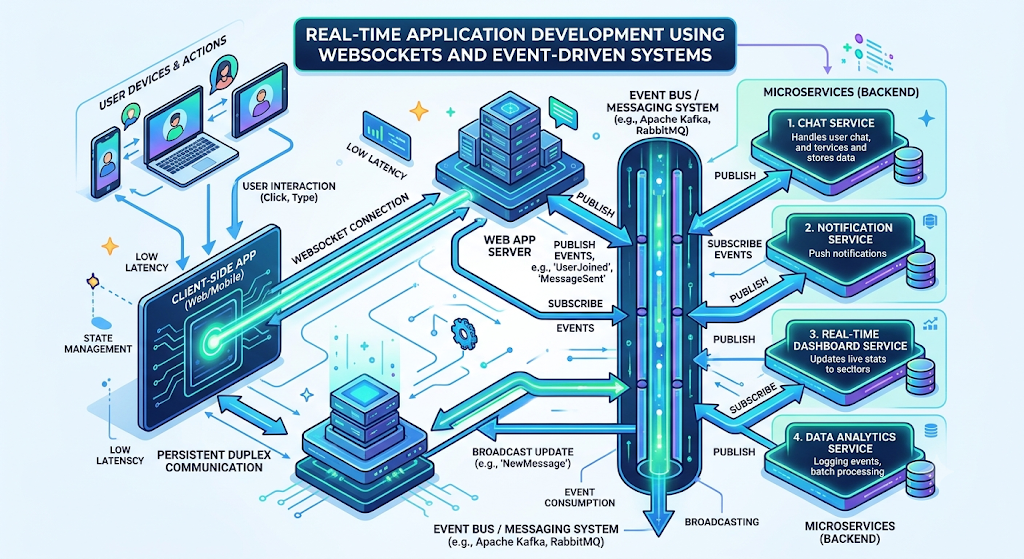
Real-time is not just about the transport. It is about the architecture that produces the events. An event-driven architecture decouples the producers of events from the consumers.
The Components
1. Event producers. The services that generate events: order created, payment received, inventory updated, message sent.
2. Event bus. The infrastructure that transports events: Kafka, RabbitMQ, Redis Pub/Sub, AWS EventBridge.
3. Event consumers. The services that react to events: notification service, dashboard service, analytics service.
4. Real-time gateway. The layer that maintains client connections and pushes events to clients.
The Event Flow
text
Producer → Event Bus → Consumer → Real-time Gateway → Client
Example: A customer places an order.
The order service publishes an order.created event to the event bus.
The notification service consumes the event and sends a confirmation email.
The inventory service consumes the event and decrements stock.
The dashboard service consumes the event and pushes an update to the operations dashboard.
The customer's app receives a real-time notification.
Why Event-Driven Matters
Decoupling: Producers do not need to know who consumes their events. New consumers can be added without changing producers.
Scalability: Consumers can be scaled independently. The notification service can scale without affecting the order service.
Resilience: If a consumer is down, events queue up and are processed when it recovers.
Real-time: Events flow to the real-time gateway as they happen, enabling instant updates.
The Event Bus Options
| Bus | Throughput | Latency | Complexity | Best For |
|---|---|---|---|---|
| Redis Pub/Sub | High | Very low | Low | Simple real-time |
| RabbitMQ | Medium | Low | Medium | Task queues, routing |
| Kafka | Very high | Low | High | Event streaming, replay |
| AWS EventBridge | Medium | Medium | Low | AWS-native |
The recommendation: Start with Redis Pub/Sub for simple real-time. Move to Kafka when you need event replay, high throughput, or complex event processing.
Scaling Real-Time: The Hard Part
A single WebSocket server can handle thousands of connections. A production system needs to handle millions. Scaling real-time is harder than scaling request-response because connections are stateful.
The Scaling Challenges
1. Connection state. Each WebSocket connection is stateful. The server must track which client is connected and what they are subscribed to.
2. Sticky sessions. If a client connects to server A, subsequent messages must go to server A. Load balancers must support sticky sessions, or the architecture must decouple connection state from the server.
3. Fan-out. When an event occurs, it must be delivered to all relevant clients—potentially across many servers.
4. Reconnection. Clients disconnect. The system must handle reconnection, missed messages, and state recovery.
The Scaling Patterns
1. Sticky sessions. The load balancer routes each client to the same server. Simple but limits scaling and creates single points of failure.
2. Pub/Sub fan-out. Each server subscribes to a pub/sub channel. When an event occurs, it is published to the channel, and all servers receive it and push to their connected clients. This is the standard pattern.
3. Dedicated real-time service. A separate service (e.g., Pusher, Ably, or a custom service) handles connections and fan-out. The application publishes events to the service.
4. Edge distribution. For global users, edge nodes maintain connections close to the user and forward events to the origin.
The Scaling Table
| Pattern | Complexity | Scale | Best For |
|---|---|---|---|
| Sticky sessions | Low | Limited | Small scale |
| Pub/Sub fan-out | Medium | High | Most applications |
| Dedicated service | Medium | Very high | Managed real-time |
| Edge distribution | High | Global | Global users |
Real Costs in India (2026)
Real-time application costs depend on the transport, the scale, and whether you build or use a managed service.
Build Costs
| Scope | Build Cost (₹) | Build Cost ($ approx.) | Timeline |
|---|---|---|---|
| Basic real-time (SSE, single server) | ₹2–5 lakh | $2,400–$6,000 | 4–8 weeks |
| WebSocket chat (pub/sub, scaling) | ₹5–15 lakh | $6,000–$18,000 | 8–16 weeks |
| Full real-time platform (event bus, gateway, scaling) | ₹15–40 lakh | $18,000–$48,000 | 16–28 weeks |
| Enterprise real-time (multi-region, high scale) | ₹40–90 lakh | $48,000–$1,08,000 | 24–36 weeks |
Running Costs
| Component | Monthly Cost (₹) | Monthly Cost ($ approx.) | Notes |
|---|---|---|---|
| Real-time servers | ₹10,000–₹80,000 | $120–$960 | Scales with connections |
| Event bus | ₹5,000–₹50,000 | $60–$600 | Redis, Kafka |
| Managed real-time (Pusher, Ably) | ₹10,000–₹1,00,000 | $120–$1,200 | Per connection pricing |
| Bandwidth | ₹5,000–₹50,000 | $60–$600 | Depends on message volume |
The Managed Service Trade-off
Managed real-time services (Pusher, Ably, PubNub) handle scaling, reconnection, and fan-out. They charge per connection or per message. For small scale, they are cheaper than building. For large scale, they become expensive.
The crossover: Typically at 10,000–50,000 concurrent connections, building becomes cheaper than managed.
India-Specific Compliance: DPDPA and Real-Time Data
DPDPA and Real-Time
Real-time data often contains personal data: chat messages, notifications, live locations. Under the DPDP Act:
Consent: users must consent to real-time processing.
Purpose limitation: real-time data should be used only for the consented purpose.
Access control: users should only receive data they are authorized to receive.
Retention: real-time data should not be retained longer than needed.
Access Control in Real-Time
The most common real-time security failure is channel authorization: a user subscribes to a channel they should not have access to and receives data meant for someone else.
The fix: Authenticate every subscription. The server must verify that the user is authorized to receive data on that channel before subscribing them.
Data Localisation
For regulated sectors, real-time servers and event buses may need to be in India. Choose Indian cloud regions.
The Compliance Checklist
| Requirement | Implementation | Priority |
|---|---|---|
| Consent | At signup/feature use | High |
| Channel authorization | Verify on subscribe | High |
| Access control | Per-user data filtering | High |
| Retention | Don't persist real-time unnecessarily | Medium |
| Data localisation | Indian region | Medium (regulated) |
Implementation Framework: A Phased Approach With Cost Gates
Phase 1: Real-Time Requirements (Week 1–2)
Objective: Define what needs to be real-time and how.
Activities:
Identify real-time features (notifications, chat, dashboards).
Choose transport (SSE, WebSocket).
Assess scale (concurrent users).
Assess compliance requirements.
Cost: ₹50,000–₹1.5 lakh ($600–$1,800).
Go/No-Go: Requirements defined. Transport chosen.
Phase 2: Basic Real-Time (Week 3–8)
Objective: Implement basic real-time with SSE or WebSocket.
Activities:
Implement real-time gateway.
Implement authentication.
Implement basic pub/sub.
Implement reconnection handling.
Cost: ₹2–5 lakh ($2,400–$6,000).
Go/No-Go: Real-time works. Reconnection works.
Phase 3: Event-Driven Backend (Week 9–16)
Objective: Add event bus and decouple producers from consumers.
Activities:
Implement event bus (Redis or Kafka).
Decouple producers and consumers.
Implement fan-out.
Implement channel authorization.
Cost: ₹5–15 lakh ($6,000–$18,000).
Go/No-Go: Events flow. Fan-out works.
Phase 4: Scaling (Week 17–24)
Objective: Scale to production load.
Activities:
Implement horizontal scaling.
Implement load balancing.
Implement monitoring.
Load test.
Cost: ₹5–20 lakh ($6,000–$24,000).
Go/No-Go: System handles target load.
Phase Summary Table
| Phase | Duration | Key Deliverable | Cost (₹) | Go/No-Go Criteria |
|---|---|---|---|---|
| 1. Requirements | 2 weeks | Transport, scale | 50,000–1.5 lakh | Defined |
| 2. Basic | 6 weeks | Gateway, auth | 2–5 lakh | Works |
| 3. Event-Driven | 8 weeks | Event bus, fan-out | 5–15 lakh | Events flow |
| 4. Scaling | 8 weeks | Horizontal scale | 5–20 lakh | Handles load |
Risks, Pitfalls, and Governance
The Most Common Real-Time Failures
Polling overload. Polling every second saturates the server. Mitigation: SSE or WebSocket.
No reconnection handling. Clients lose connection and miss updates. Mitigation: Reconnection with state recovery.
Channel authorization gaps. Users receive data they should not. Mitigation: Authenticate every subscription.
Scaling without pub/sub. Sticky sessions limit scale. Mitigation: Pub/sub fan-out.
Memory leaks. Connections accumulate and exhaust memory. Mitigation: Connection limits, monitoring.
No backpressure. Slow clients cause server memory to grow. Mitigation: Backpressure, message queuing.
Risk Summary Table
| Risk | Likelihood | Impact | Mitigation |
|---|---|---|---|
| Polling overload | High | High (performance) | SSE/WebSocket |
| No reconnection | High | Medium | Reconnection |
| Authorization gaps | Medium | Critical | Channel auth |
| Scaling issues | High | High | Pub/sub |
| Memory leaks | Medium | High | Monitoring |
| No backpressure | Medium | High | Backpressure |
Benchmark Summary and Decision Framework
Decision Matrix: Transport Selection
| Use Case | Recommended Transport |
|---|---|
| Live notifications | SSE |
| Live dashboard | SSE |
| Chat | WebSocket |
| Collaborative editing | WebSocket |
| Live tracking | WebSocket or SSE |
| Low-frequency updates | Polling |
Real-Time Priority Table
| Priority | Capability | Why |
|---|---|---|
| 1 | Transport choice | Foundation |
| 2 | Reconnection | Reliability |
| 3 | Channel authorization | Security |
| 4 | Pub/sub fan-out | Scaling |
| 5 | Monitoring | Operations |
The One-Paragraph Decision Rule
If you need real-time, start with SSE for unidirectional updates and WebSockets only for bidirectional. Implement reconnection handling from day one. Authenticate every channel subscription. Use pub/sub fan-out for scaling. And monitor connection counts, latency, and errors. Real-time is an architecture, not a feature.
Frequently Asked Questions
1. What is real-time application development?
It is building applications where the server pushes data to the client as it changes, rather than the client polling for updates.
2. Should I use WebSockets or SSE?
Use SSE for unidirectional updates (notifications, dashboards). Use WebSockets for bidirectional communication (chat, collaboration).
3. What is the difference between WebSockets and polling?
Polling asks the server repeatedly for changes. WebSockets maintain a persistent connection and the server pushes changes immediately.
4. What is event-driven architecture?
An architecture where services communicate through events (messages) rather than direct calls. Producers publish events; consumers react to them.
5. How do I scale WebSockets?
Use pub/sub fan-out: each server subscribes to a channel, and events are published to all servers, which push to their connected clients.
6. How much does real-time development cost in India?
Basic real-time costs ₹2–5 lakh ($2,400–$6,000). WebSocket chat costs ₹5–15 lakh ($6,000–$18,000). A full platform costs ₹15–40 lakh ($18,000–$48,000).
7. Should I build or use a managed real-time service?
Use managed (Pusher, Ably) for small scale or when you do not want to operate infrastructure. Build when scale justifies the investment (typically 10,000+ concurrent connections).
8. How does DPDPA affect real-time applications?
Real-time data often contains personal data. Consent, purpose limitation, access control, and retention apply. Channel authorization is critical.
9. What is channel authorization?
Verifying that a user is authorized to subscribe to a channel before allowing them to receive data on it. Without it, users can receive data meant for others.
10. How do I handle reconnection?
Implement reconnection with exponential backoff, and recover missed messages using a sequence number or event replay.
11. What is backpressure?
A mechanism to slow down producers when consumers are overwhelmed. Without it, server memory can grow unbounded.
12. How can Innovative AI Solutions help?
Innovative AI Solutions builds real-time applications for Indian businesses—WebSockets, SSE, event-driven architecture, pub/sub scaling, and DPDPA-compliant channel authorization. Our Delhi-based team handles design, implementation, and scaling. Visit https://innovativeais.com to discuss your requirements.
Contact Innovative AI Solutions
Ready to build real-time features that scale and stay secure?
[One-line supporting sentence.]
Contact Information
Innovative AI Solutions
📍 Netaji Subhash Place, Pitampura, Delhi – 110034
🌐 Website: https://innovativeaislabs.com 📧 Email: info@innovativeais.com
📞 Phone: +91 7464 099 059 / +91 96899 67356
Business Services
AI Automation
AI Development
AI Consulting
Machine Learning Solutions
Deep Learning Solutions
Generative AI Services
NLP Solutions
AI Agents
AI Chatbots
Voice AI
CRM Development
Custom Software Development
Website Development
Mobile App Development
About the Author
Abhishek Kumar
Founder & CEO, Innovative AI Solutions
5+ years building production AI systems for Indian businesses. Based in Delhi, serving clients across India.
Ready to build AI solutions for your business?
Innovative AI Solutions — Delhi's leading AI development company. Free consultation available.
Get Free Consultation →
A practical 2026 guide for Indian teams building real-time applications—WebSockets vs SSE vs polling, event-driven architecture, scaling patterns, real rupee costs, and DPDPA-compliant channel authorization.
#RealTimeApplications #WebSockets #EventDrivenArchitecture #SSE #Polling #WebSocketScaling #RedisPubSub #Kafka #EventStreaming #LiveNotifications #RealTimeChat #LiveDashboard #SocketIO #DPDPA #MeitY #DelhiNCR #InnovativeAISolutions
Copyright ©️ 2015–2026 Innovative AI Solutions. All Rights Reserved. | Privacy Policy | Terms & Conditions