The CRM That Forced the Business to Change
An Indian B2B distributor implements a leading off-the-shelf CRM. The CRM is well-built, feature-rich, and widely used. It also assumes a sales process the distributor does not have. The distributor sells through channel partners, quotes in a multi-level approval chain, and prices per customer contract. The CRM assumes direct sales, standard pipelines, and list pricing.
The implementation team spends months configuring the CRM to approximate the distributor's process. Workarounds are built. Custom fields multiply. Integrations with the ERP require middleware. Three years later, the sales team still keeps a parallel spreadsheet because the CRM does not quite fit. The licence costs have grown with the team. And the business has shaped its process around the software, rather than the software around the business.
This is the hidden cost of off-the-shelf CRM: not the licence fee, but the process compromise. The business adapts to the tool, and the adaptation compounds over years.
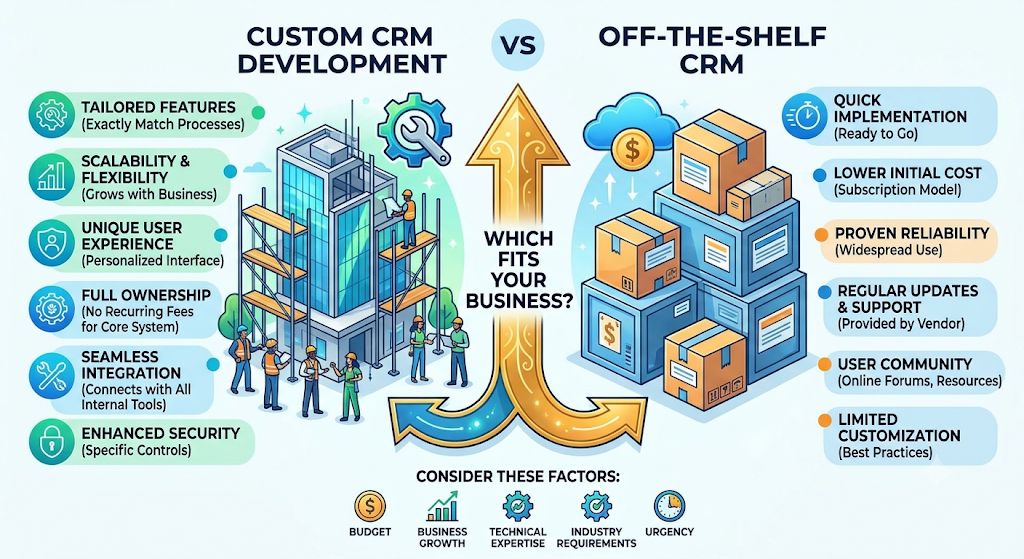
Custom CRM development takes the opposite approach. It builds the CRM around the business's actual sales process—its approvals, its channel structure, its pricing logic, its integrations. It is more expensive upfront and requires ongoing engineering. But it fits, and it owns its data, and it can evolve with the business.
The choice between custom CRM development and off-the-shelf CRM is not a choice between good and bad. It is a choice between two cost structures and two levels of fit. Off-the-shelf is cheap to start and expensive to outgrow. Custom is expensive to build and cheap to own. The right choice depends on how distinctive the sales process is, how much integration is needed, how sensitive the data is, and how much the business is willing to compromise.
For Indian businesses, this matters because sales processes are often genuinely distinctive. Channel partner networks, multi-level approvals, contract pricing, GST-specific invoicing, WhatsApp-first communication—these are common in India and not always well-served by global CRM templates.
India adds specific considerations. DPDPA applies to customer data in the CRM, and data ownership matters—a custom CRM keeps data in the business's infrastructure, while a SaaS CRM stores it with the vendor. Data localisation may require Indian data centres for regulated sectors. MeitY AI governance applies if the CRM includes AI features. And cost sensitivity means the total cost of ownership, not just the first invoice, determines the decision.
This guide is written for Indian business leaders, sales heads, CTOs, and founders evaluating CRM. We will cover the trade-offs, the total cost of ownership, the integration and compliance considerations, real costs in rupees and dollars, DPDPA compliance, and a decision framework with clear go/no-go gates.
The Real Trade-offs: What Each Option Optimises For
What Off-the-Shelf CRM Optimises For
1. Time to value. A SaaS CRM can be live in days or weeks. Configuration, not development.
2. Feature breadth. Vendors have invested years in features: pipelines, forecasting, email integration, reporting, mobile apps.
3. Vendor support. Updates, security patches, and support are included.
4. Lower upfront cost. Subscription pricing avoids large capital expenditure.
5. Ecosystem. Integrations with common tools (email, calendar, marketing automation) are pre-built.
What Custom CRM Optimises For
1. Process fit. The CRM matches the actual sales process, not a template.
2. Integration depth. Custom integrations with ERP, billing, WhatsApp, and internal systems.
3. Data ownership. Customer data stays in the business's infrastructure.
4. Differentiation. The CRM can encode the business's unique advantage.
5. Long-term cost. No per-user licence fees; cost is infrastructure and maintenance.
The Trade-off Table
| Dimension | Off-the-Shelf | Custom |
|---|---|---|
| Time to value | Fast | Slow |
| Feature breadth | High | Built as needed |
| Process fit | Template | Exact |
| Integration | Pre-built connectors | Custom |
| Data ownership | Vendor | Business |
| Upfront cost | Low | High |
| Long-term cost | Per-user licences | Infrastructure + maintenance |
| Differentiation | Low | High |
For teams building custom CRM and integrations, our CRM Development and Custom Software Development practices cover the full stack.
Total Cost of Ownership: The Three-Year View
The first invoice is misleading. The right comparison is total cost of ownership over three years.
Off-the-Shelf TCO
Costs:
Subscription: per-user per-month. For 50 users at ₹2,500/user/month = ₹15 lakh/year.
Implementation: configuration, data migration, training. ₹3–10 lakh.
Customisation: fields, workflows, integrations. ₹2–10 lakh.
Integration: middleware, connectors. ₹2–8 lakh.
Add-ons: additional modules (marketing, support). ₹2–10 lakh/year.
Training and change management: ongoing.
Three-year TCO for 50 users: ₹55–90 lakh.
Custom CRM TCO
Costs:
Development: ₹15–40 lakh.
Infrastructure: ₹5,000–₹50,000/month = ₹1.8–18 lakh over three years.
Maintenance: 15–25% of build annually = ₹7–30 lakh over three years.
Training: ₹1–3 lakh.
Three-year TCO for 50 users: ₹25–90 lakh.
The Crossover Point
Custom CRM becomes cheaper than off-the-shelf at a certain scale and timeframe. The crossover depends on:
User count: more users = higher off-the-shelf cost.
Customisation needs: more customisation = higher off-the-shelf cost.
Integration needs: more integrations = higher off-the-shelf cost.
Timeframe: longer timeframe = custom becomes relatively cheaper.
Typical crossover: 3–5 years for a mid-sized business with moderate customisation needs. Sooner if customisation and integration needs are high.
The TCO Table
| Factor | Off-the-Shelf (3yr) | Custom (3yr) |
|---|---|---|
| 50 users, low customisation | ₹55–70 lakh | ₹40–70 lakh |
| 50 users, high customisation | ₹80–1.2 crore | ₹50–90 lakh |
| 200 users, moderate | ₹2–3 crore | ₹60–1 crore |
Note: Indicative figures for Indian businesses. USD conversions at ₹83/$.
Integration: Where Off-the-Shelf Often Falls Short
Indian businesses rarely run CRM in isolation. The CRM must integrate with ERP (for orders and invoices), billing (for GST), WhatsApp (for communication), and often a custom internal system. The integration depth often determines which CRM fits.
Off-the-Shelf Integration
Strengths: Pre-built connectors for common tools (Gmail, Outlook, Slack, Zapier).
Weaknesses: Custom systems require custom connectors. ERP integration (SAP, Tally, custom) often requires middleware. WhatsApp integration may require third-party add-ons.
Custom CRM Integration
Strengths: Native integration with the business's actual systems. No middleware. Direct API connections.
Weaknesses: Every integration must be built and maintained.
The Integration Table
| Integration | Off-the-Shelf | Custom |
|---|---|---|
| Pre-built | Built | |
| ERP | Middleware | Native |
| Add-on | Native | |
| Billing/GST | Add-on or custom | Native |
| Internal systems | Custom | Native |
The rule: If the CRM needs deep integration with more than two custom systems, the integration cost of off-the-shelf may exceed the build cost of custom.
Data Ownership and DPDPA
Data Ownership
Off-the-shelf (SaaS): Customer data is stored on the vendor's infrastructure. The business can export it, but the vendor controls the storage, security, and access.
Custom: Customer data is stored on the business's infrastructure. The business controls storage, security, and access.
DPDPA Implications
Under the DPDP Act, the business is typically the Data Fiduciary for customer data. It is responsible for consent, purpose limitation, security, and breach notification. Whether the CRM is SaaS or custom, the business remains accountable.
The differences:
Data Processing Agreement: For SaaS, a DPA with the vendor is required.
Data localisation: For regulated sectors, the CRM data may need to be in India. SaaS vendors may or may not offer Indian data centres.
Breach notification: If the SaaS vendor is breached, the business must still notify.
Erasure: Deleting customer data requires the vendor's cooperation for SaaS.
The Data Ownership Table
| Aspect | Off-the-Shelf | Custom |
|---|---|---|
| Storage | Vendor | Business |
| Control | Limited | Full |
| DPA required | Yes | No (internal) |
| Localisation | Vendor-dependent | Business-controlled |
| Erasure | Vendor cooperation | Direct |
Real Costs in India (2026)
Off-the-Shelf CRM Costs
| CRM | Pricing (₹/user/month) | Notes |
|---|---|---|
| Zoho CRM | ₹800–₹3,000 | India-focused, GST support |
| Salesforce | ₹2,500–₹8,000 | Enterprise, extensive ecosystem |
| HubSpot | ₹1,500–₹8,000 | Marketing + sales |
| Freshsales | ₹1,000–₹4,000 | India-focused |
Custom CRM Costs
| Scope | Build Cost (₹) | Build Cost ($ approx.) | Timeline |
|---|---|---|---|
| Basic CRM (contacts, deals, pipeline) | ₹5–15 lakh | $6,000–$18,000 | 8–14 weeks |
| Full CRM (automation, reports, integrations) | ₹15–40 lakh | $18,000–$48,000 | 14–28 weeks |
| Enterprise CRM (multi-team, ERP, WhatsApp, AI) | ₹40–90 lakh | $48,000–$1,08,000 | 24–36 weeks |
The Decision Cost
The wrong choice is expensive. An off-the-shelf CRM that does not fit leads to workarounds, shadow spreadsheets, and eventual migration. A custom CRM built for the wrong process leads to scope creep and unused features.
Implementation Framework: A Phased Approach With Cost Gates
Phase 1: Requirements Assessment (Week 1–3)
Objective: Understand the sales process and requirements.
Activities:
Map the sales process: stages, approvals, roles.
Identify integration requirements (ERP, billing, WhatsApp).
Assess data sensitivity (DPDPA).
Assess customisation needs.
Estimate user count and growth.
Cost: ₹50,000–₹1.5 lakh ($600–$1,800).
Go/No-Go: Requirements documented. Decision criteria defined.
Phase 2: Build vs Buy Decision (Week 4)
Objective: Choose between custom and off-the-shelf.
Activities:
Compare TCO over three years.
Assess process fit of off-the-shelf options.
Assess integration complexity.
Assess data ownership requirements.
Decide.
Cost: Included in assessment.
Go/No-Go: Decision made.
Phase 3: Implementation (Week 5–20)
Objective: Implement the chosen CRM.
Activities:
For off-the-shelf: configure, integrate, migrate, train.
For custom: build, integrate, migrate, train.
Cost: Off-the-shelf ₹10–30 lakh; custom ₹15–40 lakh.
Go/No-Go: CRM works. Team uses it.
Phase 4: Optimization (Ongoing)
Objective: Improve and expand.
Activities:
Monitor adoption.
Add features as needed.
Optimize integrations.
Train new users.
Cost: ₹20,000–₹80,000/month ($240–$960).
Phase Summary Table
| Phase | Duration | Key Deliverable | Cost (₹) | Go/No-Go Criteria |
|---|---|---|---|---|
| 1. Assessment | 3 weeks | Requirements | 50,000–1.5 lakh | Documented |
| 2. Decision | 1 week | Build vs buy | Included | Decided |
| 3. Implementation | 16 weeks | Working CRM | 10–40 lakh | Team uses it |
| 4. Optimization | Ongoing | Improvements | 20,000–80,000/month | Adoption |
Risks, Pitfalls, and Governance
The Most Common CRM Failures
Choosing off-the-shelf for a distinctive process. Workarounds and shadow spreadsheets. Mitigation: Process fit assessment.
Choosing custom without engineering capability. The CRM becomes unmaintainable. Mitigation: Assess team capability.
Underestimating integration. Integration is more complex than expected. Mitigation: Integration assessment.
Ignoring data ownership. Data locked in a vendor. Mitigation: Assess data ownership needs.
No DPDPA compliance. Customer data processed without consent. Mitigation: Consent, DPA, retention.
Poor adoption. The team does not use the CRM. Mitigation: Training, involvement.
Risk Summary Table
| Risk | Likelihood | Impact | Mitigation |
|---|---|---|---|
| Wrong fit | High | High (workarounds) | Process assessment |
| No engineering | High | High (unmaintainable) | Capability check |
| Underestimated integration | High | Medium | Integration assessment |
| Data ownership | Medium | High | Assess needs |
| DPDPA gaps | Medium | Critical | Consent, DPA |
| Poor adoption | High | High | Training |
Benchmark Summary and Decision Framework
Decision Matrix: Custom vs Off-the-Shelf
| Factor | Off-the-Shelf | Custom |
|---|---|---|
| Standard sales process | ✓ | |
| Distinctive process | ✓ | |
| Deep integration needed | ✓ | |
| Data ownership critical | ✓ | |
| Limited engineering | ✓ | |
| Fast time to value | ✓ | |
| Large user count | ✓ (long-term) |
CRM Selection Priority Table
| Priority | Capability | Why |
|---|---|---|
| 1 | Process fit | Adoption |
| 2 | Integration | Operational |
| 3 | Data ownership | Compliance |
| 4 | TCO | Financial |
| 5 | Scalability | Growth |
The One-Paragraph Decision Rule
If your sales process is standard and you need to move fast, choose off-the-shelf. If your process is distinctive, you need deep integration with custom systems, or data ownership is critical, build custom. If you are unsure, start with off-the-shelf and migrate to custom only when the workarounds become more expensive than a rebuild.
Frequently Asked Questions
1. Should I build a custom CRM or buy off-the-shelf?
Choose off-the-shelf for standard sales processes and fast time to value. Choose custom for distinctive processes, deep integration needs, or data ownership requirements.
2. How much does custom CRM development cost in India?
Basic CRM costs ₹5–15 lakh ($6,000–$18,000). Full CRM costs ₹15–40 lakh ($18,000–$48,000). Enterprise CRM costs ₹40–90 lakh ($48,000–$1,08,000).
3. How much does off-the-shelf CRM cost?
Zoho CRM costs ₹800–₹3,000/user/month. Salesforce costs ₹2,500–₹8,000/user/month. HubSpot costs ₹1,500–₹8,000/user/month.
4. What is the crossover point between custom and off-the-shelf?
Typically 3–5 years for a mid-sized business with moderate customisation. Sooner if customisation and integration needs are high.
5. How does DPDPA affect CRM choice?
Customer data in the CRM is personal data. Consent, purpose limitation, security, and retention apply. Data ownership matters—custom keeps data in your infrastructure; SaaS stores it with the vendor.
6. Can I migrate from off-the-shelf to custom later?
Yes, but it is expensive. Plan the migration carefully and assess whether the workarounds justify a rebuild.
7. What integrations do Indian businesses need in a CRM?
ERP (SAP, Tally), billing/GST, WhatsApp, email, and often a custom internal system.
8. How do I assess process fit?
Map your sales process and compare it to the CRM's assumptions. If the CRM requires significant workarounds, the fit is poor.
9. What is data ownership in CRM?
Whether the customer data is stored and controlled by the business or the vendor. Custom CRM gives full ownership; SaaS gives limited control.
10. How long does custom CRM development take?
Basic CRM takes 8–14 weeks. Full CRM takes 14–28 weeks. Enterprise CRM takes 24–36 weeks.
11. What if my sales team does not adopt the CRM?
Involve them in design, train them, and show benefits. Adoption is a change management problem, not just a software problem.
12. How can Innovative AI Solutions help?
Innovative AI Solutions builds custom CRM systems for Indian businesses—sales pipelines, ERP/WhatsApp integration, DPDPA-compliant data handling, and AI features. Our Delhi-based team handles assessment, implementation, and migration. Visit https://innovativeais.com to discuss your requirements.
Contact Innovative AI Solutions
Ready to choose a CRM that fits the way you sell?
[One-line supporting sentence.]
Contact Information
Innovative AI Solutions
📍 Netaji Subhash Place, Pitampura, Delhi – 110034
🌐 Website: https://innovativeaislabs.com 📧 Email: info@innovativeais.com
📞 Phone: +91 7464 099 059 / +91 96899 67356
Business Services
AI Automation
AI Development
AI Consulting
Machine Learning Solutions
Deep Learning Solutions
Generative AI Services
NLP Solutions
AI Agents
AI Chatbots
Voice AI
CRM Development
Custom Software Development
Website Development
Mobile App Development
About the Author
Abhishek Kumar
Founder & CEO, Innovative AI Solutions
5+ years building production AI systems for Indian businesses. Based in Delhi, serving clients across India.
Ready to build AI solutions for your business?
Innovative AI Solutions — Delhi's leading AI development company. Free consultation available.
Get Free Consultation →
A practical 2026 guide for Indian businesses choosing between custom CRM development and off-the-shelf CRM—process fit, total cost of ownership, integration, data ownership, real rupee costs, and DPDPA compliance.
#CustomCRM #OffTheShelfCRM #CRMDevelopment #BuildVsBuy #Salesforce #Zoho #CRMIntegration #TotalCostOfOwnership #DataOwnership #DPDPA #MeitY #CRMMigration #Scalability #SalesAutomation #B2BSales #DelhiNCR #InnovativeAISolutions
Copyright ©️ 2015–2026 Innovative AI Solutions. All Rights Reserved. | Privacy Policy | Terms & Conditions