


The Integration Tax That MCP Eliminates
An Indian enterprise builds an AI assistant for its sales team. The assistant needs to access the CRM, the ERP, the document management system, and a payment gateway. Each integration requires a custom connector: authentication, data mapping, error handling, and maintenance. When the CRM vendor updates its API, the connector breaks. When the enterprise adds a new AI assistant—perhaps for HR or finance—the integrations must be built again. The integration tax compounds with every new AI application and every new business tool.
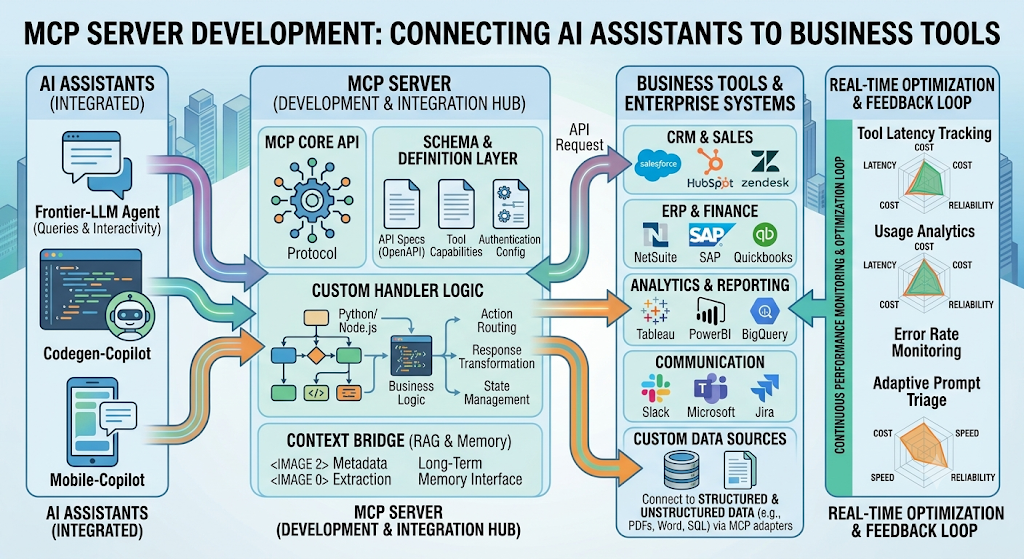
This is the problem Model Context Protocol (MCP) solves. MCP is an open standard for connecting AI applications to external systems—data sources, tools, and workflows. The official documentation describes it as a "USB-C port for AI applications": just as USB-C provides a standardized way to connect electronic devices, MCP provides a standardized way to connect AI applications to external systems .
For Indian businesses, this matters because AI assistants are proliferating. A sales assistant, a support assistant, a finance assistant, an HR assistant—each needs access to different business tools. Without a standard, each integration is a custom build. With MCP, the business tool exposes itself once as an MCP server, and any MCP-compatible AI assistant can use it. The Government of India has already adopted this approach: the Ministry of Statistics and Programme Implementation launched an MCP server for the eSankhyiki portal, allowing AI tools to query official statistical databases directly .
India adds specific considerations. DPDPA applies to tools that expose personal data, and the MCP server must enforce access controls and audit logging. MeitY AI governance expects transparency about which tools were used and accountability for actions. Security is critical—an MCP server that exposes write operations without proper authentication and authorization is a data breach waiting to happen. And cost management matters because MCP server development has a distinct cost structure driven by tool count, system complexity, and security requirements.
This guide is written for Indian CTOs, AI engineers, and product managers building MCP servers. We will cover the MCP architecture, the tool design principles, the OAuth 2.1 security requirements, the production hardening, real costs in rupees and dollars, DPDPA compliance, and a phased implementation framework with clear go/no-go gates.
MCP Architecture: Host, Client, Server
MCP follows a client-host-server architecture. Understanding the roles is essential for designing a server that fits the ecosystem .
The Host
The host is the AI application—Claude, ChatGPT, GitHub Copilot, Cursor, or a custom assistant. It creates and manages multiple client instances, controls connection permissions, enforces security policies, and coordinates AI/LLM integration. The host handles user authorization decisions and manages context aggregation across clients .
Design implication for server developers: The server does not control the conversation. It receives only the contextual information necessary for its tools. The full conversation history stays with the host. Servers must not expect to "see" the whole conversation .
The Client
Each client is created by the host and communicates with exactly one server. The client attaches protocol version and capabilities to every request, routes messages, and maintains security boundaries between servers .
Design implication: A host with multiple servers creates multiple clients, one per server. The server does not need to manage multi-tenancy at the protocol level—the host handles isolation.
The Server
The server exposes resources, tools, and prompts via MCP primitives. It operates independently with focused responsibilities, respects security constraints, and can be a local process or a remote service .
Design implication: Servers should be extremely easy to build and highly composable. Each server provides focused functionality in isolation. Multiple servers can be combined seamlessly .
The Message Flow
MCP uses JSON-RPC. The core messages include :
InitializeRequest: Client connects and requests initialization.
ListToolsRequest: Client requests the list of tools the server has.
CallToolRequest: Client invokes a tool.
ListResourcesRequest / ReadResourceRequest: Client accesses server resources.
ListPromptsRequest / GetPromptRequest: Client accesses prompt templates.
CreateMessageRequest: Server requests sampling from an LLM via the client (with human-in-the-loop approval).
Architecture Table
| Component | Role | Server Developer Implication |
|---|---|---|
| Host | AI application, orchestration | Server does not control conversation |
| Client | 1:1 connection to server | Server does not manage multi-tenancy |
| Server | Exposes tools, resources, prompts | Focus on focused, composable capabilities |
For teams building MCP servers and AI integrations, our AI Development and AI Agents practices cover the full stack.
Tool Design: The Highest-Leverage Decision
The most common failure in MCP server development is mirroring a REST API one-to-one. The AI client then has to chain five low-level calls to do one business task, pick the wrong endpoint, or pass malformed arguments .
The Task-Shaped Tool Principle
Tools should be designed around business tasks, not API endpoints. A tool called create_invoice with a complete input schema is better than five tools called create_invoice_header, add_line_item, set_tax, apply_discount, and finalize_invoice. The AI client should be able to complete a task with one tool call, not five.
Fewer, well-designed tools cost far less than thirty thin wrappers around REST endpoints, and usually work better .
The Tool Schema
Each tool needs :
LLM-friendly name: clear, descriptive, unambiguous.
Description: what the tool does, when to use it, what it returns.
Input schema: typed parameters with descriptions and constraints.
Error semantics: structured errors that the AI can understand and recover from.
Tests: scenario tests that run real AI clients against the tool and measure correct selection and argument accuracy.
Read-Only vs Write Tools
Read-only tools are low-risk. Write tools—create orders, refund payments, modify records—need :
Permission scoping: only authorized callers can invoke them.
Idempotency: retries do not create duplicates.
Confirmation steps: human-in-the-loop for consequential actions.
Audit trails: every write is logged.
The Idempotency Requirement
Retries are normal in distributed systems. AI clients, HTTP libraries, proxies, and users can all repeat a request. Production write tools should be safe under retries. An idempotency key lets the server recognize repeated requests: workspace_id + user_id + idempotency_key -> previous result. This is especially important for tools that create tickets, send messages, start jobs, charge accounts, publish content, or trigger automation .
If a tool cannot be made idempotent, document that clearly and consider requiring confirmation.
Tool Design Table
| Principle | What It Means | Why |
|---|---|---|
| Task-shaped | One tool per business task | Fewer calls, better accuracy |
| Typed schema | Clear input parameters | AI passes correct arguments |
| Structured errors | Recoverable error format | AI can retry or escalate |
| Idempotent writes | Safe under retries | No duplicate actions |
| Permission scoped | Caller-specific access | Security, compliance |
Security: OAuth 2.1 and Beyond
An MCP server sits between AI agents and business systems. It holds credentials and executes actions. A security mistake can give an attacker the rights of a user or the host .
Authentication: OAuth 2.1
The MCP authorization specification requires OAuth 2.1. Clients must use PKCE (Proof Key for Code Exchange) when performing authorization code flows .
Key requirements:
Validate every authorization token. Verify issuer, audience, and expiry on each incoming request. Do not trust tokens missing required claims or issued for a different resource .
Bind tokens to their intended audience. A token issued for one service must not be replayable against another .
Enforce strict redirect-URI matching. Allow only preregistered, exact redirect URIs. Require per-client consent .
Follow least-privilege RBAC. Grant each caller only the roles required for its task. Enable only the tools each caller needs .
The Token Passthrough Anti-Pattern
The MCP security best practices explicitly forbid token passthrough: accepting a token from a client without checking it was issued to your server, then forwarding it downstream. This breaks rate limits and audit trails, blurs identity in downstream logs, and widens trust. The rule is unambiguous: MCP servers must not accept tokens that were not explicitly issued for them .
Local Server Hardening
Local MCP servers run with the client's privileges. If the server can act with your identity, review what your account can access before connecting an agent .
Hardening practices:
Run the local server from a trusted workstation or container.
Do not expose the local endpoint to untrusted networks.
Sandbox local code with restricted file and network access.
Keep the server current .
Remote Server Protection
For remote servers, place the MCP server behind an enforcement gateway (API gateway, APIM). The gateway can validate tokens, apply rate limiting, restrict allowed tool paths, and log every request for audit .
Protect the endpoint: A substituted or spoofed URL can receive tool-execution requests and expose credentials. Connect only to trusted endpoints. Verify TLS certificates. Fail closed on certificate errors .
Security Checklist
| Requirement | Implementation | Priority |
|---|---|---|
| OAuth 2.1 | Authorization server, PKCE | High |
| Token audience validation | Verify audience on every request | High |
| No token passthrough | Separate credentials for downstream | High |
| Least-privilege RBAC | Minimal roles, minimal tools | High |
| Endpoint verification | TLS, trusted URLs only | High |
| Local sandboxing | Restricted file/network access | High |
| Audit logging | Log every tool call with identity | High |
Production Hardening: Beyond the Prototype
A proof-of-concept MCP server is easy. A production server requires hardening across reliability, observability, and abuse prevention.
Error Handling
Production errors should be structured and predictable. The client should distinguish bad input, missing authentication, forbidden access, not found, conflict, rate limit, and internal failure. Do not expose stack traces or secrets in tool responses. Detailed errors go to internal logs with redaction .
Rate Limiting
Rate limiting protects reliability and cost. MCP clients can call tools repeatedly, and malicious users can intentionally trigger expensive operations. A search tool that scans thousands of documents or an external API tool that makes paid requests can become expensive quickly. Start with per-user limits, per-IP limits, request body limits, concurrent request limits, tool timeouts, and response size caps .
Caching Safety
Caching improves performance but can break authorization if done carelessly. Cache keys must include the same boundary used for authorization. An unsafe cache key like document:pricing.md can serve cached data to a user who has lost access. A safer key is tenant:{tenantId}:workspace:{workspaceId}:document:pricing.md. Permission changes require cache invalidation or short TTLs .
Logging and Audit
Logs help operate the service. Audit trails explain what happened. Both are necessary. Audit logs should record who called what, in which workspace, against which resource, and whether it succeeded. Do not log access tokens, refresh tokens, client secrets, full document contents, or sensitive prompts .
Production Hardening Table
| Area | Requirement | Why |
|---|---|---|
| Errors | Structured, safe, recoverable | Client can handle failures |
| Rate limits | Per-user, per-IP, tool timeout | Prevent abuse and cost overrun |
| Caching | Permission-scoped keys | Prevent authorization bypass |
| Audit | Who did what, when | Incident response, compliance |
Real Costs in India (2026)
MCP server development costs are driven by tool count, system complexity, authentication requirements, and multi-tenancy. India-based senior teams deliver at significantly lower cost than US in-house teams .
Build Costs
| Scope | What You Get | Build Cost (₹) | Build Cost ($ approx.) | Timeline |
|---|---|---|---|---|
| Proof-of-concept | 3–5 tools over one existing API, tested end-to-end | ₹6.6–12.5 lakh | $8K–$15K | 1–2 weeks |
| Production server | 5–15 tools, OAuth 2.1, scoped permissions, rate limiting, audit logs, observability | ₹12.5–33 lakh | $15K–$40K | 3–6 weeks |
| Enterprise multi-tenant | Tenant isolation, per-customer credentials, billing-aware limits, SOC 2-aligned audit | ₹33–66 lakh | $40K–$80K | 6–10 weeks |
| Hardening existing prototype | Add OAuth, RBAC, rate limits, structured logging, human-in-the-loop | ₹8.3–20.8 lakh | $10K–$25K | 2–4 weeks |
Note: USD conversions at ₹83/$. Ranges assume senior engineers delivering from India .
The Cost Drivers
Two MCP servers with the same number of tools can differ in cost by 3x. The factors that move the number :
Number of tools: Each tool needs a name, description, input schema, error semantics, and tests.
Systems behind the tools: A single modern REST API is cheap to wrap. Legacy SOAP, mainframe batch jobs, or systems without an API add integration work that dwarfs the MCP layer.
Read-only vs write actions: Write tools need permission scoping, idempotency, confirmation, and audit.
Authentication model: Local stdio servers read credentials from environment. Remote servers need OAuth 2.1 with protected resource metadata.
Multi-tenancy: Tenant isolation, per-customer scopes, and usage metering are the single biggest jump in cost.
Testing and evaluation: Unit tests are not enough. Production servers need scenario tests that run real AI clients and measure correct tool selection.
Running Costs
| Component | Monthly Cost (₹) | Monthly Cost ($ approx.) | Notes |
|---|---|---|---|
| Hosting | ₹10,000–₹50,000 | $120–$600 | Cloud infrastructure |
| API gateway | ₹5,000–₹30,000 | $60–$360 | Rate limiting, auth |
| Monitoring | ₹5,000–₹25,000 | $60–$300 | Logs, traces, alerts |
| Maintenance | 15–25% of build annually | — | Updates, dependency upgrades |
India-Specific Compliance: DPDPA and MCP
DPDPA and MCP Servers
An MCP server that exposes business tools may process personal data: customer records, employee data, financial information. Under the DPDP Act:
Consent and purpose limitation. The server should only expose data for the purpose it was collected for. A CRM tool that exposes customer phone numbers for a support workflow should not make them available for marketing without separate consent.
Access control. The server must enforce the same permissions as the underlying system. A user should not be able to use an MCP tool to access data they could not access directly.
Audit logging. Every tool call that accesses or modifies personal data should be logged, with the identity of the caller.
Retention. Tool outputs and logs containing personal data should have defined retention periods.
The DPDPA MCP Server Example
An India-specific MCP server has been built for DPDPA compliance auditing. The dpdpa-mcp server plugs into AI coding assistants (Claude, Cursor, Copilot) and audits code in real-time for :
Aadhaar exposure: Verhoeff D5 checksum validation.
PAN exposure: ITD 10-character format with entity-type validation.
Consent gates: Flags code that processes personal data without a consent check.
Retention violations: Detects ttl=-1, datetime.max, hardcoded durations.
Rule 6 safeguards: Every finding includes exact remediation from the November 2025 DPDP notification.
This demonstrates the pattern: an MCP server can itself be a compliance tool, auditing systems for DPDPA gaps.
Compliance Checklist
| Requirement | Implementation | Priority |
|---|---|---|
| Access control | Same permissions as source system | High |
| Audit logging | Tool calls with caller identity | High |
| Purpose limitation | Only consented data exposed | High |
| Retention policy | Defined for tool outputs and logs | Medium |
| PII masking | Mask where full value not needed | High |
Implementation Framework: A Phased Approach With Cost Gates
Phase 1: Tool Selection and Design (Week 1–2)
Objective: Choose the business tools to expose and design the tool schema.
Activities:
Identify the business capability the AI assistant needs (CRM lookup, invoice creation, document search).
Design task-shaped tools, not API wrappers.
Define input schemas, error semantics, and read/write classification.
Assess DPDPA exposure (personal data in tools).
Cost: ₹50,000–₹1.5 lakh ($600–$1,800) for design.
Go/No-Go: Tools designed. Schema approved.
Phase 2: Proof-of-Concept (Week 3–5)
Objective: Build a working server with 3–5 tools and test with real AI clients.
Activities:
Implement MCP server with chosen SDK (C# or Python).
Implement tool handlers over existing APIs.
Test with Claude, Cursor, or another MCP-compatible client.
Measure tool selection accuracy and argument accuracy.
Cost: ₹6.6–12.5 lakh ($8K–$15K) .
Go/No-Go: AI clients use tools correctly. Arguments are accurate.
Phase 3: Production Hardening (Week 6–12)
Objective: Add OAuth 2.1, rate limiting, audit logging, and observability.
Activities:
Implement OAuth 2.1 authorization.
Add rate limiting and abuse controls.
Implement structured error handling.
Add audit logging.
Deploy behind API gateway.
Cost: ₹12.5–33 lakh ($15K–$40K) .
Go/No-Go: Security review passes. Audit trail works.
Phase 4: Scale and Multi-Tenancy (Week 13–20)
Objective: Add multi-tenancy and scale.
Activities:
Implement tenant isolation.
Add per-customer credentials.
Add usage metering.
Scale infrastructure.
Cost: ₹33–66 lakh ($40K–$80K) .
Go/No-Go: Tenant isolation verified. Performance acceptable.
Phase Summary Table
| Phase | Duration | Key Deliverable | Cost (₹) | Go/No-Go Criteria |
|---|---|---|---|---|
| 1. Tool Design | 2 weeks | Tool schema | 50,000–1.5 lakh | Schema approved |
| 2. PoC | 3 weeks | Working server, 3–5 tools | 6.6–12.5 lakh | AI uses tools correctly |
| 3. Hardening | 7 weeks | OAuth, rate limits, audit | 12.5–33 lakh | Security review passes |
| 4. Scale | 8 weeks | Multi-tenant, metered | 33–66 lakh | Isolation verified |
Risks, Pitfalls, and Governance
The Most Common MCP Server Failures
Mirroring REST APIs one-to-one. The AI client has to chain calls or picks the wrong endpoint. Mitigation: Task-shaped tools, not endpoint wrappers.
No idempotency on writes. Retries create duplicate records or double charges. Mitigation: Idempotency keys, draft-send workflows.
Token passthrough. The server accepts tokens not issued for it and forwards them downstream. Mitigation: Audience validation, separate downstream credentials.
Over-permissive scopes. The server exposes all tools to all callers. Mitigation: Least-privilege RBAC, tool allowlists.
No audit logging. Cannot explain who did what. Mitigation: Structured audit logs.
DPDPA non-compliance. Personal data exposed without consent or access control. Mitigation: Purpose limitation, access control, masking.
Risk Summary Table
| Risk | Likelihood | Impact | Mitigation |
|---|---|---|---|
| REST mirroring | High | High (AI fails) | Task-shaped tools |
| No idempotency | High | High (duplicates) | Idempotency keys |
| Token passthrough | Medium | Critical (security) | Audience validation |
| Over-permissive scopes | High | High (security) | Least privilege |
| No audit | Medium | High (compliance) | Structured logging |
| DPDPA violations | Medium | Critical | Purpose limitation, masking |
Benchmark Summary and Decision Framework
Decision Matrix: Build vs Partner
| Your Situation | Recommended Path |
|---|---|
| Existing REST API, simple tools | Build in-house with SDK |
| Legacy systems, complex integration | Partner with MCP specialist |
| Multi-tenant SaaS product | Partner (highest complexity) |
| Internal tools only | Build in-house |
MCP Tool Priority Table
| Priority | Capability | Why |
|---|---|---|
| 1 | Task-shaped tool design | AI accuracy |
| 2 | OAuth 2.1 + audience validation | Security |
| 3 | Idempotent writes | Reliability |
| 4 | Audit logging | Compliance |
| 5 | Rate limiting | Cost control |
The One-Paragraph Decision Rule
If you are exposing business tools to AI assistants, design task-shaped tools, not API wrappers. Implement OAuth 2.1 with audience validation. Make writes idempotent. Log every tool call. Start with a proof-of-concept (3–5 tools, 1–2 weeks) to validate that AI clients actually use your tools correctly, then harden for production. And ensure DPDPA compliance—access control, purpose limitation, audit—from the start.
Frequently Asked Questions
1. What is MCP server development?
MCP server development is building a server that exposes business tools, resources, and prompts to AI assistants through the Model Context Protocol, an open standard for connecting AI applications to external systems.
2. What is the difference between MCP and an API?
An API is a direct interface for software to call. MCP is a standard that lets AI assistants discover and use tools. MCP servers often wrap APIs, but they add tool descriptions, schemas, and security controls designed for AI consumption.
3. How much does MCP server development cost in India?
A proof-of-concept costs ₹6.6–12.5 lakh ($8K–$15K). A production server costs ₹12.5–33 lakh ($15K–$40K). An enterprise multi-tenant server costs ₹33–66 lakh ($40K–$80K) .
4. What is task-shaped tool design?
Designing tools around business tasks rather than API endpoints. Fewer, well-designed tools cost less and work better than many thin API wrappers.
5. What security does an MCP server need?
OAuth 2.1 with PKCE, audience validation, no token passthrough, least-privilege RBAC, endpoint verification, and local sandboxing .
6. What is token passthrough and why is it forbidden?
Accepting a token not issued for your server and forwarding it downstream. It breaks audit trails and widens trust. MCP servers must only accept tokens issued for them .
7. How does DPDPA affect MCP servers?
Servers that expose personal data must enforce access control, purpose limitation, audit logging, and retention policies. PII should be masked where full value is not needed.
8. What is the Government of India's MCP server?
The Ministry of Statistics and Programme Implementation launched an MCP server for the eSankhyiki portal, allowing AI tools to query official statistical databases directly .
9. Should I build or partner for MCP server development?
Build in-house if you have a modern REST API and simple tools. Partner if you have legacy systems, complex integration, or multi-tenant requirements.
10. How long does MCP server development take?
A proof-of-concept takes 1–2 weeks. A production server takes 3–6 weeks. Enterprise multi-tenant takes 6–10 weeks .
11. What is the biggest risk in MCP server development?
Mirroring REST APIs one-to-one, which causes AI clients to chain calls or pick wrong endpoints. Task-shaped tools mitigate this.
12. How can Innovative AI Solutions help?
Innovative AI Solutions builds MCP servers for Indian businesses—tool design, OAuth 2.1 security, idempotent writes, audit logging, and DPDPA-compliant deployment. Our Delhi-based team handles assessment, implementation, and hardening. Visit https://innovativeais.com to discuss your requirements.
Contact Innovative AI Solutions
Ready to connect your business tools to AI assistants without the integration tax?
[One-line supporting sentence.]
Contact Information
Innovative AI Solutions
📍 Netaji Subhash Place, Pitampura, Delhi – 110034
🌐 Website: https://innovativeaislabs.com 📧 Email: info@innovativeais.com
📞 Phone: +91 7464 099 059 / +91 96899 67356
Business Services
AI Automation
AI Development
AI Consulting
Machine Learning Solutions
Deep Learning Solutions
Generative AI Services
NLP Solutions
AI Agents
AI Chatbots
Voice AI
CRM Development
Custom Software Development
Website Development
Mobile App Development
About the Author
Abhishek Kumar
Founder & CEO, Innovative AI Solutions
5+ years building production AI systems for Indian businesses. Based in Delhi, serving clients across India.
Ready to build AI solutions for your business?
Innovative AI Solutions — Delhi's leading AI development company. Free consultation available.
Get Free Consultation →
A practical 2026 guide for Indian developers building MCP servers—host-client-server architecture, task-shaped tool design, OAuth 2.1 security, production hardening, real rupee costs, and DPDPA compliance.
#MCPServerDevelopment #ModelContextProtocol #MCPArchitecture #MCPTools #MCPSecurity #OAuth21 #AIAssistantIntegration #BusinessTools #DPDPA #MeitY #MCPIndia #EnterpriseIntegration #AIAgents #ToolCalling #ProductionMCP #DelhiNCR #InnovativeAISolutions
Copyright ©️ 2015–2026 Innovative AI Solutions. All Rights Reserved. | Privacy Policy | Terms & Conditions