


The Agent That Forgot the Customer
A sales agent runs for three months. In week one, the customer mentions they prefer WhatsApp over email. In week four, the agent sends an email. In week eight, the customer complains. The agent has no record of the preference because the conversation history aged out of the context window weeks ago.
This is the defining limitation of long-running agents. Large language models have bounded context windows. They can only hold a finite amount of text—typically 100K to 200K tokens in 2026—and everything beyond that is lost. An agent that runs for days, weeks, or months cannot keep its entire history in the prompt. It needs external memory: a system that stores what matters, retrieves it when relevant, and forgets what does not.
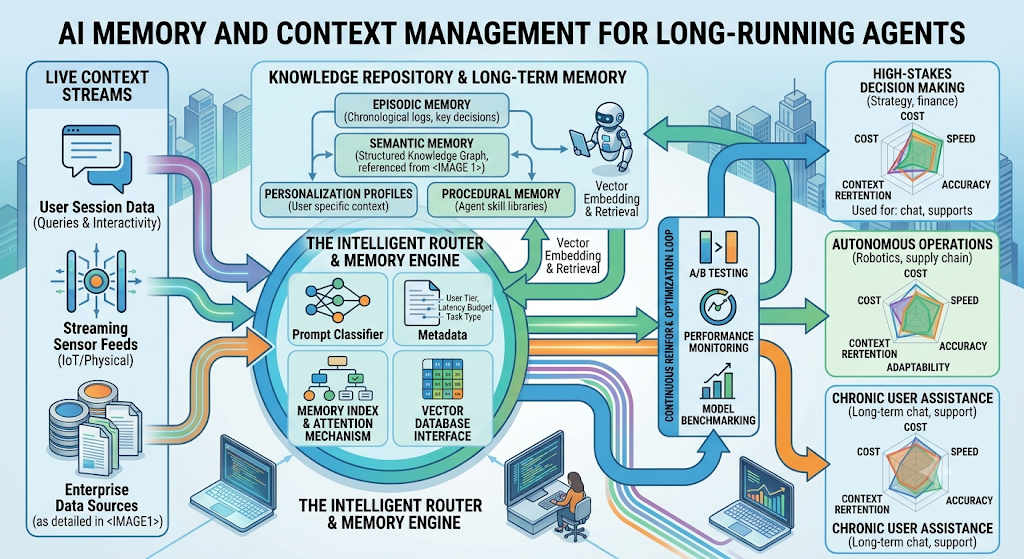
AI memory and context management is the discipline of building that system. It is not a single database. It is an architecture of tiers—working memory, episodic memory, semantic memory—connected by consolidation and retrieval processes that determine what the agent remembers, what it forgets, and what it recalls at the right moment.
The field has matured rapidly. Research from 2026 shows that selective memory outperforms full history: an agent that retains only four categories of reusable context completes tasks at essentially the same cost as one with no memory, while an agent with full conversation history uses twice the tokens and does not improve on completion . What is kept matters more than how much is kept.
For Indian businesses, this matters because long-running agents are moving from demos to production. An agent that manages customer relationships over months, an agent that monitors operations continuously, an agent that maintains a project across sessions—all require memory that survives the context window. The businesses that build this correctly get agents that improve over time. The ones that do not get agents that repeat mistakes and forget preferences.
India adds specific considerations. DPDPA applies to memory that contains personal data, requiring consent tracking, retention policies, and erasure capabilities. MeitY AI governance expects transparency about what the agent remembers and why. Data localisation may require memory stores in India for regulated sectors. And cost management matters because memory systems consume storage, retrieval tokens, and consolidation compute.
This guide is written for Indian CTOs, AI engineers, and product managers building long-running agents. We will cover the tiered memory architecture, the compression and consolidation strategies, the retention and forgetting policies, real costs in rupees and dollars, DPDPA compliance, and a phased implementation framework with clear go/no-go gates.
The Memory Hierarchy: Working, Episodic, and Semantic
Human memory is not a single store. It is a hierarchy: working memory for the current task, episodic memory for events, semantic memory for facts. AI agent memory architectures mirror this structure because it solves the same problem: managing bounded attention over unbounded experience.
Working Memory (The Context Window)
Working memory is what the LLM sees right now. It is bounded by the context window—typically 100K–200K tokens. It contains the system prompt, the current task, recent conversation turns, and retrieved memories.
The design challenge is bounded prompt growth. In a long-running session, the prompt grows monotonically as messages accumulate. Eventually it exceeds the context window, and the oldest messages are truncated. This creates a "sawtooth" pattern: the agent forgets the oldest context precisely when it might need it.
The solution is non-blocking compression. When working memory exceeds a soft limit, the oldest messages are compressed into a summary and moved to a lower tier. The main agent loop never waits for summarization. This keeps the prompt size stable during long-running sessions .
Episodic Memory (The Event Log)
Episodic memory stores what happened: conversation turns, tool calls, outcomes, timestamps. It is the raw material from which semantic memory is built.
The design principle is timeline-ordered events tagged by session. Each episode contains an event description, a summary, entities involved, and potentially emotional valence. Episodes serve as an accumulation buffer before consolidation .
Episodic memory is not retrieved directly in most architectures. It is the source that consolidation processes read from to extract facts.
Semantic Memory (The Knowledge Store)
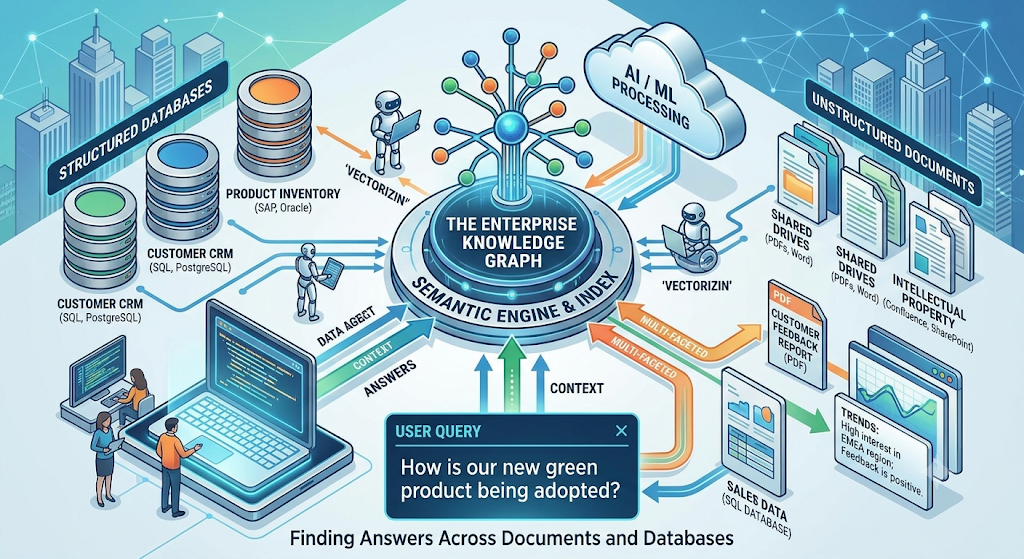
Semantic memory stores consolidated facts as subject-predicate-object triples or structured records. It is what the agent "knows" about the world: customer preferences, project constraints, operational rules.
Three design decisions distinguish a robust semantic memory :
Contradiction detection. Before storing a new fact, the system checks existing facts with matching subject and predicate. If a contradiction is found, both facts are recorded with confidence scores and provenance, allowing downstream consumers to resolve conflicts.
Soft deletes. Facts are never hard-deleted. They are retracted with a reason and timestamp, preserving the audit trail. This models the observation that memory suppresses rather than erases.
Mandatory provenance. Every semantic fact references at least one source episode. Orphan facts are architecturally impossible. This enables full traceability from any fact back to the experience that produced it.
The Memory Hierarchy Table
| Tier | Capacity | Content | Retrieval | Persistence |
|---|---|---|---|---|
| Working | Bounded (100K–200K tokens) | System prompt, recent turns | Always visible | Session |
| Episodic | Unbounded | Events, conversations, tool calls | Search, recent | Cross-session |
| Semantic | Unbounded | Facts, preferences, rules | Semantic search | Permanent (with retention) |
For teams building the memory systems and integrations, our AI Agents and AI Development practices cover the full stack.
Consolidation: Turning Experience Into Knowledge
Consolidation is the process that transforms episodic memory into semantic memory. It is what makes memory useful rather than just large.
The Consolidation Pipeline
1. Episode ingestion. After each session, the transcript is parsed into a structured episode with entities and valence .
2. Fact extraction. An LLM processes the episode and extracts semantic facts: "Customer prefers WhatsApp," "Project deadline is March 15," "Vendor requires 30-day notice."
3. Contradiction check. Extracted facts are compared against existing facts. Contradictions are recorded, not silently overwritten.
4. Storage with provenance. Facts are stored with a reference to the source episode.
5. Marking as consolidated. The episode is marked to prevent reprocessing.
The Salience Engine
Not all memories are equally important. A salience engine scores every memory item on multiple dimensions, and the composite score governs eviction, consolidation priority, and retrieval ranking.
Research on cognitive-science-inspired memory architectures identifies six salience signals :
| Signal | Cognitive Analog | Range |
|---|---|---|
| Reward signal | Dopaminergic reinforcement | [0,1] |
| Error signal | Prediction error / surprise | [0,1] |
| Novelty score | Orienting response | [0,1] |
| Emotional intensity | Amygdala modulation | [0,1] |
| Goal relevance | Prefrontal attention | [0,1] |
| Access count | Rehearsal / retrieval practice | N |
The composite score determines what gets evicted from working memory, what gets consolidated first, and what gets retrieved when the agent needs context.
Decay and Forgetting
Memory should decay. An agent that remembers everything equally is an agent that retrieves noise. The design challenge is graceful forgetting: retaining what matters, letting what does not fade, and preserving the ability to audit what was forgotten and why.
Decay-aware retrieval weights recent memories more heavily than old ones, unless the old memory has high salience. TTL-based retention deletes memories after a defined period unless they are consolidated into semantic memory. Soft deletes preserve the audit trail even after a fact is retracted.
Context Compression: Fitting Experience Into the Window
The context window is the agent's desk. It is small and it must be kept clear. Compression is how the agent decides what goes on the desk.
The Compression Strategies
1. Truncation. Drop the oldest messages. Simple, fast, but loses information. Use as a fallback, not a primary strategy.
2. Pruning. Remove low-value content: tool outputs that are no longer relevant, trivial exchanges ("ok", "thanks"), redundant messages. Faster than summarization (~50ms) and preserves the important turns .
3. Summarization. Compress old messages into a summary using an LLM. Slower (~3–5s) but preserves the essence of the conversation. Can run in the background so the agent loop never waits .
4. Selective memory. Instead of keeping everything, retain only specific categories of reusable context: task specifications, data schemas, tool configurations, output constraints. Discard session-specific reasoning traces .
The Selective Memory Advantage
Research on coding agents found that selective memory outperforms full history. In a controlled experiment, no memory completed 0/12 trials at 3.8K input tokens, selective memory completed 12/12 at 3.9K, and full conversation history completed 8/12 at 7.7K .
The lesson: what is kept matters more than how much is kept. An agent that retains the right four categories of context can complete tasks at the same cost as an agent with no memory, while an agent that keeps everything uses twice the tokens and performs worse.
The Compression Pipeline
A production compression pipeline runs in the background:
Working memory approaches soft limit.
Oldest messages are sliced into chunks.
Noise is pruned.
Cleaned content is sent to a summarization model (local Ollama or cloud).
Extracted outputs are merged into episodic and semantic memory.
Original messages are removed from working memory.
The agent loop continues without waiting .
This creates a repeating "sawtooth" token profile rather than monotonic growth.
Memory Platforms: Mem0, Letta, Zep, and Beyond
The memory platform landscape has matured. Choosing the right platform depends on the agent's requirements, the team's capabilities, and the compliance context.
The Major Platforms
Mem0. Universal memory SDK for LLM apps. $24M Series A, ~48K GitHub stars. Vector search, partial graph support (Pro tier), managed infrastructure. Accuracy benchmark: 82.1% on LOCOMO, avg latency 180ms .
Letta (ex-MemGPT). Stateful agent platform based on the "LLM-as-OS" concept. $10M seed, ~17K stars. Native memory blocks, full open-source, local execution. The strongest choice for teams that want an agent runtime with first-class memory .
Zep. Enterprise temporal knowledge graph. Bi-temporal modeling (valid_from/valid_to), point-in-time queries. Accuracy benchmark: 80.4% on LOCOMO, avg latency 85ms—faster than Mem0 but slightly less accurate . The strongest choice for agents that need to reason about time and change.
Mnemo. On-prem, MCP-native, cryptographically-auditable memory database. Includes DPDPA consent management and EU AI Act audit-log export. The strongest choice for Indian enterprises with strict compliance requirements .
Platform Comparison Table
| Platform | Type | Strength | India Consideration |
|---|---|---|---|
| Mem0 | Managed SDK | Accuracy, ecosystem | Verify India data region |
| Letta | Agent runtime | Full control, local | Self-host in India |
| Zep | Temporal KG | Time-aware reasoning | Managed India region |
| Mnemo | Compliance-first | DPDPA, audit | On-prem, India-ready |
The Starting Point
The escalation path recommended by practitioners :
Start with file-based memory. Most agents do not need a temporal knowledge graph on day one. A simple file or JSON store for preferences and constraints is sufficient for early agents.
Move to Mem0 or a vector store when the agent needs semantic search and multi-tenant isolation.
Add Zep/Graphiti when the agent needs relationship traversal, temporal validity, or cross-session synthesis.
Use Letta or Cognee when the agent must self-manage its memory with deep introspection.
Real Costs in India (2026)
AI memory costs have three components: storage, retrieval, and consolidation compute.
Implementation Costs
| Scope | Cost (₹) | Cost ($ approx.) | Timeline |
|---|---|---|---|
| Simple memory (file-based, working memory compression) | ₹1–3 lakh | $1,200–$3,600 | 3–6 weeks |
| Vector memory (semantic search, episodic storage) | ₹3–8 lakh | $3,600–$9,600 | 6–12 weeks |
| Tiered memory (working + episodic + semantic, consolidation) | ₹8–20 lakh | $9,600–$24,000 | 12–20 weeks |
| Enterprise memory (temporal KG, compliance, multi-agent) | ₹20–50 lakh | $24,000–$60,000 | 20–32 weeks |
Running Costs
| Component | Monthly Cost (₹) | Monthly Cost ($ approx.) | Notes |
|---|---|---|---|
| Vector/graph storage | ₹5,000–₹40,000 | $60–$480 | Scales with memory volume |
| Retrieval API | ₹5,000–₹30,000 | $60–$360 | Per-query pricing |
| Consolidation LLM | ₹10,000–₹50,000 | $120–$600 | Summarization and fact extraction |
| Maintenance | ₹15,000–₹60,000 | $180–$720 | 15–25% of build annually |
The Memory Cost Trade-off
Memory is not free, but forgetting is more expensive. An agent that forgets a customer preference loses trust. An agent that forgets a project constraint produces incorrect work. The cost of memory is justified by the cost of amnesia.
Research on production deployments found that mean query latency for a knowledge-graph memory system was 1.539 seconds, with a further 0.541 seconds of maintenance amortized per query . This is acceptable for background agents but may be too slow for real-time chat. Design the memory retrieval to be parallel with other operations where possible.
India-Specific Compliance: DPDPA and Memory Retention
DPDPA and Memory Stores
Memory stores contain personal data: customer preferences, employee interactions, conversation history. Under the DPDP Act:
Consent. Memory that contains personal data requires consent. The agent should not remember personal data for purposes beyond what was consented to.
Retention. Memory must have a defined retention period. The DPDP Rules 2025 specify 365 days for processing logs in some contexts . Memories should be purged or anonymised after retention expires.
Erasure. If a Data Principal requests erasure, the memory system must be able to delete their data—including from semantic memory and episodic memory. Soft deletes preserve the audit trail but the personal data must be removed.
Audit. The memory system should log what was stored, retrieved, and deleted, for accountability.
Mnemo's DPDPA Primitives
Mnemo provides technical substrate for DPDPA compliance :
Consent management: HttpConsentManager, ConsentState, ConsentScope.
Retention profiles: RetentionProfile with DPDP Rules 2025 → 365 days.
Audit export: Tamper-evident, Ed25519-signed NDJSON export.
Retention conformance: Verifies that deletion/compaction paths did not drop or rewrite log rows inside the retention floor.
This is not a compliance certificate. It is the technical substrate that supports compliance.
Compliance Checklist
| Requirement | Implementation | Priority |
|---|---|---|
| Consent tracking | Memory records consent status | High |
| Retention policy | TTL, automated purge | High |
| Erasure support | Delete personal data from all tiers | High |
| Audit logging | Log memory writes and deletes | High |
| Data localisation | Indian region for regulated data | High (regulated) |
| Provenance | Every fact traceable to source | High |
Implementation Framework: A Phased Approach With Cost Gates
Phase 1: Memory Requirements (Week 1–2)
Objective: Define what the agent needs to remember and for how long.
Activities:
Identify the categories of reusable context (task specs, schemas, preferences, constraints).
Define retention periods for each category.
Assess DPDPA exposure (personal data in memory).
Choose the memory architecture (file, vector, tiered).
Cost: ₹50,000–₹1.5 lakh ($600–$1,800).
Go/No-Go: Requirements defined. Architecture chosen.
Phase 2: Working Memory Compression (Week 3–8)
Objective: Implement bounded prompt growth.
Activities:
Implement soft/hard token limits.
Implement background summarization or pruning.
Test long-running sessions.
Measure prompt stability.
Cost: ₹1–3 lakh ($1,200–$3,600).
Go/No-Go: Prompt size stable. Agent does not forget critical context.
Phase 3: Episodic and Semantic Memory (Week 9–16)
Objective: Add persistent memory.
Activities:
Implement episodic storage (timeline, sessions).
Implement semantic storage (facts, preferences).
Implement consolidation pipeline.
Implement retrieval with salience ranking.
Cost: ₹3–8 lakh ($3,600–$9,600).
Go/No-Go: Facts retained across sessions. Retrieval relevant.
Phase 4: Compliance and Scale (Week 17–24)
Objective: Add retention, erasure, and audit.
Activities:
Implement consent tracking.
Implement retention policies and automated purge.
Implement erasure across all tiers.
Implement audit logging.
Scale to production.
Cost: ₹5–15 lakh ($6,000–$18,000).
Go/No-Go: DPDPA review passes. Memory stable at scale.
Phase Summary Table
| Phase | Duration | Key Deliverable | Cost (₹) | Go/No-Go Criteria |
|---|---|---|---|---|
| 1. Requirements | 2 weeks | Categories, retention | 50,000–1.5 lakh | Architecture chosen |
| 2. Compression | 6 weeks | Bounded prompt growth | 1–3 lakh | Prompt stable |
| 3. Persistent Memory | 8 weeks | Episodic + semantic tiers | 3–8 lakh | Facts retained |
| 4. Compliance | 8 weeks | Retention, erasure, audit | 5–15 lakh | DPDPA passes |
Risks, Pitfalls, and Governance
The Most Common Memory Failures
Keeping everything. Full history uses tokens without improving outcomes. Mitigation: Selective memory, consolidation.
Keeping nothing. The agent forgets preferences and repeats mistakes. Mitigation: Semantic memory for durable facts.
Stale facts. The agent remembers an outdated preference. Mitigation: Contradiction detection, recency weighting.
No provenance. The agent cannot explain why it believes something. Mitigation: Mandatory provenance.
Retention violations. Personal data kept beyond policy. Mitigation: TTL, automated purge.
Memory poisoning. Malicious input corrupts the memory store. Mitigation: Input validation, soft deletes, audit.
Risk Summary Table
| Risk | Likelihood | Impact | Mitigation |
|---|---|---|---|
| Keeping everything | High | Medium (cost) | Selective memory |
| Keeping nothing | High | High (quality) | Semantic memory |
| Stale facts | High | High (wrong actions) | Contradiction detection |
| No provenance | Medium | High (audit) | Mandatory provenance |
| Retention violations | Medium | Critical (DPDPA) | TTL, purge |
| Memory poisoning | Medium | High | Validation, soft deletes |
Benchmark Summary and Decision Framework
Decision Matrix: Memory Architecture by Agent Type
| Agent Type | Recommended Memory |
|---|---|
| Short-running chat | Working memory only |
| Coding agent | Selective memory (specs, schemas, tools) |
| Customer agent | Semantic memory (preferences) + episodic |
| Operations agent | Tiered memory + temporal KG |
| Compliance-sensitive | Mnemo or equivalent with audit |
Memory Priority Table
| Priority | Capability | Why |
|---|---|---|
| 1 | Working memory compression | Prevents context overflow |
| 2 | Semantic memory | Durable facts |
| 3 | Provenance | Auditability |
| 4 | Contradiction detection | Prevents stale facts |
| 5 | Retention/erasure | DPDPA compliance |
The One-Paragraph Decision Rule
If your agent runs longer than a single session, implement working memory compression first. Add semantic memory for the facts that must survive. Keep only what is reusable—task specs, schemas, preferences, constraints—not the full conversation. Add contradiction detection and provenance. And ensure DPDPA compliance: consent, retention, erasure, audit. Memory is not about storing everything. It is about storing the right things.
Frequently Asked Questions
1. What is AI memory and context management?
It is the discipline of giving long-running AI agents the ability to retain and recall information beyond the context window, through tiered memory stores (working, episodic, semantic) and consolidation processes.
2. Why do long-running agents need memory?
LLMs have bounded context windows. An agent that runs for days or weeks cannot keep its entire history in the prompt. Without external memory, it forgets preferences, repeats mistakes, and loses continuity.
3. What is the difference between working, episodic, and semantic memory? Working memory is the current context window. Episodic memory is the event log (what happened). Semantic memory is the consolidated facts (what the agent knows).
4. What is selective memory and why does it work?
Selective memory retains only reusable context (task specs, schemas, tools, constraints) and discards session-specific reasoning. Research shows it outperforms full history at a fraction of the token cost .
5. Should I use Mem0, Letta, or Zep?
Mem0 for accuracy and ecosystem. Letta for full control and local execution. Zep for temporal knowledge graphs and time-aware reasoning. Mnemo for DPDPA-compliant audit .
6. How does DPDPA affect agent memory?
Memory that contains personal data requires consent, retention policies, erasure support, and audit logging. Memory stores may need to be in Indian regions for regulated sectors.
7. What is consolidation?
Consolidation is the process of extracting semantic facts from episodic memories. It transforms experience into knowledge.
8. What is a salience engine?
A salience engine scores memory items on multiple dimensions (reward, error, novelty, emotion, goal relevance, access count) to govern eviction, consolidation, and retrieval .
9. How much does agent memory cost in India?
Simple memory costs ₹1–3 lakh. Vector memory costs ₹3–8 lakh. Tiered memory costs ₹8–20 lakh. Enterprise memory costs ₹20–50 lakh. Running costs add ₹15,000–₹60,000/month.
10. How do I prevent the agent from remembering stale facts?
Implement contradiction detection. When a new fact contradicts an existing one, record both with confidence and provenance, and let recency and confidence determine retrieval.
11. What is memory provenance and why does it matter?
Provenance is the reference from a semantic fact back to the source episode. It enables auditability and debugging. Without it, the agent cannot explain why it believes something.
12. How can Innovative AI Solutions help?
Innovative AI Solutions builds AI memory and context management systems for Indian businesses—tiered memory architecture, consolidation pipelines, retention policies, and DPDPA-compliant memory stores. Our Delhi-based team handles assessment, implementation, and optimization. Visit https://innovativeais.com to discuss your requirements.
Contact Innovative AI Solutions
Ready to build an agent that remembers what matters and forgets what does not?
[One-line supporting sentence.]
Contact Information
Innovative AI Solutions
📍 Netaji Subhash Place, Pitampura, Delhi – 110034
🌐 Website: https://innovativeaislabs.com 📧 Email: info@innovativeais.com
📞 Phone: +91 7464 099 059 / +91 96899 67356
Business Services
AI Automation
AI Development
AI Consulting
Machine Learning Solutions
Deep Learning Solutions
Generative AI Services
NLP Solutions
AI Agents
AI Chatbots
Voice AI
CRM Development
Custom Software Development
Website Development
Mobile App Development
About the Author
Abhishek Kumar
Founder & CEO, Innovative AI Solutions
5+ years building production AI systems for Indian businesses. Based in Delhi, serving clients across India.
Ready to build AI solutions for your business?
Innovative AI Solutions — Delhi's leading AI development company. Free consultation available.
Get Free Consultation →
A practical 2026 guide for Indian teams building long-running agents—tiered memory architecture, context compression, consolidation, retention, real rupee costs, and DPDPA-compliant memory stores.
#AIMemory #ContextManagement #LongRunningAgents #TieredMemory #ContextCompression #MemoryConsolidation #Mem0 #Letta #Zep #TemporalKnowledgeGraph #VectorStore #KnowledgeGraph #EpisodicMemory #SemanticMemory #DPDPA #MeitY #RetentionPolicy #DelhiNCR #InnovativeAISolutions
Copyright ©️ 2015–2026 Innovative AI Solutions. All Rights Reserved. | Privacy Policy | Terms & Conditions