


The Answer That Exists But Cannot Be Found
A compliance officer needs to verify whether a specific customer has a documented exception to the company's standard seven-year data retention policy. The exception, if it exists, could be in a contract amendment, a signed addendum stored as a scanned PDF, or a record in the compliance management system. She searches the internal portal. The top results are a three-year-old version of the general retention policy, a training slide deck, and a video walkthrough of the policy framework—none of which contain what she needs. She runs the same query in the document management system, then in the compliance tool. Nothing surfaces the right record. She eventually messages a colleague who remembers seeing the amendment during onboarding.
The organisation had the answer. The discovery layer could not find it.
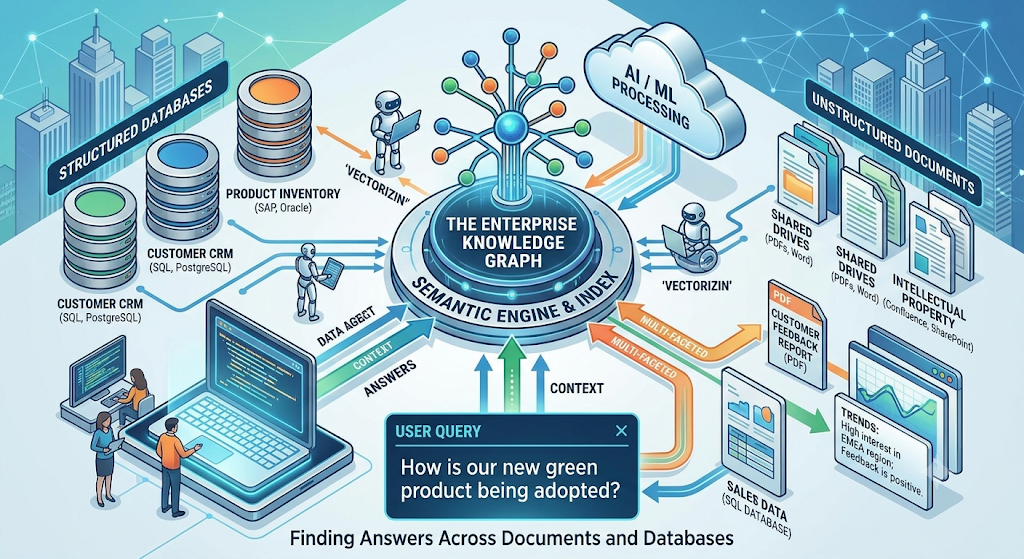
This is the defining failure of enterprise search. The data exists. It is spread across documents, databases, wikis, email, and line-of-business applications. But the search layer is built around a single retrieval method—usually keyword search, sometimes pure vector search—and that method fails for a large portion of real queries. Iron Mountain describes this precisely: the instinct is to blame data quality, but in most organisations, data quality is not the root problem. What is missing is a discovery layer capable of reaching across different content formats and systems to return the right answer from whichever of them holds it .
Enterprise semantic search is the discipline of building that discovery layer. It is not a single search engine. It is an architecture that combines multiple retrieval paths—semantic vector search over documents, structured SQL queries over databases—and resolves them into a coherent, cited, permission-aware answer.
For Indian enterprises, this matters because knowledge work is increasingly cross-system. A sales manager needs a customer's contract terms (documents) and their payment history (database). A procurement officer needs vendor compliance certificates (documents) and delivery performance records (database). A single retrieval method cannot answer these queries reliably.
India adds specific considerations. DPDPA applies to personal data in search indexes and vector stores, requiring access control, retention policies, and data localisation for regulated sectors . MeitY AI governance expects transparency about which sources were used and accountability for the answers. Permission-aware search is non-negotiable—an employee must not see documents they could not open in the source system. And cost management matters because embedding, indexing, and LLM generation all consume budget.
This guide is written for Indian CTOs, IT heads, knowledge managers, and enterprise architects evaluating semantic search. We will cover the parallel retrieval architecture, the hybrid search and reranking, the vector database and embedding choices, permission-aware discovery, real costs in rupees and dollars, DPDPA compliance, and a phased implementation framework with clear go/no-go gates.
Why a Single Retrieval Strategy Fails
Most enterprise search systems pick one retrieval method and apply it to all queries. The problem is that different question types require structurally different retrieval paths.
Consider three cases :
Case 1: Structured query. "Show me all employees earning more than ₹50,000 per month" has a precise, deterministic answer in a structured table. Keyword and semantic retrieval are both wrong here—they surface documents that discuss compensation rather than contain the actual records. A SQL query against the relevant table is the correct retrieval path.
Case 2: Synthesis query. "Summarise the compliance landscape for this account" is structurally different. There is no single database field holding a compliance summary. The right approach is retrieval-augmented generation: identify the most relevant document chunks using vector similarity, inject those chunks into the LLM context, and generate a response grounded in the retrieved content.
Case 3: Hybrid query. "What are the standard payment terms for retail vendors, and have there been any exceptions?" The first part has a structured answer in a database record; the second requires reading across contracts, amendments, and correspondence. Neither SQL alone nor RAG alone handles this adequately. Both retrieval paths need to run and their outputs need to be ranked coherently against each other.
That third case represents a substantial portion of real enterprise queries. A system designed around a single retrieval method has no good answer to it .
The Router Problem
A simpler design would be a query router: classify the query first, pick one retrieval path, execute it. The problem with a router is that it requires the classifier to be correct before any results are seen. When the classifier is wrong—and on genuinely hybrid queries, no classifier is always right—the correct answer is simply not retrieved .
Running both paths simultaneously changes the failure mode. There is a higher computational cost, but latency is not an issue because the paths execute in parallel. A misclassification at reranking costs the best result, but other relevant results are still retrieved .
Retrieval Strategy Comparison Table
| Query Type | Correct Retrieval Path | Single-Method Failure |
|---|---|---|
| Structured (counts, thresholds) | SQL | Semantic search returns documents, not records |
| Synthesis (summaries, explanations) | RAG (vector + LLM) | SQL cannot synthesise across sources |
| Hybrid (terms + exceptions) | Parallel SQL + RAG | Router misclassifies, loses the answer |
For teams building the retrieval pipelines and integrations, our AI Development and Generative AI Services practices cover the full stack.
The Parallel Retrieval Architecture
The architecture that works runs multiple retrieval paths simultaneously and resolves them at reranking.
The Components
1. Query intake. The user submits a natural language query.
2. Parallel retrieval. Two or more retrieval paths execute simultaneously:
RAG path: The query is embedded, vector similarity search retrieves relevant document chunks.
SQL path: The query is translated to SQL (or a structured query) and executed against the database.
3. Intent scoring. An intent engine evaluates the query in real time—classifying whether it points at a structured record, requests synthesis, or requires both .
4. Deduplication. Results that may have been surfaced by multiple engines are merged into a clean final list.
5. Intent-based reranking with additive bias. The final result set is reranked using generated intent scores. This "boosts" assets originating from the predicted favourite retrieval method. Crucially, top results from the "unfavourite" path are also kept. This additive bias improves performance without the risk of losing relevant content .
6. Permission filtering. Retrieved results are filtered against the user's permissions in the source systems. A user only sees documents and records they are authorised to access.
7. Answer generation and citation. The LLM generates an answer grounded in the retrieved results, with citations to the source documents and records.
The Architecture at a Glance
| Stage | Function | Key Consideration |
|---|---|---|
| Query intake | Receive natural language query | Multilingual support for Indian users |
| Parallel retrieval | Run RAG and SQL simultaneously | Cost vs accuracy trade-off |
| Intent scoring | Classify query type | Must handle hybrid queries |
| Reranking | Merge and rank results | Additive bias preserves recall |
| Permission filtering | Enforce access control | Non-negotiable for DPDPA |
| Generation | Produce cited answer | Grounding prevents hallucination |
Hybrid Search: Keyword and Vector Together
Within the RAG path, pure vector search is often insufficient. Enterprise documents are full of exact-match terminology—product codes, GSTINs, legal citations, acronyms—that vector search can miss. Hybrid search combines BM25 keyword matching with dense vector similarity to handle both exact terms and semantic concepts.
Microsoft's guidance is clear: hybrid search combined BM25 keyword matching with vector similarity to handle both exact clinical terminology and semantic concept matching. This dual approach ensured that queries for specific drug names, diagnostic codes, or test values retrieved documents containing those exact terms, while queries about symptoms or treatment approaches found semantically similar content even when different vocabulary was used .
The Production Default
Industry practitioners describe hybrid + rerank as the production default in 2026: "BM25 + dense, then cross-encoder rerank, is the production default in 2026" . The reason is that neither method alone is sufficient. Keyword search is precise but brittle. Vector search is flexible but imprecise. Together, they cover both.
Multi-Stage Reranking
Hybrid search produces an initial result set. Reranking refines it:
Stage 1: Reciprocal Rank Fusion (RRF). Combines BM25 and vector scores into a single ranking.
Stage 2: Semantic ranking. A language-understanding model re-scores the top results. Azure AI Search's semantic ranker adds minimal latency and should be enabled by default .
Stage 3: Cross-encoder reranking. A specialised model re-scores the top candidates. Adds 50–200ms but significantly improves relevance. Justify with offline evaluation showing at least 5 percentage points of nDCG improvement .
Stage 4: LLM-as-reranker. The most expensive option, reserved for the final 3–5 candidates when accuracy justifies the cost .
Search Stage Table
| Stage | Method | Latency | When to Use |
|---|---|---|---|
| Initial retrieval | BM25 + vector (hybrid) | Low | Always |
| Fusion | RRF | Minimal | Always |
| Semantic ranking | Cross-encoder | 50–200ms | Default for domain content |
| LLM reranker | LLM | High | Final candidates, high accuracy |
Embedding Models and Vector Databases
The retrieval quality is bounded by the embedding model. A great database with a mediocre embedding model produces mediocre results.
Embedding Model Choices
For Indian enterprises, three default picks cover most needs :
OpenAI text-embedding-3-large. 3072 dimensions, strong general English, Matryoshka representation allows truncation to 1024 or 256 dimensions with minimal quality loss. Default for English-dominant corpora.
Cohere embed-v4. Multilingual, strong on long documents, supports input-type hints ("search_query" vs "search_document"). Recommended when the corpus includes Hindi, Tamil, or mixed-language documents.
BGE-M3 or bge-large-en-v1.5. Open-source, runs locally or on your own GPU. Use when data cannot be sent to a hosted API, or when cost control requires self-hosting.
Practical rules: Match the embedding to the corpus language. English-only models on Hindi documents fail silently. Embed queries and documents with the same model. Re-embed everything when you change models—there is no migration path between embedding spaces .
Vector Database Choices
The vector database landscape has matured. The right choice depends on existing infrastructure, scale, and compliance requirements.
pgvector. Postgres extension. Vectors live in the same database as application data, enabling JOINs against structured tables. Scales to roughly 10 million vectors comfortably. Default for teams already on Postgres. NASSCOM's India governance guidance notes that keeping structured data, metadata, and embeddings in PostgreSQL simplifies governance and security .
Qdrant. Open-source, Rust-based, fast HNSW, good filtering. Self-hostable or managed. Default for teams that want open-source plus production polish. Binary quantization delivers 32x memory reduction .
Pinecone. Managed, scales to billions, hybrid search built in. Default for teams that want managed and have budget .
Elasticsearch. If you already run keyword search in production, the cheapest route to semantic retrieval is often the engine you have. Elasticsearch combines BM25 with dense vector retrieval in one index, plus aggregations, faceting, and permissions that operations teams already know .
Weaviate. Enterprise-friendly, multi-tenancy, hybrid search, modules for external models .
The Pragmatic Starting Point
Most teams should not start with a dedicated vector database. Start with pgvector if you are on Postgres, or Elasticsearch if you already run it. Migrate to a dedicated vector database when you outgrow it—the query API is similar enough that switching is days, not weeks .
Vector Database Comparison Table
| Database | Best For | Scale | India Consideration |
|---|---|---|---|
| pgvector | Postgres teams, governance simplicity | ~10M vectors | Data stays in existing DB |
| Qdrant | Open-source, performance | Billions | Self-host in India |
| Pinecone | Managed, scale | Billions | Verify India region |
| Elasticsearch | Existing keyword search | Large | Mature permissions |
| Weaviate | Enterprise features | Large | Managed India region |
Permission-Aware Search: The Non-Negotiable
An enterprise search system that ignores permissions is a data breach waiting to happen. An employee who is not authorised to see salary data must not be able to search for it and receive it.
The Permission Challenge
Permissions in source systems (SharePoint, SAP, CRM) are complex: inherited from folders, groups, sharing links. They change over time. They are per-user and per-object. You cannot index once and let everyone search everything, because that defeats the purpose of having permissions .
The Solution: Permission-Aware Indexing and Filtering
The approach that works:
Index time: Each document chunk is tagged with the access permissions materialised from the source system. The SAP connector reads the same authorisation objects users already have. The SharePoint connector reads the same sharing permissions .
Query time: The RBAC check is not an afterthought on top of search. It is the search. Every result is filtered against the permissions materialised from the source systems, so the index can only return what the specific user could open in the source system anyway .
The practical consequence: A junior engineer can search the same corpus as the CFO and see a smaller, correct, authorised slice of it. The financial projections are in the index. They are simply not in the junior engineer's answer .
The Cost of Doing It Properly
Materialising permissions adds ingestion overhead and a little query latency. That is the difference between a demo and a deployment . For DPDPA compliance, it is not optional.
Real Costs in India (2026)
Enterprise semantic search costs have three components: implementation, infrastructure, and ongoing operations.
Implementation Costs
| Scope | Cost (₹) | Cost ($ approx.) | Timeline |
|---|---|---|---|
| Single-source RAG (one document repository) | ₹2–5 lakh | $2,400–$6,000 | 4–8 weeks |
| Hybrid search (keyword + vector, one source) | ₹5–12 lakh | $6,000–$14,400 | 8–14 weeks |
| Parallel RAG + SQL (documents + database) | ₹12–30 lakh | $14,400–$36,000 | 14–24 weeks |
| Enterprise discovery layer (multi-source, permissions, reranking) | ₹30–80 lakh | $36,000–$96,000 | 24–36 weeks |
Infrastructure Costs
| Component | Monthly Cost (₹) | Monthly Cost ($ approx.) | Notes |
|---|---|---|---|
| Vector database | ₹5,000–₹40,000 | $60–$480 | pgvector cheaper than managed |
| Embedding API | ₹5,000–₹40,000 | $60–$480 | Scales with indexing and queries |
| LLM generation | ₹10,000–₹80,000 | $120–$960 | Scales with query volume |
| Reranking | ₹5,000–₹30,000 | $60–$360 | Cross-encoder compute |
| Hosting | ₹10,000–₹50,000 | $120–$600 | Cloud infrastructure |
The ROI Case
For a company with 500 employees spending 2 hours/week searching for information, the annual cost of search time is roughly ₹2.6 crore at ₹500/hour. A 30% reduction from semantic search saves ₹78 lakh per year. The implementation cost is recovered in months, not years.
Cost Note
USD conversions at ₹83/$. These ranges are indicative for Indian enterprise deployments. Actual costs vary with source count, document volume, and permission complexity.
India-Specific Compliance: DPDPA and Vector Database Governance
DPDPA and Semantic Search
Semantic search indexes and vector stores contain personal data: employee records, customer information, contracts. Under the DPDP Act :
Data localisation. The DPDP Act does not mandate strict localisation, but sector-specific rules remain. RBI requires payment system data to be stored in India. Insurance records must be stored within India. For these sectors, the vector database and search index must be in Indian regions .
Retention and deletion. Embeddings must have TTL metadata. Implement automated purging. Ensure deletion cascades to vector indices when source documents are removed .
Significant Data Fiduciaries. Large data processors may be classified as SDFs, requiring an India-based DPO, annual DPIAs, and independent audits .
Permission-aware access. The search layer must enforce source-system permissions. An employee must not see data they could not access in the source system.
MeitY AI Governance
MeitY's guidelines expect transparency about which sources were used and accountability for answers. For semantic search, this means citing sources, logging queries and results, and documenting the retrieval architecture.
Compliance Checklist
| Requirement | Implementation | Priority |
|---|---|---|
| Permission-aware search | RBAC filtering at query time | High |
| Data localisation | Indian region for regulated data | High (regulated) |
| Retention and deletion | TTL, automated purge, cascade | High |
| Audit logging | Log queries, retrievals, results | High |
| Source citation | Cite documents and records | High |
| SDF assessment | Assess volume and impact | Medium |
Implementation Framework: A Phased Approach With Cost Gates
Phase 1: Discovery Audit (Week 1–3)
Objective: Map data sources, query types, and permission complexity.
Activities:
Inventory document sources and databases.
Classify query types (structured, synthesis, hybrid).
Assess permission complexity in source systems.
Identify compliance requirements (DPDPA, sectoral).
Define success metrics.
Cost: ₹50,000–₹1.5 lakh ($600–$1,800).
Go/No-Go: Sources mapped. Query types understood. Business case validated.
Phase 2: Single-Path RAG (Week 4–11)
Objective: Build a working RAG pipeline on one document source.
Activities:
Implement document ingestion and chunking.
Implement embeddings and vector storage.
Build retrieval and generation with citations.
Add permission filtering.
Test with a pilot user group.
Cost: ₹2–5 lakh ($2,400–$6,000).
Go/No-Go: Answers are accurate and cited. Permissions work.
Phase 3: Hybrid Search (Week 12–19)
Objective: Add keyword search and reranking.
Activities:
Implement BM25 keyword index.
Implement hybrid search with RRF.
Add semantic reranking.
Evaluate against baseline.
Cost: ₹3–7 lakh ($3,600–$8,400).
Go/No-Go: Hybrid improves on pure vector. Reranking adds value.
Phase 4: Parallel SQL + RAG (Week 20–30)
Objective: Add structured retrieval and intent-based reranking.
Activities:
Implement SQL retrieval path.
Implement parallel execution.
Implement intent scoring and additive-bias reranking.
Add deduplication.
Test with hybrid queries.
Cost: ₹8–20 lakh ($9,600–$24,000).
Go/No-Go: Hybrid queries answered correctly. Parallel architecture works.
Phase 5: Scale and Optimise (Ongoing)
Objective: Expand sources and optimise.
Activities:
Add more sources.
Tune reranking thresholds.
Optimise cost.
Monitor quality.
Cost: ₹20,000–₹1,00,000/month ($240–$1,200).
Phase Summary Table
| Phase | Duration | Key Deliverable | Cost (₹) | Go/No-Go Criteria |
|---|---|---|---|---|
| 1. Discovery | 3 weeks | Source map, query types | 50,000–1.5 lakh | Business case |
| 2. RAG | 8 weeks | Document search with citations | 2–5 lakh | Accurate, cited |
| 3. Hybrid | 8 weeks | Keyword + vector + rerank | 3–7 lakh | Improves on RAG |
| 4. Parallel SQL | 11 weeks | SQL + RAG with intent rerank | 8–20 lakh | Hybrid queries work |
| 5. Scale | Ongoing | Multi-source, optimised | 20,000–1,00,000/month | Quality maintained |
Risks, Pitfalls, and Governance
The Most Common Semantic Search Failures
Single retrieval method. The system is built around vector search only, or SQL only, and fails on the other query types. Mitigation: Parallel retrieval.
Ignoring permissions. The search layer exposes documents the user should not see. Mitigation: Permission-aware indexing and filtering.
Poor chunking. Chunks lose structural context (section headings, table headers). Mitigation: Structure-preserving chunking.
No reranking. Initial retrieval is noisy; results are not refined. Mitigation: Hybrid + rerank.
Stale index. Documents change but embeddings are not updated. Mitigation: Incremental indexing, TTL.
DPDPA non-compliance. Personal data in vector store without access control or retention. Mitigation: RBAC, TTL, audit.
Risk Summary Table
| Risk | Likelihood | Impact | Mitigation |
|---|---|---|---|
| Single retrieval method | High | High (fails queries) | Parallel retrieval |
| Permission bypass | Medium | Critical | Permission-aware filtering |
| Poor chunking | High | Medium (quality) | Structure-preserving |
| No reranking | High | Medium (noise) | Hybrid + rerank |
| Stale index | High | Medium | Incremental indexing |
| DPDPA non-compliance | Medium | Critical | RBAC, TTL, audit |
Benchmark Summary and Decision Framework
Decision Matrix: Retrieval Architecture by Query Mix
| Query Mix | Recommended Architecture |
|---|---|
| Mostly synthesis (summaries, explanations) | RAG + hybrid + rerank |
| Mostly structured (counts, thresholds) | SQL + natural language to SQL |
| Mixed (terms + exceptions) | Parallel RAG + SQL + intent rerank |
| Single document source | RAG + hybrid + permission filtering |
Retrieval Priority Table
| Priority | Capability | Why |
|---|---|---|
| 1 | Permission-aware retrieval | Security, compliance |
| 2 | Hybrid search (BM25 + vector) | Handles exact and semantic |
| 3 | Reranking | Refines noisy initial results |
| 4 | Parallel SQL + RAG | Handles hybrid queries |
| 5 | Intent-based reranking | Resolves paths coherently |
The One-Paragraph Decision Rule
If your enterprise search is failing on real queries, stop indexing more content and fix the discovery layer. Run keyword and vector search together. Add reranking. If your queries span documents and databases, run both retrieval paths in parallel and resolve them at reranking with intent-based scoring. Enforce permissions at query time, not as an afterthought. Cite every source. And ensure DPDPA compliance—access control, retention, localisation—from the start.
Frequently Asked Questions
1. What is enterprise semantic search?
Enterprise semantic search is a discovery layer that finds answers across documents and databases using multiple retrieval methods—vector search, keyword search, and SQL—resolved into a coherent, cited answer.
2. Why does a single retrieval method fail?
Different query types require different retrieval paths. Structured queries need SQL; synthesis queries need RAG; hybrid queries need both. A single method fails on the others .
3. What is parallel retrieval and why does it work?
Parallel retrieval runs RAG and SQL simultaneously, then reranks results with intent-based scoring. It avoids the router problem where a misclassification loses the answer .
4. What is hybrid search?
Hybrid search combines BM25 keyword matching with dense vector similarity. It handles exact terminology (product codes, GSTINs) and semantic concepts in one query .
5. What is reranking and why is it needed?
Reranking refines initial retrieval results using more powerful but slower models. Cross-encoder reranking adds 50–200ms but significantly improves relevance .
6. Which vector database should I use?
pgvector if you are on Postgres. Qdrant for open-source performance. Elasticsearch if you already run keyword search. Pinecone for managed scale .
7. How do I ensure permission-aware search?
Materialise permissions at index time and enforce them at query time. The search must only return what the user could open in the source system .
8. How does DPDPA affect semantic search?
Vector stores contain personal data. Data localisation for regulated sectors, retention and deletion policies, access control, and audit logging apply .
9. How much does enterprise semantic search cost in India?
Single-source RAG costs ₹2–5 lakh. Hybrid search costs ₹5–12 lakh. Parallel RAG + SQL costs ₹12–30 lakh. Enterprise discovery layer costs ₹30–80 lakh.
10. How long does implementation take?
Single-source RAG takes 4–8 weeks. Parallel RAG + SQL takes 14–24 weeks. Enterprise discovery layer takes 24–36 weeks.
11. What is the biggest risk?
Permission bypass—exposing data the user should not see. This is a DPDPA violation and a security failure.
12. How can Innovative AI Solutions help?
Innovative AI Solutions builds enterprise semantic search for Indian businesses—parallel RAG and SQL retrieval, hybrid search, reranking, permission-aware discovery, and DPDPA-compliant vector governance. Our Delhi-based team handles assessment, implementation, and optimization. Visit https://innovativeais.com to discuss your requirements.
Contact Innovative AI Solutions
Ready to build a discovery layer that actually finds the answer?
[One-line supporting sentence.]
Contact Information
Innovative AI Solutions
📍 Netaji Subhash Place, Pitampura, Delhi – 110034
🌐 Website: https://innovativeaislabs.com 📧 Email: info@innovativeais.com
📞 Phone: +91 7464 099 059 / +91 96899 67356
Business Services
AI Automation
AI Development
AI Consulting
Machine Learning Solutions
Deep Learning Solutions
Generative AI Services
NLP Solutions
AI Agents
AI Chatbots
Voice AI
CRM Development
Custom Software Development
Website Development
Mobile App Development
About the Author
Abhishek Kumar
Founder & CEO, Innovative AI Solutions
5+ years building production AI systems for Indian businesses. Based in Delhi, serving clients across India.
Ready to build AI solutions for your business?
Innovative AI Solutions — Delhi's leading AI development company. Free consultation available.
Get Free Consultation →
A practical 2026 guide for Indian enterprises building semantic search—parallel RAG and SQL retrieval, hybrid search, reranking, permission-aware discovery, real rupee costs, and DPDPA-compliant vector governance.
#EnterpriseSemanticSearch #SemanticSearch #EnterpriseSearch #RAG #SQLRetrieval #HybridSearch #VectorSearch #Reranking #KnowledgeDiscovery #VectorDatabase #pgvector #Elasticsearch #DPDPA #MeitY #PermissionAware #DelhiNCR #InnovativeAISolutions
Copyright ©️ 2015–2026 Innovative AI Solutions. All Rights Reserved. | Privacy Policy | Terms & Conditions