The Rewrite Question
Every business with a legacy application eventually asks the same question: should we rewrite it?
The appeal is obvious. The old system is hard to change, expensive to maintain, and holds back new features. A rewrite promises a clean slate — modern architecture, current technology, no technical debt.
The reality is less appealing. Most rewrites fail. They take longer than expected, cost more than budgeted, and deliver less than promised. The business continues to depend on the legacy system while the rewrite drags on, and when the new system finally launches, it does not handle the edge cases the old system handled.
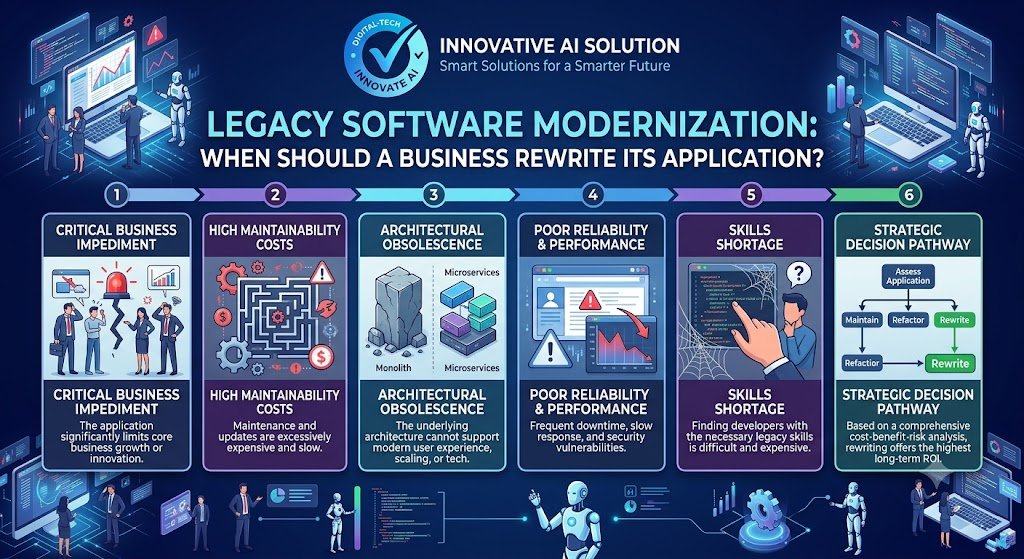
A rewrite is sometimes the right decision. It is justified when incremental modernization cannot deliver the required outcome. The question is knowing when that is.
This guide explains when a business should rewrite its legacy application in 2026. It covers the signals that justify a rewrite, the signals that do not, cost comparisons, and a decision framework.
For organisations modernizing legacy systems, Innovative AI Solutions provides custom software development and architecture consulting.
Why Most Rewrites Fail
The Failure Patterns
| Failure Pattern | Why It Happens |
|---|---|
| Undocumented business logic | Rules embedded in code, not documented |
| Underestimated scope | Legacy does more than anyone remembers |
| Moving requirements | Business evolves during development |
| Edge case loss | Old system handled cases nobody documented |
| Timeline overrun | Rewrites take 2–3x longer than estimated |
| Dual maintenance | Must maintain old system during rewrite |
The Cost of a Failed Rewrite
| Cost Category | Impact |
|---|---|
| Direct cost | 2–3x the original budget |
| Opportunity cost | Years of delayed features |
| Business disruption | Launch failures, rollback |
| Team morale | Burnout, turnover |
| Trust | Executive confidence lost |
The Core Problem
The value of a legacy system is not in its code. It is in the business logic embedded in that code — logic that is partially documented, partially remembered, and partially encoded in behaviours nobody fully understands.
A rewrite discards the code but must preserve the logic. If the logic is not fully captured, the rewrite will fail.
Signals That Justify a Rewrite
Signal 1: The Platform Is End-of-Life
| Situation | Why Rewrite |
|---|---|
| Language no longer supported | No security updates |
| Framework abandoned | No modern libraries |
| Hardware unavailable | Cannot run anymore |
| Vendor discontinued | No support |
When the platform itself is dying, incremental modernization has limited value.
Signal 2: The Architecture Cannot Be Fixed
| Situation | Why Rewrite |
|---|---|
| Monolith with no module boundaries | Cannot extract services |
| Tightly coupled everything | Changes break unrelated things |
| No separation of concerns | Cannot modernize incrementally |
| Fundamental design flaws | Architecture blocks all progress |
If the architecture is fundamentally broken, incremental modernization may not be possible.
Signal 3: Requirements Have Changed Fundamentally
| Situation | Why Rewrite |
|---|---|
| Business model changed | Old system does not fit |
| Scale requirements 100x | Architecture cannot scale |
| Completely new workflows | Old system cannot support |
| Regulatory transformation | Compliance requires redesign |
When requirements have changed so fundamentally that the old system is solving a different problem, a rewrite may be justified.
Signal 4: Total Cost of Ownership Is Unsustainable
| Situation | Why Rewrite |
|---|---|
| Maintenance costs exceed replacement | Financial case |
| Talent unavailable | Cannot hire for the platform |
| Security risk unmanageable | Cannot patch |
| Performance unacceptable | Cannot fix |
When maintaining the legacy system costs more than replacing it, a rewrite becomes financially rational.
Signal 5: Strategic Value Requires Modern Capabilities
| Situation | Why Rewrite |
|---|---|
| AI integration required | Legacy cannot support |
| Real-time requirements | Architecture cannot deliver |
| Mobile-first strategy | Legacy is desktop-only |
| API-first strategy | Legacy has no APIs |
When the business strategy requires capabilities the legacy system cannot provide, and incremental modernization cannot bridge the gap, a rewrite may be justified.
Signals That Do NOT Justify a Rewrite
Signal 1: "The Code Is Ugly"
Ugly code is not a reason to rewrite. Code quality can be improved incrementally through refactoring.
Signal 2: "Developers Do Not Like It"
Developer preference is not a business reason. If the system works and can be maintained, it does not need rewriting.
Signal 3: "It Is Old"
Age alone is not a reason. Many old systems work perfectly. Age matters only when it creates specific problems.
Signal 4: "We Want Modern Technology"
Technology fashion is not a business reason. Modern technology that does not deliver business value is just expensive.
Signal 5: "Maintenance Is Expensive"
Maintenance cost alone is not a reason. Compare maintenance cost to rewrite cost — the rewrite is usually more expensive.
The Wrong Reasons
| Reason | Why It Fails |
|---|---|
| Code aesthetics | Not a business problem |
| Developer preference | Not a business reason |
| Technology fashion | Not justified by value |
| Age alone | Age is not a problem |
| Maintenance cost alone | Rewrite costs more |
Cost Comparison: Rewrite vs Modernize
Rewrite Costs
| Scope | Cost Range (INR) | Cost Range (USD) | Timeline |
|---|---|---|---|
| Small application | ₹15,00,000–₹40,00,000 | $18,000–$48,000 | 6–12 months |
| Medium application | ₹40,00,000–₹1,20,00,000 | $48,000–$144,000 | 12–24 months |
| Large application | ₹1,20,00,000–₹4,00,00,000+ | $144,000–$480,000+ | 24–48 months |
| Enterprise system | ₹4,00,00,000–₹15,00,00,000+ | $480,000–$1,800,000+ | 36–60 months |
Incremental Modernization Costs
| Scope | Cost Range (INR) | Cost Range (USD) | Timeline |
|---|---|---|---|
| API wrapping | ₹3,00,000–₹10,00,000 | $3,600–$12,000 | 8–16 weeks |
| Module replacement | ₹8,00,000–₹25,00,000 | $9,600–$30,000 | 16–32 weeks |
| Full programme | ₹50,00,000–₹2,00,00,000 | $60,000–$240,000 | 12–36 months |
The Real Cost Comparison
| Factor | Rewrite | Incremental |
|---|---|---|
| Upfront cost | High | Lower (phased) |
| Total cost | Often 2–3x estimate | Predictable |
| Risk | High | Low |
| Time to value | Years | Weeks |
| Business disruption | Significant | Minimal |
| Failure rate | High | Low |
Cost Reality Check
| Question | Rewrite | Incremental |
|---|---|---|
| Can you afford 2–3x the estimate? | Required | Not applicable |
| Can you wait 2+ years? | Required | Not applicable |
| Can you run both systems? | Required | Not applicable |
| Can you handle launch failure? | Required | Not applicable |
The Decision Framework
The Rewrite Decision Tree
Question 1: Is the platform end-of-life?
| Answer | Action |
|---|---|
| Yes | Consider rewrite |
| No | Continue |
Question 2: Can the architecture be modernized incrementally?
| Answer | Action |
|---|---|
| Yes | Modernize incrementally |
| No | Continue |
Question 3: Have requirements changed fundamentally?
| Answer | Action |
|---|---|
| Yes | Consider rewrite |
| No | Continue |
Question 4: Is TCO of legacy unsustainable?
| Answer | Action |
|---|---|
| Yes | Consider rewrite |
| No | Modernize incrementally |
Question 5: Does strategy require capabilities legacy cannot provide?
| Answer | Action |
|---|---|
| Yes | Consider rewrite |
| No | Modernize incrementally |
Decision Matrix
| Your Situation | Recommended Approach |
|---|---|
| Platform end-of-life | Rewrite |
| Architecture unfixable | Rewrite |
| Requirements fundamentally changed | Rewrite |
| TCO unsustainable | Rewrite |
| Strategy requires new capabilities | Rewrite or hybrid |
| Code is ugly | Modernize incrementally |
| Developers dislike it | Modernize incrementally |
| Maintenance expensive | Compare costs first |
| System is old | Modernize incrementally |
Readiness Scorecard
| Criteria | Weight | Score (1–5) | Weighted Score |
|---|---|---|---|
| Platform end-of-life | 25% | ||
| Architecture unfixable | 20% | ||
| Requirements changed fundamentally | 20% | ||
| TCO unsustainable | 15% | ||
| Strategy requires new capabilities | 10% | ||
| Budget for rewrite risk | 10% | ||
| Total | 100% | /5 |
A score above 3.5 justifies considering a rewrite. Below 2.5, modernize incrementally.
If You Decide to Rewrite: Doing It Right
Principle 1: Preserve Business Logic First
| Activity | Purpose |
|---|---|
| Document current behaviour | Capture what the system does |
| Write characterisation tests | Encode current behaviour |
| Interview users | Capture undocumented rules |
| Map edge cases | Understand exceptions |
Principle 2: Run in Parallel
| Phase | What Happens |
|---|---|
| Build | New system developed |
| Shadow | New system processes but does not act |
| Compare | Outputs compared |
| Gradual switch | Traffic moved progressively |
| Retire legacy | Old system decommissioned |
Principle 3: Phase the Rewrite
| Phase | Scope |
|---|---|
| Phase 1 | Core functionality |
| Phase 2 | Secondary features |
| Phase 3 | Edge cases |
| Phase 4 | Legacy retirement |
Principle 4: Plan for Failure
| Contingency | Purpose |
|---|---|
| Rollback plan | Revert to legacy |
| Extended timeline | 2–3x estimate |
| Extended budget | 2–3x estimate |
| Dual maintenance | Both systems running |
India-Specific Considerations
Common Indian Legacy Systems
| System | Rewrite Justified? |
|---|---|
| COBOL banking systems | Often yes — skills scarce |
| Legacy ERP | Usually no — modernize |
| Custom .NET/Java apps | Depends |
| FoxPro/dBASE systems | Often yes — platform dead |
| Access/SQL Server apps | Depends |
Indian Talent Context
| Factor | Implication |
|---|---|
| Legacy skills | Scarce, expensive |
| Modern skills | Abundant, cheaper |
| Rewrite capability | Strong |
| Cost advantage | 40–60% below West |
Compliance
| Requirement | Implication |
|---|---|
| DPDPA | Rewrite must be compliant |
| RBI | Financial data handling |
| Audit trails | Migration logging |
| Data residency | Where data stored |
Frequently Asked Questions
1. When should a business rewrite its legacy application?
When the platform is end-of-life, the architecture cannot be modernized incrementally, requirements have changed fundamentally, TCO is unsustainable, or strategy requires capabilities legacy cannot provide.
2. How much does it cost to rewrite a legacy application in India?
Small applications cost ₹15,00,000–₹40,00,000 ($18,000–$48,000). Medium applications cost ₹40,00,000–₹1,20,00,000 ($48,000–$144,000). Enterprise systems cost ₹4,00,00,000–₹15,00,00,000+ ($480,000–$1,800,000+).
3. Why do most legacy rewrites fail?
Undocumented business logic, underestimated scope, moving requirements, edge case loss, timeline overruns, and dual maintenance burden.
4. What is the alternative to rewriting?
Incremental modernization: API wrapping, replatforming, strangler fig, and service extraction. Each replaces pieces while the system keeps running.
5. Is a rewrite ever justified?
Yes — when the platform is dead, architecture is unfixable, requirements have fundamentally changed, TCO is unsustainable, or strategy requires capabilities legacy cannot provide.
6. What are the wrong reasons to rewrite?
Ugly code, developer preference, technology fashion, age alone, and maintenance cost alone. None justify a rewrite.
7. How do I decide between rewrite and modernization?
Use the decision tree: platform end-of-life, architecture fixability, requirement changes, TCO, and strategic requirements. If all answers favour rewrite, consider it.
8. How long does a rewrite take?
Rewrites take 2–3x longer than estimated. Small applications: 6–12 months. Medium: 12–24 months. Large: 24–48 months. Enterprise: 36–60 months.
9. What is dual maintenance?
Running both the legacy system and the new system during a rewrite. It is expensive and often underestimated.
10. How do I preserve business logic in a rewrite?
Document current behaviour, write characterisation tests, interview users, and map edge cases before rewriting.
11. How does DPDPA affect a rewrite?
A rewrite must be DPDPA compliant. It is also an opportunity to address legacy compliance gaps.
12. How can Innovative AI Solutions help?
Innovative AI Solutions is a Delhi-based software development company that helps businesses decide between rewriting and modernizing legacy applications. We assess systems, document logic, and execute the right strategy. Explore our custom software development.
Contact Innovative AI Solutions
Deciding whether to rewrite your legacy application?
We help Indian businesses assess legacy systems and choose between rewriting and incremental modernization.
Contact Information
Innovative AI Solutions
📍 Netaji Subhash Place, Pitampura, Delhi – 110034
🌐 Website: https://innovativeais.com 📧 Email: info@innovativeais.com
📞 Phone: +91 7464 099 059 / +91 96899 67356
Business Services
• AI Automation • AI Development • AI Consulting • Machine Learning Solutions • Deep Learning Solutions • Generative AI Services • NLP Solutions • AI Agents • AI Chatbots • Voice AI • CRM Development • Custom Software Development • Website Development • Mobile App Development
About the Author
Abhishek Kumar
Founder & CEO, Innovative AI Solutions
5+ years building production AI systems for Indian businesses. Based in Delhi, serving clients across India.
Ready to build AI solutions for your business?
Innovative AI Solutions — Delhi's leading AI development company. Free consultation available.
Get Free Consultation →
Final Tagline
A practical 2026 guide to legacy software modernization — when a rewrite is justified, what it costs, and how to decide for your business.
Hashtags: #LegacyModernization #Rewrite #Application #2026 #DecisionFramework #Signals #Cost #Risk #IncrementalModernization #StranglerFig #Refactoring #Replacement #India #DelhiNCRTech #EnterpriseApps #StartupApps #LegacySystems #SoftwareModernization #TechnicalDebt #Architecture #TechIndia #DigitalProducts #BusinessSoftware #ModernizationStrategy #InnovativeAISolutions
Copyright © 2015–2026 Innovative AI Solutions. All Rights Reserved. | Privacy Policy | Terms & Conditions