The System That Works and Holds Everything Back
A large Indian enterprise runs its core operations on an application built in the early 2000s. It works. It has worked for twenty years. It processes orders, manages inventory, and generates invoices. The business depends on it.
But it also holds the business back. The original developers have retired. The few who understand the codebase are expensive and overworked. The application runs on a database version that is no longer supported. Security patches cannot be applied because the vendor no longer supports the framework. Integrating with a modern CRM requires custom middleware. Hiring new developers is difficult because nobody wants to work on a technology stack from two decades ago. And the compliance team is nervous because the system processes personal data without the audit logging that DPDPA requires.
This is the legacy paradox. The system works, and that is precisely the problem. It works in a way that limits the business's ability to adapt, integrate, secure, and comply. Replacing it is risky and expensive. Keeping it is also risky and expensive—just in slower, less visible ways.
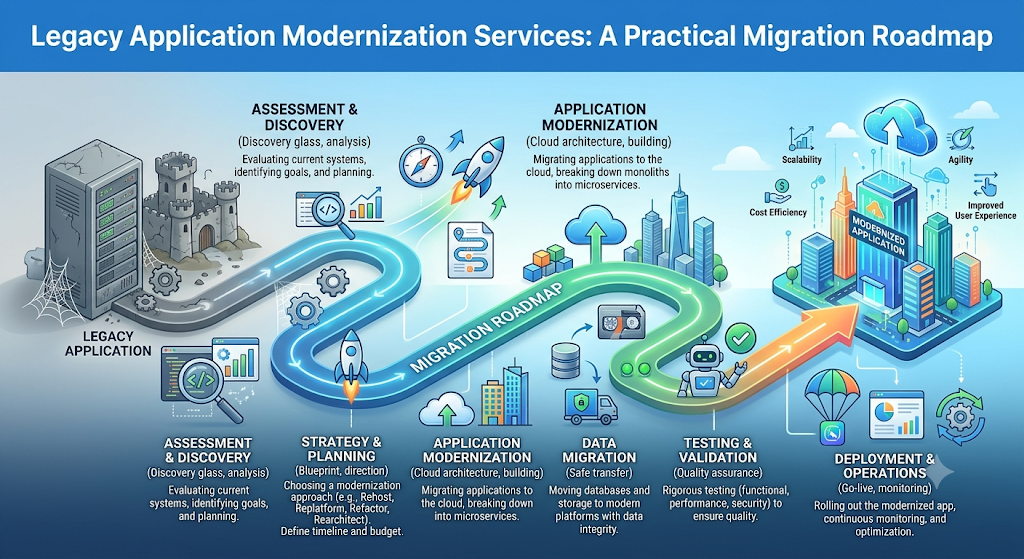
Legacy application modernization is the discipline of moving these systems forward without breaking the business. It is not a rewrite. It is a structured programme of assessment, pattern selection, incremental migration, and governance. The goal is not to replace the system in one big bang. It is to progressively wrap, extract, and replace functionality while the business continues to operate.
For Indian enterprises, this matters because legacy systems are pervasive. Banks, insurers, manufacturers, government departments, and large distributors all run core operations on systems that are decades old. The businesses that modernize successfully gain agility, reduce risk, and cut maintenance costs. The ones that do not find themselves increasingly constrained.
India adds specific considerations. DPDPA applies to legacy systems that process personal data, and many do not have the consent, audit, or erasure capabilities the Act requires. RBI, SEBI, and IRDAI impose sectoral requirements that legacy systems may not meet. Data localisation constrains where modernized systems can run. And talent scarcity—COBOL and mainframe developers are retiring—makes the status quo increasingly expensive.
This guide is written for Indian CTOs, IT heads, enterprise architects, and business leaders evaluating legacy modernization. We will cover the assessment framework, the migration patterns (including the strangler fig), the roadmap, real costs in rupees and dollars, DPDPA compliance, and a phased implementation framework with clear go/no-go gates.
Why Legacy Systems Become a Business Risk
Legacy systems are not just technical debt. They are business risk in four dimensions.
1. Security Risk
Legacy systems often run on unsupported frameworks, databases, and operating systems. Security patches are unavailable. Vulnerabilities remain unpatched for years. The system becomes a target because attackers know it is unpatched. A breach in a legacy system can expose decades of data.
2. Compliance Risk
DPDPA requires consent, purpose limitation, audit logging, and erasure. Legacy systems were built before these requirements existed. They may not have the architecture to support them. The DPDP Rules 2025 phase in obligations through 2027, but retrofitting a legacy system to meet them is expensive—and may be impossible without modernization .
3. Talent Risk
The developers who built and maintained legacy systems are retiring. New developers do not want to learn COBOL, old Java frameworks, or proprietary languages. The organization becomes dependent on a shrinking pool of expensive contractors. Knowledge walks out the door with every retirement.
4. Agility Risk
Legacy systems are hard to change. Integrating with a new CRM requires custom middleware. Adding a new product line requires modifying core code. Launching a new channel requires months of work. The business cannot respond to market changes at the speed competitors can.
The Business Risk Table
| Risk | Impact | Cost |
|---|---|---|
| Security | Breach, data loss | Regulatory penalties, reputation |
| Compliance | DPDPA non-compliance | Up to ₹250 crore penalty |
| Talent | Knowledge loss, hiring difficulty | Higher contractor costs |
| Agility | Slow time-to-market | Lost revenue, competitive disadvantage |
For teams building the modernized applications and integrations, our Custom Software Development and AI Development practices cover the full stack.
The Assessment Framework: What to Modernize and How
The most common modernization mistake is trying to modernize everything at once. The second most common is modernizing the wrong things. A structured assessment prevents both.
The Application Portfolio Assessment
The assessment inventories every application and scores it on business value and technical health.
Business value dimensions:
Revenue contribution.
Customer impact.
Regulatory criticality.
Strategic alignment.
Technical health dimensions:
Age and support status.
Security vulnerabilities.
Maintainability.
Integration capability.
Compliance readiness (DPDPA).
The Portfolio Quadrants
Plotting business value against technical health produces four quadrants:
| Quadrant | Business Value | Technical Health | Action |
|---|---|---|---|
| Invest | High | High | Maintain, enhance |
| Modernize | High | Low | Prioritize modernization |
| Migrate | Low | High | Move to cloud, consolidate |
| Retire | Low | Low | Decommission |
The Modernize quadrant is where the investment goes. These are the systems that matter to the business but are technically constrained.
The 7 Rs of Modernization
The assessment assigns each application to one of seven strategies:
| Strategy | Description | When to Use |
|---|---|---|
| Retire | Decommission | Low value, low health |
| Retain | Keep as-is | Low risk, stable |
| Rehost | Lift and shift to cloud | Quick win, low change |
| Replatform | Move to managed services | Moderate change, cloud benefits |
| Refactor | Restructure code | Maintainability improvement |
| Re-architect | Rebuild as cloud-native | High value, high constraint |
| Replace | Buy SaaS alternative | Commodity functionality |
The Assessment Table
| Application | Business Value | Technical Health | Strategy |
|---|---|---|---|
| Core ERP | High | Low | Re-architect (strangler) |
| Billing system | High | Medium | Replatform |
| Legacy CRM | Medium | Low | Replace (SaaS) |
| Reporting tool | Low | Low | Retire |
| HR system | Medium | High | Retain |
The Strangler Fig Pattern: Modernizing Without a Big Bang
The strangler fig pattern is the dominant approach for modernizing high-value legacy systems. It avoids the risk of a full rewrite by incrementally replacing functionality.
How It Works
The pattern is named after a vine that grows around a tree, gradually replacing it. In software:
1. Build a facade. Place a routing layer (API gateway, proxy) in front of the legacy system. All traffic goes through the facade.
2. Identify a capability. Choose one business capability to extract first—something with clear boundaries and manageable complexity.
3. Build the new capability. Implement the capability as a modern service.
4. Route traffic. The facade routes requests for that capability to the new service, and everything else to the legacy system.
5. Repeat. Over time, more capabilities are extracted. The legacy system shrinks. Eventually, it is decommissioned.
Why It Works
Incremental risk: Each extraction is small and reversible.
Continuous operation: The business never stops.
Proven value: Each extraction delivers value before the next begins.
Knowledge transfer: Teams learn the domain as they extract.
The Strangler Fig Table
| Phase | Action | Risk |
|---|---|---|
| Facade | Add routing layer | Low |
| First extraction | Move one capability | Medium |
| Expansion | Extract more capabilities | Medium |
| Decommission | Retire legacy | Low (if done last) |
When Not to Use Strangler Fig
The strangler fig pattern requires the legacy system to expose interfaces that can be routed. If the legacy system is a tightly coupled monolith with no interfaces, the pattern may not be feasible without significant refactoring first. In that case, a re-architect approach with a phased rewrite may be necessary.
The Modernization Roadmap
A modernization programme follows a predictable sequence. Each phase has a cost gate.
Phase 1: Assessment and Business Case (Month 1–2)
Objective: Understand the portfolio and build the business case.
Activities:
Inventory applications.
Score business value and technical health.
Assign 7 Rs strategies.
Assess DPDPA compliance gaps.
Estimate costs and benefits.
Build the business case.
Cost: ₹5–15 lakh ($6,000–$18,000) for assessment.
Go/No-Go: Business case approved. Priorities set.
Phase 2: Foundation (Month 3–5)
Objective: Build the technical foundation.
Activities:
Set up the facade (API gateway, routing).
Establish CI/CD for new services.
Set up monitoring and observability.
Define integration standards.
Train teams on new patterns.
Cost: ₹10–25 lakh ($12,000–$30,000).
Go/No-Go: Foundation works. First capability ready to extract.
Phase 3: First Extraction (Month 6–9)
Objective: Extract the first capability.
Activities:
Build the new capability as a service.
Route traffic via the facade.
Run in parallel with legacy.
Validate and cut over.
Cost: ₹15–40 lakh ($18,000–$48,000) depending on capability.
Go/No-Go: Capability works. Business value demonstrated.
Phase 4: Expansion (Month 10–24)
Objective: Extract additional capabilities.
Activities:
Extract capabilities in waves.
Migrate data incrementally.
Decommission legacy components as they are replaced.
Cost: ₹50 lakh–₹3 crore+ ($60,000–$3,60,000+) depending on scope.
Go/No-Go: Capabilities extracted. Legacy shrinking.
Phase 5: Decommission (Month 25–30)
Objective: Retire the legacy system.
Activities:
Verify all capabilities are on the new system.
Archive legacy data.
Decommission infrastructure.
Capture lessons learned.
Cost: ₹5–15 lakh ($6,000–$18,000).
Go/No-Go: Legacy decommissioned. No operational impact.
The Roadmap Table
| Phase | Duration | Key Deliverable | Cost (₹) |
|---|---|---|---|
| Assessment | 2 months | Business case, roadmap | 5–15 lakh |
| Foundation | 3 months | Facade, CI/CD, monitoring | 10–25 lakh |
| First Extraction | 4 months | First capability live | 15–40 lakh |
| Expansion | 15 months | Multiple capabilities | 50 lakh–3 crore |
| Decommission | 6 months | Legacy retired | 5–15 lakh |
Real Costs in India (2026)
Legacy modernization costs depend on the scope, the pattern, and the complexity of the legacy system.
Cost by Strategy
| Strategy | Typical Cost (₹) | Typical Cost ($ approx.) | Timeline |
|---|---|---|---|
| Rehost | ₹2–10 lakh per app | $2,400–$12,000 | 2–6 weeks |
| Replatform | ₹10–40 lakh per app | $12,000–$48,000 | 2–6 months |
| Refactor | ₹20–60 lakh per app | $24,000–$72,000 | 3–9 months |
| Re-architect | ₹50 lakh–₹3 crore+ | $60,000–$3,60,000+ | 6–24 months |
| Replace (SaaS) | ₹5–30 lakh | $6,000–$36,000 | 2–6 months |
Note: USD conversions at ₹83/$. Ranges are indicative for Indian enterprises.
The Hidden Costs
Data migration. Migrating decades of data from legacy schemas to modern schemas is often the hardest part. Budget 20–30% of the project cost for data migration.
Integration. Legacy systems integrate with many other systems. Each integration must be maintained or replaced.
Training. Teams must learn new technologies and patterns.
Parallel running. Running legacy and modern systems in parallel during transition adds cost.
Compliance. DPDPA compliance may require additional work on consent, audit, and erasure.
The ROI Case
For an enterprise spending ₹5 crore per year maintaining legacy systems, modernization typically reduces maintenance costs by 30–50% while improving agility and reducing risk. A ₹2 crore modernization investment that reduces maintenance by ₹2 crore per year pays back in roughly 12–18 months, plus the value of reduced risk and improved agility.
India-Specific Compliance: DPDPA and Sectoral Requirements
DPDPA
Legacy systems that process personal data are subject to the DPDP Act. The DPDP Rules 2025 phase in obligations through 2027 . Key requirements:
Consent: Legacy systems may not capture or track consent.
Purpose limitation: Data may be used for purposes beyond what was consented to.
Audit logging: Legacy systems may not have audit trails.
Erasure: Legacy systems may not support data deletion.
Breach notification: Incident response may not meet CERT-In's six-hour requirement.
Modernization is an opportunity to build these capabilities in. The assessment should identify DPDPA gaps and prioritize remediation.
Sectoral Requirements
RBI: Payment system data localisation, KYC, cyber security framework.
SEBI: Securities market data, record keeping.
IRDAI: Insurance records must be stored in India.
Modernized systems must meet these requirements, and modernization is often the trigger to achieve compliance.
The Compliance Checklist
| Requirement | Modernization Action | Priority |
|---|---|---|
| Consent tracking | Build consent management | High |
| Audit logging | Add event logging | High |
| Erasure | Build deletion workflows | High |
| Data localisation | Deploy in Indian regions | High (regulated) |
| Breach notification | Update incident response | High |
Implementation Framework: A Phased Approach With Cost Gates
Phase 1: Portfolio Assessment (Week 1–8)
Objective: Understand the portfolio and prioritize.
Activities:
Inventory applications.
Score business value and technical health.
Assign strategies.
Assess compliance gaps.
Build business case.
Cost: ₹5–15 lakh ($6,000–$18,000).
Go/No-Go: Business case approved. Priorities set.
Phase 2: Foundation (Week 9–20)
Objective: Build the technical foundation.
Activities:
Set up API gateway/facade.
Establish CI/CD.
Set up observability.
Define standards.
Train teams.
Cost: ₹10–25 lakh ($12,000–$30,000).
Go/No-Go: Foundation works. Team trained.
Phase 3: First Extraction (Week 21–36)
Objective: Extract the first capability.
Activities:
Build new capability.
Route via facade.
Run in parallel.
Cut over.
Cost: ₹15–40 lakh ($18,000–$48,000).
Go/No-Go: Capability works. Value demonstrated.
Phase 4: Expansion (Month 10–24)
Objective: Extract additional capabilities.
Activities:
Extract in waves.
Migrate data.
Decommission components.
Cost: ₹50 lakh–₹3 crore ($60,000–$3,60,000+).
Go/No-Go: Capabilities extracted. Legacy shrinking.
Phase Summary Table
| Phase | Duration | Key Deliverable | Cost (₹) | Go/No-Go Criteria |
|---|---|---|---|---|
| 1. Assessment | 8 weeks | Business case, roadmap | 5–15 lakh | Approved |
| 2. Foundation | 12 weeks | Facade, CI/CD, observability | 10–25 lakh | Foundation works |
| 3. First Extraction | 16 weeks | First capability | 15–40 lakh | Value demonstrated |
| 4. Expansion | 15 months | Multiple capabilities | 50 lakh–3 crore | Legacy shrinking |
Risks, Pitfalls, and Governance
The Most Common Modernization Failures
Big bang rewrite. Replacing everything at once, which fails more often than it succeeds. Mitigation: Strangler fig, incremental extraction.
No business case. Modernizing for its own sake, without measurable outcomes. Mitigation: Business case with metrics.
Underestimating data migration. Data migration is often harder than application migration. Mitigation: Dedicated data workstream.
Ignoring compliance. Modernizing without addressing DPDPA gaps. Mitigation: Compliance assessment in phase one.
Talent gaps. Teams do not know the new technologies. Mitigation: Training, hiring, partner support.
No decommissioning. Legacy systems are kept "just in case." Mitigation: Decommissioning plan.
Risk Summary Table
| Risk | Likelihood | Impact | Mitigation |
|---|---|---|---|
| Big bang rewrite | High | High (failure) | Strangler fig |
| No business case | High | Medium | Metrics |
| Data migration | High | High | Dedicated workstream |
| Compliance gaps | Medium | Critical | Assessment |
| Talent gaps | High | Medium | Training |
| No decommissioning | High | Medium | Plan |
Benchmark Summary and Decision Framework
Decision Matrix: Pattern Selection
| System Characteristic | Recommended Pattern |
|---|---|
| Well-defined interfaces | Strangler fig |
| Tightly coupled monolith | Re-architect with phased rewrite |
| Commodity functionality | Replace with SaaS |
| Cloud-ready | Rehost or replatform |
| Low value, low health | Retire |
Modernization Priority Table
| Priority | Capability | Why |
|---|---|---|
| 1 | Assessment | Prevents wrong priorities |
| 2 | Facade | Enables incremental migration |
| 3 | Compliance | DPDPA risk |
| 4 | First extraction | Proves value |
| 5 | Decommissioning | Avoids eternal legacy |
The One-Paragraph Decision Rule
If you are modernizing legacy systems, start with an assessment, not a rewrite. Score business value and technical health, assign strategies, and prioritize the high-value, low-health systems. Use the strangler fig pattern to extract capabilities incrementally, routing traffic through a facade. Build the compliance capabilities (consent, audit, erasure) into the modernized system. Train the team. And plan the decommissioning from day one—otherwise the legacy system will persist forever.
Frequently Asked Questions
1. What is legacy application modernization?
It is the process of moving legacy systems forward—rehosting, replatforming, refactoring, re-architecting, or replacing—without breaking the business. It is incremental, not a big bang rewrite.
2. How much does legacy modernization cost in India?
Rehost costs ₹2–10 lakh per app. Replatform costs ₹10–40 lakh. Refactor costs ₹20–60 lakh. Re-architect costs ₹50 lakh–₹3 crore+. Enterprise programmes cost more depending on scope.
3. What is the strangler fig pattern?
A pattern where a facade routes traffic between the legacy system and new services. Capabilities are extracted one at a time, and the legacy system shrinks until it can be decommissioned.
4. How long does modernization take?
Assessment takes 2 months. Foundation takes 3 months. First extraction takes 4 months. Full modernization takes 2–3 years depending on scope.
5. How does DPDPA affect legacy modernization?
Legacy systems may lack consent, audit, and erasure capabilities. Modernization is an opportunity to build them in. The DPDP Rules phase in obligations through 2027.
6. What are the 7 Rs of modernization?
Retire, Retain, Rehost, Replatform, Refactor, Re-architect, Replace. Each application is assigned a strategy based on business value and technical health.
7. Should I rewrite or modernize?
Modernize. Big bang rewrites fail more often than incremental modernization. Use the strangler fig pattern to extract capabilities incrementally.
8. What is the hardest part of modernization?
Data migration. Moving decades of data from legacy schemas to modern schemas is often harder than the application migration itself.
9. How do I build the business case?
Quantify maintenance cost reduction, risk reduction, and agility improvement. For an enterprise spending ₹5 crore/year on legacy maintenance, a 30–50% reduction justifies the investment.
10. What skills does modernization require?
Modern architecture, cloud, CI/CD, APIs, and domain knowledge of the legacy system. Training and partner support are essential.
11. How do I avoid the legacy system persisting forever?
Plan decommissioning from day one. Set a target date. Track the percentage of functionality on the new system.
12. How can Innovative AI Solutions help?
Innovative AI Solutions provides legacy modernization services for Indian enterprises—portfolio assessment, strangler fig implementation, cloud migration, DPDPA compliance, and decommissioning. Our Delhi-based team handles assessment, implementation, and governance. Visit https://innovativeais.com to discuss your requirements.
Contact Innovative AI Solutions
Ready to modernize without breaking the business?
[One-line supporting sentence.]
Contact Information
Innovative AI Solutions
📍 Netaji Subhash Place, Pitampura, Delhi – 110034
🌐 Website: https://innovativeaislabs.com 📧 Email: info@innovativeais.com
📞 Phone: +91 7464 099 059 / +91 96899 67356
Business Services
AI Automation
AI Development
AI Consulting
Machine Learning Solutions
Deep Learning Solutions
Generative AI Services
NLP Solutions
AI Agents
AI Chatbots
Voice AI
CRM Development
Custom Software Development
Website Development
Mobile App Development
About the Author
Abhishek Kumar
Founder & CEO, Innovative AI Solutions
5+ years building production AI systems for Indian businesses. Based in Delhi, serving clients across India.
Ready to build AI solutions for your business?
Innovative AI Solutions — Delhi's leading AI development company. Free consultation available.
Get Free Consultation →
A practical 2026 roadmap for Indian enterprises modernizing legacy applications—portfolio assessment, the 7 Rs, strangler fig migration, real rupee costs, and DPDPA and sectoral compliance.
#LegacyModernization #ApplicationModernization #MigrationRoadmap #StranglerFig #MonolithToMicroservices #COBOLModernization #ERPModernization #PortfolioAssessment #RePlatform #ReArchitect #CloudMigration #DPDPA #MeitY #MainframeModernization #ApplicationRationalization #DelhiNCR #InnovativeAISolutions
Copyright ©️ 2015–2026 Innovative AI Solutions. All Rights Reserved. | Privacy Policy | Terms & Conditions