Why Rebuilding Legacy Applications Fails
Every few years, a business decides to rebuild its legacy application. The reasoning is sound: the old system is hard to change, expensive to maintain, and holds back new features. A rebuild promises a clean slate.
Most rebuilds fail. The new system takes longer than expected. Requirements change during development. The old system continues to evolve, so the new system is out of date before launch. And when the new system finally goes live, it does not handle the edge cases the old system handled — because those edge cases were undocumented and no one remembered them.
The failures are predictable. Rewrites fail because they ignore the core lesson of legacy modernization: the value is not in the code, it is in the business logic embedded in it, and that logic is not fully documented anywhere.
The alternative is incremental modernization. Instead of replacing everything, you replace pieces — one at a time — while the system keeps running. Each replacement delivers value. The old system shrinks until it can be retired.
This guide explains how to modernize legacy applications without rebuilding everything in 2026. It covers the strategies, the patterns, costs in India, and how to plan a phased modernization.
For organisations modernizing legacy systems, Innovative AI Solutions provides custom software development and architecture consulting.
Why Legacy Applications Resist Modernization
The Seven Challenges
| Challenge | Why It Matters |
|---|---|
| Missing documentation | Nobody knows what the system does |
| Lost knowledge | Original developers are gone |
| Tight coupling | Everything depends on everything |
| Undocumented business logic | Rules embedded in code |
| Obsolete dependencies | Security vulnerabilities |
| No tests | Changes are risky |
| Business criticality | Downtime has consequences |
The Cost of Doing Nothing
| Cost Category | Impact |
|---|---|
| Development velocity | Slower feature delivery |
| Security risk | Unpatched vulnerabilities |
| Talent retention | Engineers avoid legacy work |
| Operational cost | Expensive to maintain |
| Opportunity cost | Cannot pursue new capabilities |
The Modernization Strategies
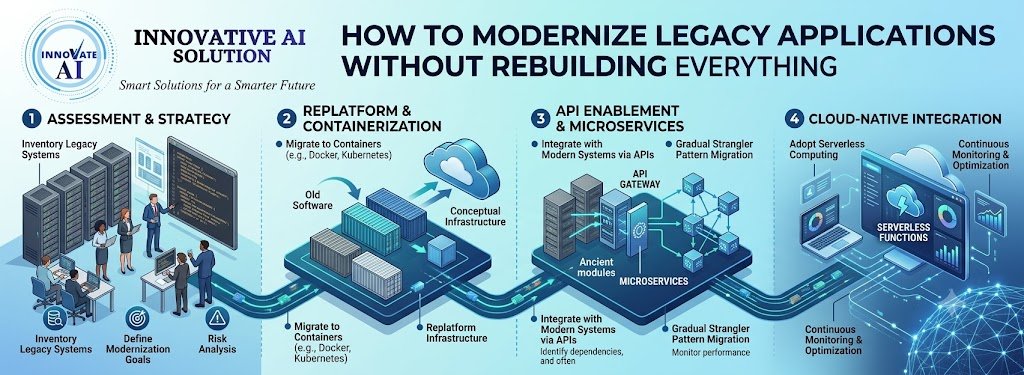
Strategy 1: Encapsulate (API Wrapping)
Put an API layer in front of the legacy system. New applications call the API instead of the legacy system directly.
text New apps → API layer → Legacy system
| Aspect | Detail |
|---|---|
| Change to legacy | None |
| Risk | Low |
| Speed | Fast |
| Benefit | Enables integration |
| Best for | First step in modernization |
Example: Wrap a legacy ERP with REST APIs so mobile apps and new services can integrate without touching the legacy code.
Strategy 2: Replatform
Move the legacy application to a modern platform (e.g., cloud) with minimal changes.
text Legacy app → Cloud infrastructure
| Aspect | Detail |
|---|---|
| Change to application | Minimal |
| Risk | Low-Moderate |
| Speed | Moderate |
| Benefit | Cloud benefits, reduced ops |
| Best for | Stable applications needing modernization |
Strategy 3: Strangler Fig
Gradually replace legacy functionality with new services, routing traffic progressively until the legacy system can be retired.
text
Phase 1: Legacy handles 100%
Phase 2: New handles 20%, legacy 80%
Phase 3: New handles 60%, legacy 40%
Phase 4: New handles 90%, legacy 10%
Phase 5: Legacy retired
| Aspect | Detail |
|---|---|
| Change to legacy | Gradual |
| Risk | Low |
| Speed | Slower overall |
| Benefit | Low risk, incremental value |
| Best for | Most modernization projects |
Example: Replace a legacy customer management module with a new service, routing customer-related traffic to the new service while orders and billing remain in the legacy system.
Strategy 4: Extract Services
Pull specific functions out of the legacy system into standalone services.
text Legacy system ├── Remaining functionality ├── Extracted service: Notifications ├── Extracted service: Reporting └── Extracted service: Integrations
| Aspect | Detail |
|---|---|
| Change to legacy | Targeted |
| Risk | Moderate |
| Speed | Moderate |
| Benefit | New capabilities |
| Best for | Specific functions that need modernization |
Strategy 5: Rehost (Lift and Shift)
Move the legacy application to new infrastructure without changing it.
| Aspect | Detail |
|---|---|
| Change | None |
| Risk | Lowest |
| Speed | Fastest |
| Benefit | Infrastructure modernization |
| Best for | Immediate data centre exit |
Strategy Comparison
| Strategy | Risk | Speed | Benefit | Best For |
|---|---|---|---|---|
| Encapsulate | Low | Fast | Integration | First step |
| Replatform | Low-Moderate | Moderate | Cloud | Stable apps |
| Strangler Fig | Low | Slower | Full modernization | Most projects |
| Extract Services | Moderate | Moderate | New capabilities | Specific functions |
| Rehost | Lowest | Fastest | Infrastructure | Data centre exit |
Building the Modernization Plan
Phase 1: Assess the Legacy System (Weeks 1–4)
| Activity | Purpose |
|---|---|
| Inventory functionality | Know what exists |
| Document business logic | Capture undocumented rules |
| Map dependencies | Understand coupling |
| Identify pain points | Where modernization helps |
| Assess risks | What could break |
Phase 2: Prioritise Modernization Targets (Weeks 4–6)
| Activity | Purpose |
|---|---|
| Score by business value | Where value is highest |
| Score by risk | Where risk is lowest |
| Identify quick wins | Early value delivery |
| Sequence the roadmap | Order of modernization |
Phase 3: Build the Foundation (Weeks 6–12)
| Activity | Purpose |
|---|---|
| Implement API layer | Enable integration |
| Set up testing | Safety net for changes |
| Build observability | Understand behaviour |
| Establish deployment pipeline | Enable fast changes |
Phase 4: Execute Incrementally (Weeks 12+)
| Activity | Purpose |
|---|---|
| Replace one module | Prove the approach |
| Route traffic gradually | Manage risk |
| Measure outcomes | Validate value |
| Repeat | Scale the approach |
The Strangler Fig Pattern in Detail
How It Works
text
Phase 1: All traffic to legacy
↓ Phase 2: New service built for one function ↓ Phase 3: Traffic routed to new service for that function ↓ Phase 4: New service handles 100% of that function ↓ Phase 5: Legacy code for that function removed ↓ Repeat for next function
What Makes It Work
| Element | Purpose |
|---|---|
| Routing layer | Direct traffic to old or new |
| Feature flags | Enable gradual rollout |
| Dual-write | Keep data in sync during transition |
| Monitoring | Compare behaviour |
| Rollback | Revert if issues arise |
Strangler Fig Best Practices
| Practice | Purpose |
|---|---|
| Start with low-risk functions | Prove the approach |
| Route traffic gradually | Manage risk |
| Monitor both systems | Compare behaviour |
| Keep rollback capability | Handle issues |
| Retire legacy code promptly | Avoid maintaining both |
What It Costs in India
Modernization Cost by Strategy
| Strategy | Cost Range (INR) | Cost Range (USD) | Timeline |
|---|---|---|---|
| API wrapping | ₹3,00,000–₹10,00,000 | $3,600–$12,000 | 8–16 weeks |
| Replatform | ₹5,00,000–₹20,00,000 | $6,000–$24,000 | 12–24 weeks |
| Strangler fig (per module) | ₹8,00,000–₹25,00,000 | $9,600–$30,000 | 16–32 weeks |
| Extract services | ₹4,00,000–₹15,00,000 | $4,800–$18,000 | 8–20 weeks |
| Rehost | ₹2,00,000–₹10,00,000 | $2,400–$12,000 | 6–16 weeks |
| Full modernization programme | ₹50,00,000–₹2,00,00,000+ | $60,000–$240,000+ | 12–36 months |
Ongoing Costs
| Cost Category | Monthly Range (INR) | Monthly Range (USD) |
|---|---|---|
| New infrastructure | ₹20,000–₹1,50,000 | $240–$1,800 |
| Maintenance (during transition) | ₹30,000–₹1,50,000 | $360–$1,800 |
| Monitoring | ₹10,000–₹50,000 | $120–$600 |
| Team | ₹3,00,000–₹15,00,000 | $3,600–$18,000 |
Cost Comparison: Incremental vs Rebuild
| Factor | Incremental | Rebuild |
|---|---|---|
| Upfront cost | Lower (phased) | Higher |
| Risk | Lower | Higher |
| Time to first value | Weeks | Years |
| Business disruption | Minimal | Significant |
| Failure rate | Lower | Higher |
India-Specific Considerations
Common Indian Legacy Systems
| System | Challenge |
|---|---|
| COBOL banking systems | Rare skills, critical |
| Legacy ERP (SAP, Oracle) | Customisation debt |
| Custom .NET/Java apps | Outdated frameworks |
| FoxPro/dBASE systems | Obsolete platforms |
| Access/SQL Server apps | Small team dependency |
Indian Talent Context
| Factor | Implication |
|---|---|
| Legacy skills | COBOL, FoxPro scarce |
| Modern skills | Abundant |
| Migration experience | Growing |
| Cost advantage | 40–60% below West |
Compliance
| Requirement | Implementation |
|---|---|
| DPDPA | Data protection during migration |
| RBI | Financial data handling |
| Audit trails | Migration logging |
| Data residency | Where data stored |
Decision Framework: Modernization Readiness
Readiness Scorecard
| Criteria | Weight | Score (1–5) | Weighted Score |
|---|---|---|---|
| Pain points identified | 20% | ||
| Business logic documented | 20% | ||
| Testing capability | 15% | ||
| Team capability | 15% | ||
| Budget for phased approach | 15% | ||
| Risk tolerance | 15% | ||
| Total | 100% | /5 |
Strategy Selection Matrix
| Your Situation | Recommended Strategy |
|---|---|
| Need integration now | API wrapping |
| Data centre exit | Rehost |
| Stable app, cloud move | Replatform |
| Most modernization projects | Strangler fig |
| Specific function modernization | Extract services |
| Full transformation | Strangler fig programme |
Implementation Roadmap
| Phase | What to Build | Timeline | Cost (INR) |
|---|---|---|---|
| Phase 1 | Assessment, documentation | 4–6 weeks | ₹2,00,000–₹8,00,000 |
| Phase 2 | API layer, testing | 6–12 weeks | ₹3,00,000–₹12,00,000 |
| Phase 3 | First module replacement | 8–16 weeks | ₹4,00,000–₹15,00,000 |
| Phase 4 | Scale modernization | Ongoing | Variable |
Frequently Asked Questions
1. How do I modernize a legacy application without rebuilding it?
Use incremental strategies: API wrapping, replatforming, strangler fig, or service extraction. Each replaces pieces while the system keeps running.
2. What is the strangler fig pattern?
A modernization approach where new services gradually replace legacy functionality, routing traffic progressively until the legacy system can be retired.
3. Why do legacy rewrites fail?
Rewrites fail because they ignore undocumented business logic, take longer than expected, and do not handle edge cases the old system handled.
4. What is API wrapping?
Putting an API layer in front of a legacy system so new applications can integrate without touching legacy code. It is the lowest-risk first step.
5. How much does legacy modernization cost in India?
API wrapping costs ₹3,00,000–₹10,00,000 ($3,600–$12,000). Strangler fig per module costs ₹8,00,000–₹25,00,000 ($9,600–$30,000). Full programmes cost ₹50,00,000–₹2,00,00,000+.
6. How long does legacy modernization take?
API wrapping takes 8–16 weeks. Module replacement takes 16–32 weeks. Full programmes take 12–36 months.
7. Should I modernize or rebuild?
Modernize incrementally. Rebuilds fail more often than they succeed. Incremental modernization delivers value at each step and manages risk.
8. What is the first step in legacy modernization?
Assessment: document what the system does, map dependencies, and identify pain points. You cannot modernize what you do not understand.
9. How do I handle undocumented business logic?
Extract it through code analysis, interviews with users, and testing. Document it before modernizing.
10. What is the biggest risk in legacy modernization?
Breaking business-critical functionality. Mitigate with comprehensive testing, gradual rollout, and rollback capability.
11. How does DPDPA affect legacy modernization?
DPDPA requires data protection during migration. Legacy systems may not be compliant — modernizing them creates an opportunity to address compliance.
12. How can Innovative AI Solutions help?
Innovative AI Solutions is a Delhi-based software development company that modernizes legacy applications. We assess systems, wrap APIs, and execute strangler fig migrations — designed for Indian requirements and DPDPA compliance. Explore our custom software development.
Contact Innovative AI Solutions
Ready to modernize your legacy applications?
We help Indian businesses modernize incrementally — without the risk of a full rebuild.
Contact Information
Innovative AI Solutions
📍 Netaji Subhash Place, Pitampura, Delhi – 110034
🌐 Website: https://innovativeais.com 📧 Email: info@innovativeais.com
📞 Phone: +91 7464 099 059 / +91 96899 67356
Business Services
• AI Automation • AI Development • AI Consulting • Machine Learning Solutions • Deep Learning Solutions • Generative AI Services • NLP Solutions • AI Agents • AI Chatbots • Voice AI • CRM Development • Custom Software Development • Website Development • Mobile App Development
About the Author
Abhishek Kumar
Founder & CEO, Innovative AI Solutions
5+ years building production AI systems for Indian businesses. Based in Delhi, serving clients across India.
Ready to build AI solutions for your business?
Innovative AI Solutions — Delhi's leading AI development company. Free consultation available.
Get Free Consultation →
A practical 2026 guide to modernizing legacy applications incrementally — strangler fig, API wrapping, replatforming, costs in India, and phased modernization strategies.
#LegacyModernization #Applications #Incremental #2026 #StranglerFig #APIWrapping #Replatforming #Migration #ModernizationCost #Architecture #Strategy #India #DelhiNCRTech #EnterpriseApps #StartupApps #LegacySystems #SoftwareModernization #CloudMigration #TechIndia #DigitalProducts #ApplicationModernization #BusinessSoftware #TechnicalDebt #ModernizationRoadmap #InnovativeAISolutions
Copyright © 2015–2026 Innovative AI Solutions. All Rights Reserved. | Privacy Policy | Terms & Conditions