Why Multi-Tenant Security Is Different
Multi-tenancy is what makes SaaS efficient. Multiple customers share infrastructure, which reduces cost and enables scale. But sharing infrastructure means one tenant's data lives near another's — and that proximity creates risk.
A single misconfigured query can expose one tenant's data to another. A missing authorisation check can let a user access another tenant's records. A shared cache without tenant scoping can return the wrong customer's data.
These are not theoretical risks. Tenant data leakage is one of the most serious and most common SaaS security failures. It damages trust, triggers regulatory action under DPDPA, and can end customer relationships.
Building secure multi-tenant SaaS requires designing isolation into the architecture from the start. Retrofitting isolation is expensive and error-prone.
This guide explains how to build a secure multi-tenant SaaS application in 2026. It covers tenant isolation models, access control, encryption, DPDPA compliance, and costs.
For organisations building secure SaaS products, Innovative AI Solutions provides custom software development and AI development services.
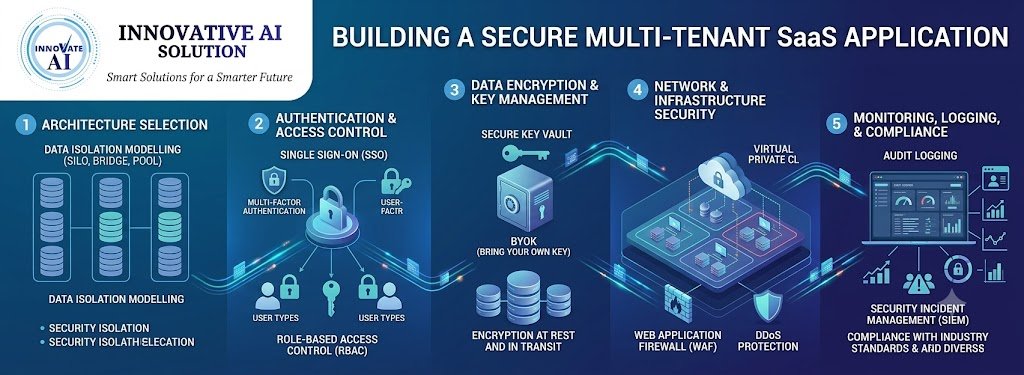
The Multi-Tenancy Models
Model 1: Shared Everything
All tenants share the same database, tables, and rows — distinguished by a tenant ID column.
| Aspect | Detail |
|---|---|
| Isolation | Logical only (tenant_id) |
| Cost | Lowest |
| Complexity | Lowest |
| Security risk | Highest |
| Best for | SMB SaaS, free tier |
Model 2: Shared Database, Separate Schemas
All tenants share a database, but each has its own schema.
| Aspect | Detail |
|---|---|
| Isolation | Schema-level |
| Cost | Low |
| Complexity | Moderate |
| Security risk | Moderate |
| Best for | Mid-market SaaS |
Model 3: Database Per Tenant
Each tenant has its own database.
| Aspect | Detail |
|---|---|
| Isolation | Database-level |
| Cost | Higher |
| Complexity | Moderate |
| Security risk | Lower |
| Best for | Enterprise SaaS |
Model 4: Fully Isolated
Each tenant has dedicated infrastructure.
| Aspect | Detail |
|---|---|
| Isolation | Infrastructure-level |
| Cost | Highest |
| Complexity | High |
| Security risk | Lowest |
| Best for | Regulated industries |
Model Comparison
| Model | Isolation | Cost | Security | Best For |
|---|---|---|---|---|
| Shared everything | Logical | Lowest | Lowest | SMB, free tier |
| Separate schemas | Schema | Low | Moderate | Mid-market |
| Database per tenant | Database | Higher | High | Enterprise |
| Fully isolated | Infrastructure | Highest | Highest | Regulated |
The Security Layers
Layer 1: Tenant Identification
Every request must be associated with a tenant.
| Method | How It Works |
|---|---|
| Subdomain | tenant.app.com |
| Path | app.com/tenant/ |
| JWT claim | Tenant ID in token |
| Header | Custom header |
| Domain | Custom domain per tenant |
Layer 2: Authentication
Verify user identity before any access.
| Requirement | Implementation |
|---|---|
| Strong authentication | Password + MFA |
| SSO support | SAML, OAuth |
| Session management | Secure sessions |
| Token validation | Verify on every request |
Layer 3: Authorisation
Enforce permissions after authentication.
| Control | Purpose |
|---|---|
| Tenant check | User belongs to tenant |
| Role-based access | Roles within tenant |
| Resource-level permissions | Per-resource access |
| Attribute-based access | Access by attributes |
Layer 4: Data Isolation
Ensure queries return only the requesting tenant's data.
| Technique | Implementation |
|---|---|
| Row-level security | Database-enforced tenant filtering |
| Query scoping | Application-enforced filtering |
| Schema isolation | Separate schemas |
| Database isolation | Separate databases |
Layer 5: Encryption
Protect data at rest and in transit.
| Data State | Protection |
|---|---|
| At rest | AES-256 |
| In transit | TLS 1.3 |
| Per-tenant keys | Tenant-specific encryption |
| Key management | Secure key storage |
Layer 6: Audit Logging
Record all access and actions.
| What to Log | Purpose |
|---|---|
| Authentication events | Track access |
| Data access | Track retrievals |
| Data modifications | Track changes |
| Admin actions | Track privileged operations |
| Tenant context | Which tenant |
Layer 7: Monitoring
Detect anomalies and security events.
| What to Monitor | Purpose |
|---|---|
| Unusual access patterns | Detect compromise |
| Cross-tenant attempts | Detect attacks |
| Failed authorisations | Detect probing |
| Data volume anomalies | Detect exfiltration |
Tenant Isolation in Practice
Row-Level Security (PostgreSQL)
sql -- Enable row-level security ALTER TABLE orders ENABLE ROW LEVEL SECURITY;
-- Create policy that filters by tenant
CREATE POLICY tenant_isolation ON orders
USING (tenant_id = current_setting('app.tenant_id')::uuid);
-- Application sets tenant context per request SET app.tenant_id = 'tenant-uuid-here'; Row-level security enforces tenant isolation at the database level — even if application code has a bug, the database prevents cross-tenant access.
Application-Level Isolation
javascript // Every query must include tenant filter async function getOrders(tenantId, userId) { // Verify user belongs to tenant const user = await getUser(userId); if (user.tenantId !== tenantId) { throw new ForbiddenError(); }
// Query scoped to tenant return db.query( 'SELECT
- FROM orders WHERE tenant_id = $1', [tenantId] ); } Application-level isolation requires discipline — every query must include the tenant filter.
Schema Isolation
text
Database
├── tenant_a schema │ ├── orders │ ├── customers │ └── users ├── tenant_b schema │ ├── orders │ ├── customers │ └── users └── tenant_c schema ├── orders ├── customers └── users Each tenant has its own schema. Queries are scoped by schema.
Database Isolation
text
Tenant A → Database A
Tenant B → Database B
Tenant C → Database C
Each tenant has its own database. Complete data isolation.
Common Multi-Tenant Security Failures
Failure 1: Missing Tenant Filter
Symptom: User sees another tenant's data.
Cause: Query missing tenant_id filter.
Prevention: Row-level security, query review, automated testing.
Failure 2: Insecure Direct Object Reference
Symptom: User accesses another tenant's record by guessing ID.
Cause: No authorisation check on resource access.
Prevention: Always verify resource belongs to user's tenant.
Failure 3: Cache Poisoning
Symptom: User receives another tenant's cached data.
Cause: Cache keys not scoped by tenant.
Prevention: Include tenant ID in cache keys.
Failure 4: Cross-Tenant Query Injection
Symptom: Malicious input causes cross-tenant data access.
Cause: Unsanitised input in queries.
Prevention: Parameterised queries, input validation.
Failure 5: Privilege Escalation
Symptom: User gains access to another tenant's admin functions.
Cause: Insufficient role checks.
Prevention: Role-based access with tenant scoping.
Failure 6: Backup Cross-Contamination
Symptom: Backup contains multiple tenants' data.
Cause: Shared backup without tenant separation.
Prevention: Tenant-scoped backups, encryption.
DPDPA Compliance for Multi-Tenant SaaS
The Core Requirements
| Requirement | Multi-Tenant Implementation |
|---|---|
| Consent | Per-tenant consent management |
| Purpose limitation | Data used only for stated purposes |
| Data minimisation | Only necessary data |
| Storage limitation | Retention policies |
| Security safeguards | Encryption, access control |
| User rights | Access, correction, deletion |
| Audit trails | Per-tenant logging |
The Deletion Challenge
| Data Location | Deletion Process |
|---|---|
| Tenant data | Delete tenant records |
| Shared tables | Delete rows with tenant_id |
| Cache | Clear tenant cache |
| Backups | Expire tenant backups |
| Logs | Retain as required |
Multi-Tenant Consent
| Consideration | Implementation |
|---|---|
| Per-tenant consent | Each tenant's users consent separately |
| Tenant as controller | Tenant may be data controller |
| SaaS as processor | SaaS may be data processor |
| Data processing agreement | Required with tenants |
What It Costs in India
Implementation Costs
| Scope | Cost Range (INR) | Cost Range (USD) | Timeline |
|---|---|---|---|
| Basic multi-tenant security | ₹3,00,000–₹8,00,000 | $3,600–$9,600 | 6–12 weeks |
| Standard with RLS | ₹8,00,000–₹20,00,000 | $9,600–$24,000 | 12–20 weeks |
| Advanced with per-tenant isolation | ₹20,00,000–₹50,00,000 | $24,000–$60,000 | 20–36 weeks |
| Enterprise regulated | ₹50,00,000–₹1,50,00,000+ | $60,000–$180,000+ | 36–52 weeks |
Cost by Component
| Component | Cost Range (INR) | Cost Range (USD) |
|---|---|---|
| Tenant identification | ₹75,000–₹2,50,000 | $900–$3,000 |
| Authentication | ₹1,00,000–₹3,00,000 | $1,200–$3,600 |
| Authorisation | ₹1,50,000–₹4,00,000 | $1,800–$4,800 |
| Data isolation | ₹2,00,000–₹8,00,000 | $2,400–$9,600 |
| Encryption | ₹1,00,000–₹4,00,000 | $1,200–$4,800 |
| Audit logging | ₹1,00,000–₹3,00,000 | $1,200–$3,600 |
| Monitoring | ₹75,000–₹2,50,000 | $900–$3,000 |
Ongoing Costs
| Cost Category | Monthly Range (INR) | Monthly Range (USD) |
|---|---|---|
| Infrastructure | ₹20,000–₹1,50,000 | $240–$1,800 |
| Security monitoring | ₹15,000–₹75,000 | $180–$900 |
| Audit and compliance | ₹10,000–₹50,000 | $120–$600 |
| Maintenance | ₹25,000–₹1,00,000 | $300–$1,200 |
The Cost of a Tenant Data Breach
| Impact | Estimated Cost |
|---|---|
| Immediate response | ₹10,00,000+ |
| Regulatory penalties | DPDPA penalties |
| Customer loss | Multiple tenants |
| Reputation damage | Long-term impact |
Decision Framework: Multi-Tenant Security Readiness
Readiness Scorecard
| Criteria | Weight | Score (1–5) | Weighted Score |
|---|---|---|---|
| Tenant isolation model chosen | 20% | ||
| Authentication implemented | 15% | ||
| Authorisation enforced | 20% | ||
| Data isolation verified | 20% | ||
| Encryption in place | 10% | ||
| Audit logging active | 10% | ||
| Monitoring deployed | 5% | ||
| Total | 100% | /5 |
Isolation Model Selection
| Your Market | Recommended Model |
|---|---|
| SMB SaaS | Shared database with RLS |
| Mid-market | Schema per tenant |
| Enterprise | Database per tenant |
| Regulated | Fully isolated |
Implementation Roadmap
| Phase | What to Build | Timeline | Cost (INR) |
|---|---|---|---|
| Phase 1 | Tenant identification, auth | 4–6 weeks | ₹1,75,000–₹5,50,000 |
| Phase 2 | Authorisation, data isolation | 4–8 weeks | ₹3,50,000–₹12,00,000 |
| Phase 3 | Encryption, audit logging | 3–5 weeks | ₹2,00,000–₹7,00,000 |
| Phase 4 | Monitoring, testing | 3–5 weeks | ₹1,50,000–₹5,00,000 |
Frequently Asked Questions
1. What is a multi-tenant SaaS application?
A multi-tenant SaaS application serves multiple customers (tenants) from shared infrastructure. Each tenant's data is isolated, but resources are shared for efficiency.
2. Why is multi-tenant security hard?
Sharing infrastructure means one tenant's data lives near another's. A single misconfigured query or missing authorisation check can expose one tenant's data to another.
3. What is the most secure multi-tenancy model?
Fully isolated (dedicated infrastructure per tenant) is most secure. Database per tenant is next. Shared database with row-level security is the most common secure model for most SaaS.
4. What is row-level security?
Row-level security enforces tenant isolation at the database level. Even if application code has a bug, the database prevents cross-tenant access.
5. How do I prevent tenant data leakage?
Implement tenant isolation at multiple layers: row-level security in the database, tenant filtering in queries, tenant scoping in cache keys, and authorisation checks on every resource access.
6. How does DPDPA affect multi-tenant SaaS?
DPDPA requires consent, purpose limitation, data minimisation, security safeguards, user rights, and audit trails. Multi-tenant SaaS must implement these per tenant.
7. Who is the data controller in multi-tenant SaaS?
It depends. The tenant may be the data controller for their users' data, and the SaaS is the data processor. A data processing agreement is required.
8. How much does secure multi-tenant SaaS cost in India?
Basic security costs ₹3,00,000–₹8,00,000 ($3,600–$9,600). Advanced isolation costs ₹20,00,000–₹50,00,000 ($24,000–$60,000). Enterprise regulated costs ₹50,00,000–₹1,50,00,000+.
9. What is the biggest multi-tenant security failure?
Missing tenant filters in queries. A single query without tenant_id can expose all tenants' data. Row-level security prevents this.
10. Should I use a shared or separate database?
Shared database with row-level security for SMB and mid-market SaaS. Database per tenant for enterprise. Fully isolated for regulated industries.
11. How do I test multi-tenant security?
Test that users cannot access other tenants' data. Test authorisation checks. Test cache isolation. Test with automated security scanning.
12. How can Innovative AI Solutions help?
Innovative AI Solutions is a Delhi-based software development company that builds secure multi-tenant SaaS applications. We implement tenant isolation, access control, encryption, and DPDPA compliance — designed for Indian SaaS builders. Explore our custom software development.
Contact Innovative AI Solutions
Ready to build a secure multi-tenant SaaS application?
We help Indian SaaS builders design tenant isolation, access control, and DPDPA-compliant security from the start.
Contact Information
Innovative AI Solutions
📍 Netaji Subhash Place, Pitampura, Delhi – 110034
🌐 Website: https://innovativeais.com 📧 Email: info@innovativeais.com
📞 Phone: +91 7464 099 059 / +91 96899 67356
Business Services
• AI Automation • AI Development • AI Consulting • Machine Learning Solutions • Deep Learning Solutions • Generative AI Services • NLP Solutions • AI Agents • AI Chatbots • Voice AI • CRM Development • Custom Software Development • Website Development • Mobile App Development
About the Author
Abhishek Kumar
Founder & CEO, Innovative AI Solutions
5+ years building production AI systems for Indian businesses. Based in Delhi, serving clients across India.
Ready to build AI solutions for your business?
Innovative AI Solutions — Delhi's leading AI development company. Free consultation available.
Get Free Consultation →
A practical 2026 guide to building secure multi-tenant SaaS applications — tenant isolation models, access control, encryption, DPDPA compliance, and costs in India.
#MultiTenantSaaS #Security #2026 #TenantIsolation #AccessControl #Encryption #DPDPA #Compliance #Architecture #DataIsolation #RowLevelSecurity #SchemaIsolation #DatabaseIsolation #SaaSDevelopment #India #DelhiNCRTech #EnterpriseApps #StartupApps #CloudSecurity #SaaSSecurity #TechIndia #DigitalProducts #SecureSaaS #BusinessSoftware #InnovativeAISolutions
Copyright © 2015–2026 Innovative AI Solutions. All Rights Reserved. | Privacy Policy | Terms & Conditions