The Scalability Mistake Startups Make
Most startups approach scalability wrong. They either ignore it entirely — building something that breaks at a thousand users — or they over-engineer it — building microservices and distributed systems before they have product-market fit.
Both mistakes are expensive. Ignoring scalability means rebuilding when growth comes. Over-engineering means burning runway on infrastructure you do not need.
The right approach is different. Build for the scale you have today, but design so you can scale when you need to. Every architectural decision should preserve a path forward without paying the cost now.
This guide covers how to build scalable software applications for startups in 2026. It explains the patterns that matter, when to apply them, what they cost in India, and how to avoid both premature scaling and unscalable foundations.
For organisations building scalable applications, Innovative AI Solutions provides custom software development and AI development services.
What Scalability Actually Means
The Definition
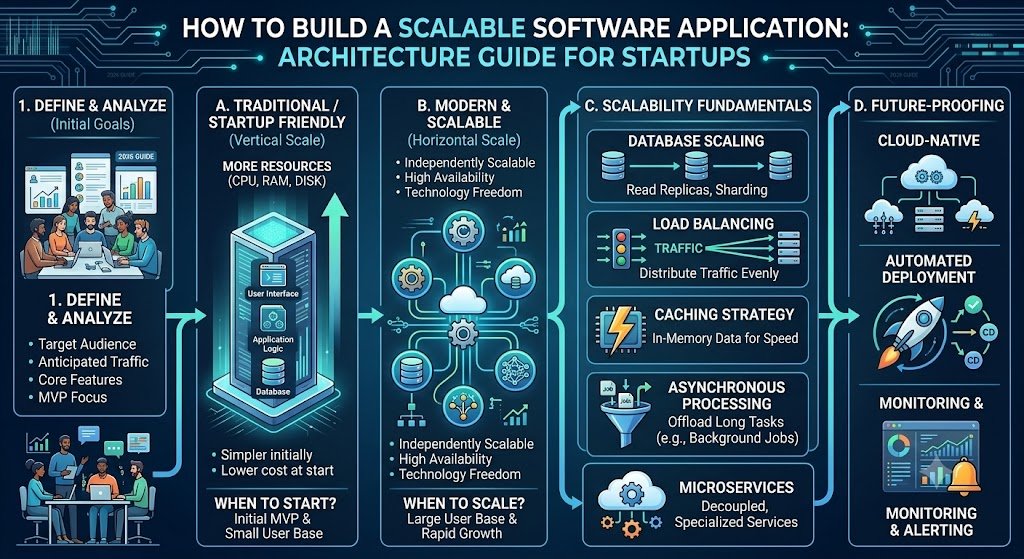
Scalability is the ability of a system to handle growing amounts of work by adding resources. A scalable system handles more users, more data, and more transactions without proportional increases in cost or degradation in performance.
| Not Scalable | Scalable |
|---|---|
| Breaks at 1,000 users | Handles 10,000+ users |
| Costs grow linearly with users | Costs grow sub-linearly |
| Performance degrades under load | Performance maintained |
| Requires rebuilding to grow | Grows by adding resources |
Two Types of Scaling
| Type | How It Works | Limits |
|---|---|---|
| Vertical scaling | Bigger server | Hardware limits, cost |
| Horizontal scaling | More servers | Application must support |
Horizontal scaling is the goal for web applications because it has no theoretical limit and uses commodity hardware.
The Scalability Dimensions
| Dimension | What Scales |
|---|---|
| Traffic | More requests per second |
| Data | More data stored and processed |
| Users | More concurrent users |
| Features | More functionality |
| Geography | More regions served |
The Startup Scaling Journey
Stage 1: Single Server (0–1,000 users)
text
Users → Single Server → Database
Everything on one machine. Simple, cheap, adequate for early growth.
| Aspect | Detail |
|---|---|
| Cost | ₹5,000–₹20,000/month |
| Capacity | Hundreds to low thousands of users |
| Complexity | Minimal |
When to move on: Response times increase, server CPU consistently high.
Stage 2: Separated Application and Database (1,000–10,000 users) text
Users → Load Balancer → App Servers → Database Server
Application and database on separate machines. Optionally multiple app servers.
| Aspect | Detail |
|---|---|
| Cost | ₹20,000–₹80,000/month |
| Capacity | Thousands to tens of thousands of users |
| Complexity | Low |
When to move on: Database becomes bottleneck, repeated queries slow down.
Stage 3: Caching and Read Replicas (10,000–100,000 users)
text
Users → Load Balancer → App Servers → Cache
→ Database (primary + replicas) Add caching layer and database read replicas. Static assets served from CDN.
| Aspect | Detail |
|---|---|
| Cost | ₹80,000–₹3,00,000/month |
| Capacity | Hundreds of thousands of users |
| Complexity | Moderate |
When to move on: Write volume becomes bottleneck, need queue-based processing.
Stage 4: Distributed Architecture (100,000+ users)
text
Users → CDN → Load Balancer → Service Cluster →
↓ ↓
Message Queue Cache
↓ ↓
Background Workers Database Cluster
Multiple services, message queues for async processing, database clustering.
| Aspect | Detail |
|---|---|
| Cost | ₹3,00,000–₹15,00,000+/month |
| Capacity | Millions of users |
| Complexity | High |
Architecture Patterns That Enable Scale
Pattern 1: Stateless Application Servers
Application servers should not store session state. State goes in a shared store (Redis, database).
| With State | Stateless |
|---|---|
| Sessions on server | Sessions in Redis |
| Cannot scale horizontally | Scales horizontally |
| Server failure loses sessions | Session survives |
Pattern 2: Load Balancing
Distribute traffic across multiple servers.
| Type | When to Use |
|---|---|
| Round robin | Even distribution |
| Least connections | Variable request durations |
| IP hash | Session affinity |
Pattern 3: Caching
Store frequently accessed data in fast storage.
| Cache Type | Purpose |
|---|---|
| Application cache | Data in memory (Redis) |
| Database cache | Query results |
| CDN | Static assets |
| Browser cache | Client-side assets |
Pattern 4: Database Scaling
| Technique | When to Use |
|---|---|
| Indexing | Slow queries |
| Read replicas | Read-heavy workloads |
| Connection pooling | Connection overhead |
| Sharding | Very large datasets |
| Partitioning | Large tables |
Pattern 5: Asynchronous Processing
Move long-running work out of the request path.
text Request → Queue → Response (immediate) ↓
Background Worker → Process
| Use Case | Benefit |
|---|---|
| Email sending | Fast response |
| Report generation | Non-blocking |
| Image processing | Parallel work |
| Third-party API calls | Decoupled |
Pattern 6: CDN for Static Assets
Serve static files from edge locations.
| Benefit | Impact |
|---|---|
| Faster delivery | Global performance |
| Reduced server load | Offload traffic |
| Cost efficiency | Cheaper bandwidth |
The Startup Architecture Stack
Recommended Stack by Stage
| Stage | Stack |
|---|---|
| Pre-seed | Managed hosting (Vercel, Railway), managed DB (Supabase, Neon) |
| Seed | Cloud VMs (AWS EC2, DigitalOcean), managed DB, Redis |
| Series A | Load balancing, auto-scaling, read replicas, CDN |
| Series B+ | Multi-region, service extraction, message queues |
Technology Choices
| Layer | Early Stage | Later Stage |
|---|---|---|
| Hosting | Managed platforms | Cloud VMs |
| Database | Managed PostgreSQL | Managed PostgreSQL + replicas |
| Cache | Managed Redis | Redis cluster |
| Queue | Managed queue | Kafka, RabbitMQ |
| CDN | Cloudflare | CloudFront, Cloudflare |
What to Avoid Early
| Avoid | Why |
|---|---|
| Microservices | Complexity without benefit |
| Kubernetes | Overhead without scale |
| Custom infrastructure | Maintenance burden |
| Premature optimisation | Cost without benefit |
What It Costs in India
Infrastructure Cost by Stage
| Stage | Monthly Cost (INR) | Monthly Cost (USD) |
|---|---|---|
| Single server | ₹5,000–₹20,000 | $60–$240 |
| Separated app/DB | ₹20,000–₹80,000 | $240–$960 |
| Caching + replicas | ₹80,000–₹3,00,000 | $960–$3,600 |
| Distributed | ₹3,00,000–₹15,00,000+ | $3,600–$18,000+ |
Cost Per User at Scale
| Users | Infrastructure Cost Per User (INR/month) |
|---|---|
| 1,000 | ₹20–₹80 |
| 10,000 | ₹8–₹30 |
| 100,000 | ₹3–₹15 |
| 1,000,000 | ₹1–₹5 |
Costs decrease at scale due to shared infrastructure.
Development Cost Impact
| Factor | Cost Impact |
|---|---|
| Stateless design | Minimal extra |
| Caching layer | 5–10% extra |
| Database replicas | 10–15% extra |
| Queue integration | 10–20% extra |
| Microservices | 30–50% extra |
India-Specific Considerations
Indian Startup Context
| Factor | Implication |
|---|---|
| Cost sensitivity | Choose managed services |
| Talent availability | Strong in major cities |
| Infrastructure | Cloud regions in Mumbai, Hyderabad, Pune, Chennai |
| Traffic patterns | Peak during evening, festivals |
Indian Traffic Patterns
| Pattern | Implication |
|---|---|
| Evening peaks | Auto-scaling helps |
| Festival spikes | Capacity planning |
| Regional variation | Multi-region beneficial |
| Mobile-first | Optimise for mobile |
Compliance
| Requirement | Implementation |
|---|---|
| DPDPA | Data protection, consent |
| RBI | Financial data localisation |
| Data residency | Where data is stored |
Decision Framework: Scaling Readiness
When to Scale
| Signal | Action |
|---|---|
| Response time increasing | Add caching, optimise queries |
| CPU consistently high | Add application servers |
| Database bottleneck | Add read replicas |
| Write bottleneck | Add queue, sharding |
| Geographic latency | Add CDN, multi-region |
Scaling Readiness Scorecard
| Criteria | Weight | Score (1–5) | Weighted Score |
|---|---|---|---|
| Current traffic | 25% | ||
| Growth trajectory | 20% | ||
| Performance issues | 20% | ||
| Budget for scaling | 15% | ||
| Team capability | 10% | ||
| Compliance requirements | 10% | ||
| Total | 100% | /5 |
Scaling Priority Matrix
| Action | Effort | Impact | Priority |
|---|---|---|---|
| Database indexing | Low | High | Immediate |
| Caching | Low | High | Immediate |
| Stateless design | Low | High | Immediate |
| Load balancing | Moderate | High | High |
| Read replicas | Moderate | High | High |
| CDN | Low | Moderate | High |
| Queue integration | Moderate | High | Medium |
| Sharding | High | High | Later |
| Microservices | High | Moderate | Much later |
Implementation Roadmap
| Phase | What to Build | Timeline |
|---|---|---|
| Phase 1 | Stateless design, indexing, caching | 2–4 weeks |
| Phase 2 | Load balancing, read replicas, CDN | 4–8 weeks |
| Phase 3 | Queue integration, auto-scaling | 4–8 weeks |
| Phase 4 | Sharding, multi-region, services | As needed |
Frequently Asked Questions
1. How do I build a scalable software application?
Start simple — single server with separated database. Add caching, load balancing, and read replicas as traffic grows. Move to distributed architecture only when needed. Design stateless from the start.
2. When should startups worry about scalability?
Design for scalability from the start but do not build for scale you do not have. Make decisions that preserve a path forward without paying the cost now.
3. Should startups use microservices?
No. Start with a monolith or modular monolith. Move to microservices only when you have multiple teams and clear scaling needs.
4. What is the most important scalability pattern?
Stateless application servers. Without stateless design, you cannot scale horizontally, which is the foundation of all other scaling.
5. How much does scalable infrastructure cost in India?
Single server costs ₹5,000–₹20,000 monthly. Separated app/DB costs ₹20,000–₹80,000. Caching and replicas cost ₹80,000–₹3,00,000. Distributed architecture costs ₹3,00,000–₹15,00,000+.
6. When should I add caching?
Add caching when database queries are slow or repeated. Start with application-level caching (Redis) and CDN for static assets.
7. When should I add read replicas?
Add read replicas when read traffic overwhelms the primary database. Read replicas offload read queries, keeping the primary for writes.
8. How do I scale a database?
Start with indexing. Add connection pooling. Add read replicas for read-heavy workloads. Shard for very large datasets. Partitioning helps with large tables.
9. What is the difference between vertical and horizontal scaling?
Vertical scaling means bigger servers (limited by hardware). Horizontal scaling means more servers (no theoretical limit). Horizontal is the goal for web applications.
10. When should I use a message queue?
Use a queue when you have long-running tasks that should not block requests — email sending, report generation, image processing, third-party API calls.
11. How does DPDPA affect scaling?
DPDPA requires data protection, consent, and potentially data residency. Scaling across regions must maintain compliance.
12. How can Innovative AI Solutions help?
Innovative AI Solutions is a Delhi-based software development company that builds scalable applications. We design stateless architectures, implement caching, load balancing, and database scaling — designed for Indian requirements and DPDPA compliance. Explore our custom software development.
Contact Innovative AI Solutions
Ready to build a scalable application?
We help Indian startups design software that scales — from single server to distributed architecture, without over-engineering.
Contact Information
Innovative AI Solutions
📍 Netaji Subhash Place, Pitampura, Delhi – 110034
🌐 Website: https://innovativeais.com 📧 Email: info@innovativeais.com
📞 Phone: +91 7464 099 059 / +91 96899 67356
Business Services
• AI Automation • AI Development • AI Consulting • Machine Learning Solutions • Deep Learning Solutions • Generative AI Services • NLP Solutions • AI Agents • AI Chatbots • Voice AI • CRM Development • Custom Software Development • Website Development • Mobile App Development
About the Author
Abhishek Kumar
Founder & CEO, Innovative AI Solutions
5+ years building production AI systems for Indian businesses. Based in Delhi, serving clients across India.
Ready to build AI solutions for your business?
Innovative AI Solutions — Delhi's leading AI development company. Free consultation available.
Get Free Consultation →
A practical 2026 architecture guide for startups building scalable software — patterns, trade-offs, costs in India, and when to scale what.
#ScalableArchitecture #SoftwareApplication #Startups #2026 #ArchitectureGuide #HorizontalScaling #VerticalScaling #Caching #LoadBalancing #DatabaseScaling #Microservices #Monolith #CDN #MessageQueues #StartupCTO #Costs #India #DelhiNCRTech #StartupApps #EnterpriseApps #SystemDesign #TechIndia #DigitalProducts #BackendArchitecture #ScalingStrategy #InnovativeAISolutions
Copyright © 2015–2026 Innovative AI Solutions. All Rights Reserved. | Privacy Policy | Terms & Conditions