What a REST API Actually Is
A REST API is the interface between software systems. It defines how one application requests data or actions from another over HTTP.
Mobile apps use APIs to fetch data from servers. Web frontends use APIs to load content. Internal systems use APIs to exchange information. Third-party integrations use APIs to connect services.
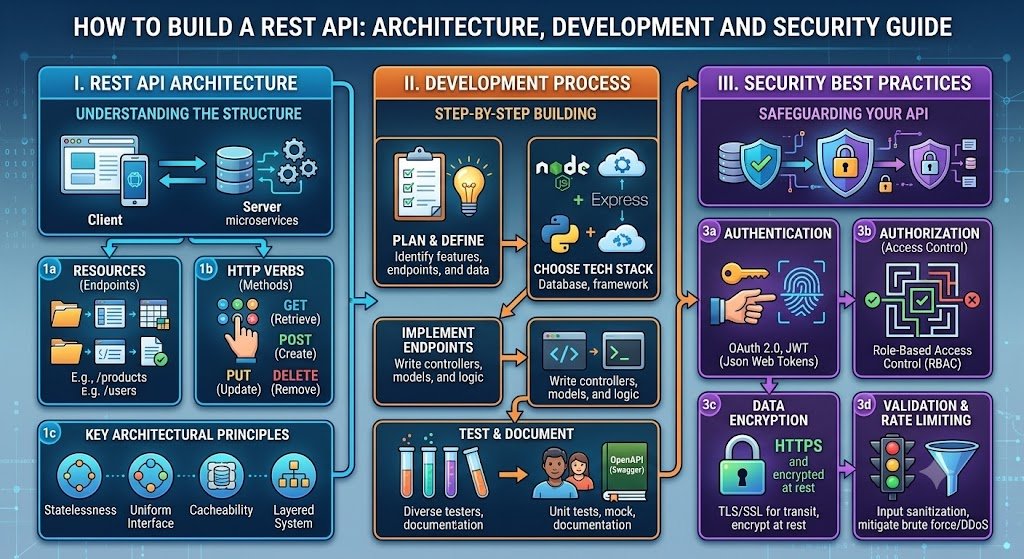
REST — Representational State Transfer — is an architectural style, not a protocol. It defines principles for designing APIs that are simple, scalable, and stateless. Most modern APIs follow REST principles.
The quality of your API determines how easily other systems integrate with you. A well-designed API is predictable, secure, and documented. A poorly designed API creates integration problems, security vulnerabilities, and maintenance burdens.
This guide covers how to build a REST API in 2026. It addresses architecture, design principles, development, security, documentation, and costs for Indian teams.
For organisations building APIs and backend systems, Innovative AI Solutions provides custom software development and AI development services.
REST API Architecture
The Request-Response Cycle
text Client (mobile, web, service) ↓ HTTP Request (method, URL, headers, body) ↓
API Gateway / Load Balancer
↓
Application Server
↓
Business Logic
↓
Database
↓ HTTP Response (status, headers, body) ↓
Client
Core REST Principles
| Principle | What It Means |
|---|---|
| Stateless | Each request contains all needed information |
| Client-server | Separation of concerns |
| Cacheable | Responses can be cached |
| Uniform interface | Consistent design across endpoints |
| Layered system | Intermediaries allowed |
| Code on demand | Optional — server can send code |
HTTP Methods
| Method | Purpose | Idempotent |
|---|---|---|
| GET | Retrieve resource | Yes |
| POST | Create resource | No |
| PUT | Replace resource | Yes |
| PATCH | Update resource partially | No |
| DELETE | Remove resource | Yes |
HTTP Status Codes
| Code | Meaning | When to Use |
|---|---|---|
| 200 | OK | Successful GET, PUT, PATCH |
| 201 | Created | Successful POST |
| 204 | No Content | Successful DELETE |
| 400 | Bad Request | Invalid input |
| 401 | Unauthorised | Missing or invalid auth |
| 403 | Forbidden | Valid auth, insufficient permission |
| 404 | Not Found | Resource does not exist |
| 409 | Conflict | State conflict |
| 422 | Unprocessable Entity | Validation failure |
| 429 | Too Many Requests | Rate limit exceeded |
| 500 | Internal Server Error | Server failure |
API Design Principles
Resource Naming
| Practice | Example |
|---|---|
| Use nouns, not verbs | /users not /getUsers |
| Use plural nouns | /orders not /order |
| Use hierarchical relationships | /users/123/orders |
| Use lowercase and hyphens | /user-profiles |
| Avoid deep nesting | /orders?userId=123 |
Endpoint Design
| Operation | Method | Endpoint |
|---|---|---|
| List users | GET | /users |
| Get user | GET | /users/{id} |
| Create user | POST | /users |
| Update user | PUT | /users/{id} |
| Partial update | PATCH | /users/{id} |
| Delete user | DELETE | /users/{id} |
| List user orders | GET | /users/{id}/orders |
Query Parameters
| Parameter Type | Example |
|---|---|
| Filtering | ?status=active |
| Sorting | ?sort=created_at&order=desc |
| Pagination | ?page=2&limit=20 |
| Search | ?q=john |
| Field selection | ?fields=id,name,email |
Response Structure
json { "data": { "id": 123, "name": "Abhishek Kumar", "email": "abhishek@example.com" }, "meta": { "requestId": "abc-123", "timestamp": "2026-01-15T10:30:00Z" } }
Error Response Structure
json { "error": { "code": "VALIDATION_ERROR", "message": "Email format is invalid", "details": [ { "field": "email", "issue": "Invalid email format" } ] }, "meta": { "requestId": "abc-123", "timestamp": "2026-01-15T10:30:00Z" } }
Development Approach
Technology Stack
| Layer | Options |
|---|---|
| Language | Node.js, Python, Go, Java, .NET |
| Framework | Express, Fastify, FastAPI, Django REST, Spring Boot |
| Database | PostgreSQL, MySQL, MongoDB |
| Cache | Redis, Memcached |
| API Gateway | Kong, AWS API Gateway, NGINX |
Project Structure
text project/ ├── src/ │ ├── routes/ # Endpoint definitions │ ├── controllers/ # Request handling │ ├── services/ # Business logic │ ├── models/ # Data models │ ├── middleware/ # Auth, validation, logging │ ├── utils/ # Helpers │ └── config/ # Configuration ├── tests/ # Test suites ├── docs/ # API documentation └── package.json
Development Practices
| Practice | Purpose |
|---|---|
| Consistent structure | Predictable codebase |
| Separation of concerns | Maintainable code |
| Input validation | Prevent bad data |
| Error handling | Graceful failures |
| Logging | Debugging and audit |
| Testing | Quality assurance |
API Versioning
| Approach | Example |
|---|---|
| URL versioning | /v1/users |
| Header versioning | Accept: application/vnd.api.v1+json |
| Query versioning | /users?version=1 |
URL versioning is simplest and most common.
API Security
Authentication
| Method | When to Use |
|---|---|
| API keys | Simple server-to-server |
| JWT | Stateless authentication |
| OAuth 2.0 | Third-party access |
| Session-based | Traditional web apps |
JWT Authentication Flow
text 1. Client sends credentials ↓
2. Server validates and issues JWT
↓
3. Client stores JWT
↓
4. Client sends JWT in Authorization header
↓ 5. Server validates JWT and processes request
Authorisation
| Model | How It Works |
|---|---|
| Role-based (RBAC) | Permissions by role |
| Attribute-based (ABAC) | Permissions by attributes |
| Scope-based | Permissions by scope |
| Resource-based | Permissions per resource |
Security Best Practices
| Practice | Purpose |
|---|---|
| HTTPS only | Encrypt traffic |
| Input validation | Prevent injection |
| Output encoding | Prevent XSS |
| Rate limiting | Prevent abuse |
| Authentication | Verify identity |
| Authorisation | Enforce permissions |
| Audit logging | Track actions |
| Secret management | Protect credentials |
Rate Limiting
| Strategy | When to Use |
|---|---|
| Fixed window | Simple limiting |
| Sliding window | Smoother limiting |
| Token bucket | Burst handling |
| Leaky bucket | Smooth output |
Common Security Risks
| Risk | Mitigation |
|---|---|
| Injection | Input validation, parameterised queries |
| Broken authentication | Strong auth, secure tokens |
| Data exposure | Encryption, minimal data |
| Rate limit bypass | Multiple limiting strategies |
| Insecure dependencies | Regular updates, scanning |
API Documentation
What to Document
| Element | Purpose |
|---|---|
| Endpoints | All available endpoints |
| Methods | HTTP methods supported |
| Parameters | Required and optional params |
| Request examples | Sample requests |
| Response examples | Sample responses |
| Error codes | All possible errors |
| Authentication | How to authenticate |
Documentation Tools
| Tool | Purpose |
|---|---|
| OpenAPI/Swagger | Industry standard |
| Postman | Testing and docs |
| Redoc | Beautiful API docs |
| API Blueprint | Markdown-based docs |
OpenAPI Example
yaml paths: /users/{id}: get: summary: Get user by ID parameters:
- name: id in: path required: true schema: type: integer responses: '200': description: User found content: application/json: schema: $ref: '#/components/schemas/User' '404': description: User not found Testing APIs Testing Types
| Type | Purpose |
|---|---|
| Unit tests | Test individual functions |
| Integration tests | Test API endpoints |
| Contract tests | Verify API contracts |
| Load tests | Test under load |
| Security tests | Find vulnerabilities |
Testing Tools
| Tool | Purpose |
|---|---|
| Postman | Manual and automated testing |
| Jest/Mocha | Unit testing |
| Supertest | HTTP assertions |
| k6 | Load testing |
| OWASP ZAP | Security testing |
What to Test
| Test | Purpose |
|---|---|
| Happy path | Normal operation |
| Error cases | Invalid inputs |
| Authentication | Auth works |
| Authorisation | Permissions enforced |
| Edge cases | Boundary conditions |
| Performance | Response times |
What It Costs in India
API Development Cost Benchmarks
| API Scope | Cost Range (INR) | Cost Range (USD) | Timeline |
|---|---|---|---|
| Simple API (few endpoints) | ₹1,50,000–₹4,00,000 | $1,800–$4,800 | 4–8 weeks |
| Standard API (multiple endpoints) | ₹4,00,000–₹12,00,000 | $4,800–$14,400 | 8–16 weeks |
| Complex API (integrations, auth) | ₹12,00,000–₹25,00,000 | $14,400–$30,000 | 16–28 weeks |
| Enterprise API platform | ₹25,00,000–₹60,00,000+ | $30,000–$72,000+ | 28–44 weeks |
Ongoing Costs
| Cost Category | Monthly Range (INR) | Monthly Range (USD) |
|---|---|---|
| Cloud infrastructure | ₹5,000–₹80,000 | $60–$960 |
| API gateway | ₹5,000–₹30,000 | $60–$360 |
| Monitoring | ₹3,000–₹20,000 | $36–$240 |
| Maintenance | ₹15,000–₹80,000 | $180–$960 |
Cost Drivers
| Factor | Impact |
|---|---|
| Number of endpoints | More endpoints, higher cost |
| Authentication complexity | OAuth adds cost |
| Integration requirements | Third-party APIs add cost |
| Security requirements | Compliance adds cost |
| Documentation | Comprehensive docs add cost |
India-Specific Considerations
Common Indian API Use Cases
| Industry | API Use |
|---|---|
| Fintech | Payment APIs, KYC APIs |
| E-commerce | Product, order, payment APIs |
| Logistics | Tracking, routing APIs |
| Healthcare | Patient, appointment APIs |
| SaaS | Core product APIs |
Indian Payment APIs
| API | Use Case |
|---|---|
| UPI | Payment processing |
| Razorpay, Cashfree | Payment gateway |
| Paytm, PhonePe | Wallet integration |
Compliance
| Requirement | Implementation |
|---|---|
| DPDPA | Data protection, consent |
| RBI | Financial data handling |
| Audit trails | Log all actions |
| Data residency | Where data is stored |
Decision Framework: API Development Readiness
Readiness Scorecard
| Criteria | Weight | Score (1–5) | Weighted Score |
|---|---|---|---|
| Use case defined | 20% | ||
| Endpoints specified | 20% | ||
| Authentication requirements known | 20% | ||
| Integration needs identified | 15% | ||
| Security requirements understood | 15% | ||
| Budget allocated | 10% | ||
| Total | 100% | /5 |
Architecture Selection
| Your Situation | Recommended Approach |
|---|---|
| Simple API | Monolith with API layer |
| Microservices | API gateway + services |
| High traffic | API gateway + caching |
| Third-party access | OAuth + rate limiting |
Implementation Roadmap
| Phase | What to Build | Timeline |
|---|---|---|
| Phase 1 | Design API specification | 2–4 weeks |
| Phase 2 | Core endpoints | 4–8 weeks |
| Phase 3 | Authentication and security | 2–4 weeks |
| Phase 4 | Documentation and testing | 2–4 weeks |
Frequently Asked Questions
1. What is a REST API?
A REST API is an interface that lets applications exchange data over HTTP. It follows REST principles — stateless, client-server, cacheable, uniform interface.
2. How do I design a REST API?
Use nouns for resources, HTTP methods for operations, and proper status codes. Design consistent endpoint structures, version your API, and document everything.
3. What is the difference between REST and GraphQL?
REST uses fixed endpoints for fixed resources. GraphQL uses a single endpoint with flexible queries. REST is simpler and more cacheable. GraphQL is more flexible for complex data needs.
4. How do I secure a REST API?
Use HTTPS, authentication (JWT, OAuth), authorisation (RBAC), input validation, rate limiting, and audit logging. Never expose sensitive data in URLs or logs.
5. What is JWT authentication?
JWT (JSON Web Token) is a stateless authentication method. The server issues a signed token, the client sends it with each request, and the server validates it without storing session state.
6. How do I version a REST API?
Common approaches are URL versioning (/v1/users), header versioning, or query versioning. URL versioning is simplest and most common.
7. How do I document a REST API?
Use OpenAPI/Swagger specification. Document all endpoints, methods, parameters, request examples, response examples, error codes, and authentication requirements.
8. How much does REST API development cost in India?
Simple APIs cost ₹1,50,000–₹4,00,000 ($1,800–$4,800). Standard APIs cost ₹4,00,000–₹12,00,000 ($4,800–$14,400). Complex APIs cost ₹12,00,000–₹25,00,000 ($14,400–$30,000).
9. How do I test a REST API?
Use unit tests for functions, integration tests for endpoints, contract tests for API contracts, load tests for performance, and security tests for vulnerabilities.
10. What is rate limiting and why does it matter?
Rate limiting restricts how many requests a client can make in a time period. It prevents abuse, protects infrastructure, and ensures fair usage.
11. How does DPDPA affect API development?
DPDPA requires data protection, consent, audit trails, and potentially data residency. APIs handling personal data must comply.
12. How can Innovative AI Solutions help?
Innovative AI Solutions is a Delhi-based software development company that builds REST APIs. We implement API architecture, authentication, security, documentation, and testing — designed for Indian requirements and DPDPA compliance. Explore our custom software development.
Contact Innovative AI Solutions
Ready to build a REST API?
We help Indian businesses build secure, well-documented REST APIs with proper architecture and testing.
Contact Information
Innovative AI Solutions
📍 Netaji Subhash Place, Pitampura, Delhi – 110034
🌐 Website: https://innovativeais.com 📧 Email: info@innovativeais.com
📞 Phone: +91 7464 099 059 / +91 96899 67356
Business Services
• AI Automation • AI Development • AI Consulting • Machine Learning Solutions • Deep Learning Solutions • Generative AI Services • NLP Solutions • AI Agents • AI Chatbots • Voice AI • CRM Development • Custom Software Development • Website Development • Mobile App Development
About the Author
Abhishek Kumar
Founder & CEO, Innovative AI Solutions
5+ years building production AI systems for Indian businesses. Based in Delhi, serving clients across India.
Ready to build AI solutions for your business?
Innovative AI Solutions — Delhi's leading AI development company. Free consultation available.
Get Free Consultation →
A complete 2026 guide to building REST APIs — architecture, design principles, development, security, documentation, and costs for Indian teams.
#RESTAPI #Architecture #Development #Security #2026 #APIDesign #HTTP #JSON #Authentication #Authorisation #JWT #OAuth #RateLimiting #Versioning #Documentation #Testing #Nodejs #Python #FastAPI #APIGateway #Microservices #India #DelhiNCRTech #EnterpriseApps #StartupApps #TechIndia #DigitalProducts #BackendDevelopment #WebServices #InnovativeAISolutions
Copyright © 2015–2026 Innovative AI Solutions. All Rights Reserved. | Privacy Policy | Terms & Conditions