Why Enterprises Need Private AI Chatbots
Public AI services — ChatGPT, Claude, Gemini — are powerful. They are also public. Data sent to them leaves your perimeter. It may be used for training. It may be accessible to the provider. It is not under your control.
For enterprises handling sensitive data — customer information, financial records, intellectual property, employee data — this is unacceptable. Regulatory requirements under DPDPA, sector regulations, and internal policies prevent sending sensitive data to public services.
Yet the productivity gains from AI are real. Employees want to ask questions about internal documents, policies, and data. They want instant answers instead of searching through wikis, PDFs, and shared drives.
A private AI chatbot solves this. It runs on your infrastructure (or dedicated private cloud), uses your data, answers questions with your knowledge, and keeps everything inside your perimeter.
This guide explains how to build a private AI chatbot for enterprise data in 2026. It covers architecture, RAG, security, DPDPA compliance, and costs for Indian enterprises.
For organisations building private AI systems, Innovative AI Solutions provides AI development services and AI consulting.
What a Private AI Chatbot Is
The Definition
A private AI chatbot is an AI assistant that runs on your infrastructure, uses your data, and keeps all processing inside your perimeter.
| Public AI Chatbot | Private AI Chatbot |
|---|---|
| Runs on provider infrastructure | Runs on your infrastructure |
| Data leaves your perimeter | Data stays inside |
| Shared with other customers | Isolated to your organisation |
| Provider controls updates | You control updates |
| Limited customisation | Full customisation |
The Three Deployment Models
| Model | Description | Best For |
|---|---|---|
| Fully on-premise | Everything runs in your data centre | Highest security needs |
| Private cloud | Dedicated cloud infrastructure | Balance of control and scale |
| Hybrid | Sensitive data on-premise, other processing in cloud | Mixed requirements |
What It Enables
| Capability | Business Value |
|---|---|
| Internal knowledge access | Employees find answers instantly |
| Document Q&A | Query policies, contracts, reports |
| Data insights | Ask questions about business data |
| Secure assistance | AI without data leakage |
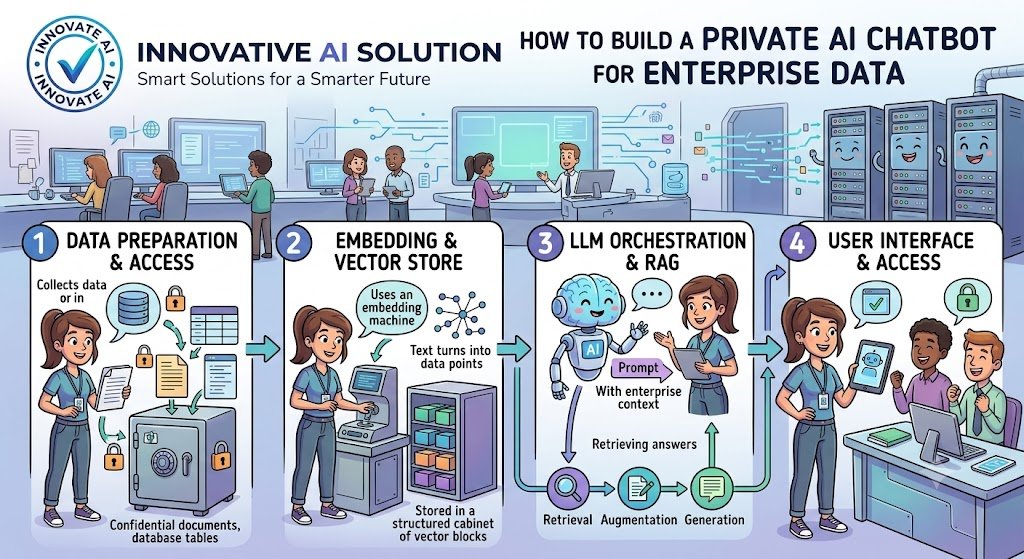
Architecture of a Private AI Chatbot
The Core Components
text
User Interface (web, Slack, Teams)
↓
Authentication and Authorisation
↓
Orchestration Layer
↓
RAG Pipeline
├── Vector database (your documents) ├── Retrieval └── Context assembly ↓ LLM (on-premise or private cloud) ↓
Guardrails and Output Filtering
↓
Response to user
↓ Audit logging
Component 1: User Interface
| Option | When to Use |
|---|---|
| Web application | General access |
| Slack/Teams integration | Where employees work |
| Internal portal | Existing intranet |
| API | Custom integrations |
Component 2: Authentication and Authorisation
| Requirement | Implementation |
|---|---|
| User authentication | SSO, MFA |
| Access control | Role-based, document-level |
| Permission filtering | Users see only what they can access |
| Audit logging | Track all queries |
Component 3: RAG Pipeline
RAG retrieves relevant documents before generating responses.
| RAG Component | Purpose |
|---|---|
| Document ingestion | Load enterprise documents |
| Chunking | Split into retrievable pieces |
| Embedding | Convert to vectors |
| Vector database | Store and search |
| Retrieval | Find relevant content |
| Reranking | Order by relevance |
| Context assembly | Prepare for LLM |
Component 4: LLM
The language model generates responses.
| Option | Characteristics |
|---|---|
| Self-hosted open-source | Full control, no data leaves |
| Private cloud LLM | Managed, isolated |
| Fine-tuned model | Domain-specific |
| Hybrid | Mix based on sensitivity |
Component 5: Guardrails
| Guardrail | Purpose |
|---|---|
| Input validation | Prevent prompt injection |
| Output filtering | Prevent data leakage |
| Access control | Enforce permissions |
| Rate limiting | Prevent abuse |
| Audit logging | Record all actions |
Technology Choices
LLM Options
| Model Type | Characteristics | Deployment |
|---|---|---|
| Llama family | Open-source, capable | Self-hosted |
| Mistral | Efficient, capable | Self-hosted |
| Indian models (Sarvam, BharatGen) | Indian language focus | Self-hosted |
| Private cloud models | Managed, isolated | Private cloud |
Vector Database Options
| Option | Characteristics |
|---|---|
| Pinecone | Managed, scalable |
| Weaviate | Open-source, flexible |
| Qdrant | Open-source, fast |
| pgvector | PostgreSQL extension |
| Milvus | Open-source, scalable |
Technology Stack Example
| Layer | Technology |
|---|---|
| Frontend | React, Next.js |
| Backend | Python (FastAPI) |
| LLM | Llama 3, Mistral |
| Vector DB | Qdrant, pgvector |
| Orchestration | LangChain, LlamaIndex |
| Infrastructure | On-premise GPU, private cloud |
Security Architecture
Security Layers
| Layer | Controls |
|---|---|
| Network | VPC, firewalls, isolation |
| Identity | SSO, MFA, RBAC |
| Data | Encryption at rest and transit |
| Application | Input validation, output filtering |
| Monitoring | Audit logs, anomaly detection |
Access Control
| Control | Purpose |
|---|---|
| Document-level permissions | Users see only permitted documents |
| Role-based access | Access by role |
| Attribute-based access | Access by attributes |
| Audit trails | Track all access |
Data Protection
| Data State | Protection |
|---|---|
| At rest | Encryption (AES-256) |
| In transit | TLS 1.3 |
| In processing | Isolated environment |
| In logs | Redaction of sensitive data |
Prompt Injection Defence
| Defence | Purpose |
|---|---|
| Input validation | Sanitise inputs |
| Instruction hierarchy | System prompts take precedence |
| Output filtering | Prevent data leakage |
| Tool restrictions | Limit what AI can do |
DPDPA Compliance
Requirements for Private AI Chatbots
| Requirement | Implementation |
|---|---|
| Consent | For processing personal data |
| Purpose limitation | Data used only for stated purposes |
| Data minimisation | Process only necessary data |
| Storage limitation | Delete when no longer needed |
| Security safeguards | Encryption, access control |
| User rights | Access, correction, deletion |
| Audit trails | Log all processing |
The Deletion Challenge
| Data Location | Deletion Approach |
|---|---|
| Vector database | Delete embeddings |
| Document store | Remove documents |
| Conversation logs | Delete records |
| Model weights | Retraining if fine-tuned |
RAG-based chatbots have a compliance advantage — deletion means removing documents, not retraining models.
What It Costs in India
Implementation Costs
| Scope | Cost Range (INR) | Cost Range (USD) | Timeline |
|---|---|---|---|
| Basic private chatbot | ₹5,00,000–₹15,00,000 | $6,000–$18,000 | 8–16 weeks |
| Standard enterprise chatbot | ₹15,00,000–₹35,00,000 | $18,000–$42,000 | 16–28 weeks |
| Advanced with access control | ₹35,00,000–₹75,00,000 | $42,000–$90,000 | 28–44 weeks |
| Full enterprise platform | ₹75,00,000–₹1,50,00,000+ | $90,000–$180,000+ | 44–64 weeks |
Cost by Component
| Component | Cost Range (INR) | Cost Range (USD) |
|---|---|---|
| RAG pipeline | ₹4,00,000–₹12,00,000 | $4,800–$14,400 |
| LLM deployment | ₹3,00,000–₹10,00,000 | $3,600–$12,000 |
| Vector database setup | ₹1,50,000–₹4,00,000 | $1,800–$4,800 |
| Access control | ₹2,00,000–₹6,00,000 | $2,400–$7,200 |
| Guardrails | ₹1,50,000–₹5,00,000 | $1,800–$6,000 |
| UI development | ₹2,00,000–₹6,00,000 | $2,400–$7,200 |
| Integration | ₹2,00,000–₹8,00,000 | $2,400–$9,600 |
Infrastructure Costs
| Component | Monthly Range (INR) | Monthly Range (USD) |
|---|---|---|
| GPU compute (self-hosted) | ₹50,000–₹5,00,000+ | $600–$6,000+ |
| Private cloud LLM | ₹30,000–₹2,00,000 | $360–$2,400 |
| Vector database | ₹5,000–₹30,000 | $60–$360 |
| Application servers | ₹20,000–₹80,000 | $240–$960 |
| Storage | ₹5,000–₹30,000 | $60–$360 |
Ongoing Costs
| Cost Category | Monthly Range (INR) | Monthly Range (USD) |
|---|---|---|
| Infrastructure | ₹1,00,000–₹6,00,000 | $1,200–$7,200 |
| Monitoring | ₹10,000–₹40,000 | $120–$480 |
| Maintenance | ₹25,000–₹1,00,000 | $300–$1,200 |
| Content updates | ₹10,000–₹50,000 | $120–$600 |
India-Specific Considerations
Indian Enterprise Context
| Factor | Implication |
|---|---|
| Data sensitivity | Private deployment essential |
| Regulatory requirements | DPDPA, sector rules |
| Cost sensitivity | Optimise infrastructure |
| Talent | Growing AI engineering pool |
Indian Language Support
| Language | Support Level |
|---|---|
| English | Excellent |
| Hindi | Good |
| Hinglish | Moderate |
| Regional languages | Variable |
Compliance
| Requirement | Implementation |
|---|---|
| DPDPA | Data protection, consent |
| RBI | Financial data handling |
| IRDAI | Insurance data |
| Data residency | On-premise or India cloud |
Decision Framework: Private Chatbot Readiness
Deployment Model Selection
| Your Situation | Recommended Model |
|---|---|
| Highest security needs | Fully on-premise |
| Balance of control and scale | Private cloud |
| Mixed requirements | Hybrid |
| Cost-sensitive | Private cloud with open-source |
| Data residency critical | On-premise or India cloud |
Readiness Scorecard
| Criteria | Weight | Score (1–5) | Weighted Score |
|---|---|---|---|
| Use case defined | 20% | ||
| Data sources identified | 20% | ||
| Security requirements clear | 20% | ||
| Infrastructure available | 15% | ||
| Budget for build and ongoing | 15% | ||
| Compliance requirements known | 10% | ||
| Total | 100% | /5 |
Implementation Roadmap
| Phase | What to Build | Timeline | Cost (INR) |
|---|---|---|---|
| Phase 1 | RAG pipeline, basic chatbot | 8–12 weeks | ₹5,00,000–₹12,00,000 |
| Phase 2 | Access control, security | 6–10 weeks | ₹4,00,000–₹12,00,000 |
| Phase 3 | Guardrails, governance | 4–8 weeks | ₹3,00,000–₹10,00,000 |
| Phase 4 | Scale, optimise | Ongoing | Variable |
Frequently Asked Questions
1. What is a private AI chatbot?
A private AI chatbot runs on your infrastructure, uses your data, and keeps all processing inside your perimeter. No data leaves your organisation.
2. Why do enterprises need private AI chatbots?
Enterprise data is sensitive. Public AI services may use data for training, expose it to providers, or fail regulatory requirements. Private chatbots keep data secure.
3. How does a private AI chatbot work?
It uses RAG to retrieve relevant documents, an LLM to generate responses, and access controls to ensure users see only permitted content. Everything runs on your infrastructure.
4. How much does it cost to build a private AI chatbot in India?
Basic private chatbots cost ₹5,00,000–₹15,00,000 ($6,000–$18,000). Standard enterprise chatbots cost ₹15,00,000–₹35,00,000 ($18,000–$42,000). Advanced platforms cost ₹75,00,000–₹1,50,00,000+ ($90,000–$180,000+).
5. What LLM should I use for a private chatbot?
Open-source models like Llama or Mistral for self-hosted deployment. Private cloud models for managed isolation. Indian models like Sarvam AI for Indian language focus.
6. What is RAG and why does it matter?
RAG (Retrieval-Augmented Generation) retrieves relevant documents before generating responses. It enables the chatbot to answer using your data without retraining.
7. How do I control access to documents?
Implement document-level permissions. Users see only documents they are authorised to access. Enforce permissions in the retrieval layer.
8. How does DPDPA affect private AI chatbots?
DPDPA requires consent, data protection, security safeguards, user rights, and audit trails. RAG-based chatbots have a deletion advantage — remove documents, not retrain models.
9. What infrastructure is needed?
GPU compute for self-hosted LLMs (₹50,000–₹5,00,000+ monthly) or private cloud LLM (₹30,000–₹2,00,000 monthly). Vector database, application servers, and storage.
10. How do I prevent prompt injection?
Input validation, instruction hierarchy (system prompts take precedence), output filtering, tool restrictions, and human approval for sensitive actions.
11. How long does it take to build a private AI chatbot?
Basic chatbots take 8–16 weeks. Standard enterprise chatbots take 16–28 weeks. Advanced platforms take 28–44 weeks.
12. How can Innovative AI Solutions help?
Innovative AI Solutions is a Delhi-based AI development company that builds private AI chatbots. We implement RAG pipelines, on-premise LLM deployment, access control, and DPDPA-compliant governance. Explore our AI development services and AI consulting.
Contact Innovative AI Solutions
Ready to build a private AI chatbot for your enterprise?
We help Indian enterprises build secure AI chatbots that keep data inside the perimeter while delivering AI-powered knowledge access.
Contact Information
Innovative AI Solutions
📍 Netaji Subhash Place, Pitampura, Delhi – 110034
🌐 Website: https://innovativeais.com 📧 Email: info@innovativeais.com
📞 Phone: +91 7464 099 059 / +91 96899 67356
Business Services
• AI Automation • AI Development • AI Consulting • Machine Learning Solutions • Deep Learning Solutions • Generative AI Services • NLP Solutions • AI Agents • AI Chatbots • Voice AI • CRM Development • Custom Software Development • Website Development • Mobile App Development
About the Author
Abhishek Kumar
Founder & CEO, Innovative AI Solutions
5+ years building production AI systems for Indian businesses. Based in Delhi, serving clients across India.
Ready to build AI solutions for your business?
Innovative AI Solutions — Delhi's leading AI development company. Free consultation available.
Get Free Consultation →
A complete 2026 guide to building a private AI chatbot for enterprise data — architecture, RAG, security, DPDPA compliance, and costs for Indian enterprises.
#PrivateAIChatbot #EnterpriseData #2026 #RAG #OnPremise #SelfHosted #Security #DPDPA #Architecture #Implementation #Costs #VectorDatabase #LLM #AccessControl #Governance #India #DelhiNCRTech #EnterpriseApps #StartupApps #InternalKnowledge #ChatbotDevelopment #TechIndia #DigitalProducts #EnterpriseAI #BusinessSoftware #InnovativeAISolutions
Copyright © 2015–2026 Innovative AI Solutions. All Rights Reserved. | Privacy Policy | Terms & Conditions