What an AI Engineer Actually Does
AI engineering is the fastest-growing role in technology. It is also one of the most misunderstood.
An AI engineer is not a researcher. Researchers invent new models and publish papers. AI engineers take existing models — often large language models — and build them into working products. They handle data pipelines, retrieval systems, prompt design, evaluation, deployment, and monitoring.
The role emerged because building AI products requires skills that neither traditional software engineers nor ML researchers have on their own. Software engineers can build products but do not understand model behaviour. Researchers understand models but do not build production systems. AI engineers do both.
This matters for anyone planning a career. AI engineering is more accessible than ML research (no PhD required) and more in-demand than general software engineering (AI skills command premiums). It is a practical path with clear requirements.
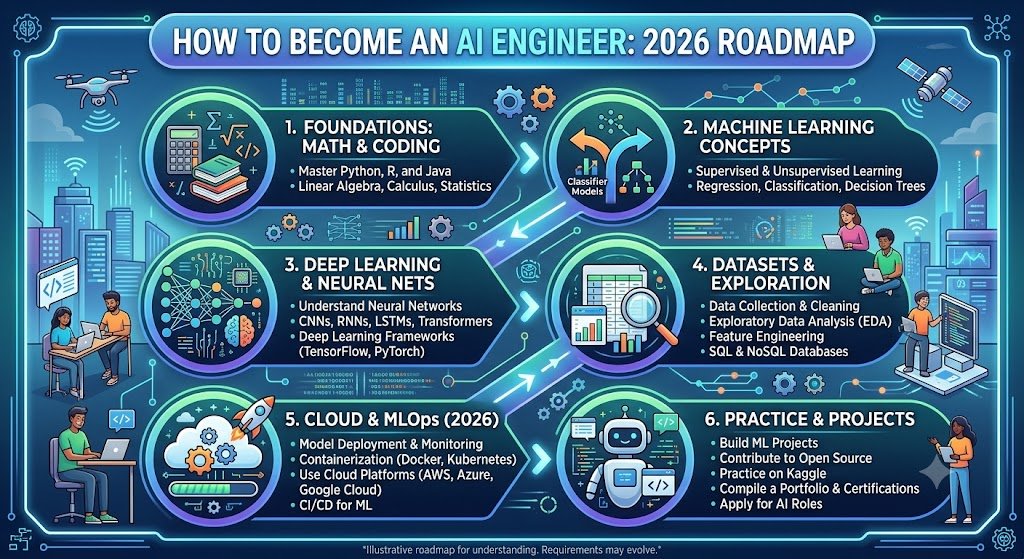
This guide provides a complete roadmap for becoming an AI engineer in 2026. It covers the skills, the tools, the projects, realistic timelines, and career expectations in India.
For those building AI engineering teams, Innovative AI Solutions provides AI development services and works with AI engineers across India.
AI Engineer vs Related Roles
Role Comparison
| Role | Focus | Typical Background |
|---|
| AI Engineer | Building AI-powered products | Software engineering |
| ML Engineer | Training and deploying models | ML, data science |
| Data Scientist | Analysis, insights, modelling | Statistics, analytics |
| ML Researcher | Inventing new methods | PhD, research |
| AI Product Manager | Defining AI products | Product management |
What Makes AI Engineering Distinct
| Aspect | Detail |
|---|
| Model use | Uses existing models, not inventing them |
| Focus | Production systems |
| Skills | Software engineering + AI |
| Deliverable | Working products |
| Barrier to entry | Lower than research |
Where AI Engineers Work
| Organisation Type | Focus |
|---|
| Startups | Building AI-native products |
| Product companies | Adding AI features |
| Enterprises | Internal AI systems |
| Agencies | Client AI projects |
| Consultancies | AI transformation |
The Skills AI Engineers Need
Skill Category 1: Software Engineering
| Skill | Why It Matters |
|---|
| Python | Primary language |
| APIs | Integrating services |
| Databases | Data storage |
| Git | Version control |
| Testing | Code quality |
| Docker | Deployment |
Skill Category 2: ML Fundamentals
| Skill | Why It Matters |
|---|
| Model types | Understanding options |
| Evaluation | Measuring quality |
| Overfitting | Avoiding common errors |
| Feature engineering | Data preparation |
| Metrics | Accuracy, precision, recall |
You do not need deep maths. You need working understanding.
Skill Category 3: LLM Engineering
| Skill | Why It Matters |
|---|
| Prompt engineering | Getting good outputs |
| RAG | Grounding in data |
| Fine-tuning | Adapting models |
| Embeddings | Semantic search |
| Vector databases | Retrieval storage |
| Evaluation | Measuring LLM quality |
Skill Category 4: AI Agents
| Skill | Why It Matters |
|---|
| Tool calling | Agents taking actions |
| Orchestration | Multi-step workflows |
| Guardrails | Safety controls |
| Memory | Context management |
| Agent frameworks | LangGraph, CrewAI |
Skill Category 5: Production and MLOps
| Skill | Why It Matters |
|---|
| Model deployment | Serving models |
| Monitoring | Detecting issues |
| Cost management | Controlling inference cost |
| CI/CD | Automated deployment |
| Observability | Debugging AI systems |
Skill Priority Matrix
| Skill | Priority | Why |
|---|
| Python | Critical | Foundation |
| LLM APIs | Critical | Most AI work |
| RAG | Critical | Most AI products |
| Prompt engineering | Critical | Daily work |
| Evaluation | High | Quality assurance |
| Agents | High | Growing demand |
| Deployment | High | Production skills |
| Fine-tuning | Medium | Specific use cases |
| Custom ML models | Medium | Specialised needs |
The AI Engineer Roadmap
Phase 1: Software Engineering Foundation (Months 1–3)
| Topic | What to Learn |
|---|
| Python | Basics, OOP, libraries |
| APIs | REST, HTTP, JSON |
| Databases | SQL, basic NoSQL |
| Git | Version control |
| Testing | Unit tests |
Outcome: Can build basic applications.
Phase 2: ML Fundamentals (Months 3–5)
| Topic | What to Learn |
|---|
| ML concepts | Supervised, unsupervised |
| Model types | Regression, classification |
| Evaluation | Metrics, cross-validation |
| scikit-learn | Practical ML |
| Pandas/NumPy | Data handling |
Outcome: Understand ML concepts and can train basic models.
Phase 3: LLM Engineering (Months 5–8)
| Topic | What to Learn |
|---|
| LLM APIs | OpenAI, Claude, Gemini |
| Prompt engineering | System prompts, few-shot |
| RAG | Retrieval pipelines |
| Embeddings | Vector representation |
| Vector databases | Pinecone, Qdrant, pgvector |
| Evaluation | LLM quality metrics |
Outcome: Can build RAG applications and chatbots.
Phase 4: AI Agents (Months 8–10)
| Topic | What to Learn |
|---|
| Tool calling | Function calling |
| Agent frameworks | LangGraph, CrewAI |
| Orchestration | Multi-step workflows |
| Guardrails | Safety, permissions |
| Memory | Context management |
Outcome: Can build production AI agents.
Phase 5: Production and MLOps (Months 10–12)
| Topic | What to Learn |
|---|
| Deployment | Serving AI systems |
| Monitoring | Observability tools |
| Cost optimisation | Caching, routing |
| CI/CD | Automated pipelines |
| Evaluation frameworks | Continuous measurement |
Outcome: Can deploy and operate AI systems in production.
Tools AI Engineers Use
Development Tools
| Tool | Purpose |
|---|
| Python | Primary language |
| VS Code / Cursor | Code editors |
| Git/GitHub | Version control |
| Docker | Containerisation |
| Postman | API testing |
AI/LLM Tools
| Tool | Purpose |
|---|
| OpenAI API | LLM access |
| Anthropic Claude | LLM access |
| Hugging Face | Models, datasets |
| LangChain/LangGraph | Orchestration |
| LlamaIndex | RAG framework |
| Pinecone/Qdrant | Vector databases |
Evaluation and Monitoring
| Tool | Purpose |
|---|
| LangSmith | LLM observability |
| Langfuse | Open-source observability |
| Ragas | RAG evaluation |
| Custom evals | Task-specific evaluation |
Deployment Tools
| Tool | Purpose |
|---|
| FastAPI | API framework |
| Vercel/Railway | Simple deployment |
| AWS/GCP/Azure | Cloud platforms |
| Docker/Kubernetes | Container orchestration |
Projects That Get AI Engineers Hired
Beginner Projects
| Project | Skills |
|---|
| Chatbot with LLM API | API integration |
| Document Q&A | Basic RAG |
| Text summariser | Prompt engineering |
| Sentiment classifier | Classic ML |
Intermediate Projects
| Project | Skills |
|---|
| RAG knowledge base | Full RAG pipeline |
| AI support agent | Tools, escalation |
| Document processing | Extraction, validation |
| Recommendation system | Embeddings, search |
Advanced Projects
| Project | Skills |
|---|
| Multi-tool AI agent | Orchestration, guardrails |
| Production RAG system | Evaluation, monitoring |
| AI-powered SaaS | Full stack + AI |
| Agentic workflow | Multi-step automation |
What Makes Projects Stand Out
| Factor | Why It Matters |
|---|
| Deployed and live | Shows you can ship |
| Real users | Shows impact |
| Evaluation metrics | Shows rigour |
| Clean code | Shows quality |
| Documentation | Shows communication |
| Cost awareness | Shows production thinking |
Learning Resources
Free Resources
| Resource | Best For |
|---|
| DeepLearning.AI courses | LLM engineering |
| Fast.ai | Practical deep learning |
| Hugging Face courses | Transformers, LLMs |
| LangChain docs | Orchestration |
| OpenAI cookbook | Practical examples |
Paid Resources
| Resource | Best For |
|---|
| DeepLearning.AI specialisations | Structured learning |
| Coursera | University courses |
| Coding Ninjas | India-focused |
| Scaler | India-focused, mentorship |
Indian Communities
| Community | Purpose |
|---|
| Local AI meetups | Networking (Delhi NCR, Bangalore) |
| Discord/Slack groups | Help, discussion |
| GitHub | Open source contribution |
Realistic Timelines
Full-Time Study
| Phase | Duration |
|---|
| Software engineering | 3 months |
| ML fundamentals | 2 months |
| LLM engineering | 3 months |
| AI agents | 2 months |
| Production/MLOps | 2 months |
| Total | 12 months |
Part-Time Study
| Phase | Duration |
|---|
| Software engineering | 6 months |
| ML fundamentals | 4 months |
| LLM engineering | 6 months |
| AI agents | 4 months |
| Production/MLOps | 4 months |
| Total | 24 months |
For Experienced Software Engineers
Experienced engineers can skip Phase 1 and reach job-ready in 6–9 months of focused study.
Career Expectations in India
AI Engineer Salaries
| Level | Experience | Salary Range (INR) | Salary Range (USD) |
|---|
| Entry | 0–2 years | ₹8,00,000–₹18,00,000 | $9,600–$21,600 |
| Mid-level | 3–5 years | ₹18,00,000–₹40,00,000 | $21,600–$48,000 |
| Senior | 5–8 years | ₹35,00,000–₹80,00,000 | $42,000–$96,000 |
| Lead / Principal | 8+ years | ₹60,00,000–₹1,50,00,000+ | $72,000–$1,80,000+ |
Salary by City
| City | Mid-Level (INR/year) |
|---|
| Bangalore | ₹20,00,000–₹45,00,000 |
| Delhi NCR | ₹18,00,000–₹40,00,000 |
| Mumbai | ₹18,00,000–₹42,00,000 |
| Hyderabad | ₹17,00,000–₹38,00,000 |
| Pune | ₹16,00,000–₹35,00,000 |
Roles to Target
| Role | Focus |
|---|
| AI Engineer | Building AI products |
| LLM Engineer | LLM applications |
| AI Product Engineer | Full-stack AI |
| Agent Engineer | AI agents |
| AI Solutions Engineer | Client AI systems |
Job Market Reality
| Factor | Consideration |
|---|
| Demand | Very high |
| Competition | Moderate |
| Portfolio matters | More than certificates |
| Production skills valued | Deployment, monitoring |
| LLM skills premium | Significant |
India-Specific Considerations
Indian AI Ecosystem
| Factor | Status |
|---|
| Talent | Growing rapidly |
| Companies hiring | Startups, product, services |
| AI investment | Increasing |
| Government support | IndiaAI Mission |
Learning Challenges in India
| Challenge | Solution |
|---|
| Cost of courses | Use free resources |
| GPU access | Use cloud credits, Colab |
| Mentorship | Join communities |
| English resources | Hindi resources growing |
Common Indian AI Engineer Roles
| Industry | Focus |
|---|
| E-commerce | Recommendations, support |
| Fintech | Fraud, credit, support |
| SaaS | AI features |
| Healthcare | Diagnosis, records |
| Logistics | Route, forecast |
Decision Framework: AI Engineer Readiness
Readiness Scorecard
| Criteria | Weight | Score (1–5) | Weighted Score |
|---|
| Programming foundation | 25% |
| Time available | 20% |
| Learning resources | 15% |
| Practice opportunities | 15% |
| Career goal clarity | 15% |
| Budget for learning | 10% |
| Total | 100% | /5 |
Path Selection
| Your Background | Recommended Path |
|---|
| Complete beginner | Full 12-month path |
| Software engineer | 6–9 month path (skip Phase 1) |
| Data scientist | 6–9 month path (accelerate ML) |
| ML engineer | 4–6 month path (LLM focus) |
| Working professional | Part-time 24-month path |
Implementation Roadmap
| Phase | What to Learn | Timeline |
|---|
| Phase 1 | Python, APIs, databases | 3 months |
| Phase 2 | ML fundamentals | 2 months |
| Phase 3 | LLM engineering, RAG | 3 months |
| Phase 4 | AI agents | 2 months |
| Phase 5 | Production, MLOps | 2 months |
Frequently Asked Questions
1. What is an AI engineer?
An AI engineer builds AI-powered products using existing models. They handle data pipelines, RAG systems, prompt design, evaluation, deployment, and monitoring.
2. How long does it take to become an AI engineer?
Full-time: 12 months from scratch. Experienced software engineers: 6–9 months. Part-time: 24 months.
3. What skills does an AI engineer need?
Software engineering (Python, APIs, databases), ML fundamentals, LLM engineering (prompting, RAG, fine-tuning), AI agents, and production/MLOps.
4. Do I need a degree to become an AI engineer?
No. AI engineering is more accessible than ML research. What matters is skills, portfolio, and production experience.
5. What is the difference between AI engineer and ML engineer?
AI engineers build AI-powered products using existing models. ML engineers train and deploy models. AI engineering focuses on production systems, ML engineering on model development.
6. What tools do AI engineers use?
Python, OpenAI/Claude APIs, LangChain/LangGraph, vector databases (Pinecone, Qdrant), FastAPI, Docker, and cloud platforms.
7. What projects should I build to get hired?
3–5 deployed projects: LLM chatbot, RAG knowledge base, AI support agent, document processing system, multi-tool agent. Deployed, with evaluation metrics and documentation.
8. What is the salary for AI engineers in India?
Entry: ₹8,00,000–₹18,00,000. Mid-level: ₹18,00,000–₹40,00,000. Senior: ₹35,00,000–₹80,00,000. Lead: ₹60,00,000–₹1,50,00,000+.
9. Do I need to learn deep learning to be an AI engineer?
Not deeply. You need to understand deep learning concepts, but AI engineers primarily use existing models rather than training them from scratch.
10. What is the best way to learn AI engineering?
Build projects. Courses provide foundations, but production experience comes from building, deploying, and iterating on real systems.
11. Can I become an AI engineer without ML experience?
Yes, if you have software engineering experience. AI engineering is closer to software engineering than to ML research. Skip straight to LLM engineering.
12. How can Innovative AI Solutions help?
Innovative AI Solutions is a Delhi-based AI development company that builds AI products. We work with AI engineers and help businesses implement AI solutions. Explore our AI development services and AI consulting.
Contact Innovative AI Solutions
Building AI products or growing an AI engineering team?
We help Indian businesses implement AI solutions and work with AI engineers across India.
Contact Information
Innovative AI Solutions
📍 Netaji Subhash Place, Pitampura, Delhi – 110034
🌐 Website: https://innovativeais.com 📧 Email: info@innovativeais.com
📞 Phone: +91 7464 099 059 / +91 96899 67356
Business Services
• AI Automation • AI Development • AI Consulting • Machine Learning Solutions • Deep Learning Solutions • Generative AI Services • NLP Solutions • AI Agents • AI Chatbots • Voice AI • CRM Development • Custom Software Development • Website Development • Mobile App Development
About the Author
Abhishek Kumar
Founder & CEO, Innovative AI Solutions
5+ years building production AI systems for Indian businesses. Based in Delhi, serving clients across India.
Ready to build AI solutions for your business?
Innovative AI Solutions — Delhi's leading AI development company. Free consultation available.
Get Free Consultation →
A complete 2026 roadmap to becoming an AI engineer — skills, tools, projects, timelines, and India-specific salary expectations for beginners and career switchers.
#AIEngineer #Roadmap #2026 #Career #Skills #LLM #RAG #Agents #Python #PyTorch #HuggingFace #LangChain #Salary #India #DelhiNCRTech #Beginners #CareerSwitcher #AIDevelopment #MachineLearning #DeepLearning #TechIndia #DigitalProducts #CareerGuide #Upskilling #AIJobs #InnovativeAISolutions
Copyright © 2015–2026 Innovative AI Solutions. All Rights Reserved. | Privacy Policy | Terms & Conditions