What Full Stack Development Actually Means
A full stack developer builds both the frontend and backend of web applications. They work on what users see and interact with, and on the servers, APIs, and databases that power it.
The term does not mean knowing everything. It means knowing enough across the stack to build complete products — and knowing where to go deeper when needed.
In 2026, full stack developers are in high demand in India. Startups need people who can build complete features. Product companies need engineers who understand the whole system. Agencies need developers who can work across the stack.
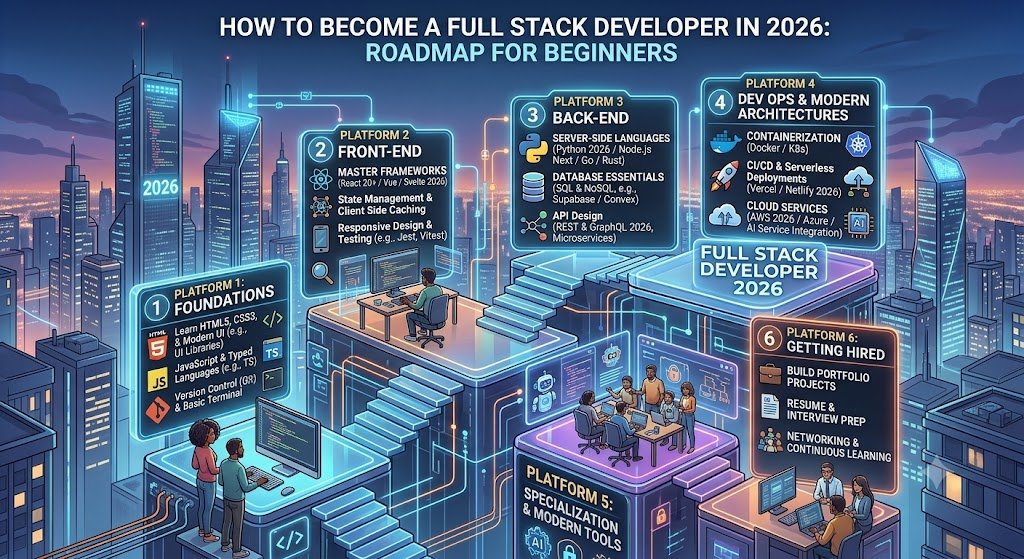
This roadmap covers how to become a full stack developer in 2026. It explains what to learn, in what order, with realistic timelines, projects, and salary expectations for Indian developers.
For developers building full stack applications, Innovative AI Solutions provides custom software development and engineering opportunities.
What a Full Stack Developer Does
The Stack
text Frontend (what users see)
├── HTML, CSS, JavaScript
├── React, Vue, Angular
└── Responsive design ↓ Backend (what powers it)
├── Node.js, Python, Java
├── REST APIs, GraphQL
└── Authentication, authorisation ↓ Database (where data lives)
├── PostgreSQL, MySQL
├── MongoDB └── Caching (Redis) ↓ DevOps (how it runs)
├── Git, CI/CD
├── Cloud (AWS, Azure) └── Monitoring
Core Responsibilities
| Responsibility | What It Involves |
|---|---|
| Build UI | Frontend development |
| Build APIs | Backend development |
| Design databases | Data modelling |
| Integrate systems | Third-party services |
| Deploy applications | Cloud deployment |
| Debug and optimise | Performance, issues |
What Full Stack Is Not
| Myth | Reality |
|---|---|
| Knowing everything | Knowing enough across the stack |
| Replacing specialists | Complementing specialists |
| One skill | Multiple skills |
| Learned in weeks | Learned in months |
The Learning Roadmap
Phase 1: Web Fundamentals (Weeks 1–6)
| Topic | What to Learn |
|---|---|
| HTML | Structure, semantic elements |
| CSS | Styling, layouts, responsive design |
| JavaScript basics | Variables, functions, DOM |
| Git | Version control basics |
Project: Build a static personal website.
Resources: FreeCodeCamp, MDN Web Docs, YouTube tutorials.
Phase 2: Frontend Development (Weeks 6–16)
| Topic | What to Learn |
|---|---|
| JavaScript advanced | ES6+, async/await, promises |
| React | Components, hooks, state |
| TypeScript | Type safety |
| CSS frameworks | Tailwind CSS |
| State management | Context, Zustand |
| API integration | Fetch, Axios |
Project: Build a task management app with React.
Resources: React documentation, Next.js learn, Scrimba.
Phase 3: Backend Development (Weeks 16–28)
| Topic | What to Learn |
|---|---|
| Node.js | Server-side JavaScript |
| Express/Fastify | Web frameworks |
| REST APIs | Design principles |
| Authentication | JWT, OAuth |
| Validation | Input validation |
| Error handling | Graceful failures |
Project: Build a REST API for the task app.
Resources: Node.js documentation, Express guide.
Phase 4: Databases (Weeks 24–32)
| Topic | What to Learn |
|---|---|
| PostgreSQL | Relational databases |
| SQL | Queries, joins, indexes |
| MongoDB | Document databases |
| ORM | Prisma, Drizzle |
| Caching | Redis basics |
Project: Add persistent storage to your app.
Resources: PostgreSQL tutorial, MongoDB University.
Phase 5: DevOps and Deployment (Weeks 32–40)
| Topic | What to Learn |
|---|---|
| Git workflows | Branching, PRs |
| CI/CD | GitHub Actions |
| Cloud basics | AWS, Vercel |
| Docker | Containerisation |
| Monitoring | Logging, error tracking |
Project: Deploy your app to production.
Resources: AWS free tier, Vercel docs, Docker tutorials.
Phase 6: Advanced Topics (Weeks 40–52)
| Topic | What to Learn |
|---|---|
| Testing | Unit, integration, E2E |
| Performance | Optimisation techniques |
| Security | OWASP basics |
| AI integration | LLM APIs, RAG |
| System design | Scalability basics |
Project: Build a complete production application.
Resources: Testing Library, OWASP, system design resources.
The Recommended Tech Stack for 2026
Frontend
| Technology | Why |
|---|---|
| React | Most in-demand |
| Next.js | Full-stack framework |
| TypeScript | Type safety |
| Tailwind CSS | Fast styling |
Backend
| Technology | Why |
|---|---|
| Node.js | JavaScript everywhere |
| Express/Fastify | Web frameworks |
| Python/Django | AI integration |
| PostgreSQL | Reliable database |
Alternative Stacks
| Stack | Technologies |
|---|---|
| MERN | MongoDB, Express, React, Node |
| MEAN | MongoDB, Express, Angular, Node |
| T3 | Next.js, tRPC, Prisma, Tailwind |
| Python | Django/FastAPI, React |
What to Learn First
| Priority | Technology |
|---|---|
| 1 | HTML, CSS, JavaScript |
| 2 | React + TypeScript |
| 3 | Node.js + Express |
| 4 | PostgreSQL |
| 5 | Git + deployment |
Projects That Get You Hired
Beginner Projects
| Project | Skills |
|---|---|
| Personal website | HTML, CSS |
| Todo app | JavaScript, DOM |
| Weather app | API integration |
| Calculator | JavaScript logic |
Intermediate Projects
| Project | Skills |
|---|---|
| Task management app | React, state management |
| Blog platform | Full CRUD, auth |
| E-commerce store | Cart, payments |
| Chat application | WebSockets, real-time |
Advanced Projects
| Project | Skills |
|---|---|
| SaaS application | Multi-tenancy, billing |
| AI-powered app | LLM integration |
| Real-time dashboard | WebSockets, charts |
| Marketplace | Complex workflows |
What Makes Projects Stand Out
| Factor | Why It Matters |
|---|---|
| Deployed and live | Shows you can ship |
| Clean code | Shows quality |
| Documentation | Shows communication |
| Tests | Shows rigour |
| Real users | Shows impact |
Salary Expectations in India
Full Stack Developer Salaries
| Level | Experience | Monthly (INR) | Monthly (USD) |
|---|---|---|---|
| Fresher | 0–1 years | ₹25,000–₹50,000 | $300–$600 |
| Junior | 1–3 years | ₹40,000–₹90,000 | $480–$1,080 |
| Mid-level | 3–5 years | ₹90,000–₹1,80,000 | $1,080–$2,160 |
| Senior | 5–8 years | ₹1,80,000–₹3,50,000 | $2,160–$4,200 |
| Lead/Architect | 8+ years | ₹3,00,000–₹6,00,000 | $3,600–$7,200 |
Salary by Company Type
| Company Type | Fresher (INR) | Mid-level (INR) |
|---|---|---|
| Startup | ₹25,000–₹45,000 | ₹80,000–₹1,50,000 |
| Product company | ₹40,000–₹80,000 | ₹1,20,000–₹2,50,000 |
| IT services | ₹25,000–₹45,000 | ₹70,000–₹1,40,000 |
| FAANG/Global | ₹80,000–₹1,50,000 | ₹2,50,000–₹5,00,000+ |
Salary by City
| City | Fresher (INR) | Mid-level (INR) |
|---|---|---|
| Bangalore | ₹30,000–₹60,000 | ₹1,00,000–₹2,00,000 |
| Delhi NCR | ₹25,000–₹50,000 | ₹90,000–₹1,80,000 |
| Mumbai | ₹28,000–₹55,000 | ₹95,000–₹1,90,000 |
| Hyderabad | ₹25,000–₹50,000 | ₹90,000–₹1,80,000 |
Learning Timeline
Realistic Timeline
| Phase | Duration | Outcome |
|---|---|---|
| Web fundamentals | 6 weeks | Static websites |
| Frontend | 10 weeks | React apps |
| Backend | 12 weeks | APIs |
| Databases | 8 weeks | Persistent apps |
| DevOps | 8 weeks | Deployed apps |
| Advanced | 12 weeks | Production apps |
| Total | 12 months | Job-ready |
Full-Time vs Part-Time
| Study Mode | Hours/Week | Time to Job-Ready |
|---|---|---|
| Full-time | 40 hours | 6–9 months |
| Part-time | 20 hours | 12–18 months |
| Evenings/weekends | 10 hours | 18–24 months |
India-Specific Considerations
Indian Job Market
| Factor | Implication |
|---|---|
| Demand | High across sectors |
| Competition | Moderate to high |
| Startups | Strong demand |
| IT services | Steady demand |
| Remote work | Growing opportunities |
Indian Learning Resources
| Resource | Type |
|---|---|
| FreeCodeCamp | Free courses |
| Scrimba | Interactive learning |
| Namaste JavaScript | YouTube (Hindi) |
| CodeWithHarry | YouTube (Hindi) |
| Coding Ninjas | Paid courses |
| Scaler | Paid programs |
Portfolio for Indian Market
| Element | Why It Matters |
|---|---|
| Live projects | Shows shipping |
| GitHub profile | Shows code |
| LinkedIn presence | Shows professionalism |
| Resume | Shows communication |
Decision Framework: Full Stack Readiness
Learning Readiness Scorecard
| Criteria | Weight | Score (1–5) | Weighted Score |
|---|---|---|---|
| Time available | 25% | ||
| Learning resources | 20% | ||
| Practice projects | 20% | ||
| Community support | 15% | ||
| Financial runway | 10% | ||
| Career goal clarity | 10% | ||
| Total | 100% | /5 |
Specialisation Paths
| Path | Focus |
|---|---|
| Frontend-heavy | React, UI/UX |
| Backend-heavy | APIs, databases |
| AI-integrated | LLMs, RAG |
| DevOps-focused | Deployment, scaling |
| Product-focused | Full ownership |
Job Search Roadmap
| Phase | Activity |
|---|---|
| Month 10 | Start applying |
| Month 11 | Interview preparation |
| Month 12 | Active job search |
| Month 12+ | Continue learning while applying |
Frequently Asked Questions
1. How long does it take to become a full stack developer?
Full-time study takes 6–9 months. Part-time study takes 12–18 months. Evenings/weekends takes 18–24 months. Timeline depends on prior experience and study hours.
2. What should I learn first to become a full stack developer?
Start with HTML, CSS, and JavaScript. Then learn React, Node.js, and a database. Finally, learn deployment and DevOps.
3. What is the best tech stack for full stack development in 2026?
React + Next.js for frontend, Node.js + Express for backend, PostgreSQL for database, and Vercel/AWS for deployment. MERN is also popular.
4. Do I need a computer science degree to become a full stack developer?
No. Many full stack developers are self-taught or bootcamp graduates. What matters is skills, projects, and ability to build.
5. How much do full stack developers earn in India?
Freshers earn ₹25,000–₹50,000 monthly. Junior developers earn ₹40,000–₹90,000. Mid-level developers earn ₹90,000–₹1,80,000. Senior developers earn ₹1,80,000–₹3,50,000.
6. What projects should I build for my portfolio?
Build projects that solve real problems and are deployed live. Include a task management app, an e-commerce store, and an AI-powered application. Clean code and documentation matter.
7. Should I learn Python or JavaScript for full stack?
JavaScript is required for full stack. Python is optional but valuable for AI integration. Start with JavaScript, add Python if you want to work with AI.
8. Is full stack development still in demand in 2026?
Yes. Startups need full stack developers. Product companies need engineers who understand the whole system. Demand remains high.
9. What is the difference between full stack and MERN stack?
Full stack is the general concept of working across frontend and backend. MERN is a specific stack (MongoDB, Express, React, Node). MERN is one way to do full stack.
10. How do I get my first full stack developer job?
Build a portfolio of 3–5 deployed projects. Create a GitHub profile. Network on LinkedIn. Apply to startups and product companies. Prepare for technical interviews.
11. Should I learn TypeScript?
Yes. TypeScript is increasingly the default for new projects. It catches errors at compile time and improves maintainability.
12. How can Innovative AI Solutions help?
Innovative AI Solutions is a Delhi-based software development company that builds full stack applications. We help developers learn through real projects and help businesses build production systems. Explore our custom software development.
Contact Innovative AI Solutions
Ready to start your full stack developer journey?
We help Indian developers learn through real projects and help businesses build full stack applications.
Contact Information
Innovative AI Solutions
📍 Netaji Subhash Place, Pitampura, Delhi – 110034
🌐 Website: https://innovativeais.com 📧 Email: info@innovativeais.com
📞 Phone: +91 7464 099 059 / +91 96899 67356
Business Services
• AI Automation • AI Development • AI Consulting • Machine Learning Solutions • Deep Learning Solutions • Generative AI Services • NLP Solutions • AI Agents • AI Chatbots • Voice AI • CRM Development • Custom Software Development • Website Development • Mobile App Development
About the Author
Abhishek Kumar
Founder & CEO, Innovative AI Solutions
5+ years building production AI systems for Indian businesses. Based in Delhi, serving clients across India.
Ready to build AI solutions for your business?
Innovative AI Solutions — Delhi's leading AI development company. Free consultation available.
Get Free Consultation →
A practical 2026 roadmap for becoming a full stack developer — skills, technologies, projects, timelines, and salary expectations for Indian beginners.
#FullStackDeveloper #Roadmap #Beginners #2026 #Frontend #Backend #Database #MERN #MEAN #React #Nodejs #Python #Django #TypeScript #API #DevOps #Salary #India #DelhiNCRTech #WebDevelopment #CareerGuide #TechIndia #DigitalProducts #SoftwareDevelopment #Coding #FullStackSkills #InnovativeAISolutions
Copyright © 2015–2026 Innovative AI Solutions. All Rights Reserved. | Privacy Policy | Terms & Conditions