


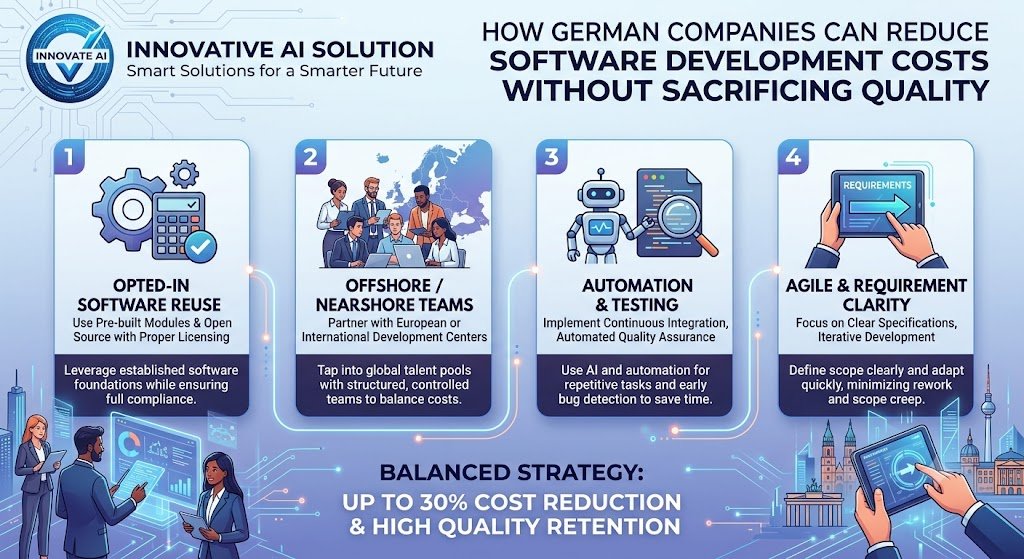
The German Cost Problem
German companies build excellent software. German engineering standards are world-renowned. But German software development costs are among the highest in the world.
A senior software developer in Germany costs €70,000–€110,000 per year in salary, plus employer contributions, office space, equipment, and benefits. Fully loaded, the cost is €90,000–€140,000. For a team of ten developers, that is €900,000–€1,400,000 per year.
These costs are sustainable for some businesses. For others, they constrain growth. Companies that need to build more software — faster — face a choice: accept the cost, or find ways to reduce it without sacrificing the quality that German customers and regulators expect.
The good news is that quality and cost are not opposites. The highest-cost approach is not always the highest-quality approach. Many German companies reduce development costs significantly while maintaining or improving quality — through better architecture, more efficient processes, and strategic use of global talent.
This guide explains how German companies can reduce software development costs without sacrificing quality in 2026. It covers the strategies, the cost comparisons, and the quality safeguards that matter for German businesses.
For organisations looking to build software cost-effectively, Innovative AI Solutions provides custom software development and AI development services.
The German Cost Baseline
Fully Loaded Developer Costs
| Role | Annual Salary (EUR) | Fully Loaded Cost (EUR) |
|---|---|---|
| Junior developer | €45,000–€60,000 | €60,000–€80,000 |
| Mid-level developer | €60,000–€85,000 | €80,000–€110,000 |
| Senior developer | €85,000–€110,000 | €110,000–€145,000 |
| Lead / Architect | €100,000–€130,000 | €130,000–€170,000 |
Fully Loaded Developer Costs (INR Equivalent)
| Role | Fully Loaded Cost (INR) |
|---|---|
| Junior developer | ₹54,00,000–₹72,00,000 |
| Mid-level developer | ₹72,00,000–₹99,00,000 |
| Senior developer | ₹99,00,000–₹1,30,50,000 |
| Lead / Architect | ₹1,17,00,000–₹1,53,00,000 |
Team Cost Comparison
| Team Size | Annual Cost (EUR) | Annual Cost (INR) |
|---|---|---|
| 5 developers | €450,000–€650,000 | ₹4,05,00,000–₹5,85,00,000 |
| 10 developers | €900,000–€1,300,000 | ₹8,10,00,000–₹11,70,00,000 |
| 25 developers | €2,250,000–€3,250,000 | ₹20,25,00,000–₹29,25,00,000 |
| 50 developers | €4,500,000–€6,500,000 | ₹40,50,00,000–₹58,50,00,000 |
The Cost Reduction Strategies
Strategy 1: Near-Shoring to India
India offers fully loaded developer costs that are 60–75% below German rates while delivering comparable technical quality.
| Role | Germany (EUR/year) | India (EUR/year) | Saving |
|---|---|---|---|
| Junior developer | €60,000–€80,000 | €12,000–€18,000 | 75–80% |
| Mid-level developer | €80,000–€110,000 | €18,000–€32,000 | 70–77% |
| Senior developer | €110,000–€145,000 | €32,000–€50,000 | 65–71% |
| Lead / Architect | €130,000–€170,000 | €45,000–€70,000 | 60–70% |
Strategy 2: Hybrid Team Model
Keep senior architects and product owners in Germany. Move implementation to India.
| Role | Location | Rationale |
|---|---|---|
| Product owner | Germany | Business context |
| Architect | Germany | Technical leadership |
| Senior developers | Germany or India | Depends on criticality |
| Mid-level developers | India | Cost efficiency |
| Junior developers | India | Cost efficiency |
| QA | India | Cost efficiency |
Cost impact: 40–60% reduction in total team cost.
Strategy 3: Build a Dedicated Offshore Team
Rather than staff augmentation, build a dedicated team in India that works exclusively for your company.
| Model | Cost (EUR/year) | Control |
|---|---|---|
| Staff augmentation | €25,000–€45,000 per developer | Moderate |
| Dedicated team | €20,000–€40,000 per developer | High |
| Offshore subsidiary | €30,000–€50,000 per developer | Highest |
Strategy 4: Architecture Improvements
Better architecture reduces development cost through faster iteration, fewer bugs, and easier maintenance.
| Improvement | Cost Impact |
|---|---|
| Modular architecture | 20–30% faster feature development |
| Automated testing | 30–50% fewer bugs |
| CI/CD | 50–70% faster deployment |
| Cloud-native design | 20–40% lower infrastructure cost |
Strategy 5: Process Optimisation
Inefficient processes waste developer time.
| Improvement | Cost Impact |
|---|---|
| Clear requirements | 20–40% less rework |
| Shorter feedback loops | 15–30% faster iteration |
| Automated tooling | 10–20% productivity gain |
| Better documentation | 20–30% faster onboarding |
Strategy 6: AI-Assisted Development
AI tools improve developer productivity.
| Tool Type | Productivity Gain |
|---|---|
| Code completion | 20–40% |
| AI code review | 20–30% faster review |
| Test generation | 30–50% faster |
| Documentation | 40–60% faster |
Cost impact: 15–30% effective cost reduction.
Quality Safeguards
Why German Companies Worry About Quality
| Concern | Why It Matters |
|---|---|
| Engineering standards | German reputation |
| Regulatory compliance | GDPR, EU AI Act |
| Customer expectations | Quality is expected |
| Long-term maintenance | Code quality affects TCO |
Quality Safeguards for Offshore Development
| Safeguard | Purpose |
|---|---|
| Code review | Maintain standards |
| Automated testing | Catch regressions |
| CI/CD pipelines | Consistent deployment |
| Architecture oversight | German architect reviews |
| Regular audits | Verify quality |
| Clear standards | Documented expectations |
Quality Metrics to Track
| Metric | Target |
|---|---|
| Code coverage | 70–80% |
| Bug escape rate | Under 5% |
| Code review coverage | 100% |
| Technical debt ratio | Under 10% |
| Deployment frequency | Weekly or better |
| Mean time to recovery | Under 4 hours |
GDPR and EU AI Act Compliance
GDPR Considerations
| Requirement | Implementation |
|---|---|
| Data protection | Encryption, access control |
| Data residency | EU or adequate countries |
| Consent | Explicit consent |
| User rights | Access, correction, deletion |
| Data processing agreements | With all vendors |
EU AI Act Considerations
| Requirement | Implementation |
|---|---|
| Risk classification | Classify AI systems |
| High-risk obligations | Full compliance for high-risk |
| Transparency | Disclose AI interaction |
| Documentation | Technical documentation |
| Conformity assessment | For high-risk systems |
Data Residency for German Companies
| Option | Implication |
|---|---|
| EU-only | Highest compliance, higher cost |
| EU + India with safeguards | Balance of cost and compliance |
| India-only | Cost efficiency, compliance risk |
For most German companies, a hybrid approach works: sensitive data stays in the EU, non-sensitive processing happens in India with appropriate safeguards.
Cost Comparison: Models
In-House (Germany)
| Factor | Detail |
|---|---|
| Cost per developer | €90,000–€140,000/year |
| Control | Highest |
| Quality | High |
| Scalability | Limited |
| Time to hire | 3–6 months |
Near-Shore (Eastern Europe)
| Factor | Detail |
|---|---|
| Cost per developer | €45,000–€70,000/year |
| Control | High |
| Quality | High |
| Scalability | Moderate |
| Time to hire | 4–8 weeks |
Offshore (India)
| Factor | Detail |
|---|---|
| Cost per developer | €18,000–€50,000/year |
| Control | Moderate-High |
| Quality | High (with safeguards) |
| Scalability | High |
| Time to hire | 4–8 weeks |
Hybrid (Germany + India)
| Factor | Detail |
|---|---|
| Cost per developer | €40,000–€70,000/year (blended) |
| Control | High |
| Quality | High |
| Scalability | High |
| Time to hire | 4–8 weeks |
Cost Comparison Summary
| Model | Team of 10 (EUR/year) | Saving vs In-House |
|---|---|---|
| In-house Germany | €900,000–€1,400,000 | Baseline |
| Near-shore | €450,000–€700,000 | 45–50% |
| Hybrid | €400,000–€700,000 | 50–55% |
| Offshore India | €180,000–€500,000 | 65–80% |
Implementation Roadmap
Phase 1: Assessment (Weeks 1–4)
| Activity | Purpose |
|---|---|
| Assess current costs | Baseline |
| Identify cost drivers | Where money goes |
| Evaluate models | In-house, near-shore, offshore, hybrid |
| Assess quality requirements | What standards matter |
Phase 2: Model Selection (Weeks 4–8)
| Activity | Purpose |
|---|---|
| Select delivery model | Based on requirements |
| Select partners | If outsourcing |
| Define quality standards | Documented expectations |
| Plan transition | Phased approach |
Phase 3: Pilot (Weeks 8–20)
| Activity | Purpose |
|---|---|
| Start with one project | Validate model |
| Measure quality | Verify standards |
| Measure cost | Verify savings |
| Decide: scale or adjust | Evidence-based |
Phase 4: Scale (Weeks 20–52)
| Activity | Purpose |
|---|---|
| Expand to more projects | Scale model |
| Refine processes | Continuous improvement |
| Monitor quality | Maintain standards |
| Optimise cost | Further reduction |
India-Specific Considerations
Why India for German Companies
| Factor | Advantage |
|---|---|
| Cost | 60–75% below Germany |
| Talent | Large, skilled pool |
| English | Business proficiency |
| Time zone | Overlap with Europe |
| Quality | Strong engineering culture |
| GDPR awareness | Growing expertise |
Time Zone Advantage
| India Time | Germany Time | Overlap |
|---|---|---|
| 9:30 AM IST | 6:00 AM CET | 0 hours |
| 12:30 PM IST | 9:00 AM CET | 2 hours |
| 6:30 PM IST | 3:00 PM CET | 3.5 hours |
Indian teams can overlap with German teams for 3–4 hours daily, enabling real-time collaboration.
German-Indian Collaboration Best Practices
| Practice | Purpose |
|---|---|
| Clear documentation | Compensate for time zone |
| Overlapping hours | Real-time collaboration |
| Regular syncs | Alignment |
| Cultural awareness | Effective communication |
| Quality standards | Shared expectations |
Frequently Asked Questions
1. How can German companies reduce software development costs?
Near-shoring to India (60–75% savings), hybrid teams (40–60% savings), architecture improvements (20–30%), process optimisation (20–40%), and AI-assisted development (15–30%).
2. How much do developers cost in Germany vs India?
German mid-level developers cost €80,000–€110,000/year fully loaded. Indian mid-level developers cost €18,000–€32,000/year. Savings of 70–77%.
3. Can offshore development maintain German quality standards?
Yes, with proper safeguards: code review, automated testing, CI/CD, architecture oversight, regular audits, and clear standards.
4. Is offshore development GDPR compliant?
It can be. Sensitive data stays in the EU. Non-sensitive processing happens in India with data processing agreements and appropriate safeguards.
5. What is the best delivery model for German companies?
Hybrid: senior architects and product owners in Germany, implementation in India. This balances cost, control, and quality.
6. How long does it take to set up an offshore team?
4–8 weeks to hire and onboard. Pilot projects take 8–20 weeks to validate.
7. What quality metrics should I track?
Code coverage (70–80%), bug escape rate (under 5%), code review coverage (100%), technical debt ratio (under 10%), deployment frequency, and mean time to recovery.
8. How does the EU AI Act affect offshore development?
AI systems serving EU users must comply with the EU AI Act regardless of where they are developed. Risk classification and high-risk obligations apply.
9. What is the time zone overlap between Germany and India?
3–4 hours daily overlap (IST 12:30 PM–6:30 PM = CET 9:00 AM–3:00 PM). This enables real-time collaboration.
10. How do I ensure quality with an offshore team?
Define quality standards, implement code review, use automated testing, maintain architecture oversight from Germany, conduct regular audits, and track quality metrics.
11. Should I use staff augmentation or a dedicated team?
Staff augmentation for flexibility. Dedicated team for consistency and control. Dedicated teams are usually better for long-term projects.
12. How can Innovative AI Solutions help?
Innovative AI Solutions is a Delhi-based software development company that works with German companies. We provide dedicated teams, maintain quality standards, and ensure GDPR and EU AI Act compliance. Explore our custom software development and AI development services.
Contact Innovative AI Solutions
Ready to reduce your software development costs without sacrificing quality?
We help German companies build software cost-effectively with dedicated teams, quality safeguards, and GDPR/EU AI Act compliance.
Contact Information
Innovative AI Solutions
📍 Netaji Subhash Place, Pitampura, Delhi – 110034
🌐 Website: https://innovativeais.com 📧 Email: info@innovativeais.com
📞 Phone: +91 7464 099 059 / +91 96899 67356
Business Services
• AI Automation • AI Development • AI Consulting • Machine Learning Solutions • Deep Learning Solutions • Generative AI Services • NLP Solutions • AI Agents • AI Chatbots • Voice AI • CRM Development • Custom Software Development • Website Development • Mobile App Development
About the Author
Abhishek Kumar
Founder & CEO, Innovative AI Solutions
5+ years building production AI systems for Indian businesses. Based in Delhi, serving clients across India and internationally.
Ready to build AI solutions for your business?
Innovative AI Solutions — Delhi's leading AI development company. Free consultation available.
Get Free Consultation →
A practical 2026 guide for German companies to reduce software development costs without sacrificing quality — near-shoring, hybrid teams, architecture, and compliance.
#GermanCompanies #SoftwareDevelopmentCosts #CostReduction #Quality #2026 #NearShoring #Outsourcing #India #GDPR #EUAIAct #SoftwareQuality #DevelopmentRates #Architecture #ProcessOptimisation #EngineeringStandards #OffshoreDevelopment #Europe #TechIndia #DigitalProducts #SoftwareEngineering #BusinessSoftware #CostOptimisation #TechnologyStrategy #EnterpriseApps #InnovativeAISolutions
Copyright © 2015–2026 Innovative AI Solutions. All Rights Reserved. | Privacy Policy | Terms & Conditions