The Integration Problem
Businesses run on existing software. ERP systems that manage operations. CRM systems that manage customers. Legacy applications that handle core processes. These systems work. They contain years of data and business logic. Replacing them is expensive, risky, and slow.
But these systems do not have AI. And businesses want AI capabilities — automation, prediction, conversational interfaces, document processing.
The question is not whether to add AI. It is how to add AI to software you cannot easily replace.
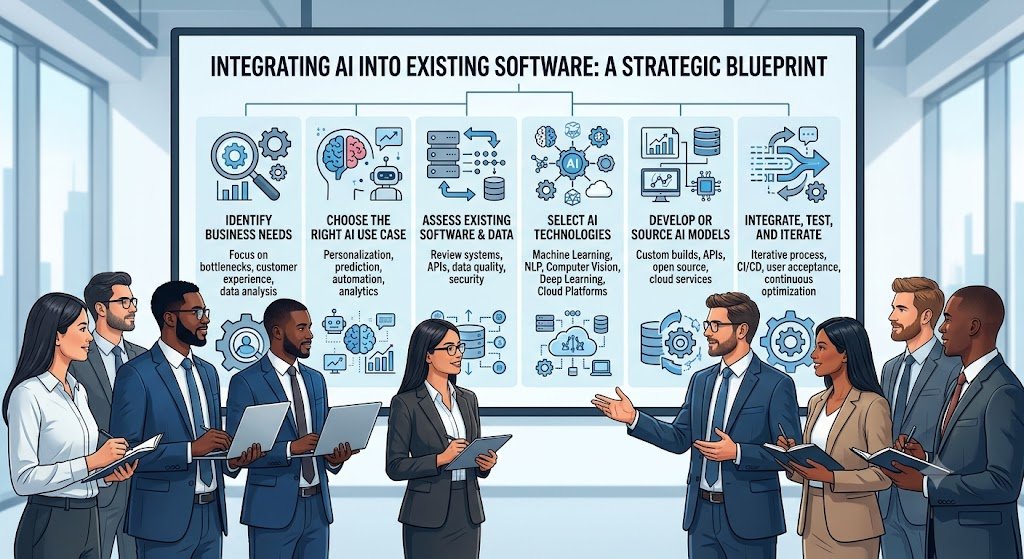
The answer is integration. Instead of rebuilding software, you integrate AI capabilities into existing systems. The software continues to work. The AI adds new capabilities. The combination delivers value.
This guide explains how businesses can integrate AI into existing software in 2026. It covers integration patterns, architecture approaches, costs in India, governance, and implementation strategies.
For organisations integrating AI into existing systems, Innovative AI Solutions provides AI development services and custom software development.
Why Integration Beats Replacement
The Replacement Problem
| Factor | Challenge |
|---|---|
| Cost | Full replacement is expensive |
| Risk | Replacement can break operations |
| Time | Replacement takes years |
| Data | Migrating data is complex |
| Business logic | Embedded logic is hard to replicate |
| User training | New systems require retraining |
The Integration Advantage
| Factor | Benefit |
|---|---|
| Cost | Lower than replacement |
| Risk | Incremental, reversible |
| Time | Weeks to months, not years |
| Data | Existing data stays in place |
| Business logic | Preserved |
| User training | Minimal — same system |
When to Integrate vs Replace
| Situation | Recommendation |
|---|---|
| Software works, needs AI | Integrate |
| Software is end-of-life | Replace |
| Core differentiator | Build new, integrate AI |
| Standard processes | Integrate AI into existing |
| Heavily customised legacy | Integrate carefully |
AI Integration Patterns
Pattern 1: API Integration
The AI system calls existing software through APIs.
text User request ↓ AI service ↓ API call to existing software ↓ Existing software processes ↓
Response back to AI
↓ AI generates response
| Aspect | Detail |
|---|---|
| Best for | Software with good APIs |
| Complexity | Low to moderate |
| Risk | Low |
| Speed | Fast |
Example: A chatbot that queries the CRM API to answer customer questions.
Pattern 2: AI Layer
An AI layer sits between users and existing software, adding intelligence.
text
User
↓ AI layer (intelligence, orchestration) ↓ Existing software (execution) ↓
Database
| Aspect | Detail |
|---|---|
| Best for | Adding AI without changing core software |
| Complexity | Moderate |
| Risk | Low |
| Speed | Moderate |
Example: A conversational interface on top of an ERP system.
Pattern 3: Event-Driven Integration
AI listens to events from existing software and acts on them.
text Existing software emits event ↓ Event bus ↓ AI service receives event ↓ AI processes and acts ↓ Action in existing software
| Aspect | Detail |
|---|---|
| Best for | Automated workflows |
| Complexity | Moderate to high |
| Risk | Moderate |
| Speed | Moderate |
Example: AI agent that processes new orders automatically.
Pattern 4: Embedded AI
AI models are embedded directly into existing software.
text Existing software ├── Business logic ├── Database access └── Embedded AI model
| Aspect | Detail |
|---|---|
| Best for | Performance-critical AI |
| Complexity | High |
| Risk | Higher |
| Speed | Slower |
Example: Fraud detection model embedded in transaction processing.
Pattern 5: Data Integration
AI reads from existing software's database and writes results back.
text Existing software database ↓ AI reads data ↓ AI processes ↓ AI writes results back
| Aspect | Detail |
|---|---|
| Best for | Batch processing, analytics |
| Complexity | Low to moderate |
| Risk | Moderate (data access) |
| Speed | Fast |
Example: AI reads transaction data, generates risk scores, writes back to database.
Pattern Comparison
| Pattern | Complexity | Risk | Speed | Best For |
|---|---|---|---|---|
| API Integration | Low | Low | Fast | Software with APIs |
| AI Layer | Moderate | Low | Moderate | Adding intelligence |
| Event-Driven | Moderate-High | Moderate | Moderate | Automation |
| Embedded | High | Higher | Slower | Performance-critical |
| Data Integration | Low-Moderate | Moderate | Fast | Batch, analytics |
What You Can Integrate
AI Capabilities for Existing Software
| Capability | What It Adds |
|---|---|
| Conversational interface | Natural language interaction |
| Document processing | Extract data from documents |
| Predictions | Forecast outcomes |
| Recommendations | Suggest actions |
| Automation | Execute workflows |
| Search | Semantic search |
| Summarisation | Summarise content |
| Classification | Categorise data |
Integration Targets
| Target | Integration Approach |
|---|---|
| ERP | API, event-driven |
| CRM | API, AI layer |
| HRMS | API, data integration |
| Support systems | API, AI layer |
| Custom applications | Any pattern |
| Legacy systems | Data integration, API wrapper |
Common Use Cases
| Use Case | Pattern |
|---|---|
| Chatbot on CRM | AI layer + API |
| Document processing in ERP | API integration |
| Automated order processing | Event-driven |
| Fraud detection | Embedded or data integration |
| Predictive maintenance | Data integration |
| Customer support automation | AI layer + API |
Architecture Considerations
API Design for AI
| Consideration | Why It Matters |
|---|---|
| Well-documented APIs | AI needs to understand tools |
| Consistent interfaces | Predictable behaviour |
| Error handling | Graceful failures |
| Rate limits | Prevent abuse |
| Authentication | Secure access |
Tool Registry Pattern
Expose existing software capabilities as tools for AI.
text
Existing Software Tools
├── Tool: get_customer(id) ├── Tool: create_order(data) ├── Tool: update_status(id, status) ├── Tool: send_notification(user, message) └── Tool: escalate_to_human(reason)
Data Access Patterns
| Pattern | When to Use |
|---|---|
| API access | Real-time, controlled |
| Database read | Batch analytics |
| Event streaming | Real-time reactions |
| Data warehouse | Historical analysis |
Governance Integration
| Governance Need | Implementation |
|---|---|
| Access control | AI respects user permissions |
| Audit trails | Log AI actions |
| Data protection | DPDPA compliance |
| Explainability | Understand AI decisions |
| Human oversight | Escalation paths |
What It Costs in India
Implementation Costs
| Integration Scope | Cost Range (INR) | Cost Range (USD) | Timeline |
|---|---|---|---|
| Simple API integration | ₹1,50,000–₹4,00,000 | $1,800–$4,800 | 4–8 weeks |
| AI layer on existing software | ₹3,00,000–₹10,00,000 | $3,600–$12,000 | 8–14 weeks |
| Event-driven automation | ₹5,00,000–₹15,00,000 | $6,000–$18,000 | 12–20 weeks |
| Multiple system integration | ₹10,00,000–₹25,00,000 | $12,000–$30,000 | 16–28 weeks |
| Enterprise AI platform | ₹25,00,000–₹60,00,000+ | $30,000–$72,000+ | 24–40 weeks |
Ongoing Costs
| Cost Category | Monthly Range (INR) | Monthly Range (USD) |
|---|---|---|
| AI API usage | ₹10,000–₹1,00,000 | $120–$1,200 |
| Infrastructure | ₹10,000–₹60,000 | $120–$720 |
| Monitoring | ₹5,000–₹30,000 | $60–$360 |
| Maintenance | ₹15,000–₹80,000 | $180–$960 |
Cost Comparison: Integration vs Replacement
| Factor | Integration | Replacement |
|---|---|---|
| Upfront cost | Lower | Higher |
| Risk | Lower | Higher |
| Timeline | Months | Years |
| Business disruption | Minimal | Significant |
| Data migration | None | Complex |
Implementation Framework
Phase 1: Assessment (Weeks 1–3)
| Activity | Purpose |
|---|---|
| Inventory existing software | Understand systems |
| Assess API availability | Determine integration options |
| Identify AI opportunities | Find high-value use cases |
| Assess data access | Verify data availability |
| Define success metrics | How to measure |
Phase 2: Design (Weeks 3–6)
| Activity | Purpose |
|---|---|
| Select integration pattern | Choose approach |
| Design architecture | Plan integration |
| Define governance | Access, audit, compliance |
| Plan rollout | Sequence implementation |
Phase 3: Pilot (Weeks 6–14)
| Activity | Purpose |
|---|---|
| Build integration | Implement solution |
| Test with real data | Validate |
| Measure against baseline | Quantify |
| Decide: scale or adjust | Evidence-based |
Phase 4: Scale (Weeks 14–28)
| Activity | Purpose |
|---|---|
| Expand integration | More systems |
| Add capabilities | More AI features |
| Train users | Adoption |
| Monitor and optimise | Continuous improvement |
India-Specific Considerations
Common Indian Integration Scenarios
| Scenario | Approach |
|---|---|
| Tally ERP + AI | API or data integration |
| Zoho CRM + AI | API integration |
| Custom legacy + AI | API wrapper, data integration |
| SAP + AI | API, event-driven |
| Multiple systems + AI | AI layer, orchestration |
Indian Language Support
| Language | Integration Support |
|---|---|
| English | Excellent |
| Hindi | Good |
| Hinglish | Moderate |
| Regional languages | Variable |
Compliance
| Requirement | Implementation |
|---|---|
| DPDPA | Data protection, consent |
| RBI | Financial data handling |
| IRDAI | Insurance data requirements |
| Audit trails | Log all AI actions |
Build vs Partner
| Situation | Recommendation |
|---|---|
| Standard integration | Partner with AI developer |
| Ongoing AI development | Build internal capability |
| Multiple systems | Partner for coordination |
| Core differentiator | Build internal capability |
Decision Framework: AI Integration Readiness
Readiness Scorecard
| Criteria | Weight | Score (1–5) | Weighted Score |
|---|---|---|---|
| Existing software has APIs | 20% | ||
| Data is accessible | 20% | ||
| Clear AI use case identified | 20% | ||
| Governance capability available | 15% | ||
| Budget for implementation | 15% | ||
| Human oversight available | 10% | ||
| Total | 100% | /5 |
Integration Pattern Selection
| Your Situation | Recommended Pattern |
|---|---|
| Software has good APIs | API integration |
| Adding conversational AI | AI layer |
| Automating workflows | Event-driven |
| Performance-critical AI | Embedded |
| Batch analytics | Data integration |
| Multiple systems | AI layer + orchestration |
Implementation Roadmap
| Phase | What to Build | Timeline |
|---|---|---|
| Phase 1 | Simple API integration | 4–8 weeks |
| Phase 2 | AI layer on core system | 8–14 weeks |
| Phase 3 | Event-driven automation | 12–20 weeks |
| Phase 4 | Multi-system integration | 16–28 weeks |
Frequently Asked Questions
1. How do I integrate AI into existing software?
Choose an integration pattern: API integration, AI layer, event-driven, embedded, or data integration. Each has different complexity, risk, and use cases. Select based on your software's capabilities and AI needs.
2. Can I add AI without replacing my software?
Yes. Integration lets you add AI capabilities without rebuilding. The existing software continues to work, and AI adds new capabilities on top.
3. What integration pattern should I use?
API integration for software with good APIs. AI layer for adding conversational intelligence. Event-driven for automation. Embedded for performance-critical AI. Data integration for batch analytics.
4. How much does AI integration cost in India?
Simple API integration costs ₹1,50,000–₹4,00,000 ($1,800–$4,800). AI layer integration costs ₹3,00,000–₹10,00,000 ($3,600–$12,000). Multi-system integration costs ₹10,00,000–₹25,00,000 ($12,000–$30,000).
5. What AI capabilities can I add to existing software?
Conversational interfaces, document processing, predictions, recommendations, automation, semantic search, summarisation, and classification.
6. What if my software does not have APIs?
Use data integration (read from database) or build API wrappers. For legacy systems, data integration is often the practical approach.
7. How long does AI integration take?
Simple API integration takes 4–8 weeks. AI layer takes 8–14 weeks. Event-driven automation takes 12–20 weeks. Multi-system integration takes 16–28 weeks.
8. How does DPDPA affect AI integration?
DPDPA requires data protection, consent, audit trails, and potentially data residency. AI integration must respect access controls and log actions.
9. Can AI integration handle Indian languages?
English is excellent. Hindi is good. Hinglish is moderate. Regional language support varies. Verify capability for your use case.
10. Should I integrate or replace my software?
Integrate when software works and needs AI. Replace when software is end-of-life or fundamentally limiting. Most businesses should integrate.
11. What is the biggest mistake in AI integration?
Poor API design or ignoring governance. AI needs well-designed tools and clear permission boundaries. Without these, integration creates risk.
12. How can Innovative AI Solutions help?
Innovative AI Solutions is a Delhi-based AI development company specialising in AI integration. We help businesses integrate AI into existing software using appropriate patterns — designed for Indian systems and DPDPA compliance. Explore our AI development services and custom software development.
Contact Innovative AI Solutions
Ready to integrate AI into your existing software?
We help Indian businesses integrate AI capabilities into existing systems with proper architecture and governance.
Contact Information
Innovative AI Solutions
📍 Netaji Subhash Place, Pitampura, Delhi – 110034
🌐 Website: https://innovativeais.com 📧 Email: info@innovativeais.com
📞 Phone: +91 7464 099 059 / +91 96899 67356
Business Services
• AI Automation • AI Development • AI Consulting • Machine Learning Solutions • Deep Learning Solutions • Generative AI Services • NLP Solutions • AI Agents • AI Chatbots • Voice AI • CRM Development • Custom Software Development • Website Development • Mobile App Development
About the Author
Abhishek Kumar
Founder & CEO, Innovative AI Solutions
5+ years building production AI systems for Indian businesses. Based in Delhi, serving clients across India.
Ready to build AI solutions for your business?
Innovative AI Solutions — Delhi's leading AI development company. Free consultation available.
Get Free Consultation →
A practical 2026 guide to integrating AI into existing software — integration patterns, architecture, costs in India, governance, and implementation.
#AIIntegration #ExistingSoftware #2026 #LegacySystems #IntegrationPatterns #Architecture #APIs #AILayer #Modernisation #IncrementalAdoption #Costs #Governance #DPDPA #India #DelhiNCRTech #EnterpriseApps #StartupApps #EnterpriseAI #TechIndia #DigitalProducts #SoftwareModernisation #AIStrategy #IntegrationRoadmap #BusinessSoftware #InnovativeAISolutions
Copyright © 2015–2026 Innovative AI Solutions. All Rights Reserved. | Privacy Policy | Terms & Conditions