Why GDPR Matters for American Businesses
American businesses often assume GDPR does not apply to them. The EU regulation, after all, governs European companies. This assumption is wrong, and it is expensive.
GDPR applies to any organisation that processes personal data of people in the EU — regardless of where the organisation is based. An American company with EU customers, EU users, or EU employees is subject to GDPR. A US-based AI application that processes data of EU residents is subject to GDPR. Full stop.
The penalties are significant. GDPR fines reach €20 million or 4% of global annual turnover, whichever is higher. Enforcement has been active, including against US companies.
AI applications introduce specific GDPR challenges. They process large volumes of personal data. They make automated decisions. They train on data that may include personal information. They can be opaque about how decisions are made. Each of these creates compliance obligations.
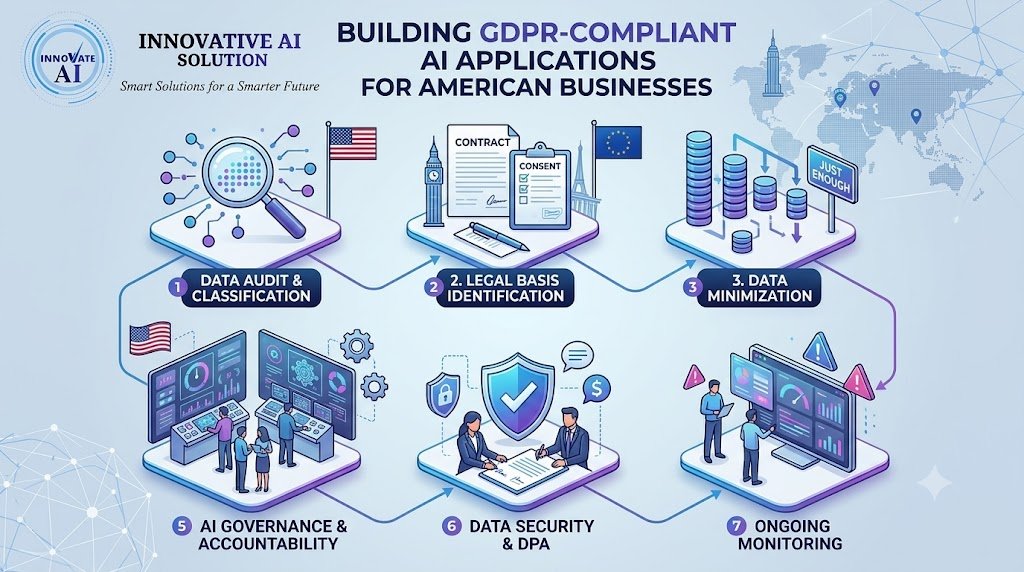
This guide explains how American businesses can build GDPR-compliant AI applications in 2026. It covers the requirements, the AI-specific challenges, practical steps, and costs.
For organisations building compliant AI systems, Innovative AI Solutions provides AI consulting and AI development services.
Does GDPR Apply to Your AI Application?
The Test
GDPR applies if you process personal data of people in the EU, regardless of where your company is based.
| Question | If Yes |
|---|---|
| Do you have EU customers? | GDPR likely applies |
| Do EU residents use your app? | GDPR likely applies |
| Do you process EU employee data? | GDPR applies |
| Do you offer goods/services to EU? | GDPR applies |
| Do you monitor behaviour of EU residents? | GDPR applies |
What Counts as Personal Data
| Data Type | Personal Data? |
|---|---|
| Names, emails | Yes |
| IP addresses | Yes |
| Device identifiers | Yes |
| Location data | Yes |
| Behavioural data | Yes |
| Inferred data | Yes |
| AI-generated profiles | Yes |
Under GDPR, personal data is any information relating to an identified or identifiable person. This is broad — and AI systems often process it.
Who Is Responsible
| Role | Definition | Your Obligation |
|---|---|---|
| Controller | Determines purpose and means of processing | Primary compliance responsibility |
| Processor | Processes on behalf of controller | Contractual obligations |
| Joint controllers | Jointly determine processing | Shared responsibility |
AI companies are typically controllers for their own data processing and processors for customer data.
The Seven GDPR Principles
Principle 1: Lawfulness, Fairness, Transparency
| Requirement | AI Implementation |
|---|---|
| Lawful basis | Consent, contract, legitimate interest |
| Fair processing | No hidden uses |
| Transparency | Clear privacy notices |
Principle 2: Purpose Limitation
Data collected for one purpose cannot be used for another without a new lawful basis.
| AI Challenge | Solution |
|---|---|
| Training on customer data | Specific consent or legitimate interest |
| Secondary use | New lawful basis required |
| Model improvement | Must be disclosed |
Principle 3: Data Minimisation
Collect only data necessary for the stated purpose.
| AI Challenge | Solution |
|---|---|
| Training on everything | Use only necessary data |
| Retaining data indefinitely | Define retention periods |
| Collecting for "future use" | Not permitted |
Principle 4: Accuracy
Personal data must be accurate and kept up to date.
| AI Challenge | Solution |
|---|---|
| Model outputs incorrect | Correction mechanisms |
| Stale training data | Periodic retraining |
| Inferred data wrong | Allow correction |
Principle 5: Storage Limitation
Data must not be kept longer than necessary.
| AI Challenge | Solution |
|---|---|
| Indefinite data retention | Define and enforce retention |
| Training data persistence | Deletion mechanisms |
| Model weights containing data | Retraining or safeguards |
Principle 6: Integrity and Confidentiality
Data must be protected with appropriate security.
| AI Challenge | Solution |
|---|---|
| Data breaches | Encryption, access control |
| Model extraction | Rate limiting, monitoring |
| Prompt injection | Input validation, guardrails |
Principle 7: Accountability
You must be able to demonstrate compliance.
| AI Challenge | Solution |
|---|---|
| Opaque AI decisions | Documentation, logging |
| No compliance evidence | Records of processing |
| No governance | Formal AI governance |
Data Subject Rights and AI
The Eight Rights
| Right | AI Implication |
|---|---|
| Access | Provide data used in AI |
| Rectification | Correct inaccurate data |
| Erasure | Delete data from systems |
| Restriction | Limit processing |
| Portability | Export data |
| Object | Stop processing |
| Automated decisions | Human review of AI decisions |
| Complaint | Provide complaint mechanism |
The Deletion Challenge
GDPR grants the right to erasure. For AI systems, this is technically complex.
| Data Location | Deletion Approach |
|---|---|
| Training data | Delete records, retrain model |
| RAG knowledge base | Remove documents, rebuild index |
| Vector database | Delete embeddings |
| Conversation logs | Delete records |
| Model weights | Retraining or policy safeguards |
RAG systems have a compliance advantage — deleting user data means removing documents, not retraining a model.
Automated Decision-Making
GDPR Article 22 restricts solely automated decisions with legal or significant effects.
| Requirement | Implementation |
|---|---|
| Human review | Human-in-the-loop for significant decisions |
| Explanation | Explain the logic |
| Contest | Allow users to contest |
| Opt-out | Allow human alternative |
For AI systems making significant decisions, human oversight is not optional — it is required.
AI-Specific GDPR Requirements
Requirement 1: Lawful Basis for AI Processing
| Basis | When to Use |
|---|---|
| Consent | Explicit, specific, informed |
| Contract | Necessary for contract performance |
| Legitimate interest | Balanced against rights |
| Legal obligation | Required by law |
For AI training, consent or legitimate interest is usually the basis. Consent must be specific to AI training, not bundled with other purposes.
Requirement 2: DPIA (Data Protection Impact Assessment)
A DPIA is required for high-risk processing. AI systems often qualify.
| DPIA Element | Purpose |
|---|---|
| Description | What the processing does |
| Necessity | Why it is needed |
| Risks | What could go wrong |
| Mitigation | How risks are addressed |
Requirement 3: Privacy by Design
Privacy must be built into AI systems from the start.
| Principle | Implementation |
|---|---|
| Proactive | Anticipate privacy issues |
| Default | Privacy-protective defaults |
| Embedded | Privacy in design, not added later |
| User-centric | Respect user rights |
Requirement 4: International Data Transfers
Transferring EU data to the US requires safeguards.
| Mechanism | When to Use |
|---|---|
| Adequacy decision | Not available for US |
| Standard Contractual Clauses | Most common |
| Binding Corporate Rules | Large organisations |
| Derogations | Limited circumstances |
For US companies, Standard Contractual Clauses (SCCs) are the standard mechanism. The EU-US Data Privacy Framework provides an alternative for certified companies.
Practical Steps to GDPR-Compliant AI
Step 1: Data Mapping
| Activity | Purpose |
|---|---|
| Inventory data | Know what data you process |
| Map flows | Where data goes |
| Identify EU data | Which data is subject to GDPR |
| Document purposes | Why you process it |
Step 2: Establish Lawful Basis
| Activity | Purpose |
|---|---|
| Identify basis | Consent, contract, legitimate interest |
| Document rationale | Evidence for basis |
| Update notices | Disclose basis to users |
| Obtain consent | Where consent is the basis |
Step 3: Implement Privacy by Design
| Activity | Purpose |
|---|---|
| Minimise data | Collect only necessary |
| Anonymise | Where possible |
| Encrypt | At rest and transit |
| Access control | Least privilege |
Step 4: Conduct DPIA
| Activity | Purpose |
|---|---|
| Assess risk | Identify privacy risks |
| Document | Record assessment |
| Mitigate | Address identified risks |
| Review | Update as systems change |
Step 5: Implement Data Subject Rights
| Right | Implementation |
|---|---|
| Access | Data export mechanism |
| Rectification | Correction process |
| Erasure | Deletion mechanism |
| Portability | Data export format |
| Objection | Processing opt-out |
| Automated decisions | Human review |
Step 6: Establish Governance
| Activity | Purpose |
|---|---|
| DPO | Data Protection Officer |
| Records | Records of processing |
| Training | Staff awareness |
| Audit | Regular compliance review |
What GDPR Compliance Costs
Implementation Costs
| Compliance Scope | Cost Range (INR) | Cost Range (USD) | Timeline |
|---|---|---|---|
| Initial assessment | ₹2,00,000–₹6,00,000 | $2,400–$7,200 | 3–6 weeks |
| Data mapping | ₹1,50,000–₹4,00,000 | $1,800–$4,800 | 3–5 weeks |
| DPIA | ₹2,00,000–₹6,00,000 | $2,400–$7,200 | 4–8 weeks |
| Privacy by design implementation | ₹5,00,000–₹15,00,000 | $6,000–$18,000 | 8–16 weeks |
| Data subject rights | ₹3,00,000–₹10,00,000 | $3,600–$12,000 | 6–12 weeks |
| Governance framework | ₹2,00,000–₹8,00,000 | $2,400–$9,600 | 4–8 weeks |
| Total | ₹15,50,000–₹49,00,000 | $18,600–$58,800 | 12–24 weeks |
Ongoing Costs
| Cost Category | Monthly Range (INR) | Monthly Range (USD) |
|---|---|---|
| Compliance monitoring | ₹20,000–₹75,000 | $240–$900 |
| DPO (part-time) | ₹50,000–₹1,50,000 | $600–$1,800 |
| Audit and review | ₹15,000–₹60,000 | $180–$720 |
| Training | ₹10,000–₹40,000 | $120–$480 |
The Cost of Non-Compliance
| Penalty Level | Maximum Fine |
|---|---|
| Standard violations | €10M or 2% of turnover |
| Serious violations | €20M or 4% of turnover |
GDPR vs Other Privacy Laws
Comparison
| Aspect | GDPR | CCPA (California) | DPDPA (India) |
|---|---|---|---|
| Scope | EU residents | California residents | Indian residents |
| Consent | Often required | Opt-out | Required |
| Rights | Extensive | Moderate | Moderate |
| Penalties | Up to 4% turnover | Up to $7,500 per violation | Significant |
| Extraterritorial | Yes | Yes | Yes |
Building for Multiple Frameworks
| Approach | Benefit |
|---|---|
| Highest standard | Build to GDPR, satisfies most |
| Modular compliance | Adapt to each jurisdiction |
| Common controls | Encryption, access, deletion |
| Documentation | Evidence for all frameworks |
Building to GDPR standards positions companies well for other privacy laws.
Decision Framework: GDPR AI Readiness
Readiness Scorecard
| Criteria | Weight | Score (1–5) | Weighted Score |
|---|---|---|---|
| GDPR applicability determined | 15% | ||
| Data mapped | 15% | ||
| Lawful basis established | 15% | ||
| Privacy by design implemented | 15% | ||
| DPIA completed | 15% | ||
| Data subject rights implemented | 15% | ||
| Governance established | 10% | ||
| Total | 100% | /5 |
Compliance Priority Matrix
| Action | Effort | Impact | Priority |
|---|---|---|---|
| Data mapping | Moderate | High | Immediate |
| Lawful basis determination | Low | High | Immediate |
| Privacy policy update | Low | High | Immediate |
| Data subject rights | Moderate | High | High |
| DPIA | Moderate | High | High |
| Governance framework | Moderate | High | High |
| International transfer safeguards | Moderate | High | High |
Implementation Roadmap
| Phase | What to Do | Timeline | Cost (INR) |
|---|---|---|---|
| Phase 1 | Assessment, data mapping | 4–6 weeks | ₹3,50,000–₹10,00,000 |
| Phase 2 | Lawful basis, DPIA | 4–8 weeks | ₹4,00,000–₹12,00,000 |
| Phase 3 | Privacy by design, rights | 8–16 weeks | ₹8,00,000–₹25,00,000 |
| Phase 4 | Governance, transfers | 4–8 weeks | ₹2,00,000–₹8,00,000 |
Frequently Asked Questions
1. Does GDPR apply to American businesses?
Yes, if you process personal data of people in the EU, regardless of where your company is based.
2. How does GDPR apply to AI applications?
AI applications process personal data, make automated decisions, and train on data. Each creates GDPR obligations around lawful basis, rights, and transparency.
3. What is the lawful basis for AI training data?
Consent, contract, or legitimate interest. Consent must be specific to AI training. Legitimate interest requires balancing against individual rights.
4. What is a DPIA and when is it required?
A Data Protection Impact Assessment is required for high-risk processing. AI systems often qualify as high-risk.
5. How do I handle deletion requests in AI systems?
Delete data from training sets, RAG knowledge bases, and vector databases. For model weights, retraining may be required. RAG systems are easier to comply with than fine-tuned models.
6. What are the rules for automated decision-making?
GDPR Article 22 restricts solely automated decisions with legal or significant effects. Human review and explanation are required.
7. How do I transfer EU data to the US?
Use Standard Contractual Clauses (SCCs) or the EU-US Data Privacy Framework if certified. Other mechanisms exist but are limited.
8. How much does GDPR compliance cost?
Initial compliance costs ₹15,50,000–₹49,00,000 ($18,600–$58,800). Ongoing costs run ₹95,000–₹3,25,000 monthly.
9. What are the penalties for GDPR non-compliance?
Up to €20 million or 4% of global annual turnover, whichever is higher.
10. What is privacy by design for AI?
Building privacy protections into AI systems from the start — data minimisation, anonymisation, encryption, and access control.
11. Should I build to GDPR even if I don't serve EU users?
Building to GDPR standards positions you for other privacy laws and future regulation. It is a strong baseline.
12. How can Innovative AI Solutions help?
Innovative AI Solutions is a Delhi-based AI development company that builds compliant AI systems. We implement privacy by design, data subject rights, DPIA, and governance — designed for GDPR, DPDPA, and other frameworks. Explore our AI consulting and AI development services.
Contact Innovative AI Solutions
Ready to build GDPR-compliant AI applications?
We help American and Indian businesses build AI applications that comply with GDPR, DPDPA, and other privacy frameworks.
Contact Information
Innovative AI Solutions
📍 Netaji Subhash Place, Pitampura, Delhi – 110034
🌐 Website: https://innovativeais.com 📧 Email: info@innovativeais.com
📞 Phone: +91 7464 099 059 / +91 96899 67356
Business Services
• AI Automation • AI Development • AI Consulting • Machine Learning Solutions • Deep Learning Solutions • Generative AI Services • NLP Solutions • AI Agents • AI Chatbots • Voice AI • CRM Development • Custom Software Development • Website Development • Mobile App Development
About the Author
Abhishek Kumar
Founder & CEO, Innovative AI Solutions
5+ years building production AI systems for Indian businesses. Based in Delhi, serving clients across India.
Ready to build AI solutions for your business?
Innovative AI Solutions — Delhi's leading AI development company. Free consultation available.
Get Free Consultation →
A practical 2026 guide for American businesses building GDPR-compliant AI applications — data subject rights, lawful basis, DPIA, transfers, and costs.
#GDPR #AIApplications #Compliance #AmericanBusinesses #2026 #DataProtection #DataSubjectRights #LawfulBasis #DPIA #InternationalTransfers #PrivacyByDesign #AIGovernance #EURegulation #GDPRAI #USCompanies #Privacy #ComplianceCosts #AIDevelopment #DataPrivacy #EnterpriseApps #TechIndia #DigitalProducts #SoftwareDevelopment #AICompliance #InnovativeAISolutions
Copyright © 2015–2026 Innovative AI Solutions. All Rights Reserved. | Privacy Policy | Terms & Conditions