The Decision That Keeps Coming Back
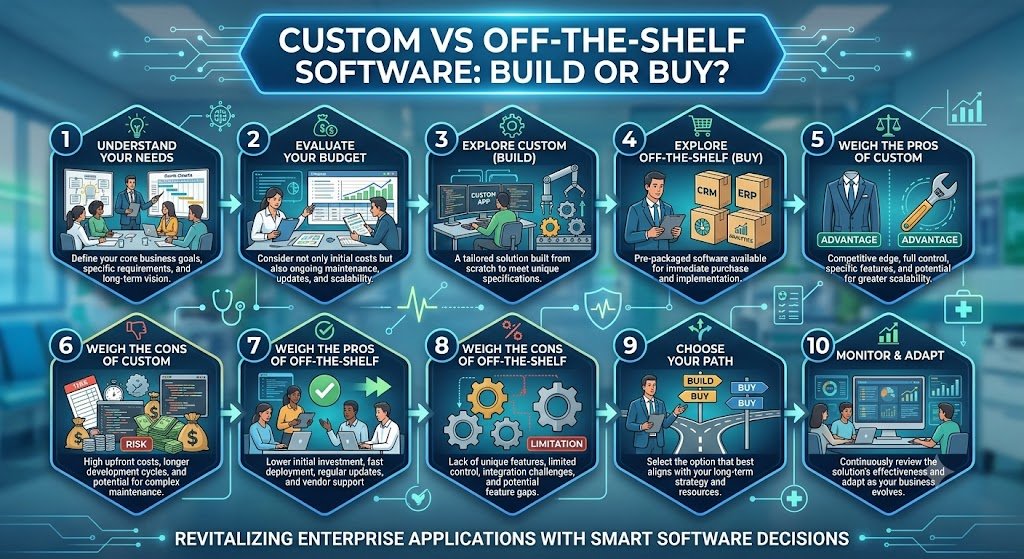
Every business faces the build vs buy question repeatedly. A new process needs software. An existing tool no longer fits. A competitor launches a capability you lack. Each time, the question returns: do we build something custom, or do we buy something that already exists?
The question is consequential. Build decisions lock in development cost, maintenance burden, and long-term commitment. Buy decisions lock in vendor dependency, subscription costs, and feature limitations. Both can be right. Both can be wrong.
The mistake most businesses make is deciding on cost alone. Cost matters, but it is not the only factor. Fit, control, competitive advantage, and long-term flexibility matter equally — sometimes more.
This guide provides a practical build vs buy framework for 2026. It covers the real costs, the trade-offs, and the questions that determine the right answer for your situation.
For organisations evaluating custom software development, Innovative AI Solutions provides custom software development services with transparent pricing.
Understanding the Two Options
Off-the-Shelf Software
Ready-made products sold as licences or subscriptions.
| Characteristic | Detail |
|---|---|
| Availability | Immediate |
| Cost model | Licence or subscription |
| Customisation | Configuration only |
| Updates | Vendor-managed |
| Fit | Approximate |
Custom Software
Software built specifically for your requirements.
| Characteristic | Detail |
|---|---|
| Availability | After development |
| Cost model | Development + maintenance |
| Customisation | Unlimited |
| Updates | Your roadmap |
| Fit | Exact |
The Spectrum
| Level | Description | Example |
|---|---|---|
| Off-the-shelf | Use as-is | Standard accounting software |
| Configured | Configure for your needs | CRM with custom fields |
| Extended | Add custom modules | ERP with custom reports |
| Custom | Built from scratch | Proprietary platform |
| Hybrid | Mix of both | Off-the-shelf + custom integrations |
Most businesses end up in the middle, not at the extremes.
Cost Comparison in India
Off-the-Shelf Software Costs
| Software Type | Cost Per User/Month (INR) | Cost Per User/Month (USD) |
|---|---|---|
| Basic CRM | ₹500–₹1,500 | $6–$18 |
| Advanced CRM | ₹1,500–₹4,000 | $18–$48 |
| Accounting software | ₹500–₹2,000 | $6–$24 |
| Project management | ₹400–₹1,200 | $5–$14 |
| HRMS | ₹200–₹800 | $2.40–$9.60 |
| ERP (SME) | ₹1,500–₹5,000 | $18–$60 |
| ERP (Enterprise) | ₹5,000–₹15,000+ | $60–$180+ |
Custom Software Costs
| Project Type | Cost Range (INR) | Cost Range (USD) |
|---|---|---|
| Simple custom tool | ₹2,00,000–₹5,00,000 | $2,400–$6,000 |
| Custom CRM | ₹6,00,000–₹20,00,000 | $7,200–$24,000 |
| Custom ERP | ₹15,00,000–₹50,00,000 | $18,000–$60,000 |
| Custom platform | ₹25,00,000–₹75,00,000+ | $30,000–$90,000+ |
Three-Year Total Cost of Ownership
Scenario: CRM for 25 users
| Cost Component | Off-the-Shelf | Custom |
|---|---|---|
| Year 1 | ₹4,50,000 | ₹12,00,000 |
| Year 2 | ₹4,50,000 | ₹2,50,000 |
| Year 3 | ₹4,50,000 | ₹2,50,000 |
| Total | ₹13,50,000 | ₹17,00,000 |
Off-the-shelf is cheaper over three years for this scenario. Custom becomes cost-competitive at larger scale or when requirements are highly specific.
Three-Year TCO at Different Scales
| Users | Off-the-Shelf (3 yr) | Custom (3 yr) | Cheaper |
|---|---|---|---|
| 10 users | ₹5,40,000 | ₹15,00,000 | Off-the-shelf |
| 25 users | ₹13,50,000 | ₹17,00,000 | Off-the-shelf |
| 50 users | ₹27,00,000 | ₹20,00,000 | Custom |
| 100 users | ₹54,00,000 | ₹25,00,000 | Custom |
| 250 users | ₹1,35,00,000 | ₹35,00,000 | Custom |
At scale, custom software becomes significantly cheaper because there are no per-user fees.
The Real Trade-Offs
What Off-the-Shelf Does Well
| Strength | Why It Matters |
|---|---|
| Immediate availability | Start using today |
| Lower upfront cost | No development investment |
| Vendor maintenance | Updates and support included |
| Proven at scale | Tested by many customers |
| Best practices | Built-in industry knowledge |
| Lower risk | Vendor accountable |
What Off-the-Shelf Does Poorly
| Limitation | Impact |
|---|---|
| Approximate fit | Process compromises |
| Limited customisation | Cannot handle unique needs |
| Per-user costs | Expensive at scale |
| Vendor dependency | Pricing, roadmap control |
| Data location | May not meet requirements |
| Integration limits | API-level only |
What Custom Software Does Well
| Strength | Why It Matters |
|---|---|
| Exact fit | Built for your process |
| Unlimited customisation | Handle any requirement |
| No per-user fees | Economical at scale |
| Full control | Your roadmap, your data |
| Competitive advantage | Differentiated capability |
| Deep integration | Connect to any system |
What Custom Software Does Poorly
| Limitation | Impact |
|---|---|
| Higher upfront cost | Significant investment |
| Longer time to value | Months, not days |
| Maintenance burden | Ongoing development |
| Execution risk | May not deliver |
| Talent requirement | Need development capability |
| No best practices | Must develop expertise |
Hidden Costs to Consider
Off-the-Shelf Hidden Costs
| Hidden Cost | Impact |
|---|---|
| Per-user scaling | Costs grow with headcount |
| Add-on modules | Extra features cost extra |
| Integration costs | Connecting to other systems |
| Customisation limits | Workarounds cost time |
| Data migration | Switching costs later |
| Price increases | Vendor-controlled |
| Process compromises | Efficiency loss |
Custom Software Hidden Costs
| Hidden Cost | Impact |
|---|---|
| Maintenance | 15–30% of build cost annually |
| Hosting | Infrastructure costs |
| Feature development | Ongoing investment |
| Technical debt | Poor decisions compound |
| Talent dependency | Key person risk |
| Opportunity cost | Engineering time not spent elsewhere |
Decision Framework
When Off-the-Shelf Wins
| Situation | Why |
|---|---|
| Standard process | No differentiation |
| Small team | Lower per-user costs |
| Urgent need | Immediate availability |
| Limited budget | Lower upfront cost |
| No development capability | Cannot build |
| Best practices valuable | Industry standards |
| Fast-changing requirements | Vendor adapts |
When Custom Wins
| Situation | Why |
|---|---|
| Unique process | No off-the-shelf fit |
| Large team | Per-user costs prohibitive |
| Core differentiator | Competitive advantage |
| Deep integration | API-level insufficient |
| Data control critical | Residency, privacy |
| Long-term investment | TCO favours custom |
| Available capability | Can build and maintain |
The Decision Tree
Question 1: Is this a core differentiator?
| Answer | Action |
|---|---|
| Yes | Custom |
| No | Continue |
Question 2: Does off-the-shelf fit your process?
| Answer | Action |
|---|---|
| Yes | Off-the-shelf |
| No | Continue |
Question 3: Is your team large enough that per-user costs are significant?
| Answer | Action |
|---|---|
| Yes | Custom |
| No | Continue |
Question 4: Do you have development capability?
| Answer | Action |
|---|---|
| Yes | Custom or hybrid |
| No | Off-the-shelf with customisation |
The Decision Matrix
| Your Situation | Recommendation |
|---|---|
| Standard process, small team | Off-the-shelf |
| Standard process, large team | Off-the-shelf or hybrid |
| Unique process, small team | Configured off-the-shelf |
| Unique process, large team | Custom |
| Core differentiator | Custom |
| Limited budget | Off-the-shelf |
| Deep integration needs | Custom or hybrid |
Readiness Scorecard
| Criteria | Weight | Score (1–5) | Weighted Score |
|---|---|---|---|
| Is this a core differentiator? | 25% | ||
| Does off-the-shelf fit? | 20% | ||
| Team size and per-user economics | 20% | ||
| Integration depth required | 15% | ||
| Budget availability | 10% | ||
| Development capability | 10% | ||
| Total | 100% | /5 |
The Hybrid Approach
Why Hybrid Is Often Best
Most businesses do not need to choose entirely. Hybrid approaches combine off-the-shelf software for standard functions with custom components where differentiation matters.
| Hybrid Model | How It Works |
|---|---|
| Off-the-shelf + integrations | Use products, build connectors |
| Off-the-shelf + custom modules | Extend products with custom code |
| Custom core + off-the-shelf tools | Build differentiator, buy the rest |
| Off-the-shelf now, custom later | Validate, then build |
When Hybrid Makes Sense
| Situation | Hybrid Approach |
|---|---|
| Standard function, unique integration | Buy product, build integration |
| Unique function, standard components | Build function, buy components |
| Validating before investing | Start with products |
| Mixed requirements | Mix based on each need |
India-Specific Considerations
Indian Software Market
| Factor | Implication |
|---|---|
| SaaS availability | Strong local and global options |
| Cost sensitivity | Off-the-shelf often preferred |
| Custom development cost | 40–60% below Western markets |
| Talent availability | Strong in major cities |
Compliance
| Requirement | Implication |
|---|---|
| DPDPA | Data protection obligations |
| Data residency | May favour custom or Indian providers |
| Sector regulations | RBI, IRDAI requirements |
| GST compliance | Billing and invoicing needs |
Common Indian Scenarios
| Scenario | Recommendation |
|---|---|
| Small business, standard needs | Off-the-shelf SaaS |
| Growing business, some unique needs | Hybrid |
| Large business, complex needs | Custom or hybrid |
| Regulated industry | Custom or compliant vendor |
Frequently Asked Questions
1. Should I choose custom software or off-the-shelf software?
It depends on whether the software is a core differentiator, whether off-the-shelf fits your process, your team size, integration needs, budget, and development capability. Most businesses should use a hybrid approach.
2. How much does custom software cost in India?
Simple custom tools cost ₹2,00,000–₹5,00,000 ($2,400–$6,000). Custom CRM costs ₹6,00,000–₹20,00,000 ($7,200–$24,000). Custom ERP costs ₹15,00,000–₹50,00,000 ($18,000–$60,000). Custom platforms cost ₹25,00,000–₹75,00,000+ ($30,000–$90,000+).
3. At what team size does custom become cheaper?
Custom typically becomes cheaper than per-user priced software at 50+ users. The break-even depends on per-user cost, custom development efficiency, and usage patterns.
4. What is the biggest risk of off-the-shelf software?
Vendor lock-in and process compromises. Off-the-shelf fits approximately, forcing workarounds. Migration is difficult once you have invested in a vendor's ecosystem.
5. What is the biggest risk of custom software?
Execution risk and opportunity cost. Custom builds may not deliver expected value, and engineering time spent building is time not spent elsewhere. Maintenance is ongoing.
6. What is the hybrid approach?
Hybrid combines off-the-shelf software for standard functions with custom components where differentiation matters. It balances speed, cost, and fit.
7. How does DPDPA affect the decision?
Custom software gives more control over data location and consent management. Off-the-shelf vendors must comply with DPDPA, but you depend on their implementation. Verify vendor data handling before adoption.
8. When should I build custom software instead of buying?
Build when the software is a core differentiator, no off-the-shelf tool fits, deep integration is required, your team is large enough to justify the investment, or you have specific compliance requirements.
9. How do I calculate total cost of ownership?
Include upfront development or subscription, ongoing costs (infrastructure, maintenance, or subscription), integration costs, training, and migration costs if switching. Compare over three years.
10. Can I start with off-the-shelf and migrate to custom later?
Yes, and this is often the best approach. Validate needs with off-the-shelf tools, then build custom once requirements are proven. The risk is that migration is more difficult than expected.
11. What software is best suited to off-the-shelf?
Standard processes like accounting, HR, basic CRM, project management, and email. These are mature categories with proven solutions.
12. How can Innovative AI Solutions help?
Innovative AI Solutions is a Delhi-based custom software development company. We help businesses evaluate build vs buy decisions, build custom software where it adds value, and integrate off-the-shelf tools where they fit. Explore our custom software development services.
Contact Innovative AI Solutions
Ready to decide between custom software and off-the-shelf?
We help Indian businesses evaluate build vs buy decisions, build custom software where it matters, and integrate off-the-shelf tools where they fit.
Contact Information
Innovative AI Solutions
📍 Netaji Subhash Place, Pitampura, Delhi – 110034
🌐 Website: https://innovativeais.com 📧 Email: info@innovativeais.com
📞 Phone: +91 7464 099 059 / +91 96899 67356
Business Services
• AI Automation • AI Development • AI Consulting • Machine Learning Solutions • Deep Learning Solutions • Generative AI Services • NLP Solutions • AI Agents • AI Chatbots • Voice AI • CRM Development • Custom Software Development • Website Development • Mobile App Development
About the Author
Abhishek Kumar
Founder & CEO, Innovative AI Solutions
5+ years building production AI systems for Indian businesses. Based in Delhi, serving clients across India.
Ready to build AI solutions for your business?
Innovative AI Solutions — Delhi's leading AI development company. Free consultation available.
Get Free Consultation →
A practical 2026 build vs buy guide — when custom software is worth it, when off-the-shelf wins, total cost of ownership, and India-specific pricing.
#CustomSoftware #OffTheShelfSoftware #BuildVsBuy #2026 #TCO #SaaS #Licensing #DecisionFramework #Costs #India #DelhiNCRTech #EnterpriseApps #StartupApps #BusinessSoftware #Procurement #SoftwareDevelopment #TechIndia #DigitalProducts #SoftwareStrategy #TotalCostOfOwnership #ERP #CRM #BusinessTechnology #SoftwareSelection #InnovativeAISolutions
Copyright © 2015–2026 Innovative AI Solutions. All Rights Reserved. | Privacy Policy | Terms & Conditions