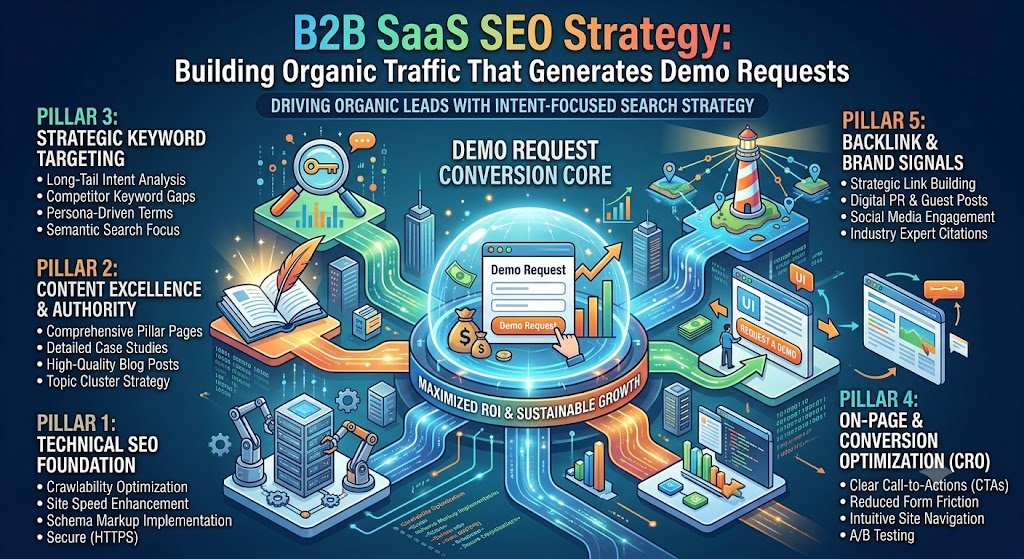
The Traffic Trap: Why Most B2B SaaS SEO Programmes Fail to Generate Pipeline Every B2B SaaS marketing team in India has seen the same dashboard. Organic sessions are up 300%. Keyword rankings look healthy. The blog publishes twice a week. And yet, at the end of the quarter, the sales team is still asking where the demo requests are coming from—and the answer is not organic search.
This is the traffic trap. SEO programmes that optimise for volume attract readers who will never buy. A blog post ranking for "what is artificial intelligence" may generate thousands of visits and zero qualified pipeline. Meanwhile, a comparison page ranking for "Zoho CRM vs Freshsales for Indian SMEs" may generate a fraction of that traffic and a steady stream of demo requests from exactly the right buyers.
The distinction matters more in 2026 than it ever has, because the search landscape itself has changed. AI-generated answers now sit above organic results for many commercial queries. Google's AI Overviews, ChatGPT, Perplexity, and Gemini are increasingly where buyers start their research. A B2B SaaS SEO strategy that was built for ten blue links is no longer sufficient. The strategy must now earn visibility in both traditional search and AI-generated answers—a discipline increasingly called AEO (Answer Engine Optimisation) and GEO (Generative Engine Optimisation) .
At the same time, the fundamentals have not changed. B2B buyers still search for solutions to specific problems, compare vendors, read reviews, and look for proof. The companies that win organic pipeline are the ones that show up at the moment of evaluation, not just at the moment of curiosity.
This guide is written for Indian B2B SaaS founders, marketing leaders, and product marketers who need an SEO strategy that produces demo requests, not just traffic. We will cover the keyword framework that separates buyers from browsers, the content architecture that builds topical authority, the conversion design that turns readers into demo requests, the AI search visibility requirements for 2026, realistic costs in rupees and dollars, and a phased execution roadmap with clear KPIs.
The Keyword Framework: Separating Buyers From Browsers
The foundation of a pipeline-generating SEO strategy is a keyword framework that maps intent to funnel stage—and prioritises the keywords that correlate with demo requests.
The Four B2B SaaS Keyword Categories
1. Problem-aware keywords. The buyer knows they have a problem but does not yet know the solution category. Examples: "how to reduce invoice processing time", "why is our sales team missing follow-ups". These are high-volume, low-intent. They build brand awareness and topical authority, but they rarely produce demo requests directly.
2. Solution-aware keywords. The buyer knows the solution category and is researching approaches. Examples: "best CRM for Indian SMEs", "AI chatbot for customer support". These are medium-volume, medium-intent. They are the workhorses of a B2B SaaS content programme.
3. Vendor-evaluation keywords. The buyer is comparing specific vendors or looking for reviews. Examples: "Zoho vs Freshsales", "[competitor] alternatives", "[competitor] pricing", "[competitor] review". These are lower-volume, very high-intent. They produce demo requests at a much higher rate than any other category.
4. Branded and product-led keywords. The buyer is searching for your brand or a specific feature. Examples: "[your brand] pricing", "[your brand] demo", "[your feature] integration". These are highest-intent but limited in volume unless you have brand recognition.
Keyword Intent Table
| Keyword Category | Example | Monthly Volume (India) | Demo Request Rate | Priority |
|---|---|---|---|---|
| Problem-aware | "how to reduce invoice processing time" | High (1,000–10,000) | Very low (<0.5%) | Medium (authority) |
| Solution-aware | "best invoice automation software India" | Medium (200–2,000) | Low-Medium (0.5–2%) | High |
| Vendor-evaluation | "[competitor] alternatives India" | Low (50–500) | High (3–8%) | Very High |
| Branded/product | "[your brand] pricing" | Low but growing | Very High (>10%) | High (defend) |
Note: Demo request rates are indicative industry benchmarks for B2B SaaS and vary by category, price point, and conversion design.
The Priority Rule for Indian B2B SaaS
Most Indian B2B SaaS companies make the same mistake: they invest heavily in problem-aware content because it is easy to write and produces visible traffic growth, while neglecting vendor-evaluation content because it is harder to write and produces less traffic. This is backwards.
The priority order should be:
Vendor-evaluation content (comparison pages, alternatives pages, "vs" pages) — highest demo conversion.
Solution-aware content (category guides, buying guides, use-case pages) — builds pipeline.
Problem-aware content (how-to guides, educational content) — builds authority and feeds the funnel.
Branded content (pricing, demo, features) — defends existing demand.
For a SaaS product with a defined competitor set, vendor-evaluation content is the highest-ROI investment in the first 6–12 months. A single well-ranked comparison page can outperform a year of blog posts in demo requests.
For teams building the product experience that turns demos into customers, our Custom Software Development and AI Development practices cover the full stack.
Content Architecture: Building Topical Authority With Clusters Google and AI search engines reward topical authority—the perception that a site comprehensively covers a subject. The way to build topical authority is through content clusters: a pillar page that covers a broad topic comprehensively, supported by cluster pages that go deep on specific subtopics, all interlinked.
The Cluster Model for B2B SaaS
A well-built cluster has four elements:
1. The pillar page. A comprehensive guide to a core topic—for example, "The Complete Guide to Invoice Automation for Indian Businesses." It covers the topic broadly, ranks for the head term, and links to every cluster page.
2. The cluster pages. Detailed articles on specific subtopics—"How to Automate GST Invoice Processing", "Invoice Automation ROI Calculator", "Invoice Automation for Manufacturing SMEs". Each targets a specific keyword, links back to the pillar, and links to related cluster pages.
3. The comparison pages. "Best Invoice Automation Software India", "[Competitor] Alternatives", "[Competitor] vs [Your Brand]". These sit within the cluster and are the highest-converting pages.
4. The use-case and industry pages. "Invoice Automation for Logistics Companies", "Invoice Automation for Healthcare Providers". These target long-tail keywords with high commercial intent.
Why Clusters Work for B2B SaaS
Topical authority: Comprehensive coverage signals expertise to search engines.
Internal linking: Cluster pages pass authority to the pillar and to each other.
Conversion paths: A reader who lands on a cluster page can move to a comparison page and then to a demo request.
Content efficiency: One pillar plus ten cluster pages is more effective than eleven unrelated blog posts.
Cluster Example: AI Chatbot for Indian Businesses
| Page Type | Example Title | Target Keyword | Funnel Stage |
|---|---|---|---|
| Pillar | The Complete Guide to AI Chatbots for Indian Businesses | "AI chatbot India" | Solution-aware |
| Cluster | How Much Does an AI Chatbot Cost in India? | "AI chatbot cost India" | Solution-aware |
| Cluster | AI Chatbot vs Rule-Based Bot: Which Does Your Business Need? | "AI chatbot vs rule-based bot" | Solution-aware |
| Cluster | How to Integrate a Chatbot With Zoho CRM | "Zoho chatbot integration" | Problem-aware |
| Comparison | Best AI Chatbot Development Companies in India | "AI chatbot development company India" | Vendor-evaluation |
| Comparison | [Competitor] Alternatives for Indian Businesses | "[competitor] alternatives" | Vendor-evaluation |
| Use-case | AI Chatbot for E-commerce Customer Support | "ecommerce chatbot India" | Solution-aware |
The Content Quality Bar for 2026
AI search engines and Google's helpful content systems reward content that demonstrates first-hand experience, expertise, and original insight. Generic, AI-generated content that restates what is already on the internet will not rank—and may actively harm the site.
For B2B SaaS, the quality bar means:
Original data and benchmarks (your own customer data, anonymised, or primary research).
Real examples and case studies (named customers where permitted, specific results).
Practical frameworks (not just "what is X" but "how to do X, step by step, with costs").
India-specific context (rupee pricing, DPDPA compliance, local regulations, Indian language considerations).
This is why B2B SaaS SEO content should be written by people with domain expertise, not just SEO writers. The content that ranks in 2026 is the content that a buyer would pay for.
Conversion Architecture: Turning Readers Into Demo Requests
Traffic without conversion is a cost centre. The conversion architecture—the design of the pages, the calls to action, and the paths between them—determines whether SEO investment produces demo requests.
The Three Conversion Paths
1. The direct path. A high-intent visitor lands on a comparison or pricing page and requests a demo immediately. This is the smallest volume but the highest conversion rate.
2. The nurture path. A visitor lands on a solution-aware article, reads related content, and converts over multiple sessions. This requires retargeting, email capture, and content that builds trust over time.
3. The sales-assist path. A visitor reads content but does not convert. They are later reached by outbound sales or retargeting. SEO content supports the sales conversation even when it does not directly produce the demo request.
Conversion Elements That Work for B2B SaaS
| Element | Purpose | Placement |
|---|---|---|
| Inline demo CTA | Capture high-intent readers | After the first substantive section, and at the end |
| Comparison table | Help buyers evaluate | On comparison and alternatives pages |
| ROI calculator | Engage solution-aware readers | On pricing and use-case pages |
| Case study callout | Provide proof | On solution-aware and comparison pages |
| Exit-intent offer | Capture leaving visitors | Site-wide (with caution—can be intrusive) |
| Content upgrade | Capture emails | On pillar and cluster pages |
| Demo request form | Primary conversion | Dedicated page, linked from every CTA |
The Demo Request Page
The demo request page is where SEO investment either converts or leaks. Common mistakes:
Too many form fields. Every additional field reduces conversion. Ask for name, work email, company, and one qualifying question. Nothing more.
No social proof. Include logos of customers, a testimonial, or a metric ("Join 500+ Indian businesses").
No expectation setting. Tell the visitor what happens next ("A 30-minute call with a product specialist").
No alternative for not-ready visitors. Offer a self-serve trial, a pricing page link, or a content download.
Conversion Benchmarks for B2B SaaS
| Page Type | Typical Conversion Rate (to demo/MQL) | Notes |
|---|---|---|
| Comparison pages | 3–8% | Highest converting; buyer is evaluating |
| Alternatives pages | 2–6% | High intent, looking for options |
| Pricing pages | 2–5% | Buyer is close to decision |
| Solution-aware guides | 0.5–2% | Mid-funnel, needs nurture |
| Problem-aware blog posts | <0.5% | Top-funnel, brand building |
Note: Conversion rates vary widely by price point, category, and traffic quality. These are indicative benchmarks for Indian B2B SaaS.
The Attribution Problem
Most B2B SaaS companies under-invest in SEO because attribution is hard. A buyer may read five blog posts, a comparison page, and a case study before requesting a demo—and the last-click attribution credits the demo page, not the content that built the intent.
Solution: Implement multi-touch attribution (first-touch, linear, or position-based) in your CRM and analytics. Track content engagement as a pipeline influence metric, not just a traffic metric. A blog post that is read by 50 buyers who later convert is valuable even if it produces zero direct demo requests.
AI Search Visibility: The 2026 Requirement
The search landscape has changed. For many commercial queries, AI-generated answers now appear above organic results. A B2B SaaS SEO strategy that ignores AI search visibility is incomplete.
How AI Search Engines Choose Sources
AI search engines (Google AI Overviews, ChatGPT with search, Perplexity, Gemini) synthesise answers from multiple sources. They tend to cite:
Pages that directly answer the question in clear, structured language.
Pages with original data, examples, and expertise.
Pages with good technical SEO (fast, mobile-friendly, structured data).
Pages from authoritative domains with strong backlink profiles.
The AEO/GEO Checklist for B2B SaaS
1. Answer the question in the first 100 words. AI engines extract the most direct answer. If your page buries the answer below three paragraphs of introduction, it may not be cited.
2. Use structured content. Headings, tables, bullet lists, and FAQ sections help AI engines parse and extract information. Schema markup (FAQ, HowTo, Article) reinforces this.
3. Include original data and citations. AI engines prefer sources that provide unique information or reference credible sources.
4. Build topical authority. AI engines favour sites that comprehensively cover a topic, not one-off articles.
5. Monitor AI citations. Tools are emerging to track when your brand is cited in AI answers. Track this as a KPI alongside traditional rankings.
6. Optimise for conversational queries. AI search queries are often longer and more conversational than traditional search queries. Content that answers natural-language questions performs better.
Traditional SEO vs AEO/GEO
| Dimension | Traditional SEO | AEO/GEO |
|---|---|---|
| Goal | Rank in search results | Be cited in AI-generated answers |
| Content format | Long-form, keyword-optimised | Direct answers, structured data, original insight |
| Success metric | Rankings, organic traffic | AI citations, brand mentions in AI answers |
| Key tactic | Keyword targeting, backlinks | Answer-first content, structured data, authority |
| Tools | Google Search Console, Ahrefs, SEMrush | Emerging AI visibility trackers |
The two disciplines overlap. A page that ranks well and answers questions directly is likely to be cited by AI engines. The difference is in emphasis: traditional SEO optimises for the click, AEO/GEO optimises for the citation—even when the click goes to the AI engine's answer.
Real Costs in India (2026)
B2B SaaS SEO costs depend on whether you build in-house, use an agency, or use freelancers—and on the scope of content production, technical SEO, and link building.
Monthly Retainer Costs
| Engagement Type | Monthly Cost (₹) | Monthly Cost ($ approx.) | What It Covers |
|---|---|---|---|
| Freelance SEO writer | ₹20,000–₹60,000 | $240–$720 | 4–8 articles/month, basic optimisation |
| Boutique SEO agency (India) | ₹50,000–₹1.5 lakh | $600–$1,800 | Strategy, content, technical SEO, reporting |
| Full-service SEO agency (India) | ₹1.5–₹4 lakh | $1,800–$4,800 | Strategy, content, technical, link building, CRO |
| In-house hire | ₹80,000–₹1.5 lakh (salary) | $960–$1,800 | Content manager or SEO specialist |
One-Time Costs
| Item | Cost (₹) | Cost ($ approx.) | Notes |
|---|---|---|---|
| SEO audit | ₹50,000–₹1.5 lakh | $600–$1,800 | Technical, content, backlink audit |
| Keyword research and strategy | ₹40,000–₹1 lakh | $480–$1,200 | Competitor analysis, keyword mapping |
| Website technical fixes | ₹1–3 lakh | $1,200–$3,600 | Speed, schema, internal linking, mobile |
| Content production (per article) | ₹5,000–₹25,000 | $60–$300 | Depends on depth and expertise required |
| Link building (per link) | ₹5,000–₹30,000 | $60–$360 | Quality varies widely |
The Realistic Budget for an Indian B2B SaaS
For a company targeting meaningful organic pipeline within 12 months, a realistic budget is:
Months 1–3: ₹1.5–3 lakh ($1,800–$3,600) for audit, strategy, technical fixes, and initial content.
Months 4–12: ₹1–2.5 lakh/month ($1,200–$3,000) for ongoing content, link building, and optimisation.
Total first-year investment: ₹12–30 lakh ($14,400–$36,000).
This is not a small investment. But for a B2B SaaS with an average contract value of ₹5 lakh+, a handful of organic demo requests per month can justify the entire programme.
Cost vs Return: The Pipeline Math
| Metric | Conservative | Moderate | Strong |
|---|---|---|---|
| Monthly organic sessions (month 12) | 3,000 | 8,000 | 15,000 |
| Demo request conversion rate | 0.5% | 1% | 2% |
| Monthly demo requests | 15 | 80 | 300 |
| Demo-to-customer rate | 15% | 20% | 25% |
| Monthly customers | 2–3 | 16 | 75 |
Note: These are illustrative ranges. Actual results depend on category, competition, content quality, and conversion design. The point is that organic traffic at a modest conversion rate can produce meaningful pipeline at scale.
Implementation Framework: A Phased Approach With KPIs
Phase 1: Foundation and Audit (Month 1–2)
Objective: Understand the current state and fix technical blockers.
Activities:
Technical SEO audit: site speed, mobile usability, indexation, schema markup, internal linking.
Keyword research: map keywords to funnel stages, identify gaps and opportunities.
Competitor analysis: what are competitors ranking for? Where are the gaps?
Content audit: which existing pages are worth keeping, updating, or removing?
Analytics setup: Google Search Console, GA4, multi-touch attribution.
Cost: ₹1.5–3 lakh ($1,800–$3,600).
KPIs: Technical issues identified and prioritised. Keyword map completed. Baseline metrics established.
Phase 2: Content Foundation (Month 3–6)
Objective: Build the pillar and cluster content for the first topic.
Activities:
Publish the first pillar page.
Publish 6–10 cluster pages supporting the pillar.
Publish the first 2–3 comparison/alternatives pages.
Implement internal linking between all pages.
Begin link building outreach.
Cost: ₹3–8 lakh ($3,600–$9,600) over four months.
KPIs: 10–15 pages published. Indexation confirmed. First rankings for long-tail keywords. Internal linking complete.
Phase 3: Optimisation and Expansion (Month 7–12)
Objective: Optimise what is working and expand into new clusters.
Activities:
Review ranking data. Optimise pages that rank 5–15 (the "striking distance" opportunities).
Expand to a second content cluster.
Build links to comparison and pillar pages.
A/B test demo request forms and CTAs.
Monitor AI search citations.
Cost: ₹6–15 lakh ($7,200–$18,000) over six months.
KPIs: Rankings improving for target keywords. Organic sessions growing month over month. First organic demo requests. AI citations beginning to appear.
Phase 4: Scale and Compound (Month 13–24)
Objective: Scale content production and build compounding authority.
Activities:
Continue publishing across clusters.
Invest in original research and data (surveys, benchmarks) that earns links and citations.
Build programmatic SEO for long-tail use-case pages if applicable.
Refresh and update existing content.
Cost: ₹12–30 lakh/year ($14,400–$36,000) ongoing.
KPIs: Organic demo requests as a percentage of total pipeline. Cost per organic demo request. Branded search volume growth.
Phase Summary Table
| Phase | Duration | Key Deliverable | Cost (₹) | Primary KPI |
|---|---|---|---|---|
| 1. Foundation & Audit | 2 months | Technical fixes, keyword map | 1.5–3 lakh | Baseline established |
| 2. Content Foundation | 4 months | Pillar + clusters + comparisons | 3–8 lakh | Pages indexed, first rankings |
| 3. Optimisation & Expansion | 6 months | Optimised pages, second cluster | 6–15 lakh | Organic sessions growing, first demos |
| 4. Scale & Compound | 12+ months | Programmatic content, original research | 12–30 lakh/year | Organic demo requests |
Risks, Pitfalls, and Governance
The Most Common B2B SaaS SEO Failures
Chasing volume over intent. A blog that ranks for high-volume informational keywords produces traffic and no pipeline. Mitigation: Prioritise vendor-evaluation and solution-aware content. Measure demo requests, not just sessions.
Publishing AI-generated content at scale. Google's helpful content systems and AI search engines penalise low-quality, generic content. Mitigation: Invest in original data, real examples, and domain expertise. Use AI for research and drafting, but require human expertise for final content.
Ignoring technical SEO. A slow site, poor internal linking, or indexation issues can undermine the best content strategy. Mitigation: Fix technical issues in phase one, not after content is published.
No conversion architecture. Content without CTAs, comparison tables, and demo request paths produces traffic and nothing else. Mitigation: Design conversion elements into every page.
Attribution blindness. If marketing cannot show which content influenced pipeline, SEO investment gets cut. Mitigation: Implement multi-touch attribution and track content influence on pipeline.
Risk Summary Table
| Risk | Likelihood | Impact | Mitigation |
|---|---|---|---|
| Traffic without pipeline | High | High (wasted budget) | Intent-based keyword prioritisation |
| AI content penalties | Medium | High (rankings drop) | Original research, human expertise |
| Technical SEO debt | Medium | Medium (slow rankings) | Audit and fix in phase one |
| Weak conversion design | High | High (traffic leaks) | Conversion architecture on every page |
| Attribution gaps | High | Medium (budget cuts) | Multi-touch attribution |
Benchmark Summary and Decision Framework
Decision Matrix: In-House vs Agency vs Freelancer
| Factor | In-House | Boutique Agency | Freelancer |
|---|---|---|---|
| Monthly cost | ₹80,000–₹1.5 lakh (salary) | ₹50,000–₹1.5 lakh | ₹20,000–₹60,000 |
| Control | Full | Medium | Low-Medium |
| Expertise | Depends on hire | Specialised | Variable |
| Scalability | Limited by headcount | High | Limited |
| Best for | Companies with existing marketing team | Companies needing strategy + execution | Companies testing SEO with low budget |
Content Priority Table
| Content Type | Demo Conversion | Effort | Priority |
|---|---|---|---|
| Comparison pages | High | Medium | Very High |
| Alternatives pages | High | Medium | Very High |
| Pricing pages | High | Low | High |
| Solution-aware guides | Medium | High | High |
| Use-case pages | Medium | Medium | High |
| Problem-aware blog | Low | Medium | Medium |
| Original research | Medium (links/citations) | Very High | Medium (long-term) |
The One-Paragraph Decision Rule
If you have limited budget and need pipeline within 12 months, invest first in vendor-evaluation content (comparison, alternatives, pricing pages) and solution-aware guides, with conversion architecture on every page. If you have a longer horizon, build topical authority through clusters and original research. In both cases, measure demo requests from organic traffic—not just sessions—and implement multi-touch attribution so you can prove the pipeline impact.
Frequently Asked Questions
1. How long does it take to see results from B2B SaaS SEO?
Most B2B SaaS companies see meaningful organic traffic growth within 6–9 months and pipeline impact within 9–12 months. Vendor-evaluation pages can rank and convert faster (3–6 months) than problem-aware content, which takes longer to build authority.
2. What is the difference between B2B SaaS SEO and regular SEO?
B2B SaaS SEO prioritises high-intent keywords (comparison, alternatives, pricing) over high-volume informational keywords, because the goal is demo requests, not traffic. It also requires conversion architecture—demo request forms, comparison tables, case studies—that consumer SEO does not.
3. How much should an Indian B2B SaaS company budget for SEO?
A realistic first-year budget is ₹12–30 lakh ($14,400–$36,000) for strategy, content, technical fixes, and link building. Monthly retainers range from ₹50,000–₹4 lakh depending on scope and agency type. The investment should be justified by the average contract value and the number of organic demo requests needed.
4. What is AEO and GEO, and why do they matter in 2026?
AEO (Answer Engine Optimisation) and GEO (Generative Engine Optimisation) are the disciplines of optimising content to be cited in AI-generated answers (Google AI Overviews, ChatGPT, Perplexity). They matter because AI answers increasingly appear above organic results for commercial queries. The tactics overlap with traditional SEO: answer-first content, structured data, original research, and topical authority.
5. Should I write comparison pages against competitors?
Yes. Comparison and alternatives pages are the highest-converting content type for B2B SaaS because they target buyers at the evaluation stage. Write them honestly—acknowledge where competitors are strong—because buyers and AI engines reward balanced comparison.
6. How do I measure SEO impact on demo requests?
Implement multi-touch attribution in your CRM and analytics. Track first-touch and linear attribution, not just last-click. Monitor content engagement (pages read, time on site) for leads that later convert. Use Google Search Console to track queries that lead to demo pages.
7. Can AI-generated content rank in 2026?
Generic AI-generated content that restates existing information does not rank well and may harm the site. Content that uses AI for research and drafting, but includes original data, real examples, and domain expertise, can rank. The key is human expertise and original insight.
8. What is programmatic SEO and should I use it?
Programmatic SEO generates many pages from a template and data set—for example, "Invoice automation for [industry]" pages for 50 industries. It can work for long-tail use cases, but requires unique, valuable content on each page. Thin, templated pages with no unique value are penalised.
9. How important are backlinks for B2B SaaS SEO?
Backlinks remain important for authority, but quality matters far more than quantity. A few links from authoritative industry publications, directories, and partner sites are worth more than hundreds of low-quality links. Original research and data are the most reliable way to earn quality links.
10. What KPIs should I track for B2B SaaS SEO?
Track: organic sessions, rankings for target keywords, demo requests from organic traffic, cost per organic demo request, organic pipeline value, AI citations, and content influence on closed deals. Avoid tracking sessions alone—it is a vanity metric.
11. How do I compete with larger competitors in SEO?
Target the keywords larger competitors neglect: long-tail use cases, India-specific queries, and comparison pages for niche competitors. Build topical authority in a narrow area before expanding. Original data and India-specific insight can earn links and citations that larger competitors do not have.
12. How can Innovative AI Solutions help?
Innovative AI Solutions builds AI-powered products and platforms for Indian B2B SaaS companies—including the conversion architecture, AI search visibility, and analytics that support SEO-driven pipeline. Our Delhi-based team handles product development, AI integration, and analytics. Visit https://innovativeais.com to discuss your requirements.
Contact Innovative AI Solutions
Ready to build a B2B SaaS SEO strategy that produces demo requests, not just traffic?
[One-line supporting sentence.]
Contact Information
Innovative AI Solutions
📍 Netaji Subhash Place, Pitampura, Delhi – 110034
🌐 Website: https://innovativeaislabs.com 📧 Email: info@innovativeais.com
📞 Phone: +91 7464 099 059 / +91 96899 67356
Business Services
AI Automation
AI Development
AI Consulting
Machine Learning Solutions
Deep Learning Solutions
Generative AI Services
NLP Solutions
AI Agents
AI Chatbots
Voice AI
CRM Development
Custom Software Development
Website Development
Mobile App Development
About the Author
Abhishek Kumar
Founder & CEO, Innovative AI Solutions
5+ years building production AI systems for Indian businesses. Based in Delhi, serving clients across India.
Ready to build AI solutions for your business?
Innovative AI Solutions — Delhi's leading AI development company. Free consultation available.
Get Free Consultation →
A practical 2026 guide for Indian B2B SaaS companies building organic pipeline—intent-based keyword frameworks, content clusters, conversion architecture, AI search visibility, real rupee costs, and a phased roadmap measured in demo requests.
#B2BSaaS #SaaS SEO #SEOS trategy #DemoRequests #OrganicTraffic #ContentMarketing #KeywordResearch #ContentClusters #AEO #GEO #AISearchVisibility #ConversionOptimisation #LinkBuilding #SaaSGrowth #B2BMarketingIndia #DPDPA #MeitY #IndiaAI #DelhiNCR #InnovativeAISolutions
Copyright ©️ 2015–2026 Innovative AI Solutions. All Rights Reserved. | Privacy Policy | Terms & Conditions