


The Order That Arrived Five Different Ways
A mid-sized Indian distributor of industrial supplies receives orders through five channels: email attachments (purchase orders in PDF), WhatsApp messages (photos of handwritten order slips), phone calls (verbal orders), a B2B portal, and two marketplaces. Each channel produces a different format. Each format requires a different manual process. And the sales coordinator's day is spent converting all of them into a single format—a sales order in the ERP—before the warehouse can act.
This is the multi-channel order problem. The business has invested in channels to make it easy for customers to order. But each channel has created a back-office burden. Orders are re-keyed, errors are introduced, and the time between order receipt and order confirmation stretches from minutes to hours or days.
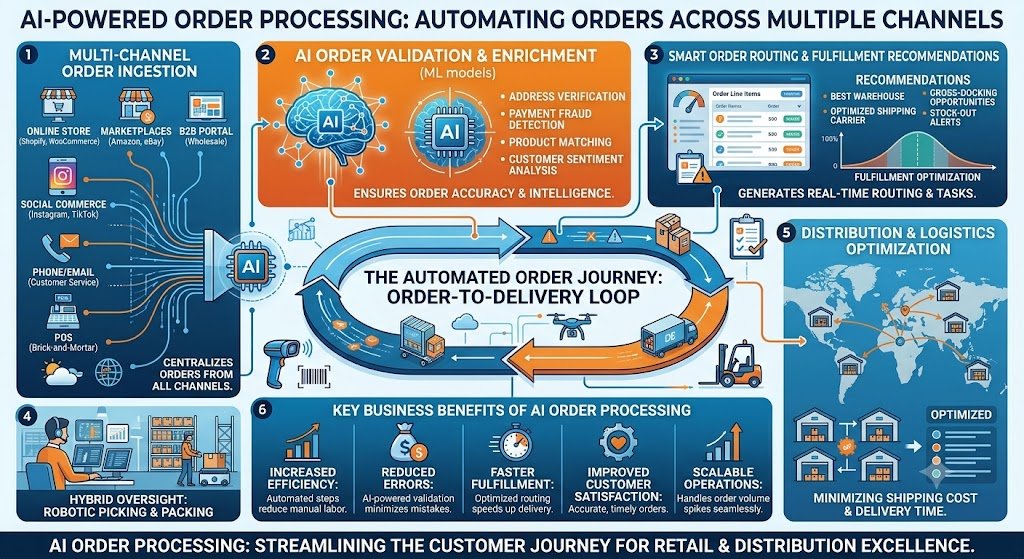
AI-powered order processing addresses this by ingesting orders from every channel, extracting the structured data, validating it against stock, pricing, and credit limits, routing it to the right fulfilment path, and flagging exceptions for human review. It does not eliminate the channels. It makes them all feed into a single, reliable order pipeline.
For Indian businesses, this matters because B2B ordering is increasingly multi-channel. Distributors receive orders on WhatsApp. Manufacturers receive purchase orders by email. Retailers receive orders through marketplaces and their own websites. The businesses that process these orders quickly and accurately win the customer; the ones that take days to confirm lose them.
India adds specific considerations. WhatsApp is a primary order channel for B2B and D2C. GST compliance requires accurate order data for invoicing. E-way bills require order details for goods movement. DPDPA applies to customer data in orders. And Indian document formats—handwritten slips, regional language orders, informal purchase orders—require robust extraction.
This guide is written for Indian business owners, operations heads, sales leaders, and founders evaluating order automation. We will cover the multi-channel ingestion, the AI extraction, the validation and routing, the exception handling, real costs in rupees and dollars, DPDPA compliance, and a phased implementation framework with clear go/no-go gates.
The Multi-Channel Order Problem
Before automating, it helps to understand why multi-channel order processing is hard.
The Channels and Their Formats
1. Email. Purchase orders as PDF attachments, often in the customer's format. Some are digital-native, some are scans.
2. WhatsApp. Order details as text messages or photos of handwritten order slips. Informal, unstructured.
3. Phone. Verbal orders, transcribed manually. High error rate.
4. B2B portal. Structured orders from your own portal. Easy to process.
5. Marketplaces. Orders from Amazon, Flipkart, IndiaMART, etc. Each marketplace has its own format and API.
6. Sales representatives. Orders collected in the field, entered later. Delayed.
7. EDI. For large customers, electronic data interchange. Structured but complex.
The Processing Challenges
| Channel | Format | Extraction Difficulty | Volume |
|---|---|---|---|
| Email (PDF) | Structured/unstructured | Medium | High |
| Email (scan) | Image | High | Medium |
| WhatsApp text | Unstructured text | Medium | High |
| WhatsApp photo | Image (handwritten) | Very High | Medium |
| Phone | Verbal | Very High | Medium |
| Portal | Structured | Low | Medium |
| Marketplace | Structured (API) | Low | High |
| EDI | Structured | Low | Low |
The Cost of Manual Processing
Time: Each order takes 5–15 minutes to process manually.
Errors: Manual entry introduces errors—wrong SKU, wrong quantity, wrong price.
Delay: Orders confirmed hours or days after receipt.
Lost sales: Customers who need faster confirmation go elsewhere.
For teams building the order processing systems and integrations, our AI Automation and Custom Software Development practices cover the full stack.
AI Order Extraction: Turning Unstructured Orders Into Structured Data Extraction is the core AI capability. It converts orders from any channel into structured data.
The Extraction Process
1. Channel ingestion. The system receives the order from the channel: email API, WhatsApp Business API, portal webhook, marketplace API.
2. Document classification. For attachments, the system identifies the document type: purchase order, order slip, email body.
3. OCR and vision. For images and scans, OCR converts pixels to text. Vision models understand handwritten text and layout.
4. Field extraction. The system extracts order fields: customer, delivery address, items (SKU, description, quantity, price), delivery date, special instructions.
5. SKU matching. The extracted item descriptions are matched to your SKU master. "Blue widget 5 inch" maps to SKU-12345.
6. Confidence scoring. Each field has a confidence score. Low-confidence fields are flagged for review.
India-Specific Extraction Challenges
Handwritten order slips. Common in B2B distribution. Vision models handle handwriting with varying accuracy.
Regional languages. Orders may be in Hindi, Tamil, or other languages. Multilingual models are required.
Informal formats. WhatsApp orders may be informal: "send 50 boxes of the usual to Sharma ji's shop." Extraction must interpret intent.
Customer-specific PO formats. Each large customer may have its own PO format. The system must handle variation.
Extraction Table
| Channel | Extraction Method | Accuracy |
|---|---|---|
| Email PDF (digital) | Text extraction + LLM | 95–99% |
| Email PDF (scan) | OCR + LLM | 85–95% |
| WhatsApp text | LLM | 90–95% |
| WhatsApp photo | Vision + OCR + LLM | 75–90% |
| Portal | API | 99%+ |
| Marketplace | API | 99%+ |
Validation and Routing: Ensuring the Order Is Correct
Extraction gives you the order data. Validation ensures it is correct, and routing sends it to the right place.
The Validation Rules
1. Customer validation. Is the customer known? Is their account active? Are they credit-approved?
2. SKU validation. Do the SKUs exist? Are they available? Is the description ambiguous?
3. Pricing validation. Does the price match the customer's contracted price? Are discounts applied correctly?
4. Quantity validation. Are quantities within minimum/maximum order quantities? Are they available in stock?
5. Address validation. Is the delivery address valid and serviceable?
6. Credit validation. Does the customer have sufficient credit limit?
7. GST validation. Is the customer's GSTIN valid? Is the order type correct (intra-state/inter-state)?
The Routing Rules
Once validated, orders are routed based on:
Fulfilment location: which warehouse has stock.
Delivery method: standard, express, same-day.
Customer priority: key accounts may get priority.
Order type: standard, urgent, backorder.
Value: high-value orders may need approval.
Validation and Routing Table
| Validation | Data Source | Action if Fail |
|---|---|---|
| Customer | CRM/ERP | Flag for review |
| SKU | Product master | Flag for review |
| Pricing | Price list | Flag for review |
| Quantity | Inventory | Backorder or flag |
| Address | Address master | Flag for correction |
| Credit | Credit system | Hold or flag |
| GST | GST database | Flag for correction |
Exception Handling: Where Humans Add Value
Not every order can be processed automatically. Exceptions are orders that fail validation or extraction confidence. They need human review.
The Exception Types
1. Extraction exceptions. Low-confidence extraction. The system could not read a field or matched an ambiguous SKU.
2. Validation exceptions. Failed validation: unknown customer, invalid SKU, price mismatch, insufficient credit.
3. Business exceptions. Unusual orders: very large quantities, unusual delivery requests, rush orders.
The Exception Workflow
Flag: the system flags the exception with the specific reason.
Queue: the exception is routed to the appropriate team (sales, credit, warehouse).
Review: the human reviews the order, the exception reason, and the source document side by side.
Resolve: the human corrects the data or contacts the customer.
Learn: the correction feeds back into the extraction model to improve future accuracy.
Exception Table
| Exception Type | Typical Resolver | Resolution |
|---|---|---|
| Low confidence extraction | Sales coordinator | Verify with customer |
| Unknown SKU | Sales coordinator | Map to correct SKU |
| Price mismatch | Sales | Confirm price |
| Credit hold | Finance | Approve or decline |
| Address issue | Logistics | Correct address |
Real Costs in India (2026)
AI order processing costs depend on the scope: extraction only, or full processing with validation and routing.
Implementation Costs
| Scope | Cost (₹) | Cost ($ approx.) | Timeline |
|---|---|---|---|
| Email/PDF extraction | ₹2–5 lakh | $2,400–$6,000 | 6–10 weeks |
| Multi-channel ingestion (email, WhatsApp, portal) | ₹5–12 lakh | $6,000–$14,400 | 10–16 weeks |
| Full processing (extraction, validation, routing, exceptions) | ₹12–30 lakh | $14,400–$36,000 | 16–28 weeks |
| Enterprise platform (marketplaces, EDI, multi-location) | ₹30–70 lakh | $36,000–$84,000 | 24–36 weeks |
Running Costs
| Component | Monthly Cost (₹) | Monthly Cost ($ approx.) | Notes |
|---|---|---|---|
| LLM/OCR API | ₹10,000–₹60,000 | $120–$720 | Per-document pricing |
| WhatsApp API | ₹5,000–₹30,000 | $60–$360 | Per-conversation |
| Hosting | ₹10,000–₹50,000 | $120–$600 | Cloud infrastructure |
| Maintenance | ₹20,000–₹1,00,000 | $240–$1,200 | 15–25% of build annually |
The ROI Case
For a distributor processing 3,000 orders/month:
Manual processing time: 10 minutes per order = 500 hours/month.
Time saved with AI: 60% = 300 hours/month.
Cost saving: 300 hours × ₹400/hour = ₹1.2 lakh/month.
Annual saving: ₹14.4 lakh.
Payback: 6–12 months on a ₹5–15 lakh implementation.
Plus, faster order confirmation improves customer satisfaction and reduces lost sales.
India-Specific Compliance: GST, E-Way Bills and DPDPA
GST Compliance
Orders must be GST-compliant for invoicing:
Customer GSTIN: validate before order confirmation.
Place of supply: determine intra-state or inter-state.
HSN codes: ensure correct classification.
Invoice generation: order data feeds invoice generation.
E-Way Bills
For goods movement above the threshold, e-way bills are required. Order data feeds e-way bill generation:
Consignor/consignee: from order.
Goods: from order line items.
Value: from order total.
Vehicle: from dispatch.
DPDPA
Orders contain customer personal data: names, phone numbers, addresses, GSTIN. Under the DPDP Act:
Consent: customers consent to their data being used for order processing.
Purpose limitation: order data should not be repurposed.
Data minimisation: collect only what is needed.
Retention: define retention periods.
Access control: restrict access based on role.
Compliance Checklist
| Requirement | Implementation | Priority |
|---|---|---|
| GSTIN validation | API validation | High |
| Place of supply | Determined from addresses | High |
| E-way bill integration | From dispatch | High |
| Customer consent | At order time | High |
| Data minimisation | Only needed fields | Medium |
| Access control | Role-based | High |
Implementation Framework: A Phased Approach With Cost Gates
Phase 1: Order Flow Audit (Week 1–3)
Objective: Understand current order channels, volumes, and pain points.
Activities:
Inventory order channels and volumes.
Measure current processing time and error rates.
Identify pain points: which channels are slowest, which have most errors.
Assess data quality: SKU master, customer master, price list.
Assess compliance requirements.
Cost: ₹50,000–₹1.5 lakh ($600–$1,800).
Go/No-Go: Channels identified. Business case validated.
Phase 2: Email/PDF Extraction (Week 4–11)
Objective: Automate extraction from email and PDF orders.
Activities:
Integrate email ingestion.
Implement document classification and extraction.
Implement SKU matching.
Build review interface for exceptions.
Integrate with ERP.
Cost: ₹2–5 lakh ($2,400–$6,000).
Go/No-Go: Extraction accuracy >90%. Manual processing reduced.
Phase 3: WhatsApp and Portal (Week 12–19)
Objective: Add WhatsApp and portal ingestion.
Activities:
Integrate WhatsApp Business API.
Implement chatbot or message parsing for text orders.
Implement vision extraction for photo orders.
Integrate portal webhook.
Extend exception handling.
Cost: ₹3–7 lakh ($3,600–$8,400).
Go/No-Go: WhatsApp orders processed. Portal orders auto-ingested.
Phase 4: Validation and Routing (Week 20–27)
Objective: Automate validation and routing.
Activities:
Implement validation rules.
Implement routing logic.
Integrate with inventory and credit systems.
Build exception workflow.
Add GST validation.
Cost: ₹5–15 lakh ($6,000–$18,000).
Go/No-Go: Validation catches errors. Routing works.
Phase 5: Marketplaces and Optimization (Ongoing)
Objective: Add marketplace integration and optimize.
Activities:
Integrate marketplace APIs.
Add EDI if needed.
Monitor accuracy.
Expand to more channels.
Optimize processing time.
Cost: ₹20,000–₹1,00,000/month ($240–$1,200).
Phase Summary Table
| Phase | Duration | Key Deliverable | Cost (₹) | Go/No-Go Criteria |
|---|---|---|---|---|
| 1. Order Audit | 3 weeks | Channels, pain points | 50,000–1.5 lakh | Business case |
| 2. Email/PDF | 8 weeks | Email extraction | 2–5 lakh | Accuracy >90% |
| 3. WhatsApp/Portal | 8 weeks | Multi-channel ingestion | 3–7 lakh | Channels work |
| 4. Validation | 8 weeks | Validation, routing | 5–15 lakh | Errors caught |
| 5. Marketplaces | Ongoing | Full multi-channel | 20,000–1,00,000/month | All channels |
Risks, Pitfalls, and Governance
The Most Common Order Automation Failures
Poor extraction on handwritten orders. Vision models struggle with handwriting. Mitigation: Human review, customer confirmation.
SKU matching errors. Ambiguous descriptions mapped to wrong SKUs. Mitigation: Confidence scoring, human review.
Integration failures. ERP integration breaks. Mitigation: Monitoring, fallback.
Exception queue overload. Too many exceptions overwhelm the team. Mitigation: Improve extraction, add validation rules.
No customer communication. Customer does not know order status. Mitigation: Automated confirmations.
DPDPA violations. Customer data processed without consent. Mitigation: Consent, purpose limitation.
Risk Summary Table
| Risk | Likelihood | Impact | Mitigation |
|---|---|---|---|
| Poor extraction | High | High (manual review) | Human review |
| SKU matching errors | High | High (wrong orders) | Confidence, review |
| Integration failures | Medium | High (orders stuck) | Monitoring |
| Exception overload | Medium | Medium | Improve extraction |
| No communication | High | Medium | Confirmations |
| DPDPA violations | Medium | High | Consent |
Benchmark Summary and Decision Framework
Decision Matrix: Build vs Buy
| Factor | Build Custom | Buy OMS |
|---|---|---|
| Unique workflows | Industry-specific | Standard orders |
| Channel integration | Custom channels | Standard connectors |
| Cost | Higher upfront | Subscription |
| Time to market | 16–28 weeks | Weeks |
| Best for | Large distributors | Mid-sized businesses |
Channel Priority Table
| Channel | Volume | Extraction Difficulty | Priority |
|---|---|---|---|
| Email/PDF | High | Medium | 1 |
| High | Medium-High | 2 | |
| Portal | Medium | Low | 3 |
| Marketplace | High | Low (API) | 3 |
| Phone | Medium | Very High | 4 |
The One-Paragraph Decision Rule
If your team spends its day re-keying orders from email and WhatsApp, start with email/PDF extraction. Add WhatsApp ingestion next. Implement validation to catch errors before they reach the warehouse. Build exception handling for orders that need human review. Add marketplace integration when volume justifies it. And ensure GST and DPDPA compliance—GSTIN validation, consent, data minimisation—from the start.
Frequently Asked Questions
1. How much does AI order processing cost in India?
Email/PDF extraction costs ₹2–5 lakh ($2,400–$6,000). Multi-channel ingestion costs ₹5–12 lakh ($6,000–$14,400). Full processing costs ₹12–30 lakh ($14,400–$36,000).
2. What is multi-channel order processing?
Processing orders that arrive through multiple channels—email, WhatsApp, phone, portal, marketplace—into a single order management system.
3. Can AI process handwritten orders?
Vision models can read handwriting with varying accuracy. Poor handwriting may require human review. Customer confirmation is recommended for handwritten orders.
4. How does SKU matching work?
The system matches extracted item descriptions to your SKU master. Ambiguous descriptions are flagged for human review.
5. What is order validation?
Validation checks the order against business rules: customer status, SKU availability, pricing, credit limit, address validity, GST.
6. How does DPDPA affect order processing?
Customer data in orders requires consent, purpose limitation, data minimisation, retention policies, and access control.
7. How do I integrate with marketplaces?
Use marketplace APIs (Amazon, Flipkart, IndiaMART) to pull orders automatically. Each marketplace has its own API.
8. Can AI process WhatsApp orders?
Yes. WhatsApp Business API allows the system to receive messages and extract order details. Text orders are easier than photo orders.
9. How long does implementation take?
Email/PDF extraction takes 6–10 weeks. Full multi-channel processing takes 16–28 weeks. Timeline depends on channels and integrations.
10. Should I build or buy order processing software?
Build if you have unique channels or workflows. Buy if you have standard channels and need to move fast.
11. What metrics should I track?
Order processing time, error rate, exception rate, order confirmation time, and customer satisfaction.
12. How can Innovative AI Solutions help?
Innovative AI Solutions builds AI order processing systems for Indian businesses—multi-channel ingestion, extraction, validation, routing, exception handling, and GST/DPDPA-compliant data handling. Our Delhi-based team handles assessment, implementation, and optimization. Visit https://innovativeais.com to discuss your requirements.
Contact Innovative AI Solutions
Ready to turn every order channel into a single, reliable pipeline?
[One-line supporting sentence.]
Contact Information
Innovative AI Solutions
📍 Netaji Subhash Place, Pitampura, Delhi – 110034
🌐 Website: https://innovativeaislabs.com 📧 Email: info@innovativeais.com
📞 Phone: +91 7464 099 059 / +91 96899 67356
Business Services
AI Automation
AI Development
AI Consulting
Machine Learning Solutions
Deep Learning Solutions
Generative AI Services
NLP Solutions
AI Agents
AI Chatbots
Voice AI
CRM Development
Custom Software Development
Website Development
Mobile App Development
About the Author
Abhishek Kumar
Founder & CEO, Innovative AI Solutions
5+ years building production AI systems for Indian businesses. Based in Delhi, serving clients across India.
Ready to build AI solutions for your business?
Innovative AI Solutions — Delhi's leading AI development company. Free consultation available.
Get Free Consultation →
A practical 2026 guide for Indian businesses automating multi-channel order processing—ingestion from email, WhatsApp, portal and marketplaces, AI extraction, validation, routing, real rupee costs, and GST and DPDPA compliance.
#AIOrderProcessing #MultiChannelOrders #OrderAutomation #OrderIntake #OrderValidation #OrderRouting #ExceptionHandling #B2BOrders #EcommerceOrders #OrderManagement #PurchaseOrders #OrderToCash #DPDPA #MeitY #DelhiNCR #InnovativeAISolutions
Copyright ©️ 2015–2026 Innovative AI Solutions. All Rights Reserved. | Privacy Policy | Terms & Conditions