


The Knowledge That Leaves When the Employee Leaves
An experienced operations manager at an Indian manufacturing company resigns. On their last day, they hand over a laptop and a folder of files. But the knowledge that made them effective—the vendor escalation contacts, the workaround for the ERP bug, the reason a particular process step exists, the location of the signed agreement from 2019—leaves with them.
Three months later, a new manager spends weeks rediscovering what the previous manager knew. They search shared drives with inconsistent folder structures, ask colleagues who are also unsure, and eventually find a document that is two versions out of date. The company's knowledge exists, but it is not accessible, not current, and not trusted.
This is the knowledge management problem, and it is one of the most expensive inefficiencies in Indian enterprises. The cost is not visible on any invoice. It appears as slower onboarding, repeated mistakes, duplicated effort, and decisions made without the information that already exists somewhere in the organisation.
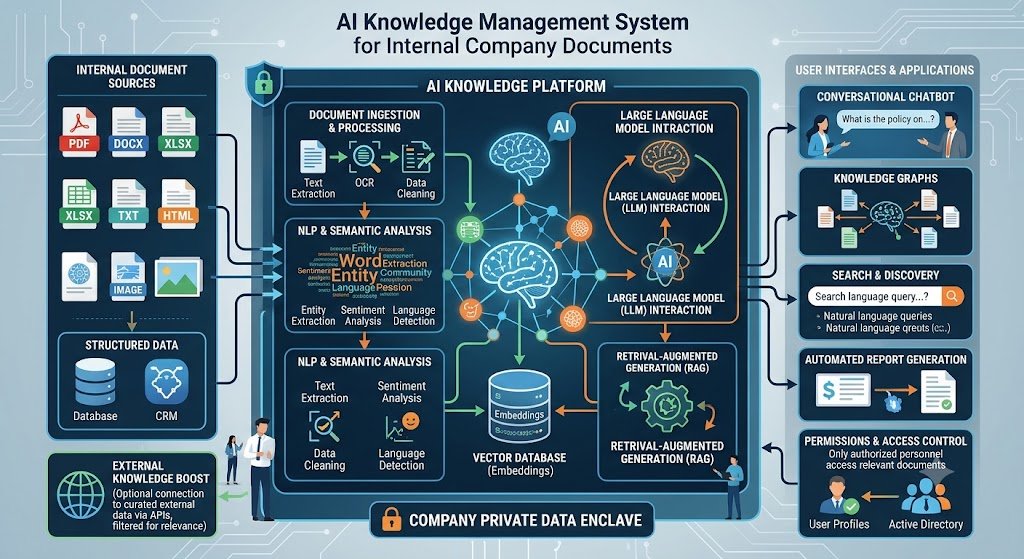
AI knowledge management systems address this by making internal documents searchable, understandable, and answerable. Employees ask a question in natural language—"What is the approval limit for capital expenditure?"—and the system retrieves the relevant document, extracts the answer, cites the source, and shows it in seconds. It is not a search engine that returns ten links. It is an assistant that answers the question, with evidence.
For Indian businesses, this matters because knowledge is scattered across tools—Google Drive, SharePoint, Confluence, email, WhatsApp, local file servers, and paper. The employee who needs an answer does not know where to look. The system that can find it across all sources, respect access controls, and cite the source changes how the organisation works.
India adds specific considerations. DPDPA applies to internal documents that contain employee or customer personal data. Access control is critical—an employee should not see documents they are not authorised to see, and an AI assistant must respect the same permissions. Data localisation may require the system to run in India for regulated sectors. MeitY AI governance applies to AI-generated answers, requiring transparency and accountability. And multilingual documents—many Indian companies have documents in English, Hindi, and regional languages—require multilingual retrieval.
This guide is written for Indian CTOs, IT heads, HR leaders, and operations managers evaluating AI knowledge management. We will cover the RAG architecture, the access control, the document ingestion, real costs in rupees and dollars, DPDPA compliance, and a phased implementation framework with clear go/no-go gates.
What AI Knowledge Management Actually Does
AI knowledge management is not a single tool. It is a system that combines document ingestion, retrieval, generation, and access control.
The Core Capabilities
1. Multi-source ingestion. The system connects to all the places where documents live: Google Drive, SharePoint, Confluence, Notion, email, local file servers, document management systems.
2. Document processing. Documents are parsed, cleaned, chunked, and indexed. Tables, images, and scanned documents are handled.
3. Semantic search. Employees search in natural language, and the system finds relevant documents based on meaning, not just keywords.
4. Answer generation (RAG). The system retrieves relevant passages and generates an answer grounded in those passages, with citations.
5. Access control. The system respects the same permissions as the source systems. An employee only sees documents they are authorised to access.
6. Source citation. Every answer cites the source document, so the employee can verify.
7. Feedback loop. Employees rate answers, and the system improves over time.
8. Analytics. The system shows what employees are searching for, what is not being found, and where the knowledge gaps are.
Capability Table
| Capability | What It Does | Business Value |
|---|---|---|
| Multi-source ingestion | Connects to all document sources | Complete coverage |
| Document processing | Parses, chunks, indexes | Searchable knowledge |
| Semantic search | Finds by meaning | Better results |
| Answer generation | Answers with citations | Faster decisions |
| Access control | Respects permissions | Security, compliance |
| Citation | Shows sources | Trust, verification |
| Feedback | Improves over time | Better answers |
| Analytics | Shows gaps | Content improvement |
For teams building the RAG systems and integrations, our Generative AI Services and NLP Solutions practices cover the full stack.
The RAG Architecture for Internal Knowledge
RAG (Retrieval-Augmented Generation) is the architecture that makes AI knowledge management work. It retrieves relevant documents and generates answers grounded in them.
The Ingestion Pipeline
1. Connectors. The system connects to document sources via APIs: Google Drive API, SharePoint API, Confluence API, email IMAP.
2. Document parsing. Documents are parsed: PDFs, Word, Excel, PowerPoint, HTML, email. Tables and images are extracted.
3. Chunking. Documents are split into chunks—paragraphs or sections—that can be retrieved independently.
4. Embedding. Each chunk is converted to a vector embedding using an embedding model.
5. Indexing. Embeddings are stored in a vector database for fast retrieval.
6. Metadata. Each chunk is tagged with metadata: source, author, date, access permissions.
The Query Pipeline
1. Query embedding. The employee's question is converted to an embedding.
2. Retrieval. The system finds the most similar chunks, filtered by access permissions.
3. Re-ranking. The retrieved chunks are re-ranked for relevance.
4. Generation. The LLM generates an answer grounded in the retrieved chunks.
5. Citation. The answer includes citations to the source documents.
6. Feedback. The employee can rate the answer or flag issues.
The Architecture at a Glance
| Stage | Component | India-Specific Consideration |
|---|---|---|
| Ingestion | Connectors, parsers | Multilingual documents |
| Processing | Chunking, embedding | Tables, scans |
| Storage | Vector database | Data localisation |
| Retrieval | Semantic search, re-ranking | Access control |
| Generation | LLM | Grounding, citation |
| Access | Permission filtering | DPDPA compliance |
Access Control: The Non-Negotiable Requirement
An AI knowledge management system that ignores access control is a data breach waiting to happen. An employee who is not authorised to see salary data must not be able to ask the AI and receive it.
The Access Control Challenge
Documents in source systems have permissions: who can view, edit, or share. The AI system must respect these permissions at retrieval time. This is harder than it sounds because:
Permissions are complex: inherited from folders, groups, sharing links.
Permissions change: an employee who had access yesterday may not have it today.
Permissions are per-document: the AI must filter at the chunk level.
The Access Control Approaches
1. Pre-filtering. Before retrieval, the system filters the index to only documents the user can access. Accurate but can be slow.
2. Post-filtering. The system retrieves documents and then filters out ones the user cannot access. Faster but can leak information in the retrieval process.
3. Permission-aware indexing. Each chunk is tagged with access permissions, and retrieval only returns chunks the user is authorised to see.
Recommendation: Permission-aware indexing with pre-filtering for sensitive documents.
The Access Control Table
| Approach | Accuracy | Performance | Best For |
|---|---|---|---|
| Pre-filtering | High | Slower | Sensitive documents |
| Post-filtering | Medium | Faster | General documents |
| Permission-aware indexing | High | Fast | Most systems |
DPDPA and Access Control
Under the DPDP Act, access control is a security obligation. An AI system that exposes personal data to unauthorised employees violates the Act. Access control must be:
Enforced at retrieval: not just at the UI.
Audited: every access logged.
Tested: regular testing to ensure permissions work.
Real Costs in India (2026)
AI knowledge management costs depend on the scope: single source, or multi-source with access control.
Implementation Costs
| Scope | Cost (₹) | Cost ($ approx.) | Timeline |
|---|---|---|---|
| Single source (e.g., Confluence only) | ₹2–5 lakh | $2,400–$6,000 | 4–8 weeks |
| Multi-source (3–5 sources) | ₹5–12 lakh | $6,000–$14,400 | 8–16 weeks |
| Full system (multi-source, access control, analytics) | ₹12–30 lakh | $14,400–$36,000 | 16–28 weeks |
| Enterprise (10+ sources, SSO, advanced permissions) | ₹30–70 lakh | $36,000–$84,000 | 24–36 weeks |
Running Costs
| Component | Monthly Cost (₹) | Monthly Cost ($ approx.) | Notes |
|---|---|---|---|
| LLM API | ₹10,000–₹80,000 | $120–$960 | Scales with queries |
| Vector database | ₹5,000–₹40,000 | $60–$480 | Managed or self-hosted |
| Hosting | ₹10,000–₹50,000 | $120–$600 | Cloud infrastructure |
| Maintenance | ₹20,000–₹1,00,000 | $240–$1,200 | 15–25% of build annually |
The ROI Case
For a company with 500 employees:
Time spent searching for information: 2 hours/week per employee = 1,000 hours/week.
Time saved with AI: 30% = 300 hours/week.
Cost saving: 300 hours × ₹500/hour = ₹1.5 lakh/week.
Annual saving: ₹78 lakh.
Payback: 2–6 months on a ₹5–15 lakh implementation.
Plus, faster onboarding, fewer repeated mistakes, and better decisions.
India-Specific Compliance: DPDPA, Data Localisation and MeitY
DPDPA
Internal documents often contain personal data: employee records, customer information, contracts. Under the DPDP Act:
Access control: only authorised employees should access personal data.
Purpose limitation: data used for knowledge management should not be repurposed.
Data minimisation: index only what is needed.
Retention: define retention periods.
Audit logging: log access to personal data.
Data Localisation
For regulated sectors (BFSI, healthcare), data localisation may require the system to run in India. Choose Indian cloud regions or self-hosted infrastructure.
MeitY AI Governance
If AI generates answers:
Transparency: employees should know the answer is AI-generated and cited.
Accountability: a named owner for the system.
Human oversight: employees should verify answers for critical decisions.
Compliance Checklist
| Requirement | Implementation | Priority |
|---|---|---|
| Access control | Permission-aware retrieval | High |
| Audit logging | Log all access | High |
| Data minimisation | Index only needed docs | Medium |
| Retention | Automated purge | Medium |
| Data localisation | Indian region | Medium (regulated) |
| AI transparency | Cite sources | High |
Implementation Framework: A Phased Approach With Cost Gates
Phase 1: Document Audit (Week 1–3)
Objective: Understand document sources, volumes, and access patterns.
Activities:
Inventory document sources: drives, wikis, email, file servers.
Measure document volume and types.
Assess access control complexity.
Identify high-value document categories (HR policies, SOPs, product docs).
Assess data sensitivity (DPDPA).
Cost: ₹50,000–₹1.5 lakh ($600–$1,800).
Go/No-Go: Sources identified. Business case validated.
Phase 2: Single Source Pilot (Week 4–11)
Objective: Build a working system on one document source.
Activities:
Connect to one source (e.g., Confluence).
Implement ingestion and chunking.
Implement embedding and vector storage.
Build query interface with citations.
Test with a pilot user group.
Cost: ₹2–5 lakh ($2,400–$6,000).
Go/No-Go: Answers are accurate and cited. Users find it useful.
Phase 3: Multi-Source and Access Control (Week 12–21)
Objective: Expand to multiple sources with access control.
Activities:
Add connectors for additional sources.
Implement permission-aware indexing.
Implement access filtering at retrieval.
Implement audit logging.
Test access control thoroughly.
Cost: ₹5–15 lakh ($6,000–$18,000).
Go/No-Go: Access control works. No data leakage.
Phase 4: Analytics and Optimization (Week 22–28)
Objective: Add analytics and optimize.
Activities:
Build analytics dashboard: popular queries, gaps, feedback.
Implement feedback loop.
Optimize retrieval quality.
Train employees.
Cost: ₹3–10 lakh ($3,600–$12,000).
Go/No-Go: Analytics used. Feedback improves answers.
Phase 5: Scale and Maintain (Ongoing)
Objective: Scale to the full organisation and maintain.
Activities:
Onboard all employees.
Add new sources.
Update index as documents change.
Monitor quality.
Cost: ₹20,000–₹1,00,000/month ($240–$1,200).
Phase Summary Table
| Phase | Duration | Key Deliverable | Cost (₹) | Go/No-Go Criteria |
|---|---|---|---|---|
| 1. Document Audit | 3 weeks | Sources, volumes | 50,000–1.5 lakh | Business case |
| 2. Single Source | 8 weeks | Working pilot | 2–5 lakh | Answers accurate |
| 3. Multi-Source | 10 weeks | Multi-source, access control | 5–15 lakh | No data leakage |
| 4. Analytics | 7 weeks | Analytics, feedback | 3–10 lakh | Used by team |
| 5. Scale | Ongoing | Full organisation | 20,000–1,00,000/month | Adoption growing |
Risks, Pitfalls, and Governance
The Most Common Knowledge Management Failures
Poor document quality. Outdated, contradictory, or poorly formatted documents produce poor answers. Mitigation: Content audit, ownership, update process.
Access control failures. Employees see documents they should not. Mitigation: Permission-aware indexing, testing, audit.
Hallucination. The AI invents answers. Mitigation: RAG grounding, citation, refusal when confidence is low.
Low adoption. Employees do not use the system. Mitigation: Training, integration with existing tools, champions.
No content ownership. Documents go stale. Mitigation: Assign owners, review cadence.
DPDPA violations. Personal data exposed. Mitigation: Access control, audit logging.
Risk Summary Table
| Risk | Likelihood | Impact | Mitigation |
|---|---|---|---|
| Poor document quality | High | High (bad answers) | Content audit |
| Access control failures | Medium | Critical | Permission-aware indexing |
| Hallucination | Medium | High | RAG, citation |
| Low adoption | High | Medium | Training, champions |
| No content ownership | High | Medium | Assign owners |
| DPDPA violations | Medium | Critical | Access control, audit |
Benchmark Summary and Decision Framework
Decision Matrix: Build vs Buy
| Factor | Build Custom | Buy Knowledge AI Platform |
|---|---|---|
| Unique sources | Custom integrations | Standard connectors |
| Access control | Complex permissions | Vendor support |
| Cost | Higher upfront | Subscription |
| Time to market | 16–28 weeks | Weeks |
| Best for | Large enterprises | Mid-sized businesses |
Implementation Priority Table
| Priority | Capability | Why |
|---|---|---|
| 1 | Access control | Security, compliance |
| 2 | Single-source RAG | Fastest to value |
| 3 | Multi-source ingestion | Complete coverage |
| 4 | Citation | Trust, verification |
| 5 | Analytics | Content improvement |
The One-Paragraph Decision Rule
If your employees cannot find the information they need, start with a single-source RAG pilot on your most-used knowledge base. Get access control right before expanding. Add sources one at a time, testing permissions at each step. Cite every answer so employees can verify. Track what is not being found and fix the content gaps. And ensure DPDPA compliance—access control, audit logging, retention—from the start.
Frequently Asked Questions
1. How much does AI knowledge management cost in India?
Single-source costs ₹2–5 lakh ($2,400–$6,000). Multi-source costs ₹5–12 lakh ($6,000–$14,400). Full system with access control costs ₹12–30 lakh ($14,400–$36,000).
2. What is RAG and why does it matter for knowledge management?
RAG (Retrieval-Augmented Generation) retrieves relevant document passages and generates answers grounded in them. It reduces hallucination and enables citation.
3. How does access control work in AI knowledge management?
The system respects the same permissions as source systems. Permission-aware indexing and pre-filtering ensure employees only see documents they are authorised to access.
4. Can the system search across multiple sources?
Yes. The system connects to Google Drive, SharePoint, Confluence, email, and other sources via APIs and indexes them together.
5. How does DPDPA affect knowledge management?
Internal documents may contain personal data. Access control, purpose limitation, data minimisation, retention, and audit logging apply.
6. What if the AI gives a wrong answer?
RAG grounding and citation reduce wrong answers. The system should refuse to answer when confidence is low. Employees should verify critical answers against cited sources.
7. How do I get employees to use the system?
Integrate it into existing tools (Slack, Teams, email), train employees, appoint champions, and demonstrate value with quick wins.
8. How do I keep documents current?
Assign owners to document categories, establish review cadence, and use analytics to identify outdated content.
9. Can the system handle Indian languages?
Yes, with multilingual embedding models and LLMs. Test with native speakers for critical documents.
10. How long does implementation take?
Single-source takes 4–8 weeks. Multi-source with access control takes 16–28 weeks. Timeline depends on sources and permissions.
11. Should I build or buy?
Build if you have unique sources or complex permissions. Buy if you have standard sources and need to move fast.
12. How can Innovative AI Solutions help?
Innovative AI Solutions builds AI knowledge management systems for Indian enterprises—multi-source ingestion, RAG, access control, citation, and DPDPA-compliant data handling. Our Delhi-based team handles assessment, implementation, and optimization. Visit https://innovativeais.com to discuss your requirements.
Contact Innovative AI Solutions
Ready to make your company's knowledge findable, trustworthy and secure?
[One-line supporting sentence.]
Contact Information
Innovative AI Solutions
📍 Netaji Subhash Place, Pitampura, Delhi – 110034
🌐 Website: https://innovativeaislabs.com 📧 Email: info@innovativeais.com
📞 Phone: +91 7464 099 059 / +91 96899 67356
Business Services
AI Automation
AI Development
AI Consulting
Machine Learning Solutions
Deep Learning Solutions
Generative AI Services
NLP Solutions
AI Agents
AI Chatbots
Voice AI
CRM Development
Custom Software Development
Website Development
Mobile App Development
About the Author
Abhishek Kumar
Founder & CEO, Innovative AI Solutions
5+ years building production AI systems for Indian businesses. Based in Delhi, serving clients across India.
Ready to build AI solutions for your business?
Innovative AI Solutions — Delhi's leading AI development company. Free consultation available.
Get Free Consultation →
A practical 2026 guide for Indian enterprises implementing AI knowledge management—multi-source ingestion, RAG architecture, access control, citation, real rupee costs, and DPDPA compliance.
#AIKnowledgeManagement #EnterpriseSearch #RAG #KnowledgeBase #CompanyDocuments #AIAssistant #AccessControl #Confluence #SharePoint #DPDPA #MeitY #EnterpriseAI #DocumentQA #KnowledgeManagement #DelhiNCR #InnovativeAISolutions
Copyright ©️ 2015–2026 Innovative AI Solutions. All Rights Reserved. | Privacy Policy | Terms & Conditions