


The Contract That Took Three Weeks and Still Missed the Indemnity An Indian enterprise signs a vendor agreement. The legal team reviews it—three weeks of back-and-forth, redlines, and email threads. The contract is signed. Eighteen months later, a dispute arises. The legal team discovers that the indemnity clause was mutual, not one-sided as they had assumed, and that the limitation of liability cap was set at a level that made the indemnity effectively meaningless.
The clause was in the contract. It was reviewed. But it was not flagged as a risk—because the reviewer was focused on the commercial terms and the delivery schedule, and the indemnity language was buried in a section that looked standard.
This is the nature of contract risk. It is rarely in the clause you read carefully. It is in the clause you skimmed because it looked familiar. And for Indian businesses signing hundreds or thousands of contracts a year—vendor agreements, customer contracts, NDAs, employment agreements, leases—manual review cannot catch every risk.
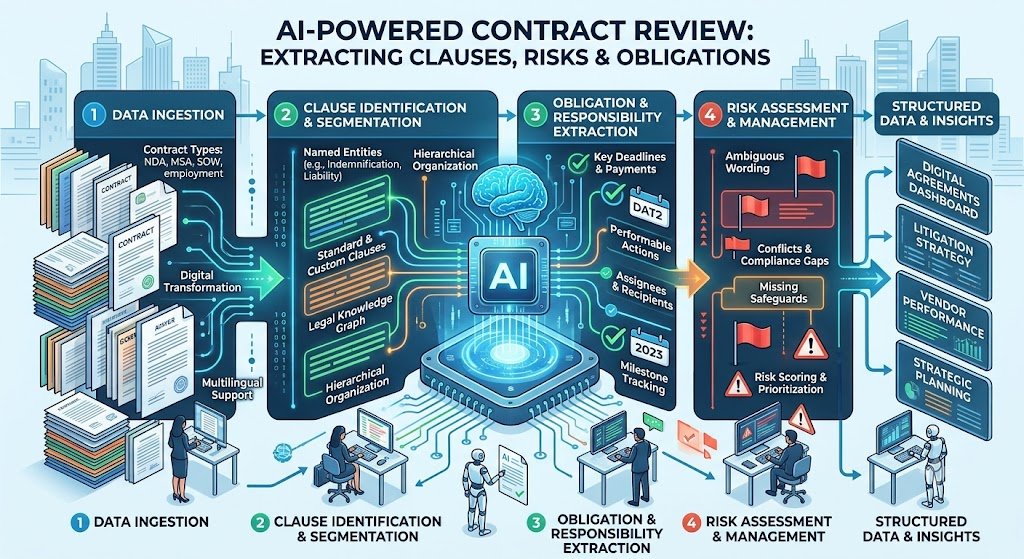
AI-powered contract review addresses this by extracting clauses, flagging risks, and tracking obligations at scale. It does not replace the lawyer. It gives the lawyer a structured starting point—a summary of what the contract says, which clauses deviate from standard, and which obligations need to be tracked—so that human expertise is applied where it matters most.
For Indian legal teams, this matters because contract volume is growing and legal capacity is finite. The businesses that review contracts efficiently—catching risks early, tracking obligations consistently, and negotiating from a position of knowledge—have a competitive advantage.
India adds specific considerations. DPDPA applies to contracts that involve personal data processing, and the contract must include data processing terms. MeitY AI governance applies if AI is used for review. Indian Contract Act and sectoral regulations (RBI, SEBI, IRDAI) shape what clauses are required or prohibited. And Indian language contracts—some contracts may be in Hindi or regional languages—require multilingual capability.
This guide is written for Indian legal teams, general counsel, contract managers, and founders evaluating AI contract review. We will cover the clause extraction, the risk flagging, the obligation tracking, real costs in rupees and dollars, DPDPA compliance, and a phased implementation framework with clear go/no-go gates.
What AI Contract Review Actually Does
AI contract review is not a single capability. It is a set of capabilities that together support the review process.
The Core Capabilities
1. Document ingestion. The system accepts contracts in various formats: PDF, Word, scanned images. It converts them to text and identifies the document structure (parties, recitals, clauses, schedules, signatures).
2. Clause extraction. The system identifies and extracts clauses by type: indemnity, limitation of liability, termination, confidentiality, payment terms, governing law, dispute resolution, data protection, force majeure.
3. Clause comparison. The system compares extracted clauses against a standard playbook or template, flagging deviations.
4. Risk flagging. The system identifies clauses that carry risk: unlimited liability, one-sided indemnity, auto-renewal, unilateral termination rights, unusual payment terms.
5. Obligation extraction. The system identifies obligations: who must do what, by when, and what happens if they do not.
6. Summarisation. The system generates a summary of the contract: key terms, parties, dates, values, and obligations.
7. Question answering. The system answers questions about the contract: "What is the termination notice period?" "Is there a non-compete?"
8. Redline suggestions. The system suggests alternative language for risky clauses, based on the playbook.
Capability Table
| Capability | What It Does | Human Role |
|---|---|---|
| Ingestion | Convert to text, structure | Verify |
| Clause extraction | Identify clause types | Review |
| Comparison | Compare to playbook | Review |
| Risk flagging | Identify risky clauses | Investigate |
| Obligation extraction | Identify obligations | Track |
| Summarisation | Generate summary | Verify |
| Q&A | Answer questions | Verify |
| Redline | Suggest alternatives | Decide |
For teams building the contract AI systems, our AI Development and NLP Solutions practices cover the full stack.
Clause Extraction: The Foundation
Clause extraction is the foundation of contract review. If the system cannot reliably identify what the contract says, nothing else works.
The Clause Types
Contracts contain many clause types. The most important for risk and obligation tracking include:
Indemnity: who indemnifies whom, for what, and with what limits.
Limitation of liability: caps on liability, exclusions of consequential loss.
Termination: termination rights, notice periods, consequences.
Confidentiality: what is confidential, for how long, exceptions.
Payment terms: amounts, timing, late payment interest.
Governing law and jurisdiction: which law applies, where disputes are heard.
Dispute resolution: arbitration, mediation, courts.
Data protection: how personal data is handled (DPDPA compliance).
Force majeure: what happens when performance is impossible.
Assignment: whether the contract can be assigned.
Entire agreement: whether prior representations are excluded.
Extraction Approaches
1. Rule-based. Regex and keyword patterns. Fast but brittle; misses variations.
2. Traditional ML. Train a model on labelled clauses. Better than rules but requires labelled data.
3. LLM-based. Use a large language model to extract clauses with a prompt. Flexible, handles variations, no training data required.
Recommendation: LLM-based extraction for flexibility, with rules for high-confidence, high-volume clause types.
The Extraction Accuracy Problem
Contract extraction accuracy depends on:
Document quality: clean digital contracts extract better than scans.
Clause complexity: simple clauses extract better than complex, cross-referenced clauses.
Language: English contracts extract better than Indian language contracts.
Template variation: standard templates extract better than unusual ones.
The honest caveat: No extraction system is 100% accurate. The system should flag low-confidence extractions for human review. The goal is to reduce the review burden, not eliminate it.
Extraction Table
| Clause Type | Extraction Difficulty | Risk if Missed |
|---|---|---|
| Indemnity | Medium | Very High |
| Limitation of liability | Medium | Very High |
| Termination | Low | High |
| Confidentiality | Low | Medium |
| Payment terms | Low | High |
| Governing law | Low | Medium |
| Data protection | Medium | High |
| Force majeure | Medium | Medium |
Risk Flagging: Finding What Matters
Risk flagging is where AI adds the most value. It identifies clauses that deviate from the playbook or that carry inherent risk.
The Risk Categories
1. Liability risks. Unlimited liability, high caps, one-sided indemnity.
2. Termination risks. Auto-renewal, unilateral termination, short notice periods.
3. Payment risks. Unusual payment terms, late payment penalties, non-refundable deposits.
4. Confidentiality risks. Broad confidentiality, long duration, exceptions.
5. IP risks. IP assignment, ownership of work product, license scope.
6. Compliance risks. Data protection, anti-bribery, sanctions.
7. Dispute risks. Foreign jurisdiction, arbitration costs, waivers.
The Playbook
Risk flagging requires a playbook: a set of rules about what the business considers acceptable. The playbook defines:
Standard clauses: what the business prefers.
Fallback positions: what the business will accept.
Red lines: what the business will not accept.
Escalation: who to escalate to when a red line is crossed.
How AI Flags Risks
The AI compares extracted clauses against the playbook and flags:
Deviations: clauses that differ from the standard.
Red lines: clauses that cross a red line.
Missing clauses: clauses that should be present but are not.
Unusual language: language that is non-standard or ambiguous.
Risk Flag Table
| Risk | Detection Method | Action |
|---|---|---|
| Unlimited liability | Pattern match | Red flag, escalate |
| One-sided indemnity | Clause comparison | Flag, suggest redline |
| Auto-renewal | Pattern match | Flag, note renewal date |
| Short termination notice | Threshold check | Flag |
| Missing data protection | Clause presence check | Flag, add clause |
| Foreign jurisdiction | Pattern match | Flag, escalate |
Obligation Tracking: What Happens After Signature
Contracts create obligations. Obligation tracking ensures that the business meets its obligations and can enforce the other party's obligations.
The Obligations
Payment obligations: who pays what, when.
Delivery obligations: what is delivered, by when.
Reporting obligations: what must be reported, to whom, how often.
Compliance obligations: what must be maintained (insurance, certifications).
Notice obligations: what must be notified, by when.
Renewal and termination obligations: when to act to renew or terminate.
Extraction and Tracking
The AI extracts obligations and maps them to:
Responsible party: who must perform the obligation.
Deadline: when it must be performed.
Trigger: what triggers the obligation (e.g., contract signature, invoice receipt).
Consequence: what happens if the obligation is not met.
These obligations are then tracked in a system that reminds the responsible party before the deadline and escalates if the obligation is missed.
Obligation Tracking Table
| Obligation | Responsible | Deadline | Consequence |
|---|---|---|---|
| Payment | Finance | Invoice + 30 days | Late payment interest |
| Delivery | Operations | Per schedule | Penalty |
| Insurance | Admin | Annual renewal | Breach |
| Reporting | Compliance | Quarterly | Escalation |
| Renewal notice | Legal | 90 days before expiry | Auto-renewal |
Real Costs in India (2026)
AI contract review costs depend on the scope: extraction only, or full review with risk and obligations.
Implementation Costs
| Scope | Cost (₹) | Cost ($ approx.) | Timeline |
|---|---|---|---|
| Clause extraction | ₹2–5 lakh | $2,400–$6,000 | 4–8 weeks |
| Extraction + risk flagging | ₹5–12 lakh | $6,000–$14,400 | 8–14 weeks |
| Full review platform (extraction, risk, obligations, playbook) | ₹12–30 lakh | $14,400–$36,000 | 14–24 weeks |
| Enterprise CLM (multi-language, integrations, analytics) | ₹30–80 lakh | $36,000–$96,000 | 24–36 weeks |
Running Costs
| Component | Monthly Cost (₹) | Monthly Cost ($ approx.) | Notes |
|---|---|---|---|
| LLM API | ₹5,000–₹40,000 | $60–$480 | Scales with contract volume |
| Hosting | ₹5,000–₹25,000 | $60–$300 | Cloud infrastructure |
| Storage | ₹2,000–₹15,000 | $24–$180 | Document storage |
| Maintenance | ₹15,000–₹60,000 | $180–$720 | 15–25% of build annually |
The ROI Case
For a legal team reviewing 500 contracts/month:
Manual review time: 2 hours per contract = 1,000 hours/month.
Time saved with AI: 40% = 400 hours/month.
Cost saving: 400 hours × ₹1,500/hour = ₹6 lakh/month.
Annual saving: ₹72 lakh.
Payback: 3–6 months on a ₹5–15 lakh implementation.
Plus, the risk reduction from catching clauses that manual review missed.
India-Specific Compliance: DPDPA, Contract Act and MeitY
DPDPA
If the contract involves processing personal data, it must include data processing terms. Under the DPDP Act:
Data processing agreement: terms for processing personal data.
Purpose limitation: the contract should specify the purpose.
Security obligations: the processor must implement security measures.
Breach notification: the processor must notify the data fiduciary of breaches.
AI contract review should flag contracts that lack these terms.
Indian Contract Act
The Indian Contract Act, 1872 governs contracts in India. AI review should be aware of:
Validity requirements: offer, acceptance, consideration, capacity, free consent.
Void and voidable contracts: contracts that are unenforceable.
Specific relief: remedies for breach.
Sectoral Regulations
RBI: for financial contracts (loan agreements, guarantees).
SEBI: for securities contracts.
IRDAI: for insurance contracts.
MeitY AI Governance
If AI is used for review:
Transparency: the lawyer should know which clauses were AI-extracted and which were human-reviewed.
Accountability: a named owner for AI review decisions.
Human oversight: AI review is advisory; the lawyer makes the final decision.
Compliance Checklist
| Requirement | Implementation | Priority |
|---|---|---|
| Data processing terms | Flag contracts missing them | High |
| Purpose limitation | Check data use clauses | High |
| Security obligations | Check security clauses | High |
| Breach notification | Check notification clauses | High |
| Human oversight | Lawyer reviews AI output | High |
| Audit trail | Log AI review decisions | Medium |
Implementation Framework: A Phased Approach With Cost Gates
Phase 1: Contract Audit (Week 1–3)
Objective: Understand contract volume, types, and review pain points.
Activities:
Inventory contract types and volumes.
Measure current review time and bottlenecks.
Identify high-risk contract types.
Assess data quality: templates, playbooks, past contracts.
Assess compliance requirements.
Cost: ₹50,000–₹1.5 lakh ($600–$1,800).
Go/No-Go: Pain points identified. Business case validated.
Phase 2: Clause Extraction (Week 4–11)
Objective: Automate clause extraction.
Activities:
Implement document ingestion.
Implement LLM-based clause extraction.
Configure clause types.
Build review interface.
Set up confidence scoring and human review.
Cost: ₹2–5 lakh ($2,400–$6,000).
Go/No-Go: Extraction accuracy >90% on key clauses. Review interface usable.
Phase 3: Risk Flagging (Week 12–19)
Objective: Implement risk flagging against playbook.
Activities:
Define playbook (standard, fallback, red lines).
Implement clause comparison.
Implement risk flagging.
Build escalation workflow.
Train legal team.
Cost: ₹3–7 lakh ($3,600–$8,400).
Go/No-Go: Risk flags accurate. Escalation works.
Phase 4: Obligation Tracking (Week 20–27)
Objective: Extract and track obligations.
Activities:
Implement obligation extraction.
Map obligations to responsible parties and deadlines.
Build tracking and reminder system.
Integrate with contract management system.
Cost: ₹5–15 lakh ($6,000–$18,000).
Go/No-Go: Obligations tracked. Reminders work.
Phase 5: Optimization (Ongoing)
Objective: Improve continuously.
Activities:
Monitor extraction accuracy.
Update playbook.
Expand to new contract types.
Add analytics.
Cost: ₹15,000–₹60,000/month ($180–$720).
Phase Summary Table
| Phase | Duration | Key Deliverable | Cost (₹) | Go/No-Go Criteria |
|---|---|---|---|---|
| 1. Contract Audit | 3 weeks | Volume, pain points | 50,000–1.5 lakh | Business case |
| 2. Extraction | 8 weeks | Clause extraction | 2–5 lakh | Accuracy >90% |
| 3. Risk Flagging | 8 weeks | Playbook, risk flags | 3–7 lakh | Flags accurate |
| 4. Obligations | 8 weeks | Obligation tracking | 5–15 lakh | Tracking works |
| 5. Optimization | Ongoing | Continuous improvement | 15,000–60,000/month | Accuracy improving |
Risks, Pitfalls, and Governance
The Most Common Contract AI Failures
Extraction errors. The AI misses or misinterprets clauses. Mitigation: Confidence scoring, human review.
Over-reliance on AI. Lawyers trust AI output without verification. Mitigation: Human oversight, audit trail.
Playbook not maintained. The playbook becomes outdated. Mitigation: Regular updates, ownership.
Poor document quality. Scans and unusual formats reduce accuracy. Mitigation: OCR quality checks, human review.
DPDPA gaps. Data processing terms missed. Mitigation: Specific checks for data protection clauses.
No obligation tracking. Contracts signed but obligations forgotten. Mitigation: Obligation extraction and tracking.
Risk Summary Table
| Risk | Likelihood | Impact | Mitigation |
|---|---|---|---|
| Extraction errors | High | High (missed risks) | Confidence, review |
| Over-reliance on AI | Medium | High (liability) | Human oversight |
| Playbook outdated | High | Medium | Regular updates |
| Poor document quality | High | Medium | OCR, review |
| DPDPA gaps | Medium | High | Specific checks |
| No obligation tracking | High | High (breach) | Extraction, tracking |
Benchmark Summary and Decision Framework
Decision Matrix: Build vs Buy
| Factor | Build Custom | Buy Contract AI Platform |
|---|---|---|
| Unique contract types | Industry-specific | Standard contracts |
| Playbook complexity | Custom | Vendor playbook |
| Integration | Custom CLM | Standard connectors |
| Cost | Higher upfront | Subscription |
| Time to market | 14–24 weeks | Weeks |
| Best for | Large legal teams | Mid-sized teams |
Review Priority Table
| Contract Type | Risk Level | Review Depth |
|---|---|---|
| High-value vendor | High | Full review |
| Customer contract | High | Full review |
| NDA | Low | Extraction + spot check |
| Employment | Medium | Template-based review |
| Lease | Medium | Full review |
The One-Paragraph Decision Rule
If your legal team is overwhelmed by contract volume, start with clause extraction to reduce the reading burden. Add risk flagging once you have a playbook. Add obligation tracking to ensure contracts are managed after signature. Keep humans in the loop for all decisions—AI is advisory, not authoritative. And ensure DPDPA compliance—data processing terms, purpose limitation, security—are checked in every relevant contract.
Frequently Asked Questions
1. How much does AI contract review cost in India?
Clause extraction costs ₹2–5 lakh ($2,400–$6,000). Extraction + risk flagging costs ₹5–12 lakh ($6,000–$14,400). Full review platform costs ₹12–30 lakh ($14,400–$36,000).
2. Can AI replace lawyers for contract review?
No. AI is advisory. It extracts clauses, flags risks, and tracks obligations, but lawyers make the final decisions. AI reduces the reading burden; it does not replace legal judgment.
3. How accurate is AI clause extraction?
Accuracy varies by document quality and clause complexity. Digital-native contracts extract better than scans. Confidence scoring and human review are essential.
4. What is a contract playbook?
A playbook defines the business's standard clauses, fallback positions, and red lines. AI compares contracts against the playbook to flag deviations.
5. What are contract obligations and why track them?
Obligations are what each party must do under the contract—payments, deliveries, reporting, notices. Tracking ensures the business meets its obligations and can enforce the other party's.
6. How does DPDPA affect contract review?
Contracts involving personal data must include data processing terms—purpose limitation, security, breach notification. AI review should flag contracts missing these terms.
7. Can AI review contracts in Indian languages?
LLMs handle Indian languages reasonably well, but accuracy varies. For critical contracts, native speaker review is recommended.
8. How do I integrate AI contract review with my CLM?
Use APIs to integrate extraction, risk flagging, and obligation tracking with your contract lifecycle management system.
9. How long does AI contract review take to implement?
Clause extraction takes 4–8 weeks. Full review platform takes 14–24 weeks. Timeline depends on contract types and playbook complexity.
10. What is the ROI of AI contract review?
For a legal team reviewing 500 contracts/month, AI can save 40% of review time, worth ₹6 lakh/month. Plus risk reduction from catching clauses that manual review missed.
11. Should I build or buy contract AI?
Build if you have unique contract types or playbook. Buy if you have standard contracts and need to move fast.
12. How can Innovative AI Solutions help?
Innovative AI Solutions builds AI contract review systems for Indian legal teams—clause extraction, risk flagging, obligation tracking, playbook comparison, and DPDPA-compliant data handling. Our Delhi-based team handles assessment, implementation, and optimization. Visit https://innovativeais.com to discuss your requirements.
Contact Innovative AI Solutions
Ready to review contracts faster and catch the risks that manual review misses?
[One-line supporting sentence.]
Contact Information
Innovative AI Solutions
📍 Netaji Subhash Place, Pitampura, Delhi – 110034
🌐 Website: https://innovativeaislabs.com 📧 Email: info@innovativeais.com
📞 Phone: +91 7464 099 059 / +91 96899 67356
Business Services
AI Automation
AI Development
AI Consulting
Machine Learning Solutions
Deep Learning Solutions
Generative AI Services
NLP Solutions
AI Agents
AI Chatbots
Voice AI
CRM Development
Custom Software Development
Website Development
Mobile App Development
About the Author
Abhishek Kumar
Founder & CEO, Innovative AI Solutions
5+ years building production AI systems for Indian businesses. Based in Delhi, serving clients across India.
Ready to build AI solutions for your business?
Innovative AI Solutions — Delhi's leading AI development company. Free consultation available.
Get Free Consultation →
A practical 2026 guide for Indian legal teams implementing AI contract review—clause extraction, risk flagging against a playbook, obligation tracking, real rupee costs, and DPDPA-compliant data handling.
#AIContractReview #ClauseExtraction #RiskAnalysis #ObligationTracking #LegalAI #LegalTech #ContractLifecycleManagement #ContractSummarization #IndemnityClause #DPDPA #MeitY #NDAReview #VendorContracts #LegalAutomation #DelhiNCR #InnovativeAISolutions
Copyright ©️ 2015–2026 Innovative AI Solutions. All Rights Reserved. | Privacy Policy | Terms & Conditions