The Empty Chair That Costs More Than a Marketing Campaign
A salon in South Delhi has eight stylists. On a typical Saturday, the appointment book looks full. By the end of the day, two or three slots were no-shows, one stylist was idle for two hours because a booking was cancelled at the last minute, and the receptionist spent the morning on the phone confirming appointments instead of upselling services.
This is the economics of service businesses. The product is time—a stylist's hour, a doctor's slot, a consultant's session. When that time is not used, it is gone. It cannot be inventoried, discounted, or sold later. An empty chair at 4 p.m. on Saturday is revenue that will never be recovered.
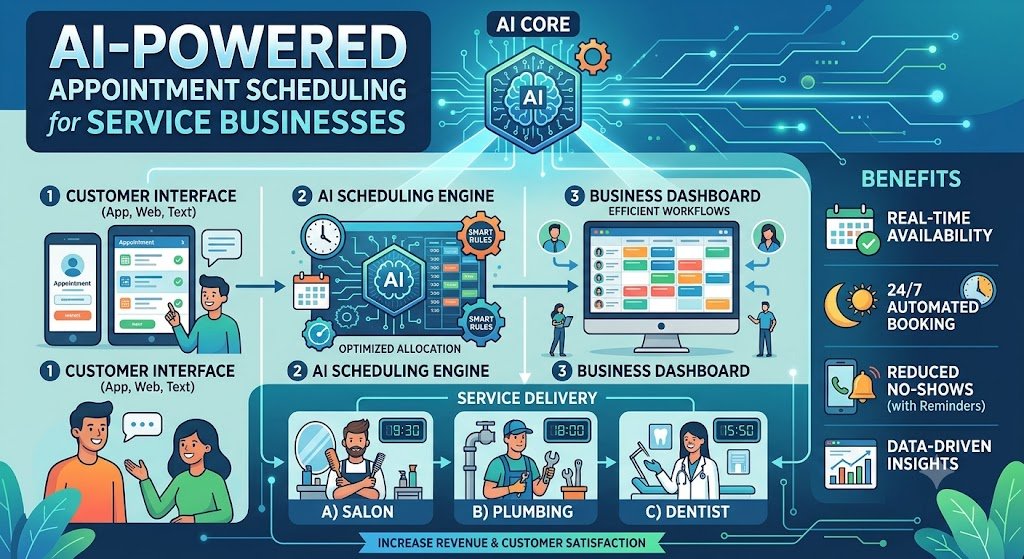
AI-powered appointment scheduling addresses this by automating the booking, confirmation, reminder, and rescheduling process—and by predicting which appointments are likely to no-show so the business can overbook intelligently or fill the slot from a waitlist. It is not just a calendar. It is a revenue protection system.
For Indian service businesses, this matters because the market is competitive and the margins are thin. Salons, clinics, spas, consultants, home services, and fitness studios all operate on appointment-based models. The businesses that maximise utilisation of their resources—staff, rooms, equipment—outperform those that do not.
India adds specific considerations. WhatsApp is the primary communication channel for most Indian consumers, and booking via WhatsApp is expected. Voice remains important—many customers prefer to call. DPDPA applies to customer data (names, phone numbers, appointment history). MeitY AI guidelines apply if AI is used for scheduling or no-show prediction. And Indian consumer behaviour—multiple family members sharing a phone, last-minute bookings, festival season spikes—shapes how the system must work.
This guide is written for Indian service business owners, clinic managers, salon chains, and SaaS founders building scheduling products. We will cover the AI scheduling architecture, the no-show prediction, the WhatsApp and voice booking channels, real costs in rupees and dollars, DPDPA compliance, and a phased implementation framework with clear go/no-go gates.
What AI Appointment Scheduling Actually Does
Scheduling sounds simple: pick a time, book it. But for a service business with multiple staff, multiple services, multiple locations, and variable durations, scheduling is a complex optimisation problem.
The Core Capabilities
1. Real-time availability. The system knows which slots are available based on staff schedules, room availability, service duration, and existing bookings.
2. Multi-resource scheduling. An appointment may require a staff member, a room, and equipment. The system checks all resources.
3. Service duration estimation. Different services take different times. The system estimates duration based on the service and, with AI, based on historical data (some stylists take longer than others).
4. Booking channels. Customers book via WhatsApp, phone, website, app, or walk-in. All channels feed into a single calendar.
5. Confirmation and reminders. Automated confirmations and reminders via WhatsApp and SMS reduce no-shows.
6. Rescheduling and cancellation. Self-service rescheduling reduces administrative load and fills cancelled slots from the waitlist.
7. Waitlist management. When a slot opens, the system offers it to waitlisted customers.
8. No-show prediction. AI predicts which appointments are likely to no-show, enabling intelligent overbooking or proactive outreach.
9. Buffer management. The system accounts for cleaning, setup, and travel time between appointments.
10. Analytics. Utilisation rates, no-show rates, peak times, and revenue per slot.
Capability Table
| Capability | Manual | Automated |
|---|---|---|
| Availability check | Phone calls, paper book | Real-time |
| Multi-resource | Memory | Automated |
| Duration estimation | Assumption | Historical data |
| Booking channels | Phone, walk-in | WhatsApp, phone, web, app |
| Reminders | Manual calls | Automated |
| Rescheduling | Phone calls | Self-service |
| Waitlist | Manual list | Automated offers |
| No-show prediction | None | AI model |
| Analytics | None | Dashboard |
For teams building the scheduling systems and AI models, our AI Development and Custom Software Development practices cover the full stack.
No-Show Prediction: The Highest-Value AI Feature
No-shows are the biggest revenue leak in service businesses. A no-show wastes a slot that could have been sold to another customer.
Why Customers No-Show
Forgot: the appointment slipped their mind.
Changed plans: something else came up.
Found better option: booked elsewhere.
Miscommunication: wrong time or location.
Unable to reach: the business could not be reached to reschedule.
How AI Predicts No-Shows
The AI model uses historical data to identify patterns that predict no-shows:
1. Customer history. Customers with prior no-shows are more likely to no-show again.
2. Booking lead time. Bookings made far in advance are more likely to no-show.
3. Appointment time. Certain times (early morning, late evening, Mondays) have higher no-show rates.
4. Service type. Some services have higher no-show rates than others.
5. Weather and events. Rain, festivals, and local events affect attendance.
6. Confirmation status. Customers who have not confirmed are more likely to no-show.
What to Do With the Prediction
Once the model predicts a no-show risk, the business can:
Send extra reminders to high-risk customers.
Request confirmation for high-risk appointments.
Overbook cautiously based on predicted no-shows.
Offer waitlist slots for high-risk appointments.
Require a deposit for high-risk bookings.
No-Show Prediction Table
| Signal | Predictive Power |
|---|---|
| Prior no-show history | Very High |
| Booking lead time | High |
| Appointment time | Medium |
| Service type | Medium |
| Confirmation status | High |
| Weather/events | Medium |
Reducing No-Shows Without AI
Even without AI, several interventions reduce no-shows:
Reminders: WhatsApp reminders 24–48 hours before, and 2–4 hours before.
Confirmation: require confirmation to hold the slot.
Deposits: for high-value appointments.
Easy rescheduling: make it easy to reschedule rather than no-show.
Waitlist: fill cancelled slots automatically.
Booking Channels: WhatsApp, Voice and Web
Indian customers book through multiple channels. The system must handle all of them.
WhatsApp Booking
WhatsApp is the dominant communication channel in India. Customers expect to book via WhatsApp.
How it works:
Customer sends a message to the business WhatsApp number.
The AI chatbot asks what service they want, when they want it, and who they prefer.
The chatbot checks availability and offers slots.
The customer confirms, and the appointment is booked.
Confirmation and reminders are sent via WhatsApp.
The AI angle: A chatbot that can handle natural language ("I want to book a haircut for Saturday afternoon") is far more useful than a rigid menu.
Voice Booking
Many Indian customers, especially older ones, prefer to call. An AI voice agent can handle bookings.
How it works:
Customer calls the business number.
The AI voice agent answers, understands the request, checks availability, and books the appointment.
Confirmation is sent via SMS or WhatsApp.
If the request is complex or the customer asks for a human, the call is transferred.
The India context: Voice AI in Indian languages (Hindi, Tamil, Bengali, etc.) makes this accessible to a much wider customer base.
Web and App Booking
For customers who prefer self-service, a web or app booking interface provides 24/7 availability.
Walk-In Management
Walk-in customers need to be accommodated alongside booked appointments. The system must manage the queue, estimate wait times, and allocate resources.
Booking Channel Table
| Channel | Customer Preference | Complexity |
|---|---|---|
| High | Medium | |
| Voice | High (especially older customers) | High |
| Web/App | Medium | Low |
| Walk-in | Medium | Medium |
For teams building these channels, our Voice AI and AI Chatbots practices cover the implementation.
Real Costs in India (2026)
AI appointment scheduling costs depend on the scope: basic booking, or full AI with no-show prediction and voice.
Implementation Costs
| Scope | Cost (₹) | Cost ($ approx.) | Timeline |
|---|---|---|---|
| Basic booking (web + reminders) | ₹1–3 lakh | $1,200–$3,600 | 3–6 weeks |
| WhatsApp booking (chatbot) | ₹2–5 lakh | $2,400–$6,000 | 4–8 weeks |
| AI scheduling + no-show prediction | ₹4–10 lakh | $4,800–$12,000 | 8–14 weeks |
| Full system (WhatsApp + voice + AI + analytics) | ₹8–20 lakh | $9,600–$24,000 | 12–20 weeks |
Running Costs
| Component | Monthly Cost (₹) | Monthly Cost ($ approx.) | Notes |
|---|---|---|---|
| WhatsApp Business API | ₹5,000–₹30,000 | $60–$360 | Per-conversation pricing |
| Voice AI | ₹5,000–₹40,000 | $60–$480 | Per-minute pricing |
| Hosting | ₹5,000–₹25,000 | $60–$300 | Cloud infrastructure |
| SMS | ₹1,000–₹10,000 | $12–$120 | Per-message |
| Maintenance | ₹10,000–₹40,000 | $120–$480 | 15–25% of build annually |
The ROI Case
For a salon with 8 stylists and 200 appointments per week:
No-show rate: 15% = 30 no-shows/week.
Average service value: ₹1,500.
Weekly loss: ₹45,000.
Annual loss: ₹23.4 lakh.
If AI scheduling reduces no-shows from 15% to 8% (a realistic improvement with reminders and prediction), the annual recovery is ₹11 lakh—far exceeding the implementation cost.
India-Specific Compliance: DPDPA and MeitY
DPDPA
Scheduling systems process customer personal data: names, phone numbers, appointment history, service preferences.
Key requirements:
Consent: customers must consent to being contacted for reminders and marketing.
Purpose limitation: data used for scheduling should not be repurposed for marketing without separate consent.
Data minimisation: collect only what is needed for the appointment.
Retention: define retention periods for appointment data.
Erasure: support data deletion on request.
MeitY AI Governance
If AI is used for no-show prediction or scheduling:
Transparency: customers should know they are interacting with an AI (if a chatbot is used).
Accountability: a named owner for AI decisions.
Non-discrimination: scheduling should not discriminate based on protected characteristics.
Human oversight: complex cases should be escalated to humans.
Compliance Checklist
| Requirement | Implementation | Priority |
|---|---|---|
| Consent for reminders | Opt-in at booking | High |
| Marketing consent separate | Distinct opt-in | High |
| Data minimisation | Only necessary fields | Medium |
| Retention policy | Automated purge | Medium |
| AI transparency | Disclose chatbot | Medium |
| Erasure support | Deletion workflow | High |
Implementation Framework: A Phased Approach With Cost Gates
Phase 1: Process Audit (Week 1–2)
Objective: Understand current booking process and pain points.
Activities:
Map current booking flow: how do customers book, confirm, and attend?
Measure current metrics: no-show rate, utilisation, booking channel mix.
Identify pain points: phone volume, manual reminders, scheduling conflicts.
Assess customer preferences: WhatsApp, voice, web.
Cost: ₹30,000–₹1 lakh ($360–$1,200).
Go/No-Go: Pain points identified. Business case validated.
Phase 2: Core Booking (Week 3–8)
Objective: Implement the core scheduling system.
Activities:
Real-time availability.
Multi-resource scheduling.
Booking via web and staff interface.
Confirmation and reminders.
Basic rescheduling.
Cost: ₹1–3 lakh ($1,200–$3,600).
Go/No-Go: Booking works. Reminders reduce no-shows.
Phase 3: WhatsApp Channel (Week 9–14)
Objective: Add WhatsApp booking.
Activities:
WhatsApp Business API integration.
AI chatbot for booking.
Confirmation and reminders via WhatsApp.
Self-service rescheduling.
Cost: ₹2–5 lakh ($2,400–$6,000).
Go/No-Go: WhatsApp booking works. Customers use it.
Phase 4: AI and Voice (Week 15–22)
Objective: Add no-show prediction and voice booking.
Activities:
Train no-show prediction model.
Implement overbooking and waitlist logic.
Voice AI booking in Indian languages.
Escalation to human.
Cost: ₹4–10 lakh ($4,800–$12,000).
Go/No-Go: No-show prediction works. Voice booking works.
Phase 5: Analytics and Optimization (Ongoing)
Objective: Optimize utilization and no-shows.
Activities:
Analytics dashboard.
Utilization tracking.
Peak time analysis.
Continuous model improvement.
Cost: ₹10,000–₹40,000/month ($120–$480).
Phase Summary Table
| Phase | Duration | Key Deliverable | Cost (₹) | Go/No-Go Criteria |
|---|---|---|---|---|
| 1. Process Audit | 2 weeks | Current state, business case | 30,000–1 lakh | Business case validated |
| 2. Core Booking | 6 weeks | Booking, reminders | 1–3 lakh | Booking works |
| 3. WhatsApp | 6 weeks | WhatsApp booking | 2–5 lakh | Customers use it |
| 4. AI & Voice | 8 weeks | No-show prediction, voice | 4–10 lakh | Prediction works |
| 5. Optimization | Ongoing | Analytics | 10,000–40,000/month | No-shows reduced |
Risks, Pitfalls, and Governance
The Most Common Failures
No-shows still high. Reminders alone do not work if customers ignore them. Mitigation: Confirmations, deposits, waitlist.
Overbooking causes complaints. AI overbooking without careful calibration. Mitigation: Conservative overbooking, monitor complaints.
Voice AI fails on accents. Speech recognition errors in Indian languages. Mitigation: Test with real customers, native speaker review.
DPDPA violations. Marketing messages sent without consent. Mitigation: Consent capture, opt-out.
Staff resistance. Staff prefer manual scheduling. Mitigation: Involve staff, show benefits.
Integration failures. Calendar and CRM do not sync. Mitigation: Test integration, monitor sync.
Risk Summary Table
| Risk | Likelihood | Impact | Mitigation |
|---|---|---|---|
| No-shows still high | High | High | Confirmations, deposits |
| Overbooking complaints | Medium | Medium | Conservative overbooking |
| Voice AI accuracy | High | Medium | Native testing |
| DPDPA violations | Medium | High | Consent, opt-out |
| Staff resistance | High | Medium | Involvement, benefits |
| Integration failures | Medium | Medium | Testing, monitoring |
Benchmark Summary and Decision Framework
Decision Matrix: Build vs Buy
| Factor | Build Custom | Buy Scheduling Software |
|---|---|---|
| Unique workflow | Complex, multi-location | Standard booking |
| AI features | Custom no-show prediction | Vendor features |
| Cost | Higher upfront | Subscription |
| Time to market | 8–20 weeks | Weeks |
| Best for | Chains, complex operations | Small businesses |
No-Show Reduction Priority Table
| Intervention | Impact | Effort |
|---|---|---|
| WhatsApp reminders | High | Low |
| Confirmation required | High | Low |
| Deposits | High (for high-value) | Medium |
| Easy rescheduling | Medium | Low |
| No-show prediction | Medium | High |
| Waitlist | Medium | Medium |
The One-Paragraph Decision Rule
If you are a service business losing revenue to no-shows, start with WhatsApp reminders and confirmation requirements—these are cheap and effective. Add easy rescheduling and a waitlist to fill cancelled slots. If you have the data and the volume, add AI no-show prediction and conservative overbooking. Build voice booking only if your customers prefer it. And ensure DPDPA compliance—consent for reminders and marketing, data minimisation, and retention policies.
Frequently Asked Questions
1. How much does AI appointment scheduling cost in India?
Basic booking costs ₹1–3 lakh ($1,200–$3,600). WhatsApp booking costs ₹2–5 lakh ($2,400–$6,000). AI scheduling with no-show prediction costs ₹4–10 lakh ($4,800–$12,000). Full system with voice costs ₹8–20 lakh ($9,600–$24,000).
2. How does AI reduce no-shows?
AI reduces no-shows through automated reminders, confirmation requirements, no-show prediction (enabling proactive outreach), intelligent overbooking, and waitlist management.
3. What is no-show prediction?
A model that predicts which appointments are likely to no-show based on customer history, booking lead time, appointment time, service type, and other signals. It enables proactive intervention.
4. Should I offer WhatsApp booking?
Yes, if your customers use WhatsApp (most Indian consumers do). WhatsApp booking is convenient and expected.
5. Can AI handle voice booking in Indian languages?
Yes, voice AI is available in Indian languages (Hindi, Tamil, Bengali, etc.). Accuracy varies, so testing with native speakers is essential.
6. How do I reduce no-shows without AI?
WhatsApp reminders 24–48 hours before and 2–4 hours before, confirmation requirements, deposits for high-value appointments, easy rescheduling, and a waitlist.
7. How does DPDPA affect appointment scheduling?
Customer data (names, phone numbers, appointment history) is personal data. Consent for reminders and marketing, purpose limitation, data minimisation, and retention policies apply.
8. Can I integrate scheduling with my CRM?
Yes. Scheduling systems can integrate with CRM for customer profiles, appointment history, and marketing automation.
9. How do I handle walk-in customers?
The system manages the queue, estimates wait times, and allocates resources. Walk-ins can be scheduled into available slots.
10. What metrics should I track?
No-show rate, utilization rate, booking channel mix, average booking lead time, and revenue per available slot.
11. Should I build or buy scheduling software?
Build if you have unique workflows, multiple locations, or specific AI needs. Buy if you have standard booking and need to move fast.
12. How can Innovative AI Solutions help?
Innovative AI Solutions builds AI appointment scheduling systems for Indian service businesses—WhatsApp and voice booking, no-show prediction, reminders, and DPDPA-compliant data handling. Our Delhi-based team handles development and integration. Visit https://innovativeais.com to discuss your requirements.
Contact Innovative AI Solutions
Ready to fill the empty chairs and stop losing revenue to no-shows?
[One-line supporting sentence.]
Contact Information
Innovative AI Solutions
📍 Netaji Subhash Place, Pitampura, Delhi – 110034
🌐 Website: https://innovativeaislabs.com 📧 Email: info@innovativeais.com
📞 Phone: +91 7464 099 059 / +91 96899 67356
Business Services
AI Automation
AI Development
AI Consulting
Machine Learning Solutions
Deep Learning Solutions
Generative AI Services
NLP Solutions
AI Agents
AI Chatbots
Voice AI
CRM Development
Custom Software Development
Website Development
Mobile App Development
About the Author
Abhishek Kumar
Founder & CEO, Innovative AI Solutions
5+ years building production AI systems for Indian businesses. Based in Delhi, serving clients across India.
Ready to build AI solutions for your business?
Innovative AI Solutions — Delhi's leading AI development company. Free consultation available.
Get Free Consultation →
A practical 2026 guide for Indian service businesses implementing AI appointment scheduling—WhatsApp and voice booking, no-show prediction, reminder automation, real rupee costs, and DPDPA compliance.
#AIAppointmentScheduling #AppointmentBooking #NoShowReduction #WhatsAppBooking #VoiceAI #SchedulingSoftware #SalonSoftware #ClinicScheduling #FieldService #CalendarAutomation #DPDPA #MeitY #ServiceBusiness #DelhiNCR #InnovativeAISolutions
Copyright ©️ 2015–2026 Innovative AI Solutions. All Rights Reserved. | Privacy Policy | Terms & Conditions