


The Frontier Model Habit That Kills AI Economics
An Indian SaaS company launches an AI feature. Every user request goes to the most capable model available. The feature works beautifully. The output quality is excellent. Six months later, the token bill has grown faster than revenue, and the finance team asks a question the engineering team cannot answer: why does every request need a frontier model?
The answer is that it does not. A password reset query, a product FAQ, and a simple data extraction task do not require the same reasoning capability as a complex multi-step analysis. Sending all of them to the same expensive model is like hiring a senior surgeon to put on a bandage. It works, but it is wasteful.
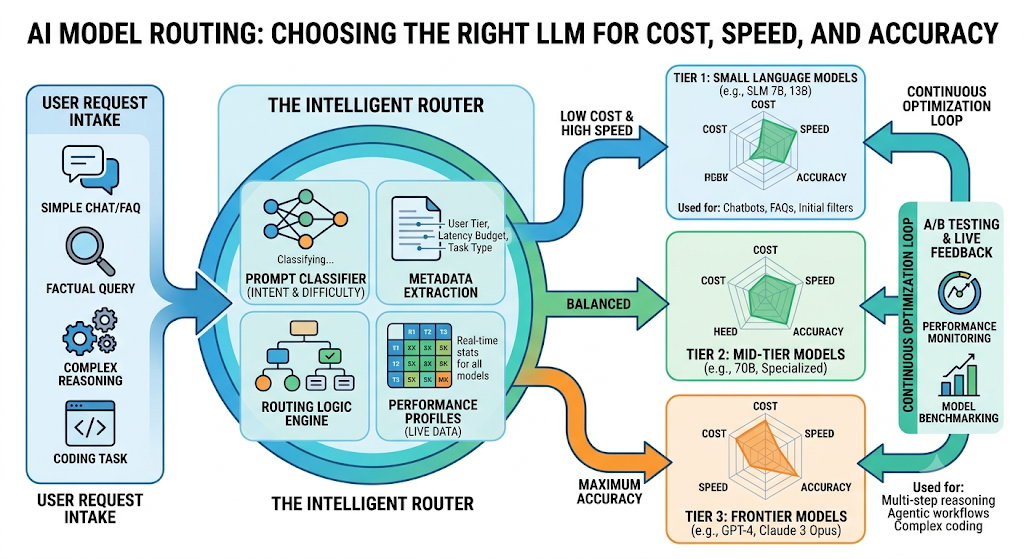
AI model routing is the discipline of dispatching each request to the most appropriate model—balancing cost, speed, and accuracy. It is not about choosing one model and sticking with it. It is about building a system that knows which model to use for which request, and escalating only when necessary.
The economic case is strong. Research on routing has shown that intelligent routing can reduce LLM costs by over 2x without sacrificing response quality . More aggressive approaches like FrugalGPT's cascade have demonstrated cost reductions of up to 98% while matching or improving accuracy . Recent routers like FLARE achieve 68% latency reduction and 75% cost reduction while maintaining competitive accuracy . And Brick, a capability-aware router, achieves 74.11% accuracy at 4.71x lower cost than always using the strongest model at a neutral quality-cost profile .
For Indian businesses, this matters because AI inference costs are a direct operating expense. A feature that costs ₹10 per user per month on a frontier model might cost ₹2–3 on a routed architecture. At scale, that difference determines whether the feature is a margin contributor or a margin drag.
India adds specific considerations. DPDPA applies to data processed by any model in the routing pool, and the router must respect data localisation and access controls. MeitY AI governance expects transparency about which model handled a request and why. Cost management is the primary driver—Indian businesses are price-sensitive, and the rupee-per-request difference is material. And Indian language routing adds complexity—a model that performs well on English may degrade on Hindi, requiring language-aware routing.
This guide is written for Indian CTOs, AI engineers, product managers, and founders building LLM applications. We will cover the routing strategies, the cascade pattern, the semantic routing approach, real cost savings in rupees, DPDPA compliance, and a phased implementation framework with clear go/no-go gates.
The Routing Strategies: How to Decide Which Model Handles a Request There is no single routing strategy. The right approach depends on the application, the model pool, and the cost-accuracy tolerance.
Strategy 1: Static Routing (Rules-Based)
The simplest approach: route based on predefined rules. If the request contains "code," route to the coding model. If the request is in Hindi, route to the multilingual model. If the request is a simple FAQ, route to the cheap model.
Pros: Transparent, predictable, easy to debug. Cons: Brittle, misses nuance, requires manual rule maintenance.
When to use: When request types are clearly distinguishable and the cost of a misroute is low.
Strategy 2: Semantic Routing (Embedding-Based)
The router embeds the query and compares it to a set of predefined routing targets, each with descriptions and examples. The closest match determines the model. The radlab-llm-router implements this with a BiEncoder model and FAISS index, matching queries to targets like "code-generation," "math-analysis," and "creative-writing" .
Pros: Handles natural language variation, no training data required, easy to add new targets. Cons: Requires well-chosen examples, may struggle with ambiguous queries.
When to use: When query types are semantically distinct but phrased variably.
Strategy 3: Learned Routing (Classifier-Based)
A machine learning model is trained to predict which model will produce the best response for a given query. RouteLLM, developed by UC Berkeley, trains routers on human preference data (Chatbot Arena) and achieves 85% cost reduction while maintaining 95% of GPT-4 quality .
Pros: Data-driven, adapts to actual quality differences, generalises to unseen queries. Cons: Requires preference data or a labelled dataset, adds a small latency overhead (15–50ms).
When to use: When you have historical data on which model performed better for which queries.
Strategy 4: Cascade Routing (Cheap-to-Expensive)
The query is first sent to the cheapest model. A confidence evaluator checks the response. If confidence is high, the response is returned. If confidence is low, the query escalates to a more capable model. This is the FrugalGPT pattern, which can reduce costs by up to 98% .
Pros: Maximises cost savings, only uses expensive models when necessary. Cons: Adds latency (sequential calls), requires a confidence evaluator, may escalate unnecessarily.
When to use: When most queries are simple and only a minority require frontier capability.
Strategy Comparison Table
| Strategy | Cost Savings | Latency Impact | Data Required | Best For |
|---|---|---|---|---|
| Static Rules | Medium | None | None | Clear request types |
| Semantic Routing | Medium-High | Low (~15ms) | Examples | Variable phrasing |
| Learned Routing | High (2x+) | Low (~15–50ms) | Preference data | Data-rich applications |
| Cascade | Very High (up to 98%) | Medium (sequential) | Confidence evaluator | Mostly simple queries |
For teams building the routing layer and model integrations, our AI Development and Generative AI Services practices cover the full stack.
The Cascade: The Highest-Savings Pattern
Cascades deserve separate attention because they offer the largest cost savings, but they also introduce the most complexity.
How a Cascade Works
Step 1: Cheap model attempt. The query goes to the cheapest adequate model. For a FAQ bot, this might be a small open-weight model or a budget API model.
Step 2: Confidence evaluation. The system evaluates whether the response is likely correct. This can be based on the model's own confidence score, a separate classifier, or a verification step (e.g., checking that the response is grounded in retrieved documents).
Step 3: Escalation decision. If confidence is high, return the response. If confidence is low, escalate to the next tier.
Step 4: Repeat. The query escalates through tiers until a confident response is produced or the frontier model is reached.
The Confidence Problem
The cascade's effectiveness depends entirely on the confidence evaluator. A poorly calibrated evaluator either escalates too often (losing savings) or too rarely (producing bad answers). Research on cascades emphasises that the optimal policy is not to predict upfront which model to use, but to attempt the cheap model, evaluate confidence, and escalate only when a probabilistic threshold is exceeded .
The Latency Trade-off
Cascades are sequential. A query that escalates through three tiers incurs the latency of three model calls. For latency-sensitive applications (real-time chat, voice), this may be unacceptable. For batch or asynchronous applications, it is fine.
Cascade Table
| Tier | Model Type | Typical Cost per 1K Tokens | Escalation Trigger |
|---|---|---|---|
| Tier 1 | Small open-weight | ₹0.10–₹1 | Confidence < threshold |
| Tier 2 | Mid-tier API | ₹5–₹30 | Confidence < threshold |
| Tier 3 | Frontier API | ₹50–₹400+ | Final tier |
Real Cost Savings in India (2026)
The savings from routing are not theoretical. They can be modelled and measured.
Illustrative Savings
Consider an Indian SaaS application processing 100,000 requests per day, with an average of 1,000 input tokens and 300 output tokens per request.
| Scenario | Model Used | Cost per 1K Requests | Monthly Cost (₹) | Monthly Cost ($ approx.) |
|---|---|---|---|---|
| No routing | Frontier model (₹400/1M output) | ₹400 | ₹12,00,000 | $14,400 |
| Cascade (70% Tier 1, 20% Tier 2, 10% Tier 3) | Mixed | ₹120 | ₹3,60,000 | $4,320 |
| Learned routing (60% Tier 2, 40% Tier 3) | Mixed | ₹200 | ₹6,00,000 | $7,200 |
Note: These are illustrative figures based on approximate model pricing. Actual savings depend on the query mix, model choices, and confidence thresholds. USD conversions at ₹83/$.
The cascade scenario reduces monthly cost from ₹12 lakh to ₹3.6 lakh—a 70% reduction—while maintaining quality for the 70% of queries that the cheap model handles confidently.
The Router Overhead
Routing adds a small cost: the router itself consumes tokens or compute. For a learned router, the overhead is 15–50ms of latency and a negligible token cost. For a semantic router, the embedding cost is minimal. The overhead is justified by the savings.
The Quality Risk
Routing introduces a risk: the router may misclassify a query, sending it to a model that produces a worse answer. This is why routing must be evaluated alongside the models. A router that saves 50% cost but degrades quality by 10% may be a bad trade. The right balance depends on the application—a customer-facing answer needs higher quality than an internal draft.
India-Specific Compliance: DPDPA and MeitY
DPDPA and Routing
Routing dispatches personal data to different models. Under the DPDP Act:
Data localisation: If the application processes personal data, all models in the routing pool must comply with data localisation requirements. A router that sends data to a model hosted outside India may violate the Act for regulated sectors.
Purpose limitation: The router must ensure that data is only processed for the consented purpose, regardless of which model handles it.
Audit: The router should log which model handled each request, for accountability and breach investigation.
MeitY AI Governance
MeitY's guidelines expect transparency about AI processing. For routing, this means:
Model transparency: The system should be able to report which model generated a response.
Accountability: A named owner for the routing policy.
Quality monitoring: The routing policy should be evaluated for quality, not just cost.
Compliance Checklist
| Requirement | Implementation | Priority |
|---|---|---|
| Data localisation | All models in Indian regions (if applicable) | High |
| Model audit logging | Log which model handled each request | High |
| Purpose limitation | Router respects consented purpose | High |
| Quality monitoring | Evaluate routing quality, not just cost | High |
| Accountability | Named owner for routing policy | Medium |
Implementation Framework: A Phased Approach With Cost Gates
Phase 1: Model Pool Definition (Week 1–2)
Objective: Define the models available for routing and their cost-quality profiles.
Activities:
Identify candidate models: cheap, mid-tier, frontier.
Measure cost per 1K tokens for each.
Benchmark quality on representative queries.
Assess data localisation compliance for each.
Define routing criteria.
Cost: ₹50,000–₹1.5 lakh ($600–$1,800).
Go/No-Go: Model pool defined. Quality benchmarks established.
Phase 2: Simple Routing (Week 3–6)
Objective: Implement static or semantic routing.
Activities:
Implement routing logic (rules or embeddings).
Integrate with the application.
Monitor routing decisions and outcomes.
Measure cost savings and quality impact.
Cost: ₹1–3 lakh ($1,200–$3,600).
Go/No-Go: Routing works. Cost savings measured. Quality maintained.
Phase 3: Cascade or Learned Routing (Week 7–14)
Objective: Implement advanced routing for greater savings.
Activities:
Implement cascade with confidence evaluator, or
Train a learned router on preference data.
Evaluate against baseline.
Tune thresholds.
Cost: ₹3–8 lakh ($3,600–$9,600).
Go/No-Go: Advanced routing improves on simple routing. Quality acceptable.
Phase 4: Continuous Optimization (Ongoing)
Objective: Improve routing over time.
Activities:
Monitor router performance.
Add new models as they are released.
Tune thresholds based on outcomes.
Review quality and cost monthly.
Cost: ₹10,000–₹40,000/month ($120–$480).
Phase Summary Table
| Phase | Duration | Key Deliverable | Cost (₹) | Go/No-Go Criteria |
|---|---|---|---|---|
| 1. Model Pool | 2 weeks | Models, benchmarks | 50,000–1.5 lakh | Pool defined |
| 2. Simple Routing | 4 weeks | Rules or semantic routing | 1–3 lakh | Savings measured |
| 3. Advanced Routing | 8 weeks | Cascade or learned router | 3–8 lakh | Improves on simple |
| 4. Optimization | Ongoing | Continuous tuning | 10,000–40,000/month | Quality maintained |
Risks, Pitfalls, and Governance
The Most Common Routing Failures
Over-routing to cheap models. Quality degrades because the router sends too much to the cheap model. Mitigation: Calibrate confidence thresholds, monitor quality.
Under-routing to cheap models. Savings are lost because the router escalates too often. Mitigation: Tune confidence evaluator, measure escalation rate.
Ignoring latency. Cascades add sequential latency that breaks user experience. Mitigation: Measure end-to-end latency, use parallel calls where possible.
No audit trail. Cannot explain which model produced a response. Mitigation: Log routing decisions.
Model pool drift. New models are released, old ones deprecated. Mitigation: Regular review of model pool and routing rules.
DPDPA non-compliance. Data sent to non-compliant models. Mitigation: Data localisation assessment for every model.
Risk Summary Table
| Risk | Likelihood | Impact | Mitigation |
|---|---|---|---|
| Over-routing to cheap | High | High (quality) | Calibrate thresholds |
| Under-routing to cheap | High | Medium (cost) | Tune evaluator |
| Latency from cascade | Medium | High (UX) | Measure, parallelise |
| No audit trail | Medium | High (compliance) | Log decisions |
| Model pool drift | High | Medium | Regular review |
| DPDPA non-compliance | Medium | Critical | Localisation assessment |
Benchmark Summary and Decision Framework
Decision Matrix: Routing Strategy Selection
| Your Situation | Recommended Strategy |
|---|---|
| Clear request types (code, FAQ, math) | Static or semantic routing |
| Historical preference data available | Learned routing |
| Most queries are simple | Cascade |
| Latency-sensitive application | Semantic or learned (not cascade) |
| Strict DPDPA compliance | Static routing with local model pool |
Routing Priority Table
| Priority | Capability | Why |
|---|---|---|
| 1 | Model pool with cost benchmarks | Foundation for routing |
| 2 | Simple routing (rules/semantic) | Fastest to value |
| 3 | Quality monitoring | Prevents degradation |
| 4 | Cascade or learned routing | Greater savings |
| 5 | Audit logging | Compliance |
The One-Paragraph Decision Rule
If you are sending every request to a frontier model, start with simple routing. Define a pool of models, route by clear criteria, and measure the savings. If most queries are simple, add a cascade with a confidence evaluator. If you have preference data, train a learned router. In all cases, monitor quality alongside cost, log which model handled each request, and ensure every model in the pool meets your DPDPA obligations.
Frequently Asked Questions
1. What is AI model routing?
Model routing is the practice of dispatching each request to the most appropriate LLM based on cost, speed, and accuracy requirements. It avoids sending every request to an expensive frontier model when a cheaper model would suffice.
2. How much can model routing save?
Research shows cost reductions of 2x or more with learned routing , up to 98% with cascades , and 75% with resource-aware routers like FLARE . Actual savings depend on the query mix and model choices.
3. What is a cascade and how does it work?
A cascade sends the query to the cheapest model first, evaluates confidence, and escalates to a more capable model only if confidence is low. FrugalGPT is the foundational cascade framework .
4. What is RouteLLM?
RouteLLM is an open-source router from UC Berkeley that trains on human preference data to route between strong and weak models. It achieves 85% cost reduction while maintaining 95% of GPT-4 quality .
5. What is semantic routing?
Semantic routing embeds the query and matches it to predefined routing targets (e.g., code, math, creative writing) based on semantic similarity. The radlab-llm-router implements this with a BiEncoder and FAISS .
6. How does routing affect latency?
Learned and semantic routers add 15–50ms. Cascades add the latency of sequential model calls, which can be significant for latency-sensitive applications .
7. How does DPDPA affect model routing?
All models in the routing pool must comply with data localisation requirements for regulated data. The router must log which model handled each request for audit and breach investigation.
8. What is the confidence evaluator in a cascade?
The component that decides whether the cheap model's response is good enough or should be escalated. It can be based on the model's own confidence, a separate classifier, or a verification step.
9. How do I choose the right routing strategy?
Use static/semantic routing for clear request types, learned routing if you have preference data, and cascades if most queries are simple. Avoid cascades for latency-sensitive applications.
10. How do I monitor routing quality?
Evaluate the routed system against a golden dataset, compare quality to the frontier-only baseline, and track escalation rates and user feedback.
11. What is the biggest risk in routing?
Over-routing to cheap models degrades quality. Under-routing loses savings. Calibrating the confidence threshold is the key challenge.
12. How can Innovative AI Solutions help?
Innovative AI Solutions builds AI model routing systems for Indian businesses—model pool assessment, semantic and learned routing, cascade implementation, cost monitoring, and DPDPA-compliant deployment. Our Delhi-based team handles design, implementation, and optimization. Visit https://innovativeais.com to discuss your requirements.
Contact Innovative AI Solutions
Ready to stop paying frontier prices for routine requests?
[One-line supporting sentence.]
Contact Information
Innovative AI Solutions
📍 Netaji Subhash Place, Pitampura, Delhi – 110034
🌐 Website: https://innovativeaislabs.com 📧 Email: info@innovativeais.com
📞 Phone: +91 7464 099 059 / +91 96899 67356
Business Services
AI Automation
AI Development
AI Consulting
Machine Learning Solutions
Deep Learning Solutions
Generative AI Services
NLP Solutions
AI Agents
AI Chatbots
Voice AI
CRM Development
Custom Software Development
Website Development
Mobile App Development
About the Author
Abhishek Kumar
Founder & CEO, Innovative AI Solutions
5+ years building production AI systems for Indian businesses. Based in Delhi, serving clients across India.
Ready to build AI solutions for your business?
Innovative AI Solutions — Delhi's leading AI development company. Free consultation available.
Get Free Consultation →
A practical 2026 guide for Indian businesses implementing AI model routing—semantic and learned routers, cascades, real rupee savings, and DPDPA-compliant model pools.
#AIModelRouting #LLMRouting #ModelSelection #CostOptimization #RouteLLM #CascadeRouting #SemanticRouting #LLMGateway #InferenceCost #FrugalGPT #DPDPA #MeitY #ModelRouter #AICostControl #DelhiNCR #InnovativeAISolutions
Copyright ©️ 2015–2026 Innovative AI Solutions. All Rights Reserved. | Privacy Policy | Terms & Conditions