


Why AI Matters in Indian Healthcare
India's healthcare system faces a structural challenge. The country has approximately one doctor for every 1,500 people — well below the WHO recommendation of 1:1,000. Specialist shortages are more severe. In rural areas, access to qualified physicians is limited or nonexistent.
The result is a system where diagnosis is delayed, diseases progress untreated, and outcomes suffer. Millions of Indians lack access to the diagnostic capabilities that patients in developed countries take for granted.
AI changes this in specific, measurable ways. AI systems can analyse medical images faster than radiologists, detect diseases from symptoms and history, predict patient deterioration before it happens, and extend specialist expertise to areas that lack it.
India's AI healthcare market reflects this. The sector has attracted significant investment, and Indian hospitals, diagnostic chains, and healthtech companies are deploying AI systems in production.
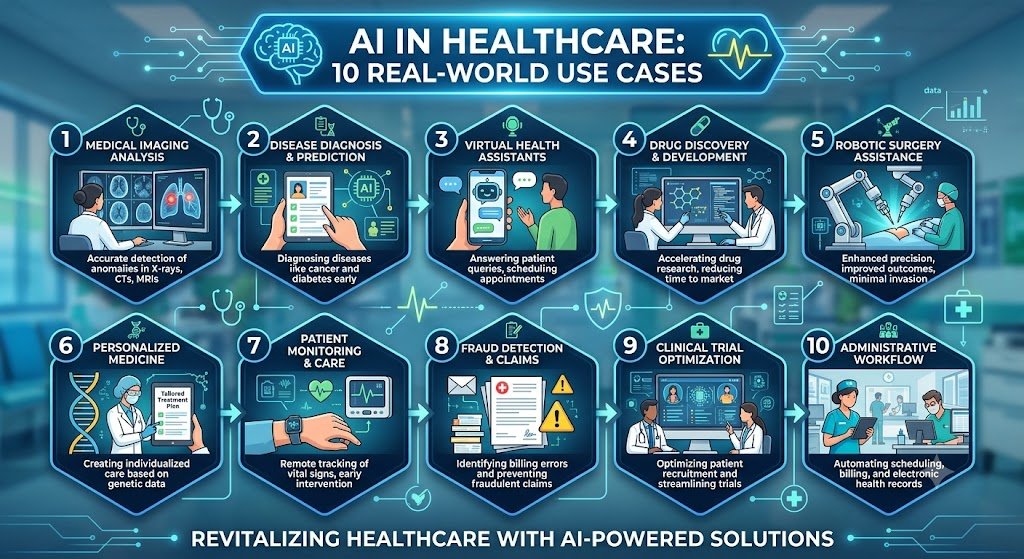
This guide covers 10 real-world use cases of AI in healthcare in 2026. It addresses the benefits, the implementation costs, and the regulatory considerations for Indian healthcare institutions.
For organisations building AI systems for healthcare, Innovative AI Solutions provides AI development services and AI consulting.
Use Case 1: Medical Imaging Analysis
What It Does
AI analyses X-rays, CT scans, MRIs, and other medical images to detect abnormalities.
| Imaging Type | AI Application |
|---|---|
| Chest X-ray | TB, pneumonia, COVID detection |
| CT scan | Cancer, stroke detection |
| MRI | Tumour, tissue analysis |
| Mammography | Breast cancer screening |
| Retinal imaging | Diabetic retinopathy |
Real-World Impact
| Metric | Typical Improvement |
|---|---|
| Detection accuracy | 90–95% (comparable to specialists) |
| Analysis speed | Seconds vs. minutes |
| Screening capacity | 3–5x increase |
| Rural access | Extends specialist reach |
Indian context: AI-based TB detection is particularly relevant given India's TB burden. Retinal screening AI addresses diabetic retinopathy, a major cause of blindness in India.
Implementation Cost
| Scope | Cost Range (INR) | Cost Range (USD) | Timeline |
|---|---|---|---|
| Single imaging type | ₹8,00,000–₹25,00,000 | $9,600–$30,000 | 16–28 weeks |
| Multi-imaging platform | ₹25,00,000–₹75,00,000 | $30,000–$90,000 | 28–44 weeks |
Use Case 2: Diagnostic Support
What It Does
AI assists doctors in diagnosis by analysing symptoms, history, and test results.
| Diagnostic Area | AI Application |
|---|---|
| Symptom analysis | Differential diagnosis |
| Lab results | Abnormality detection |
| Risk stratification | Patient prioritisation |
| Rare diseases | Pattern matching |
Real-World Impact
| Metric | Typical Improvement |
|---|---|
| Diagnostic accuracy | 10–20% improvement |
| Time to diagnosis | Faster |
| Missed diagnoses | Reduced |
| Rare disease detection | Improved |
Implementation Cost
| Scope | Cost Range (INR) | Cost Range (USD) | Timeline |
|---|---|---|---|
| Basic diagnostic support | ₹10,00,000–₹25,00,000 | $12,000–$30,000 | 20–32 weeks |
| Comprehensive system | ₹25,00,000–₹60,00,000 | $30,000–$72,000 | 32–48 weeks |
Use Case 3: Patient Monitoring
What It Does
AI continuously monitors patient vitals and alerts clinicians to deterioration.
| Monitoring Type | AI Application |
|---|---|
| ICU monitoring | Deterioration prediction |
| Wearables | Continuous health tracking |
| Remote monitoring | Chronic disease management |
| Fall detection | Elderly care |
Real-World Impact
| Metric | Typical Improvement |
|---|---|
| Early warning | Hours earlier |
| Code blue events | Reduced |
| ICU length of stay | Reduced |
| Readmissions | Reduced |
Implementation Cost
| Scope | Cost Range (INR) | Cost Range (USD) | Timeline |
|---|---|---|---|
| Basic monitoring | ₹5,00,000–₹15,00,000 | $6,000–$18,000 | 12–20 weeks |
| Comprehensive system | ₹15,00,000–₹40,00,000 | $18,000–$48,000 | 20–32 weeks |
Use Case 4: Drug Discovery
What It Does
AI accelerates drug discovery by predicting molecular interactions and identifying candidates.
| Discovery Phase | AI Application |
|---|---|
| Target identification | Protein analysis |
| Lead generation | Molecule design |
| Toxicity prediction | Safety assessment |
| Clinical trial design | Patient selection |
Real-World Impact
| Metric | Typical Improvement |
|---|---|
| Discovery time | 30–50% reduction |
| Cost per drug | Reduced |
| Success rate | Improved |
| Candidates identified | More |
Indian context: Indian pharmaceutical companies are using AI for generic drug development and formulation optimisation.
Implementation Cost
| Scope | Cost Range (INR) | Cost Range (USD) | Timeline |
|---|---|---|---|
| Basic research platform | ₹20,00,000–₹50,00,000 | $24,000–$60,000 | 24–40 weeks |
| Comprehensive platform | ₹50,00,000–₹2,00,00,000+ | $60,000–$240,000+ | 40–78 weeks |
Use Case 5: Electronic Health Records
What It Does
AI extracts, structures, and analyses data from electronic health records.
| EHR Function | AI Application |
|---|---|
| Data extraction | From unstructured notes |
| Coding | ICD, CPT codes |
| Summarisation | Patient history |
| Search | Semantic search |
Real-World Impact
| Metric | Typical Improvement |
|---|---|
| Documentation time | 30–50% reduction |
| Coding accuracy | Improved |
| Data accessibility | Better |
| Clinical decision support | Enhanced |
Implementation Cost
| Scope | Cost Range (INR) | Cost Range (USD) | Timeline |
|---|---|---|---|
| Basic EHR AI | ₹5,00,000–₹15,00,000 | $6,000–$18,000 | 12–20 weeks |
| Comprehensive system | ₹15,00,000–₹40,00,000 | $18,000–$48,000 | 20–32 weeks |
Use Case 6: Telemedicine
What It Does
AI enhances telemedicine by triaging patients, supporting remote diagnosis, and automating follow-up.
| Telemedicine Function | AI Application |
|---|---|
| Symptom triage | Urgency assessment |
| Remote diagnosis | Decision support |
| Follow-up | Automated check-ins |
| Prescription | Interaction checking |
Real-World Impact
| Metric | Typical Improvement |
|---|---|
| Triage accuracy | Improved |
| Wait times | Reduced |
| Rural access | Extended |
| Follow-up compliance | Improved |
Implementation Cost
| Scope | Cost Range (INR) | Cost Range (USD) | Timeline |
|---|---|---|---|
| Basic triage | ₹3,00,000–₹10,00,000 | $3,600–$12,000 | 8–14 weeks |
| Comprehensive platform | ₹10,00,000–₹30,00,000 | $12,000–$36,000 | 14–24 weeks |
Use Case 7: Drug Interaction and Prescription
What It Does
AI checks for drug interactions, allergies, and contraindications.
| Function | AI Application |
|---|---|
| Interaction checking | Drug-drug, drug-food |
| Allergy alerts | Patient history |
| Dosage validation | Weight, age, condition |
| Alternative suggestions | Safer alternatives |
Real-World Impact
| Metric | Typical Improvement |
|---|---|
| Adverse events | Reduced |
| Prescription errors | Reduced |
| Pharmacist time | Reduced |
Implementation Cost
| Scope | Cost Range (INR) | Cost Range (USD) | Timeline |
|---|---|---|---|
| Basic checking | ₹2,00,000–₹6,00,000 | $2,400–$7,200 | 8–12 weeks |
| Comprehensive system | ₹6,00,000–₹15,00,000 | $7,200–$18,000 | 12–20 weeks |
Use Case 8: Hospital Operations
What It Does
AI optimises hospital operations — scheduling, staffing, and resource allocation.
| Operations Function | AI Application |
|---|---|
| Bed management | Occupancy optimisation |
| Staff scheduling | Demand-based |
| OT scheduling | Utilisation optimisation |
| Supply chain | Inventory management |
Real-World Impact
| Metric | Typical Improvement |
|---|---|
| Bed utilisation | 10–20% improvement |
| Staff efficiency | Improved |
| OT utilisation | Improved |
| Supply waste | Reduced |
Implementation Cost
| Scope | Cost Range (INR) | Cost Range (USD) | Timeline |
|---|---|---|---|
| Basic operations AI | ₹5,00,000–₹15,00,000 | $6,000–$18,000 | 12–20 weeks |
| Comprehensive platform | ₹15,00,000–₹40,00,000 | $18,000–$48,000 | 20–32 weeks |
Use Case 9: Mental Health Support
What It Does
AI provides mental health support through chatbots, screening, and triage.
| Function | AI Application |
|---|---|
| Screening | Depression, anxiety |
| Support | Conversational therapy |
| Triage | Urgency assessment |
| Monitoring | Mood tracking |
Real-World Impact
| Metric | Typical Improvement |
|---|---|
| Access | Extended |
| Stigma | Reduced |
| Early intervention | Improved |
Indian context: Mental health professional shortage is severe in India. AI support extends reach.
Implementation Cost
| Scope | Cost Range (INR) | Cost Range (USD) | Timeline |
|---|---|---|---|
| Basic screening | ₹2,00,000–₹6,00,000 | $2,400–$7,200 | 8–14 weeks |
| Comprehensive support | ₹6,00,000–₹15,00,000 | $7,200–$18,000 | 14–20 weeks |
Use Case 10: Clinical Trials
What It Does
AI improves clinical trial design, patient recruitment, and monitoring.
| Trial Function | AI Application |
|---|---|
| Patient recruitment | Matching patients to trials |
| Protocol design | Optimisation |
| Monitoring | Safety signals |
| Data analysis | Pattern detection |
Real-World Impact
| Metric | Typical Improvement |
|---|---|
| Recruitment time | 30–50% reduction |
| Trial cost | Reduced |
| Success rate | Improved |
Implementation Cost
| Scope | Cost Range (INR) | Cost Range (USD) | Timeline |
|---|---|---|---|
| Basic recruitment | ₹5,00,000–₹15,00,000 | $6,000–$18,000 | 12–20 weeks |
| Comprehensive platform | ₹15,00,000–₹50,00,000 | $18,000–$60,000 | 20–36 weeks |
India-Specific Regulatory Context
DPDPA and Health Data
| Requirement | Implementation |
|---|---|
| Consent | Explicit consent for health data |
| Purpose limitation | Data used only for stated purposes |
| Data minimisation | Only necessary data |
| Security safeguards | Encryption, access control |
| User rights | Access, correction, deletion |
Health data is sensitive personal data under DPDPA. Additional protections apply.
Other Regulations
| Regulation | Implication |
|---|---|
| Drugs and Cosmetics Act | Medical device regulation |
| CDSCO guidelines | AI medical device approval |
| Telemedicine guidelines | Telemedicine practice |
| ABDM | Health data standards |
AI Governance in Healthcare
| Requirement | Implementation |
|---|---|
| Clinical validation | Testing against clinical standards |
| Explainability | Decisions explainable |
| Human oversight | Clinician review |
| Monitoring | Performance tracking |
| Audit trails | Complete logging |
Decision Framework: AI in Healthcare Readiness
Readiness Scorecard
| Criteria | Weight | Score (1–5) | Weighted Score |
|---|---|---|---|
| Use case defined | 20% | ||
| Data available | 20% | ||
| Regulatory compliance | 20% | ||
| Clinical validation plan | 15% | ||
| Budget for implementation | 15% | ||
| Human oversight | 10% | ||
| Total | 100% | /5 |
Use Case Priority Matrix
| Use Case | Impact | Risk | Priority |
|---|---|---|---|
| Medical imaging | High | Moderate | High |
| EHR automation | High | Low | High |
| Drug interaction | High | Low | High |
| Telemedicine triage | High | Moderate | High |
| Patient monitoring | High | Moderate | Medium-High |
| Hospital operations | Moderate-High | Low | Medium-High |
| Diagnostic support | High | High | Medium |
| Mental health | High | High | Medium |
| Drug discovery | High | High | Medium |
| Clinical trials | High | High | Medium |
Implementation Roadmap
| Phase | What to Build | Timeline | Cost (INR) |
|---|---|---|---|
| Phase 1 | EHR, drug interaction | 8–16 weeks | ₹5,00,000–₹20,00,000 |
| Phase 2 | Imaging, monitoring | 12–20 weeks | ₹10,00,000–₹30,00,000 |
| Phase 3 | Diagnostic, operations | 16–28 weeks | ₹15,00,000–₹50,00,000 |
| Phase 4 | Advanced AI | Ongoing | Variable |
Frequently Asked Questions
1. How is AI used in healthcare?
Medical imaging analysis, diagnostic support, patient monitoring, drug discovery, electronic health records, telemedicine, drug interaction checking, hospital operations, mental health support, and clinical trials.
2. What is the ROI of AI in healthcare?
Imaging analysis increases screening capacity 3–5x. EHR automation reduces documentation time 30–50%. Hospital operations improve bed utilisation 10–20%. Payback is typically 12–24 months.
3. How much does AI medical imaging cost in India?
Single imaging type: ₹8,00,000–₹25,00,000 ($9,600–$30,000). Multi-imaging platform: ₹25,00,000–₹75,00,000 ($30,000–$90,000).
4. Does AI replace radiologists?
No. AI assists radiologists by prioritising cases, detecting abnormalities, and increasing screening capacity. Radiologists interpret AI output, handle complex cases, and make final decisions.
5. How does DPDPA affect AI in healthcare?
Health data is sensitive personal data. DPDPA requires explicit consent, purpose limitation, data minimisation, security safeguards, and user rights.
6. What regulations apply to AI medical devices in India?
CDSCO regulates AI medical devices. Clinical validation, safety, and effectiveness evidence are required.
7. Can AI diagnose diseases in India?
AI assists diagnosis but does not replace clinicians. For screening (TB, retinopathy), AI is deployed at scale. For diagnostic decisions, human oversight is required.
8. How much does healthcare AI cost?
Basic use cases cost ₹2,00,000–₹15,00,000 ($2,400–$18,000). Comprehensive systems cost ₹15,00,000–₹75,00,000 ($18,000–$90,000).
9. What is the biggest risk of AI in healthcare?
Patient safety risk from incorrect outputs. Clinical validation, human oversight, and monitoring are essential.
10. How long does it take to implement healthcare AI?
Basic use cases take 8–16 weeks. Comprehensive systems take 20–44 weeks. Start with lower-risk use cases, measure, then expand.
11. Can AI improve rural healthcare access in India?
Yes. AI screening tools extend specialist reach to areas without specialists. Telemedicine AI improves triage and follow-up.
12. How can Innovative AI Solutions help?
Innovative AI Solutions is a Delhi-based AI development company that builds healthcare AI systems. We implement medical imaging analysis, EHR automation, and diagnostic support — designed for Indian healthcare requirements and DPDPA compliance. Explore our AI development services and AI consulting.
Contact Innovative AI Solutions
Ready to implement AI in your healthcare organisation?
We help Indian hospitals, diagnostic chains, and healthtech companies build AI systems with proper clinical validation and regulatory compliance.
Contact Information
Innovative AI Solutions
📍 Netaji Subhash Place, Pitampura, Delhi – 110034
🌐 Website: https://innovativeais.com 📧 Email: info@innovativeais.com
📞 Phone: +91 7464 099 059 / +91 96899 67356
Business Services
• AI Automation • AI Development • AI Consulting • Machine Learning Solutions • Deep Learning Solutions • Generative AI Services • NLP Solutions • AI Agents • AI Chatbots • Voice AI • CRM Development • Custom Software Development • Website Development • Mobile App Development
About the Author
Abhishek Kumar
Founder & CEO, Innovative AI Solutions
5+ years building production AI systems for Indian businesses. Based in Delhi, serving clients across India.
Ready to build AI solutions for your business?
Innovative AI Solutions — Delhi's leading AI development company. Free consultation available.
Get Free Consultation →
A practical 2026 guide to AI in healthcare — 10 real-world use cases with benefits, implementation costs, and India-specific regulatory considerations.
#AIinHealthcare #UseCases #2026 #Diagnosis #MedicalImaging #Radiology #DrugDiscovery #PatientMonitoring #Telemedicine #ElectronicHealthRecords #India #DelhiNCRTech #HealthcareAI #DigitalHealth #AIAdoption #RegulatoryCompliance #DPDPA #MedicalData #TechIndia #DigitalProducts #HealthTech #ClinicalAI #HospitalAutomation #PatientCare #InnovativeAISolutions
Copyright © 2015–2026 Innovative AI Solutions. All Rights Reserved. | Privacy Policy | Terms & Conditions