Why AI in Education Matters in India
India's education system serves more than 250 million students across 1.5 million schools. The scale is staggering. The challenge is equally staggering: how do you deliver quality education to every student when the student-teacher ratio averages 26:1 nationally and far higher in many government schools?
The answer has always been "you cannot." Personalised attention requires teachers, and teachers are finite. The result is a system where the top students thrive and the rest fall behind, not because they cannot learn but because no one has time to teach them individually.
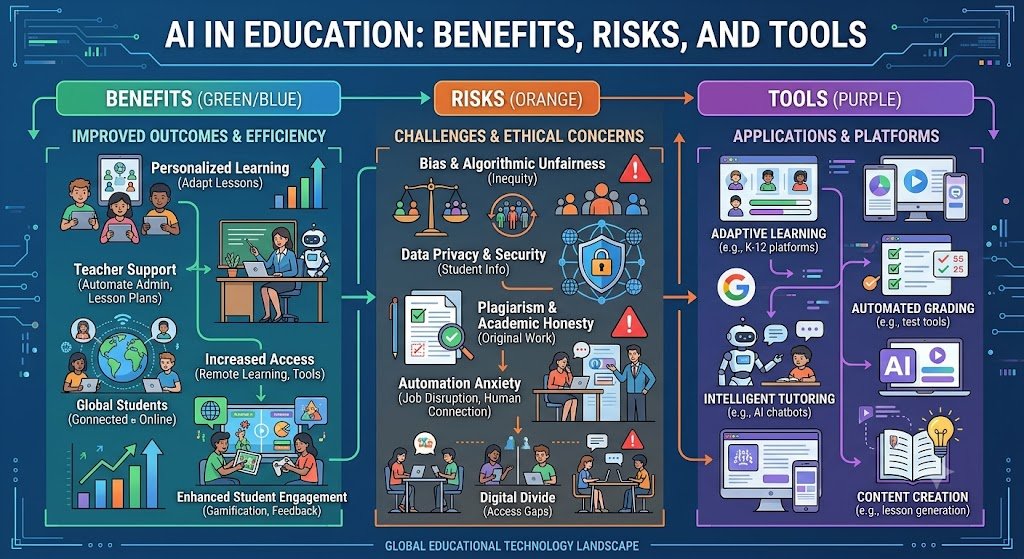
AI changes this. AI tutoring systems can provide personalised instruction at scale. Adaptive learning platforms can identify gaps and adjust content in real time. Automated assessment can reduce teacher workload, freeing time for actual teaching. Language tools can deliver content in the student's preferred language.
But AI in education is not without risk. Student data privacy, algorithmic bias, over-reliance on technology, and the digital divide all create real concerns. The benefits are real. The risks are real. The question is how to capture the first while managing the second.
This guide covers AI in education in 2026. It addresses the benefits, the risks, the tools, and the implementation considerations for Indian institutions.
For organisations building educational AI systems, Innovative AI Solutions provides AI development services and AI consulting.
The Benefits of AI in Education
Benefit 1: Personalised Learning at Scale
AI systems adapt content to individual student needs, pace, and learning style.
| Traditional | AI-Powered |
|---|---|
| One pace for all | Adaptive pace |
| Same content for everyone | Personalised content |
| Teacher attention divided | AI attention unlimited |
| Gaps missed | Gaps identified |
Indian impact: In a classroom of 60 students, a teacher cannot give individual attention. An AI tutor can.
Benefit 2: Reduced Teacher Workload
AI automates administrative and assessment tasks, freeing teachers for teaching.
| Task | AI Automation |
|---|---|
| Grading | Automated for objective assessments |
| Attendance | Automated tracking |
| Lesson planning | AI-assisted content generation |
| Progress reports | Automated generation |
| Parent communication | AI-drafted updates |
Indian impact: Indian teachers spend 30–40% of time on non-teaching tasks. AI reduces this.
Benefit 3: Early Identification of Struggling Students
AI analyses performance data to identify students at risk before they fail.
| Signal | AI Detection |
|---|---|
| Declining performance | Trend analysis |
| Engagement drops | Usage patterns |
| Concept gaps | Assessment analysis |
| Attendance issues | Pattern detection |
Indian impact: Early intervention prevents dropout, a major challenge in Indian education.
Benefit 4: Language Accessibility
AI delivers content in multiple Indian languages.
| Challenge | AI Solution |
|---|---|
| English-medium barrier | Translation |
| Regional language content | Multilingual models |
| Hinglish comprehension | Code-switching support |
| Voice-based learning | Speech interfaces |
Indian impact: Students who struggle with English can learn in their native language.
Benefit 5: 24/7 Availability
AI tutors are available any time, any place.
| Traditional | AI-Powered |
|---|---|
| School hours only | 24/7 |
| Classroom only | Anywhere with device |
| Fixed schedule | Self-paced |
Indian impact: Students in areas with limited school access can learn anytime.
Benefit 6: Consistent Quality
AI delivers consistent quality regardless of location or teacher availability.
| Factor | Human Variability | AI Consistency |
|---|---|---|
| Explanation quality | Varies by teacher | Consistent |
| Availability | Varies | Consistent |
| Patience | Varies | Unlimited |
| Language | Limited | Multiple |
Benefit 7: Scalable Assessment
AI handles assessment at scale, with detailed analytics.
| Assessment Type | AI Capability |
|---|---|
| Multiple choice | Instant grading |
| Short answer | AI evaluation |
| Essay | AI-assisted scoring |
| Coding | Automated testing |
| Math | Step-by-step analysis |
The Risks of AI in Education
Risk 1: Student Data Privacy
AI systems collect extensive student data — performance, behaviour, personal information.
| Risk | Impact |
|---|---|
| Data breaches | Personal information exposed |
| Commercial use | Data used for profit |
| Surveillance | Excessive monitoring |
| Permanent records | Data retained indefinitely |
DPDPA considerations: Student data is personal data. Consent, purpose limitation, and data minimisation apply. Special protections may be needed for minors.
Risk 2: Algorithmic Bias
AI systems can perpetuate or amplify bias.
| Bias Type | Impact |
|---|---|
| Language bias | English-first content disadvantages |
| Cultural bias | Content not suited to Indian context |
| Gender bias | Stereotyped content |
| Caste bias | Discriminatory outcomes |
| Socioeconomic bias | Disadvantaging poor students |
Risk 3: Over-Reliance on Technology
Students and teachers may become overly dependent on AI.
| Risk | Impact |
|---|---|
| Critical thinking erosion | Reduced problem-solving |
| Teacher deskilling | Reduced pedagogical skills |
| Copy-paste behaviour | Reduced learning |
| Social isolation | Reduced peer interaction |
Risk 4: Digital Divide
AI in education requires devices and connectivity.
| Challenge | Impact |
|---|---|
| Device access | Students without devices excluded |
| Internet connectivity | Rural areas lack access |
| Data costs | AI features consume data |
| Digital literacy | Students and teachers need skills |
Indian reality: A significant proportion of Indian students lack reliable device and internet access.
Risk 5: Accuracy and Hallucination
AI systems produce incorrect information.
| Risk | Impact |
|---|---|
| --- | --- |
| Wrong answers | Students learn incorrectly |
| Confident errors | Errors trusted |
| Outdated content | Curriculum misalignment |
Risk 6: Reduced Human Connection
Education is not just information transfer.
| Risk | Impact |
|---|---|
| Reduced mentorship | Less guidance |
| Reduced motivation | Less inspiration |
| Reduced social learning | Less peer interaction |
| Reduced wellbeing support | Less pastoral care |
Risk 7: Equity Concerns
AI may benefit advantaged students more.
| Concern | Impact |
|---|---|
| Access inequality | Rich students benefit more |
| Quality inequality | Better AI for those who pay |
| Outcome inequality | Gap widens |
AI Tools for Education
Tool Category 1: AI Tutors
Personalised tutoring systems.
| Tool Type | Purpose |
|---|---|
| Adaptive learning platforms | Personalised content |
| Subject-specific tutors | Maths, science, language |
| Homework help | Step-by-step guidance |
| Exam preparation | Practice, feedback |
Tool Category 2: Assessment Tools
Automated assessment and analytics.
| Tool Type | Purpose |
|---|---|
| Automated grading | Objective assessments |
| Essay scoring | AI-assisted evaluation |
| Coding assessment | Automated testing |
| Analytics dashboards | Progress tracking |
Tool Category 3: Content Tools
AI-assisted content creation.
| Tool Type | Purpose |
|---|---|
| Lesson planning | Teacher assistance |
| Content generation | Educational materials |
| Translation | Indian languages |
| Summarisation | Study aids |
Tool Category 4: Administrative Tools
Automating school operations.
| Tool Type | Purpose |
|---|---|
| Attendance | Automated tracking |
| Communication | Parent updates |
| Reporting | Automated reports |
| Scheduling | Timetable optimisation |
Tool Category 5: Language Learning
AI-powered language learning.
| Tool Type | Purpose |
|---|---|
| Conversation practice | Speaking skills |
| Vocabulary | Adaptive learning |
| Grammar | Automated correction |
| Pronunciation | Speech recognition |
Tool Selection Criteria
| Criterion | Consideration |
|---|---|
| Curriculum alignment | Matches Indian syllabus |
| Language support | Indian languages |
| Data privacy | DPDPA compliance |
| Cost | Affordable at scale |
| Integration | Works with existing systems |
| Teacher tools | Supports teachers |
What AI in Education Costs in India
Implementation Costs
| Scope | Cost Range (INR) | Cost Range (USD) | Timeline |
|---|---|---|---|
| Single-school pilot | ₹2,00,000–₹8,00,000 | $2,400–$9,600 | 8–16 weeks |
| Multi-school deployment | ₹8,00,000–₹30,00,000 | $9,600–$36,000 | 16–32 weeks |
| District-level programme | ₹30,00,000–₹1,00,00,000 | $36,000–$120,000 | 32–52 weeks |
| State-level deployment | ₹1,00,00,000–₹5,00,00,000+ | $120,000–$600,000+ | 52–104 weeks |
Ongoing Costs
| Cost Category | Monthly Range (INR) | Monthly Range (USD) |
|---|---|---|
| Platform subscription | ₹100–₹500 per student | $1.20–$6 per student |
| Infrastructure | ₹20,000–₹2,00,000 | $240–$2,400 |
| Content licensing | ₹50,000–₹5,00,000 | $600–$6,000 |
| Training | ₹25,000–₹1,00,000 | $300–$1,200 |
| Support | ₹30,000–₹1,50,000 | $360–$1,800 |
Cost Per Student
| Model | Annual Cost (INR) | Annual Cost (USD) |
|---|---|---|
| Basic (shared platform) | ₹500–₹2,000 | $6–$24 |
| Standard (personalised) | ₹2,000–₹5,000 | $24–$60 |
| Premium (AI tutor) | ₹5,000–₹15,000 | $60–$180 |
Cost Comparison
| Model | Cost Per Student | Quality |
|---|---|---|
| Human tutor | ₹50,000–₹2,00,000/year | High |
| Small class | ₹15,000–₹40,000/year | Moderate-High |
| AI tutor | ₹2,000–₹15,000/year | Moderate-High |
| No support | ₹0 | Low |
AI tutoring delivers personalised support at a fraction of human tutoring cost.
India-Specific Considerations
Indian Education Context
| Factor | Implication |
|---|---|
| Scale | 250M+ students |
| Teacher shortage | AI can help |
| Language diversity | Multilingual AI needed |
| Digital divide | Access challenges |
| Regulatory framework | DPDPA, education regulations |
Indian Language Support
| Language | AI Support |
|---|---|
| English | Excellent |
| Hindi | Good |
| Regional languages | Variable |
| Hinglish | Moderate |
Government Initiatives
| Initiative | Focus |
|---|---|
| NEP 2020 | Technology in education |
| DIKSHA | Digital content platform |
| PM eVIDYA | Multi-mode access |
| IndiaAI Mission | AI capacity building |
Compliance
| Requirement | Implementation |
|---|---|
| DPDPA | Student data protection |
| Consent | Parental consent for minors |
| Data minimisation | Only necessary data |
| Data residency | Where data stored |
| Child protection | Special safeguards |
Implementing AI in Education
Phase 1: Assessment (Weeks 1–4)
| Activity | Purpose |
|---|---|
| Identify needs | What problem to solve |
| Assess infrastructure | Devices, connectivity |
| Evaluate readiness | Teacher, student skills |
| Define success metrics | How to measure |
Phase 2: Tool Selection (Weeks 4–8)
| Activity | Purpose |
|---|---|
| Evaluate tools | Against criteria |
| Assess data privacy | DPDPA compliance |
| Check language support | Indian languages |
| Pilot planning | Test with subset |
Phase 3: Pilot (Weeks 8–20)
| Activity | Purpose |
|---|---|
| Deploy to subset | Manage risk |
| Train teachers | Ensure adoption |
| Monitor usage | Track engagement |
| Measure outcomes | Learning improvement |
Phase 4: Scale (Weeks 20+)
| Activity | Purpose |
|---|---|
| Expand deployment | Broader rollout |
| Refine processes | Based on pilot |
| Train more teachers | Scale capability |
| Monitor and improve | Continuous improvement |
Success Factors
| Factor | Why It Matters |
|---|---|
| Teacher buy-in | AI supports, not replaces |
| Infrastructure | Devices and connectivity |
| Training | Teachers and students |
| Content alignment | Curriculum fit |
| Data privacy | DPDPA compliance |
| Equity | Access for all students |
Decision Framework: AI in Education Readiness
Readiness Scorecard
| Criteria | Weight | Score (1–5) | Weighted Score |
|---|---|---|---|
| Infrastructure available | 25% | ||
| Teacher readiness | 20% | ||
| Clear use case | 20% | ||
| Data privacy compliance | 15% | ||
| Budget available | 10% | ||
| Success metrics defined | 10% | ||
| Total | 100% | /5 |
Use Case Priority Matrix
| Use Case | Impact | Feasibility | Priority |
|---|---|---|---|
| Teacher workload reduction | High | High | Immediate |
| Personalised learning | High | Moderate | High |
| Assessment automation | High | High | High |
| Language support | High | Moderate | High |
| Early intervention | High | Moderate | Medium-High |
| Administrative automation | Moderate | High | Medium |
Implementation Roadmap
| Phase | What to Build | Timeline | Cost (INR) |
|---|---|---|---|
| Phase 1 | Assessment, tool selection | 4–8 weeks | ₹50,000–₹2,00,000 |
| Phase 2 | Pilot deployment | 8–12 weeks | ₹2,00,000–₹8,00,000 |
| Phase 3 | Scale | 12–24 weeks | ₹8,00,000–₹30,00,000 |
| Phase 4 | Optimisation | Ongoing | Variable |
Frequently Asked Questions
1. What are the benefits of AI in education?
Personalised learning at scale, reduced teacher workload, early identification of struggling students, language accessibility, 24/7 availability, consistent quality, and scalable assessment.
2. What are the risks of AI in education?
Student data privacy, algorithmic bias, over-reliance on technology, digital divide, accuracy and hallucination, reduced human connection, and equity concerns.
3. Will AI replace teachers?
No. AI handles routine tasks (grading, administrative work) and provides personalised practice. Teachers focus on mentorship, motivation, complex explanation, and social-emotional learning.
4. How much does AI in education cost in India?
Platform subscriptions cost ₹100–₹500 per student monthly. Annual cost per student: ₹500–₹15,000 ($6–$180) depending on model. Implementation costs ₹2,00,000–₹5,00,00,000+.
5. What AI tools are used in education?
AI tutors (adaptive learning), assessment tools (automated grading), content tools (lesson planning), administrative tools (attendance, reporting), and language learning tools.
6. How does DPDPA affect AI in education?
Student data is personal data. DPDPA requires consent, purpose limitation, data minimisation, security safeguards, and user rights. Special protections apply for minors.
7. Can AI support Indian languages in education?
Yes. Hindi and English are well-supported. Regional language support varies. Verify capability for your specific language requirements.
8. What is personalised learning?
AI adapts content, pace, and difficulty to individual student needs. In a classroom of 60, a teacher cannot give individual attention. An AI tutor can.
9. How do I implement AI in my school?
Assess needs and infrastructure, select tools (checking DPDPA compliance), pilot with a subset, train teachers, measure outcomes, then scale.
10. What is the digital divide and how does it affect AI in education?
Many Indian students lack reliable device and internet access. AI in education must account for this — offline capability, shared devices, and low-bandwidth modes.
11. How do I ensure AI in education is fair?
Test for bias across language, gender, caste, and socioeconomic groups. Ensure content is culturally appropriate. Monitor outcomes for equity.
12. How can Innovative AI Solutions help?
Innovative AI Solutions is a Delhi-based AI development company that builds educational AI systems. We implement AI tutors, assessment tools, and learning platforms — designed for Indian languages, curriculum alignment, and DPDPA compliance. Explore our AI development services and AI consulting.
Contact Innovative AI Solutions
Ready to implement AI in your educational institution?
We help Indian schools, colleges, and edtech companies build AI-powered learning systems with proper governance and DPDPA compliance.
Contact Information
Innovative AI Solutions
📍 Netaji Subhash Place, Pitampura, Delhi – 110034
🌐 Website: https://innovativeais.com 📧 Email: info@innovativeais.com
📞 Phone: +91 7464 099 059 / +91 96899 67356
Business Services
• AI Automation • AI Development • AI Consulting • Machine Learning Solutions • Deep Learning Solutions • Generative AI Services • NLP Solutions • AI Agents • AI Chatbots • Voice AI • CRM Development • Custom Software Development • Website Development • Mobile App Development
About the Author
Abhishek Kumar
Founder & CEO, Innovative AI Solutions
5+ years building production AI systems for Indian businesses. Based in Delhi, serving clients across India.
Ready to build AI solutions for your business?
Innovative AI Solutions — Delhi's leading AI development company. Free consultation available.
Get Free Consultation →
A practical 2026 guide to AI in education — benefits for students and institutions, real risks, classroom-ready tools, and India-specific implementation costs.
#AIinEducation #Benefits #Risks #Tools #2026 #EdTech #PersonalisedLearning #AITutors #AdaptiveLearning #Assessment #Teachers #Students #India #DelhiNCRTech #DigitalProducts #AIAdoption #ClassroomTechnology #LearningAnalytics #AIGovernance #DPDPA #StudentData #EducationalTechnology #TechIndia #FutureOfEducation #AITools #InnovativeAISolutions
Copyright © 2015–2026 Innovative AI Solutions. All Rights Reserved. | Privacy Policy | Terms & Conditions