Why AI Bias Is a Business Problem
AI systems make decisions. They decide who gets a loan, who gets hired, who gets a discount, who gets flagged for fraud, who gets medical attention. These decisions affect people's lives.
When AI systems produce systematically unfair outcomes — denying loans to certain groups, hiring based on irrelevant characteristics, flagging certain customers disproportionately — the consequences are real. Customers are harmed. Regulators investigate. Trust is destroyed. And the business faces legal, financial, and reputational damage.
AI bias is not a theoretical concern. It has produced documented harm across industries: hiring algorithms that discriminated against women, credit models that disadvantaged minority applicants, facial recognition that performed worse on darker skin tones, healthcare algorithms that under-treated Black patients.
For Indian businesses, the stakes are specific. DPDPA imposes obligations. MeitY's AI Governance Guidelines emphasise Fairness & Equity. And India's diverse population — across languages, regions, religions, castes, and income levels — means bias risks are broad.
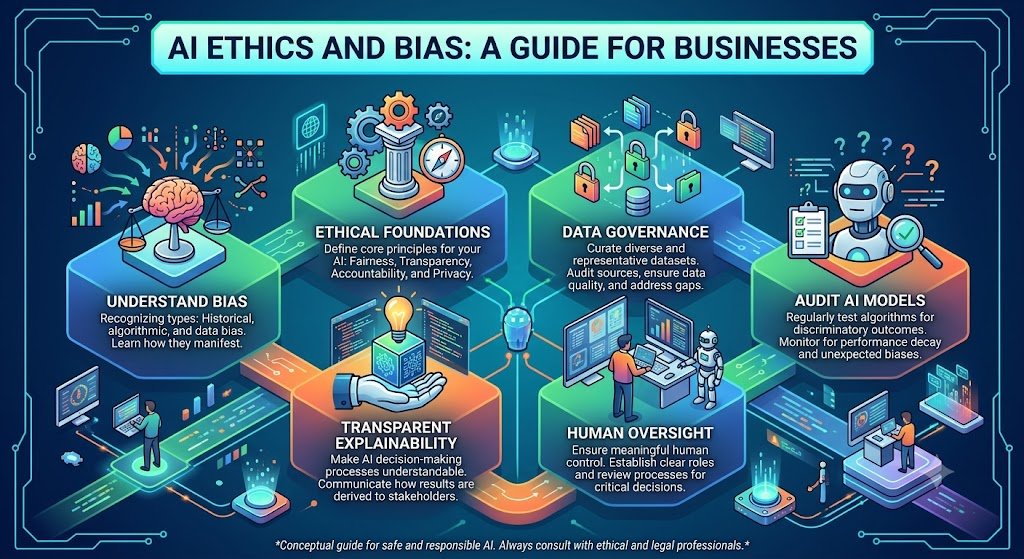
This guide explains AI ethics and bias for businesses in 2026. It covers how bias enters AI systems, how to detect it, mitigation frameworks, and compliance.
For organisations building fair AI systems, Innovative AI Solutions provides AI consulting and AI development services.
What AI Bias Actually Is
The Definition
AI bias is a systematic, repeatable error in AI outputs that produces unfair outcomes for particular groups.
| Characteristic | Detail |
|---|---|
| Systematic | Not random error |
| Repeatable | Same bias every time |
| Unfair | Disadvantages specific groups |
| Consequential | Affects real decisions |
What AI Bias Is Not
| Myth | Reality |
|---|---|
| Random error | Bias is systematic |
| Intentional | Usually unintentional |
| Rare | Common in production systems |
| Only about race/gender | Many dimensions |
Dimensions of Bias
| Dimension | Example |
|---|---|
| Gender | Hiring algorithms favouring men |
| Caste | Models learning caste correlations |
| Religion | Discriminatory targeting |
| Region | Urban-rural bias |
| Language | Poor performance on Indian languages |
| Income | Credit models disadvantaging low-income |
| Age | Age discrimination in hiring |
| Disability | Accessibility bias |
How Bias Enters AI Systems
Source 1: Training Data
The most common source of bias.
| Problem | Example |
|---|---|
| Historical bias | Data reflects past discrimination |
| Representation bias | Some groups underrepresented |
| Measurement bias | Proxies used incorrectly |
| Label bias | Labels reflect human prejudice |
Indian example: A hiring model trained on historical hiring data from a company that predominantly hired from certain institutions will learn to favour those institutions, perpetuating the pattern.
Source 2: Feature Selection
| Problem | Example |
|---|---|
| Proxy variables | Zip code as proxy for caste/religion |
| Irrelevant features | Name, gender included |
| Correlated features | Features correlated with protected attributes |
Indian example: Using pincode as a feature in credit scoring can function as a proxy for religion or caste in some areas.
Source 3: Model Design
| Problem | Example |
|---|---|
| Objective function | Optimising for wrong metric |
| Architecture | Model amplifies patterns |
| Hyperparameters | Bias in tuning |
Source 4: Deployment Context
| Problem | Example |
|---|---|
| --- | --- |
| Wrong population | Model trained on one group, deployed on another |
| Feedback loops | Model reinforces its own bias |
| Usage shift | Model used for purpose it was not designed for |
Indian example: A model trained on English-language data deployed for Hindi-speaking users will underperform and may produce biased outputs.
Source 5: Human Decisions
| Problem | Example |
|---|---|
| Labeling | Human labelers introduce bias |
| Review | Biased human review of AI outputs |
| Feedback | Biased user feedback trains model |
The Bias Pipeline
text Biased data → Biased features → Biased model → Biased deployment → Biased outcomes → Biased feedback → More biased model Bias compounds through the pipeline if not detected and mitigated.
Detecting AI Bias
Detection Method 1: Fairness Metrics
Measure outcomes across groups.
| Metric | What It Measures |
|---|---|
| Demographic parity | Equal selection rates across groups |
| Equal opportunity | Equal true positive rates |
| Equalised odds | Equal true and false positive rates |
| Predictive parity | Equal precision across groups |
| Disparate impact | Ratio of selection rates |
Detection Method 2: Bias Audits
Systematic review of AI systems for bias.
| Audit Type | Purpose |
|---|---|
| Data audit | Examine training data for bias |
| Model audit | Test model outputs for fairness |
| Outcome audit | Analyse real-world outcomes |
| Process audit | Review development process |
Detection Method 3: Subgroup Analysis
Test performance across demographic groups.
| Analysis | Purpose |
|---|---|
| Performance by group | Identify accuracy disparities |
| Outcome by group | Identify fairness disparities |
| Error analysis | Understand where model fails |
| Intersectional analysis | Combined group effects |
Detection Method 4: Explainability
Understand why the model makes decisions.
| Technique | Purpose |
|---|---|
| Feature importance | Which features drive decisions |
| SHAP values | Individual prediction explanations |
| Counterfactual analysis | What would change the outcome |
| Attention analysis | What the model focuses on |
Detection Method 5: User Feedback
Monitor for complaints and patterns.
| Source | Purpose |
|---|---|
| Complaints | Direct evidence of bias |
| Reviews | Patterns in feedback |
| Appeals | Outcomes that were overturned |
| Monitoring | Ongoing oversight |
Detection Challenges
| Challenge | Why It Matters |
|---|---|
| Protected attributes unknown | Cannot measure without data |
| Proxy variables | Bias hidden in proxies |
| Intersectionality | Combined effects hard to detect |
| Definition disagreement | Different fairness definitions |
| Trade-offs | Fairness metrics conflict |
Mitigating AI Bias
Mitigation Stage 1: Data
| Technique | Purpose |
|---|---|
| Representative data | Ensure all groups represented |
| Data augmentation | Add underrepresented examples |
| Re-weighting | Weight underrepresented examples |
| Label review | Audit labels for bias |
| Synthetic data | Generate balanced datasets |
Mitigation Stage 2: Features
| Technique | Purpose |
|---|---|
| Remove proxies | Eliminate proxy variables |
| Fairness constraints | Constrain features |
| Feature engineering | Create fairer features |
| Regularisation | Penalise biased features |
Mitigation Stage 3: Model
| Technique | Purpose |
|---|---|
| Fairness-aware training | Train with fairness objectives |
| Adversarial debiasing | Remove biased representations |
| Post-processing | Adjust outputs for fairness |
| Ensemble methods | Combine fair models |
Mitigation Stage 4: Deployment
| Technique | Purpose |
|---|---|
| Human oversight | Review high-stakes decisions |
| Appeal mechanisms | Allow challenges |
| Monitoring | Continuous bias detection |
| Feedback loops | Correct bias over time |
Mitigation Stage 5: Governance
| Technique | Purpose |
|---|---|
| Bias policy | Define fairness requirements |
| Review process | Regular bias audits |
| Accountability | Named owners |
| Training | Team awareness |
The Mitigation Framework
| Stage | Action | Impact |
|---|---|---|
| Data | Representative, balanced | Reduces source bias |
| Features | Remove proxies | Reduces proxy bias |
| Model | Fairness-aware training | Reduces model bias |
| Deployment | Human oversight | Catches residual bias |
| Governance | Policy, audits | Maintains fairness |
India-Specific Bias Considerations
India's Diversity
| Dimension | Bias Risk |
|---|---|
| Caste | Deeply embedded in data |
| Religion | Names, locations as proxies |
| Region | Urban-rural, state-level |
| Language | English vs regional languages |
| Gender | Hiring, credit, healthcare |
| Income | Credit, services access |
Indian Language Bias
| Language | Risk |
|---|---|
| English | Best supported |
| Hindi | Good but less than English |
| Regional languages | Poor support, bias risk |
| Hinglish | Moderate support |
| Dialects | Minimal support |
Models trained primarily on English data underperform on Indian languages — a form of representation bias.
Caste and Religion Bias
| Risk | Example |
|---|---|
| Name-based proxy | Surname reveals caste |
| Location-based proxy | Pincode reveals religion |
| Institution-based proxy | School reveals community |
| Network-based proxy | Social connections reveal affiliation |
Caste and religion are protected under Indian law but may be implicitly encoded in features.
Indian Regulatory Context
| Framework | Requirement |
|---|---|
| DPDPA | Data protection |
| MeitY AI Guidelines | Fairness & Equity |
| Constitution | Non-discrimination |
| Sector regulations | RBI, IRDAI fairness requirements |
What It Costs in India
Implementation Costs
| Scope | Cost Range (INR) | Cost Range (USD) | Timeline |
|---|---|---|---|
| Basic bias assessment | ₹2,00,000–₹5,00,000 | $2,400–$6,000 | 4–8 weeks |
| Bias detection framework | ₹4,00,000–₹10,00,000 | $4,800–$12,000 | 8–14 weeks |
| Mitigation implementation | ₹6,00,000–₹15,00,000 | $7,200–$18,000 | 12–20 weeks |
| Full fairness programme | ₹15,00,000–₹40,00,000 | $18,000–$48,000 | 20–32 weeks |
Cost by Component
| Component | Cost Range (INR) | Cost Range (USD) |
|---|---|---|
| Data audit | ₹1,00,000–₹3,00,000 | $1,200–$3,600 |
| Fairness metrics | ₹75,000–₹2,50,000 | $900–$3,000 |
| Bias mitigation | ₹2,00,000–₹6,00,000 | $2,400–$7,200 |
| Explainability | ₹1,50,000–₹4,00,000 | $1,800–$4,800 |
| Governance framework | ₹1,00,000–₹3,00,000 | $1,200–$3,600 |
Ongoing Costs
| Cost Category | Monthly Range (INR) | Monthly Range (USD) |
|---|---|---|
| Monitoring | ₹10,000–₹50,000 | $120–$600 |
| Audits | ₹15,000–₹75,000 | $180–$900 |
| Training | ₹5,000–₹25,000 | $60–$300 |
| Governance operations | ₹10,000–₹40,000 | $120–$480 |
The Cost of Bias
| Impact | Estimated Cost |
|---|---|
| Regulatory penalties | Significant |
| Legal action | Discrimination lawsuits |
| Customer loss | Affected groups |
| Reputation damage | Long-term |
| Remediation | Rebuilding systems |
Decision Framework: AI Ethics Readiness
Readiness Scorecard
| Criteria | Weight | Score (1–5) | Weighted Score |
|---|---|---|---|
| AI systems inventoried | 15% | ||
| Bias risks assessed | 20% | ||
| Fairness metrics defined | 15% | ||
| Detection implemented | 20% | ||
| Mitigation in place | 15% | ||
| Governance established | 15% | ||
| Total | 100% | /5 |
Bias Priority Matrix
| AI System | Risk Level | Priority |
|---|---|---|
| Hiring/recruitment | High | Immediate |
| Credit/lending | High | Immediate |
| Healthcare | High | Immediate |
| Customer targeting | Moderate | High |
| Recommendations | Moderate | Medium |
| Internal tools | Low | Low |
Implementation Roadmap
| Phase | What to Build | Timeline | Cost (INR) |
|---|---|---|---|
| Phase 1 | Assessment, risk inventory | 4–6 weeks | ₹2,00,000–₹5,00,000 |
| Phase 2 | Detection framework | 6–10 weeks | ₹3,00,000–₹8,00,000 |
| Phase 3 | Mitigation implementation | 8–16 weeks | ₹4,00,000–₹12,00,000 |
| Phase 4 | Governance, monitoring | Ongoing | ₹30,000–₹1,50,000 monthly |
Frequently Asked Questions
1. What is AI bias?
AI bias is a systematic, repeatable error in AI outputs that produces unfair outcomes for particular groups. It is not random error — it is consistent and consequential.
2. How does bias enter AI systems?
Through training data (historical, representation, measurement, label bias), feature selection (proxy variables), model design, deployment context, and human decisions. Bias compounds through the pipeline.
3. How do I detect AI bias?
Use fairness metrics (demographic parity, equal opportunity, disparate impact), bias audits, subgroup analysis, explainability techniques, and user feedback monitoring.
4. How do I mitigate AI bias?
At five stages: data (representative, balanced), features (remove proxies), model (fairness-aware training), deployment (human oversight), and governance (policy, audits).
5. What is the biggest source of bias?
Training data. Historical bias, representation bias, measurement bias, and label bias are all data problems. Most bias originates in data.
6. What are proxy variables?
Features that correlate with protected attributes. Pincode can proxy for caste or religion in India. Names can proxy for gender, caste, or religion. Institution can proxy for community.
7. How does Indian diversity affect AI bias?
India's diversity across caste, religion, region, language, and income creates broad bias risks. Models trained on English data underperform on Indian languages — a representation bias.
8. How much does bias mitigation cost in India?
Basic assessment costs ₹2,00,000–₹5,00,000 ($2,400–$6,000). Full fairness programmes cost ₹15,00,000–₹40,00,000 ($18,000–$48,000).
9. What regulations address AI bias in India?
MeitY AI Governance Guidelines emphasise Fairness & Equity. DPDPA governs data protection. The Constitution prohibits discrimination. Sector regulations add fairness requirements.
10. Can AI bias be eliminated entirely?
Not entirely. Bias can be reduced and managed, but perfect fairness is not achievable. The goal is systematic detection, mitigation, and governance.
11. What is the biggest mistake in AI bias?
Ignoring it. Many businesses assume their AI is fair without testing. Bias is usually invisible without deliberate measurement.
12. How can Innovative AI Solutions help?
Innovative AI Solutions is a Delhi-based AI development company that builds fair AI systems. We implement bias detection, fairness metrics, mitigation techniques, and governance frameworks — designed for Indian diversity and DPDPA/MeitY compliance. Explore our AI consulting and AI development services.
Contact Innovative AI Solutions
Ready to address AI ethics and bias in your systems?
We help Indian businesses detect, mitigate, and govern AI bias with proper fairness frameworks.
Contact Information
Innovative AI Solutions
📍 Netaji Subhash Place, Pitampura, Delhi – 110034
🌐 Website: https://innovativeais.com 📧 Email: info@innovativeais.com
📞 Phone: +91 7464 099 059 / +91 96899 67356
Business Services
• AI Automation • AI Development • AI Consulting • Machine Learning Solutions • Deep Learning Solutions • Generative AI Services • NLP Solutions • AI Agents • AI Chatbots • Voice AI • CRM Development • Custom Software Development • Website Development • Mobile App Development
About the Author
Abhishek Kumar
Founder & CEO, Innovative AI Solutions
5+ years building production AI systems for Indian businesses. Based in Delhi, serving clients across India.
Ready to build AI solutions for your business?
Innovative AI Solutions — Delhi's leading AI development company. Free consultation available.
Get Free Consultation →
A practical 2026 guide to AI ethics and bias for businesses — how bias enters AI systems, how to detect it, mitigation frameworks, and compliance in India.
#AIEthics #Bias #Guide #Businesses #2026 #ResponsibleAI #Fairness #BiasDetection #Mitigation #AlgorithmicBias #Discrimination #AIGovernance #Compliance #DPDPA #MeitYGuidelines #India #DelhiNCRTech #EnterpriseApps #StartupApps #MachineLearning #AIAudits #TechIndia #DigitalProducts #AIFairness #BusinessAI #InnovativeAISolutions
Copyright © 2015–2026 Innovative AI Solutions. All Rights Reserved. | Privacy Policy | Terms & Conditions