The Last Mile Problem: Why 80% of AI Projects Never Reach Production The prototype worked. The accuracy was good. The business sponsor was excited. Then six months passed, and the model was still sitting in a Jupyter notebook on someone's laptop.
This is the defining failure mode of enterprise AI. Building a model is the visible, exciting part. Deploying it—serving it reliably, monitoring it for drift, retraining it when data changes, keeping it compliant with data protection law, and doing all of this without breaking the business systems that depend on it—is the part that determines whether the investment returns anything.
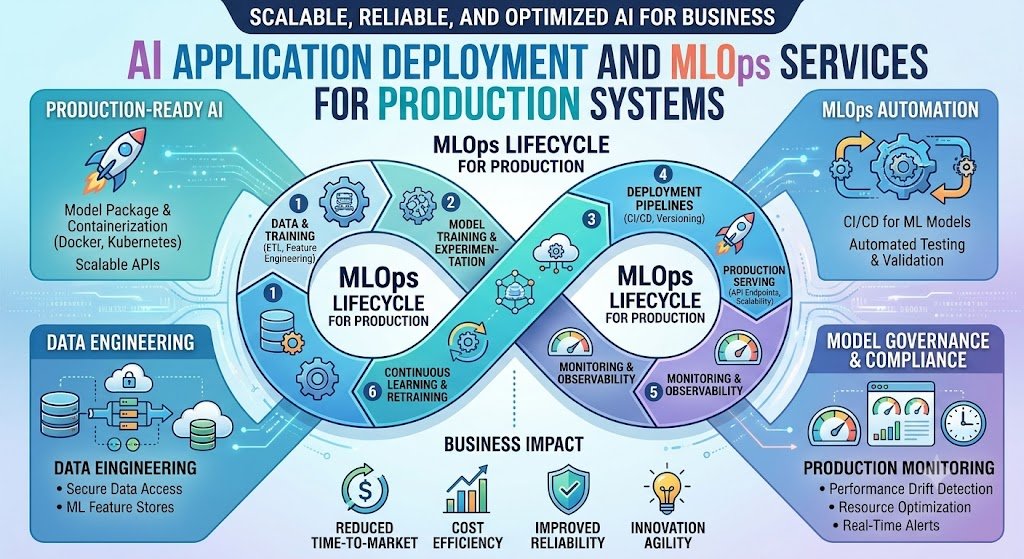
AI application deployment and MLOps (Machine Learning Operations) is the discipline that closes this gap. It applies software engineering rigour—version control, automated testing, CI/CD, monitoring, incident response—to the machine learning lifecycle. It treats a model not as a one-time artefact but as a living component of a production system that must be observed, maintained, and occasionally replaced.
The stakes are higher for AI than for traditional software. A web application that has a bug produces a wrong page. A model that has drifted produces systematically wrong predictions at scale—often silently, without an error, without a crash. A credit scoring model that degrades after a policy change does not throw an exception. It just starts approving the wrong applicants. A RAG chatbot whose knowledge base has gone stale does not fail to respond. It responds confidently with outdated information.
India's regulatory environment adds another layer. Under the DPDP Act, an AI system that processes personal data must have consent architecture, audit logging, and erasure workflows. A production AI system that was deployed without these is a compliance liability, not an asset. MeitY's AI Governance Guidelines add expectations of transparency, accountability, and human oversight for consequential decisions.
This guide is written for Indian CTOs, engineering leaders, data science heads, and product managers who need to move AI from prototype to production—and keep it there. We will cover the deployment architectures that work, the MLOps pipeline components, real costs in rupees and dollars, the India-specific infrastructure and compliance considerations, and a phased rollout framework with clear go/no-go gates.
What MLOps Actually Covers: Beyond "Deploying the Model"
MLOps is often reduced to "putting the model behind an API." That is the smallest part of it. A production MLOps capability covers the full lifecycle, and each stage has its own tooling, its own failure modes, and its own cost.
The Seven Components of a Production MLOps Stack
1. Data pipeline and feature engineering. Models consume features. In production, features must be computed consistently between training and serving—the "training-serving skew" problem. A feature store (Feast, Tecton, or a custom solution) ensures that the same feature definitions are used in both environments.
2. Experiment tracking and versioning. Every model, every training run, every hyperparameter, every dataset version must be recorded. Tools like MLflow, Weights & Biases, or a managed equivalent provide this lineage. Without it, you cannot reproduce a result, debug a regression, or prove to an auditor what the model was trained on.
3. Model registry. A central catalogue of approved, versioned models with their metadata: training data, evaluation metrics, approval status, and deployment history. The registry is the single source of truth for what is running in production.
4. CI/CD for ML (continuous integration and deployment). Automated pipelines that test a model (data validation, performance evaluation, fairness checks) and deploy it only if it passes. This is the difference between a controlled release and someone manually copying a file to a server.
5. Model serving infrastructure. The runtime that hosts the model and answers prediction requests. Options range from a simple FastAPI container to a Kubernetes cluster with GPU autoscaling, depending on latency, throughput, and cost requirements.
6. Monitoring and observability. Production models are monitored for operational health (latency, error rate, uptime), data quality (null rates, schema changes, distribution shifts), model quality (prediction drift, accuracy where labels are available), and business impact (conversion, revenue, cost per decision).
7. Governance and compliance. Audit logging, access control, human-in-the-loop workflows, and data protection controls. Under the DPDP Act, this is not optional for systems that process personal data.
MLOps Maturity Levels
| Level | Characteristics | Typical State |
|---|---|---|
| Level 0: Manual | Notebooks, manual deployment, no monitoring | Most Indian enterprises start here |
| Level 1: Automated training | Automated pipelines, versioning, basic deployment | Early-stage AI teams |
| Level 2: CI/CD for ML | Automated testing and deployment, model registry, monitoring | Mature AI teams |
| Level 3: Full lifecycle | Feature store, drift detection, automated retraining, governance | Leading enterprises |
Most Indian organisations evaluating MLOps are at Level 0 or Level 1 and need to reach Level 2 for reliable production. Level 3 is appropriate for high-stakes, high-volume systems.
For teams building the AI applications that MLOps will deploy, our AI Development and Machine Learning Solutions practices cover the full stack.
Deployment Architectures: Choosing the Right Serving Pattern
The way you serve a model determines latency, cost, reliability, and operational complexity. There is no single best pattern—the right choice depends on the workload.
Real-Time Online Serving
The model sits behind an API and answers individual requests synchronously. Latency is typically measured in tens to hundreds of milliseconds.
Best for: Fraud detection, recommendation at page load, chatbot responses, credit decisions at point of application.
Infrastructure: A containerised service (FastAPI, TorchServe, Triton Inference Server) behind a load balancer, often on Kubernetes for autoscaling. GPU nodes if the model is large.
Cost driver: Idle capacity. Real-time serving requires the model to be loaded and ready, which means paying for infrastructure even at low traffic.
Batch and Asynchronous Serving
Predictions are generated on a schedule (nightly, hourly) or in response to a job, not in real time. Results are written to a database for downstream consumption.
Best for: Risk scoring of a portfolio, churn prediction, document processing at scale, report generation.
Infrastructure: Batch jobs on cloud compute or serverless functions, writing to a data warehouse.
Cost driver: Compute time. You pay only for the batch job, which can run on cheaper spot instances.
Streaming Serving
The model consumes a stream of events (Kafka, Kinesis) and produces predictions continuously.
Best for: Real-time monitoring, anomaly detection, event-driven automation.
Infrastructure: Stream processing (Flink, Spark Streaming) with the model embedded or called as a service.
Cost driver: Continuous infrastructure. Higher than batch, lower latency than real-time request-response.
LLM-Specific Serving Patterns
For generative AI and LLM-based applications, additional patterns apply:
API-based inference (hosted model providers): Lowest operational overhead, highest per-token cost at scale.
Self-hosted open models (vLLM, TGI on GPU): Higher upfront and operational cost, lower per-token cost at high sustained volume.
Hybrid routing: Cheap models for simple requests, frontier models for complex ones—the pattern that determines LLM application economics.
Deployment Pattern Comparison
| Pattern | Latency | Cost Model | Operational Complexity | Best For |
|---|---|---|---|---|
| Real-time online | Milliseconds | Pay for idle capacity | Medium-High | Fraud, recommendations, chat |
| Batch | Hours | Pay for compute time | Low | Portfolio scoring, bulk processing |
| Streaming | Seconds | Continuous infrastructure | High | Anomaly detection, monitoring |
| API-based LLM | Hundreds of ms | Per token | Low | Generative AI, RAG, chatbots |
| Self-hosted LLM | Variable | GPU-hours | High | High-volume, data-sovereign workloads |
Monitoring and Drift: The Part That Keeps AI Working
A deployed model does not stay accurate. The world changes, and the model's assumptions become stale. Drift is the statistical term for this degradation, and monitoring for it is the single most important ongoing MLOps activity.
The Four Types of Drift
1. Data drift (covariate shift). The distribution of input features changes. A model trained on pre-pandemic transaction patterns sees different patterns after a policy change. A model trained on urban customer data is deployed to rural users.
2. Concept drift. The relationship between inputs and outputs changes. What predicted a good loan applicant last year may not predict it this year because of a regulatory change or economic shift.
3. Label drift. The distribution of the target variable changes. The base rate of fraud rises from 0.1% to 0.5%, making the model's calibration wrong.
4. Prediction drift. The distribution of the model's outputs changes, even if inputs and labels have not visibly changed. This is often the first observable signal.
What to Monitor
| Layer | Metrics | Alert Threshold (Example) |
|---|---|---|
| Operational | Latency p95, error rate, uptime, throughput | p95 > 500ms, error rate > 1% |
| Data quality | Null rate, schema violations, out-of-range values | Null rate increase > 5% |
| Data drift | Population Stability Index (PSI), KL divergence | PSI > 0.2 on key features |
| Model quality | Accuracy, precision, recall (where labels available) | Drop > 5% vs baseline |
| Prediction drift | Output distribution shift | Significant shift in mean/variance |
| Business impact | Conversion, cost per decision, revenue | Deviation from forecast > 10% |
The label delay problem: For many models, ground truth labels arrive late—a loan default is known months after the decision. Monitoring must therefore rely on proxy signals (prediction drift, data drift) in the interim, not just accuracy. This is a common blind spot in Indian AI deployments.
Retraining Triggers
Monitoring exists to trigger action. Retraining can be:
Scheduled (retrain monthly regardless),
Triggered by drift (retrain when PSI exceeds threshold),
Triggered by performance (retrain when accuracy drops below threshold),
Continuous (online learning, rarely appropriate for regulated decisions).
Most Indian enterprises should start with scheduled retraining plus drift alerts, and mature to performance-triggered retraining as label pipelines improve.
For teams building AI agents and LLM applications that need production-grade observability, our AI Agents and Generative AI Services practices cover LLMOps alongside traditional MLOps.
Real Costs in India (2026)
MLOps costs are a mix of infrastructure, tooling, and people. The people cost usually dominates, and the tooling cost is often lower than expected if open-source tools are chosen wisely.
Build and Setup Costs
| Scope | Setup Cost (₹) | Setup Cost ($ approx.) | Timeline | What It Covers |
|---|---|---|---|---|
| Single-model deployment | ₹2–6 lakh | $2,400–$7,200 | 3–6 weeks | Serving API, basic monitoring, CI/CD for one model |
| MLOps platform (Level 2) | ₹10–30 lakh | $12,000–$36,000 | 10–20 weeks | Model registry, CI/CD, monitoring, feature store (basic) |
| Enterprise MLOps (Level 3) | ₹30–80 lakh+ | $36,000–$96,000+ | 20–40 weeks | Full lifecycle, drift detection, automated retraining, governance |
Note: USD conversions at ₹83/$. Ranges are indicative for Indian teams and include engineering effort but not ongoing infrastructure.
Infrastructure and Running Costs
| Cost Component | Monthly Range (₹) | Monthly Range ($ approx.) | Notes |
|---|---|---|---|
| Compute (CPU serving) | ₹10,000–₹60,000 | $120–$720 | Scales with traffic |
| Compute (GPU serving) | ₹40,000–₹3,00,000+ | $480–$3,600+ | GPU instance hours, or more for LLM serving |
| Managed MLOps tooling | ₹15,000–₹1,50,000 | $180–$1,800 | MLflow managed, W&B, cloud ML platforms |
| Monitoring and observability | ₹10,000–₹80,000 | $120–$960 | Datadog, Grafana, custom dashboards |
| Storage and data pipeline | ₹5,000–₹40,000 | $60–$480 | Feature store, model artefacts, logs |
| People (MLOps engineer) | ₹1.5–4 lakh | $1,800–$4,800 | 1 FTE for a mature platform |
The People Cost Is the Real Cost
A mature MLOps capability typically requires:
1–2 MLOps/platform engineers to build and maintain the infrastructure,
1 data engineer for pipelines and feature engineering,
Fractional data scientists for model development and retraining,
A security/compliance reviewer for DPDPA obligations.
For an Indian enterprise, a team of 3–4 people costs ₹40 lakh–₹1 crore per year in loaded salaries. This is the dominant cost of MLOps, and it is why many organisations choose to start with a managed platform or a partner rather than building the full stack in-house.
India-Specific Infrastructure Considerations
GPU availability. GPU capacity in Indian cloud regions has improved but remains constrained compared to US regions. For self-hosted LLM serving, evaluate whether Indian-region GPU instances meet your needs or whether data residency requirements can be met with a hybrid approach.
Data localisation. For regulated sectors (BFSI, healthcare), data residency in India is often required. Cloud providers (AWS, Azure, GCP) have Indian regions, but not all services are available in every region. Verify that your MLOps tooling and serving infrastructure can be deployed in an Indian region.
Cost optimisation. Spot instances for batch workloads, autoscaling for real-time serving, and model quantisation/ distillation to reduce GPU requirements are the primary levers for reducing infrastructure cost.
DPDPA and MeitY Governance for AI in Production
A production AI system that processes personal data is subject to the DPDP Act. The obligations do not end at model development—they extend to every prediction served, every log written, and every model retrained.
Key Compliance Requirements for Production AI
1. Consent and purpose limitation. The model should only process personal data for the purpose it was collected for. A model trained on transaction data for fraud detection cannot be repurposed for marketing without fresh consent.
2. Data minimisation at inference. The serving layer should not log or retain more personal data than necessary. Request logs that capture full user profiles for debugging become a compliance liability.
3. Audit logging. Every prediction that affects a person (credit decision, insurance premium, hiring screen) should be logged with enough detail to explain the decision. This is the basis for both DPDPA accountability and MeitY's transparency principle.
4. Right to erasure. If a user requests erasure, the data must be removed from all systems—including model training sets, feature stores, and evaluation datasets. This is technically difficult and must be designed in, not retrofitted.
5. Human oversight for consequential decisions. MeitY's guidelines and sectoral regulators (RBI, SEBI, IRDAI) expect human review for high-stakes automated decisions. The MLOps pipeline must support human-in-the-loop workflows where required.
6. Model documentation. What data was the model trained on? What are its known limitations? What is its intended use? This documentation is required for accountability and is increasingly requested in procurement and audits.
Governance Checklist for Production AI
| Requirement | MLOps Implementation | Priority |
|---|---|---|
| Consent tracking | Feature store records consent status per user | High |
| Data minimisation | Serving logs redact PII by default | High |
| Audit logging | Prediction logs with input hash, model version, output | High |
| Erasure support | Pipeline to remove user data from training sets | Medium-High |
| Human oversight | Approval queue for consequential decisions | High (regulated sectors) |
| Model documentation | Registry stores data lineage, limitations, intended use | High |
| Access control | Role-based access to models, data, logs | High |
Implementation Framework: A Phased Approach With Cost Gates
Phase 1: Assessment and Architecture (Week 1–3)
Objective: Understand the current state and design the target deployment architecture.
Activities:
Inventory existing models and deployment state. How many models are in production? How are they served? How are they monitored?
Identify the highest-value model to productionise first.
Design the serving pattern (real-time, batch, streaming) based on workload.
Assess DPDPA exposure and governance requirements.
Decide build vs managed platform.
Cost: ₹1–3 lakh ($1,200–$3,600) for assessment and architecture.
Go/No-Go: Clear target architecture. Identified first model. Compliance requirements understood.
Phase 2: Serving and CI/CD (Week 4–8)
Objective: Deploy the first model with automated testing and deployment.
Activities:
Containerise the model and build the serving API.
Set up a model registry (MLflow or cloud equivalent).
Build CI/CD pipeline: automated data validation, model evaluation, deployment on pass.
Implement rollback capability.
Basic operational monitoring (latency, error rate, uptime).
Cost: ₹2–6 lakh ($2,400–$7,200) for a single-model deployment with CI/CD.
Go/No-Go: Model deploys automatically on passing tests. Rollback works. Operational monitoring is live.
Phase 3: Monitoring and Drift Detection (Week 9–14)
Objective: Add data quality, drift, and model quality monitoring.
Activities:
Implement data quality checks (null rates, schema validation, range checks).
Implement drift detection (PSI, KL divergence on key features).
Implement prediction monitoring and business metric dashboards.
Configure alerting to the on-call team.
Define retraining triggers.
Cost: ₹4–10 lakh ($4,800–$12,000) for monitoring infrastructure.
Go/No-Go: Drift alerts fire correctly in a simulated scenario. Dashboards are used by the team. Retraining triggers are documented.
Phase 4: Governance and Pilot (Week 15–18)
Objective: Add compliance controls and run a production pilot.
Activities:
Implement audit logging for consequential predictions.
Implement access control and PII redaction in logs.
Conduct DPDPA review: data mapping, consent flow, erasure process.
Run a limited production pilot with a subset of traffic.
Weekly governance review of predictions and overrides.
Cost: ₹3–8 lakh ($3,600–$9,600) for governance and compliance work.
Go/No-Go: Pilot meets performance and compliance criteria. No unexpected drift. Audit logs are complete.
Phase 5: Scale and Operate (Month 5–12)
Objective: Expand to additional models and establish ongoing operations.
Activities:
Onboard additional models to the platform.
Automate retraining where appropriate.
Establish runbooks and incident response.
Conduct quarterly compliance reviews.
Optimise infrastructure cost (spot instances, autoscaling, quantisation).
Ongoing cost: Infrastructure plus 1–2 FTE for platform operations (₹40 lakh–₹1 crore/year).
Phase Summary Table
| Phase | Duration | Key Deliverable | Cost Gate (₹) | Go/No-Go Criteria |
|---|---|---|---|---|
| 1. Assessment | 2–3 weeks | Architecture, first model identified | 1–3 lakh | Target architecture approved |
| 2. Serving & CI/CD | 4–5 weeks | Deployed model, automated pipeline | 2–6 lakh | Auto-deploy and rollback work |
| 3. Monitoring & Drift | 5–6 weeks | Dashboards, alerts, retraining triggers | 4–10 lakh | Alerts fire correctly |
| 4. Governance & Pilot | 3–4 weeks | Audit logging, DPDPA review, pilot | 3–8 lakh | Pilot meets criteria |
| 5. Scale & Operate | 6–9 months | Multiple models, runbooks, optimisation | Ongoing people + infra | Stable operations |
Risks, Pitfalls, and Governance
The Most Common Production AI Failures
Training-serving skew. The model performs well in training but poorly in production because features are computed differently in the two environments. Mitigation: Feature store, shared feature definitions, shadow deployment to compare online and offline predictions.
Silent drift. The model degrades without any error or crash. Mitigation: Drift monitoring with alerting, scheduled retraining, proxy metrics when labels are delayed.
No rollback. A bad model is deployed and cannot be quickly reverted. Mitigation: Model registry with versioned artefacts, automated rollback, blue-green deployment.
Unmonitored LLM costs. For generative AI applications, token costs can escalate without visibility. Mitigation: Cost dashboards, per-request logging, model routing, budget alerts.
Compliance afterthought. Audit logging and consent tracking are added after launch. Mitigation: Build governance into the pipeline from phase one.
Risk Summary Table
| Risk | Likelihood | Impact | Mitigation |
|---|---|---|---|
| Training-serving skew | High | High (bad predictions) | Feature store, shadow deployment |
| Silent drift | High | High (degraded accuracy) | Drift monitoring, retraining triggers |
| No rollback | Medium | Critical (extended outage) | Versioned registry, blue-green deploy |
| LLM cost overrun | Medium | Medium (margin erosion) | Cost dashboards, routing, budget alerts |
| DPDPA non-compliance | Medium | Critical (penalties) | Governance built into pipeline |
| GPU capacity constraints | Medium | Medium (scaling limits) | Multi-region, reserved capacity |
Benchmark Summary and Decision Framework
Decision Matrix: Build vs Managed vs Partner
| Factor | Build In-House | Managed Platform | Partner / MLOps Service |
|---|---|---|---|
| Team capability | Strong ML + platform engineers | Small team, limited platform expertise | No internal MLOps capability |
| Number of models | Many (>10) | Few (1–5) | Few to many |
| Cost | Highest people cost, lowest tooling cost | Predictable subscription | Project-based |
| Control | Full | Limited to platform features | Shared |
| Time to production | Slowest | Fastest | Medium |
| Best for | Large enterprises with AI teams | Startups, small teams | Enterprises needing a jump-start |
Deployment Pattern Selection Table
| Workload | Recommended Pattern | Why |
|---|---|---|
| Fraud detection at transaction | Real-time online | Sub-second decision required |
| Portfolio risk scoring | Batch | Runs nightly, no latency requirement |
| Recommendation engine | Real-time + caching | Personalisation at page load |
| Document processing | Batch / async | High volume, latency tolerant |
| RAG chatbot | API-based LLM + vector store | Operational simplicity, quality |
| High-volume LLM generation | Hybrid routing / self-hosted | Cost control at scale |
The One-Paragraph Decision Rule
If you have one model to productionise, start with a containerised serving API, a model registry, and basic operational monitoring—do not build a full platform. If you have multiple models and an AI team, invest in CI/CD for ML and drift monitoring. If you have no MLOps capability and need to move fast, use a partner to build the first deployment and transfer knowledge. In all cases, build audit logging and compliance controls in phase one—retrofitting them after a DPDPA review is expensive.
Frequently Asked Questions
1. What is MLOps and why does it matter?
MLOps is the discipline of deploying, monitoring, and maintaining machine learning models in production. It applies software engineering practices—version control, CI/CD, monitoring, incident response—to the ML lifecycle. It matters because most AI projects fail between prototype and production, not because the model is bad but because the deployment and operations discipline is missing.
2. How much does it cost to deploy an AI model in India?
A single-model deployment with serving API, CI/CD, and basic monitoring costs ₹2–6 lakh ($2,400–$7,200). An MLOps platform for multiple models costs ₹10–30 lakh ($12,000–$36,000). Monthly infrastructure costs range from ₹25,000–₹5 lakh ($300–$6,000) depending on whether GPU serving is required.
3. What is model drift and how do I detect it?
Model drift is the degradation of model performance over time as the world changes. It is detected by monitoring data distributions (data drift), prediction distributions (prediction drift), and accuracy where labels are available (concept drift). Statistical measures like Population Stability Index (PSI) and KL divergence are commonly used.
4. Do I need a feature store?
A feature store is valuable if you have multiple models sharing features, or if training-serving skew is a concern. For a single model, it may be overkill. For a mature MLOps platform, it is a core component.
5. What is the difference between real-time and batch serving?
Real-time serving answers individual requests synchronously with millisecond-to-second latency. Batch serving generates predictions on a schedule and writes results to a database. Real-time requires always-on infrastructure; batch is cheaper and simpler but not suitable for latency-sensitive use cases.
6. How do I monitor an LLM application in production?
Monitor operational metrics (latency, error rate, cost per request), quality metrics (hallucination rate, retrieval precision, user feedback), and cost (token usage per user, per feature). Implement guardrails that block unsafe outputs and escalate low-confidence responses to humans.
7. What DPDPA obligations apply to AI in production?
Consent tracking, data minimisation at inference, audit logging of consequential predictions, erasure support, and human oversight for high-stakes decisions. The serving layer must not log more personal data than necessary, and model documentation must record data lineage and limitations.
8. Should I build MLOps in-house or use a managed platform?
Use a managed platform if you have few models and a small team. Build in-house if you have many models and strong platform engineering capability. Use a partner if you need to move fast and transfer knowledge. The people cost of in-house MLOps (₹40 lakh–₹1 crore/year for 3–4 people) is the dominant factor.
9. What is training-serving skew and how do I prevent it?
Training-serving skew is when features are computed differently in training and production, causing the model to behave differently in production than in evaluation. Prevention: shared feature definitions (feature store), shadow deployment to compare predictions, and monitoring feature distributions in production.
10. How often should I retrain my model?
Depends on drift rate. Start with scheduled retraining (monthly or quarterly) plus drift-triggered retraining. Move to performance-triggered retraining as label pipelines mature. For LLM applications, retraining is usually not applicable—RAG index updates and prompt iteration replace it.
11. What GPU infrastructure is available in India for AI serving?
AWS, Azure, and GCP all have Indian regions with GPU instances, though capacity and instance types are more limited than US regions. For data residency requirements, verify that your serving infrastructure can be deployed in an Indian region. For self-hosted LLMs, capacity planning is essential.
12. How can Innovative AI Solutions help?
Innovative AI Solutions builds production-grade AI deployment and MLOps capabilities for Indian businesses—serving infrastructure, CI/CD for ML, model monitoring, drift detection, DPDPA-compliant audit logging, and LLMOps for generative AI applications. Our Delhi-based team handles architecture, implementation, and ongoing operations. Visit https://innovativeais.com to discuss your requirements.
Contact Innovative AI Solutions
Ready to move your AI from notebook to production—and keep it working?
[One-line supporting sentence.]
Contact Information
Innovative AI Solutions
📍 Netaji Subhash Place, Pitampura, Delhi – 110034
🌐 Website: https://innovativeaislabs.com 📧 Email: info@innovativeais.com
📞 Phone: +91 7464 099 059 / +91 96899 67356
Business Services
AI Automation
AI Development
AI Consulting
Machine Learning Solutions
Deep Learning Solutions
Generative AI Services
NLP Solutions
AI Agents
AI Chatbots
Voice AI
CRM Development
Custom Software Development
Website Development
Mobile App Development
About the Author
Abhishek Kumar
Founder & CEO, Innovative AI Solutions
5+ years building production AI systems for Indian businesses. Based in Delhi, serving clients across India.
Ready to build AI solutions for your business?
Innovative AI Solutions — Delhi's leading AI development company. Free consultation available.
Get Free Consultation →
A practical 2026 guide for Indian enterprises deploying AI to production—serving architectures, MLOps pipelines, drift monitoring, DPDPA governance, real rupee costs, and a phased rollout that keeps models working after launch.
#MLOps #AIDeployment #ModelDeployment #LLMOps #AIObservability #DriftDetection #ModelMonitoring #CICDforML #FeatureStore #ModelRegistry #DPDPA #MeitY #IndiaAI #Nasscom #DigitalIndia #KubernetesAI #AIProduction #DelhiNCR #InnovativeAISolutions
Copyright ©️ 2015–2026 Innovative AI Solutions. All Rights Reserved. | Privacy Policy | Terms & Conditions