The Follow-Up Gap That Costs Indian Developers Crores
A prospective buyer enquires about a three-BHK in Gurugram. The enquiry comes from a property portal at 9 p.m. on a Saturday. The developer's sales team sees it on Monday morning, assigns it to a channel partner on Tuesday, and the first call happens on Wednesday. By then, the buyer has enquired with four other projects and booked a site visit with the competitor who called back within ten minutes.
This is the follow-up gap, and it is the most expensive inefficiency in Indian real estate sales. The industry generates enormous lead volumes—portals, hoardings, WhatsApp campaigns, channel partners, walk-ins—and loses a substantial proportion of them to slow response, poor tracking, and fragmented communication. The leads exist. The systems to manage them do not.
The operational reality of most Indian developers is a patchwork: listings maintained manually on portals, leads arriving by email and WhatsApp, a spreadsheet for tracking, follow-ups managed by memory and reminders, site visits coordinated by phone, and channel partner commissions reconciled at year-end. Each gap creates leakage.
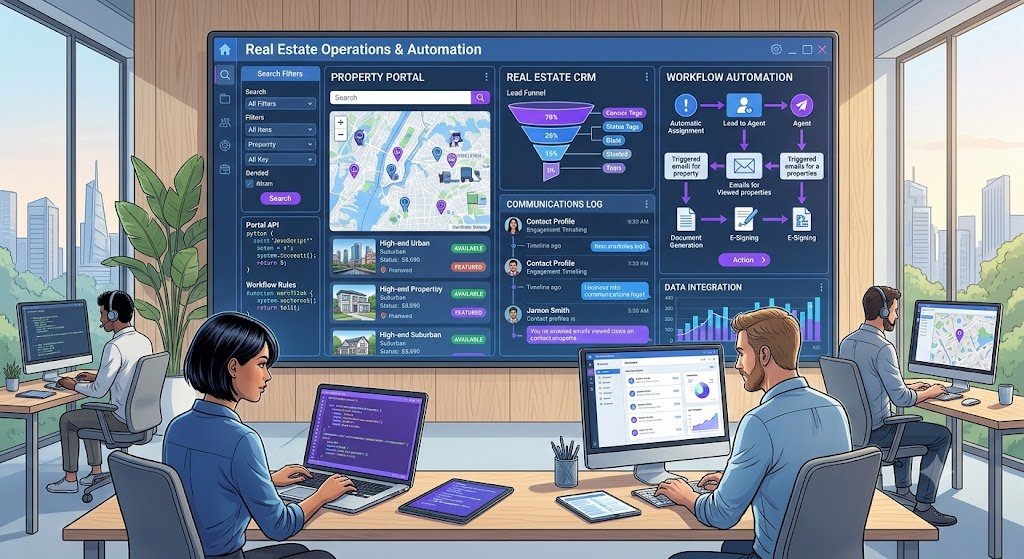
Real estate software development is the discipline of building the systems that close these gaps: property portals that present inventory accurately, CRMs that capture and track every lead, and workflow automation that ensures the right follow-up happens at the right time. It is not about replacing the sales team. It is about giving the sales team a system that ensures no lead is forgotten and no follow-up is late.
India adds specific requirements. RERA (Real Estate Regulation and Development Act) mandates transparency: project registration, quarterly updates, carpet area disclosure, and agent registration. Software that supports RERA compliance is not optional for developers operating in regulated markets. DPDPA applies to buyer personal data—names, phone numbers, financial information—and requires consent, purpose limitation, and security. And the industry's heavy reliance on WhatsApp for communication means any real estate software must integrate with WhatsApp Business API, not ignore it.
This guide is written for Indian real estate developers, brokers, channel partners, and proptech founders evaluating real estate software. We will cover the architecture that connects property portals, CRM, and workflow automation; the modules that deliver value first; real costs in rupees and dollars; RERA and DPDPA compliance; and a phased implementation framework with clear go/no-go gates.
What "Property Portals, CRM and Workflow Automation" Actually Means The three components are related but distinct. Understanding what each does—and how they connect—prevents the common mistake of buying a CRM and expecting it to solve portal and workflow problems.
Property Portals: The Discovery Layer
A property portal is the digital storefront: a website or app where buyers browse listings, view photos and floor plans, compare projects, and enquire. It answers the question: what is available, and is it right for me?
A portal has two sides:
The buyer-facing side: search, filters, project pages, photos, videos, virtual tours, location maps, price ranges, and enquiry forms.
The admin side: inventory management, listing creation, media upload, pricing, availability status, and lead capture.
For Indian developers, the portal is often the first point of contact with a buyer. The quality of the portal—its speed, its listing accuracy, its mobile experience—determines whether the buyer enquires or moves on.
CRM: The Relationship Layer
A real estate CRM tracks every lead and every interaction: who enquired, when, about which project, what was discussed, what stage the buyer is in, and what the next action is. It answers the question: who is this buyer, and what should happen next?
Real estate CRM has specific requirements that generic CRMs do not handle well:
Lead source tracking: portal, hoarding, WhatsApp, walk-in, channel partner, referral.
Project and unit interest: which project, which configuration (2BHK/3BHK), which budget range.
Site visit scheduling and tracking.
Channel partner management: who brought the lead, what commission is due.
Follow-up cadence: automated reminders, drip campaigns, and escalation when a lead goes cold.
Booking and payment tracking: from enquiry to booking to payment schedule.
Workflow Automation: The Execution Layer
Workflow automation ensures that the right actions happen at the right time without manual intervention. It answers the question: what should happen next, and did it happen?
Examples:
When a lead arrives from a portal, automatically assign it to a sales representative and send a WhatsApp message within five minutes.
When a site visit is scheduled, automatically send a confirmation and a reminder 24 hours before.
When a lead has not been contacted in 48 hours, escalate to the sales manager.
When a booking is confirmed, automatically trigger the payment schedule and the documentation workflow.
When a payment is overdue, automatically send a reminder and notify accounts.
Capability Comparison Table
| Capability | Core Question Answered | Primary Data | Typical Indian State |
|---|---|---|---|
| Property portal | What is available? | Listings, photos, pricing | Manual listings on third-party portals |
| CRM | Who is this buyer? | Leads, interactions, pipeline | Spreadsheet or generic CRM |
| Workflow automation | What should happen next? | Triggers, actions, SLAs | Manual follow-up, memory |
For teams building the integration layer that connects portals, CRM, and ERP, our Custom Software Development and CRM Development practices cover the full stack.
The Architecture: Building a Connected Real Estate Platform
A real estate platform has several layers, each with distinct responsibilities. Understanding them prevents the common mistake of treating the portal as the whole system.
Layer 1: Inventory and Project Management
This is the foundation: the projects, towers, floors, units, configurations, carpet areas, pricing, and availability status. Every other layer depends on accurate inventory.
India-specific considerations:
RERA registration: each project must have a RERA registration number, which should be displayed on the portal and stored in the system.
Carpet area vs super area: RERA mandates disclosure of carpet area. The system must store both and present them correctly.
Unit-level status: available, blocked, booked, sold. This must be real-time—a buyer enquiring about a unit that is already booked is a lost lead.
Price escalation: construction-linked plans, time-linked plans, and payment schedules vary by project.
Layer 2: Portal and Listing Management
This is the buyer-facing layer: the website, the project pages, the search, and the enquiry forms.
Key features:
Project pages: photos, videos, floor plans, amenities, location map, price range, RERA number.
Search and filters: location, budget, configuration, possession timeline.
Virtual tours: 360-degree tours, video walkthroughs.
Enquiry forms: with consent capture (DPDPA) and lead source tracking.
Mobile-first design: the majority of Indian property searches happen on mobile.
Layer 3: CRM and Lead Management
This is the relationship layer: capturing leads from all sources, tracking interactions, and managing the pipeline.
Key features:
Lead capture: from portal, WhatsApp, phone, walk-in, channel partner, and third-party portals (99acres, MagicBricks, Housing.com).
Lead assignment: automatic assignment based on project, location, or round-robin.
Interaction logging: calls, WhatsApp messages, emails, meetings, site visits.
Pipeline stages: enquiry → qualified → site visit → negotiation → booking → registration.
Follow-up reminders: automated and manual.
Channel partner management: lead attribution, commission tracking.
Layer 4: Workflow Automation and Integrations
This is the execution layer: automating follow-ups, scheduling, notifications, and integrations with other systems.
Key features:
Lead response automation: WhatsApp/SMS within minutes of enquiry.
Site visit scheduling: calendar integration, confirmation, reminder.
Follow-up cadence: automated sequences based on lead stage.
Escalation: alerts when SLAs are breached.
Booking workflow: from booking to documentation to payment schedule.
ERP integration: accounting, construction, and payment tracking.
WhatsApp Business API: for communication at scale.
The Architecture at a Glance
| Layer | Components | India-Specific Consideration |
|---|---|---|
| Inventory | Projects, units, pricing, availability | RERA registration, carpet area disclosure |
| Portal | Website, listings, search, enquiry | Mobile-first, virtual tours, RERA display |
| CRM | Leads, interactions, pipeline, partners | WhatsApp integration, channel partner tracking |
| Automation | Triggers, notifications, workflows | WhatsApp Business API, escalation SLAs |
Build vs Buy: The Platform Decision
Most Indian developers do not need to build every layer. Property portal platforms and CRM products exist. The differentiation lies in workflow automation, integration with the developer's specific sales process, and channel partner management.
| Component | Build vs Buy | Rationale |
|---|---|---|
| Property portal website | Build or configure | Custom branding and project presentation |
| CRM | Buy or build | Mature CRM products exist; custom for unique workflows |
| Workflow automation | Build | Company-specific sales process |
| Channel partner portal | Build | Company-specific commission and attribution logic |
| ERP integration | Build | Company-specific accounting systems |
Modules That Matter: What to Build First
The sequence below reflects the order in which most Indian developers see return.
Module Priority
| Module | Business Value | Complexity | Recommended Order |
|---|---|---|---|
| Lead capture and response automation | Very High (speed to lead) | Medium | 1 |
| CRM with pipeline tracking | High (visibility) | Medium | 2 |
| Property portal with listings | High (discovery) | Medium-High | 2 |
| Site visit scheduling | High (conversion) | Low-Medium | 3 |
| WhatsApp integration | High (communication) | Medium | 1 (enabler) |
| Channel partner management | High (attribution) | Medium-High | 4 |
| Booking and payment workflow | High (revenue) | High | 4 |
| RERA compliance dashboard | Medium-High (compliance) | Medium | 5 |
| AI property recommendation | Medium (differentiation) | High | 6 |
Speed to Lead: The Highest-Value Automation
The single highest-value automation in real estate is speed to lead: responding to an enquiry within minutes, not hours. Studies across industries consistently show that responding within five minutes dramatically increases the chance of qualification. In real estate, where buyers enquire with multiple projects simultaneously, the first responder often wins.
Implementation:
Lead arrives from portal, WhatsApp, or website.
System automatically assigns to a sales representative.
Automated WhatsApp message sent to the lead within minutes: "Thank you for your interest in [Project]. Our representative [Name] will call you shortly. Here is the project brochure."
Sales representative receives a notification with lead details and a call reminder.
If no call is made within 30 minutes, escalation to the sales manager.
CRM: The Pipeline Visibility Layer
A CRM gives the sales head visibility into the pipeline: how many leads, at what stage, with what conversion rates, and where the bottlenecks are.
Key features:
Dashboard: leads by source, stage, project, and sales representative.
Pipeline view: drag-and-drop stages.
Interaction history: every call, message, and meeting.
Reports: conversion rates, response times, source effectiveness.
Property Portal: The Discovery Layer
The portal is the developer's own digital storefront, complementing third-party portals. It gives the developer control over presentation, branding, and lead capture—without paying per-lead fees to third-party portals.
Key features:
Project pages with photos, videos, floor plans, amenities, location.
Search and filters.
Virtual tours.
Enquiry forms with DPDPA-compliant consent.
RERA number display.
Site Visit Scheduling
Site visits are the highest-conversion event in real estate. A buyer who visits a site is significantly more likely to book than one who only enquires. Scheduling and confirming site visits efficiently is therefore high-value.
Key features:
Calendar integration for sales representatives.
Automated confirmation and reminder (WhatsApp/SMS).
Visit tracking: did the buyer show up? What was the outcome?
Post-visit follow-up automation.
Channel Partner Management
Channel partners (brokers) bring a significant proportion of real estate leads in India. Managing them—attribution, commission, communication—is a distinct module.
Key features:
Partner portal: submit leads, track status, view commission.
Lead attribution: which partner brought which lead.
Commission calculation and tracking.
Communication: updates on lead status, project inventory.
Module Build vs Buy Table
| Module | Build Custom | Buy Standard | Notes |
|---|---|---|---|
| Lead response automation | Build | Configure | Requires WhatsApp API integration |
| CRM | If unique workflow | If standard | Real estate CRMs exist in market |
| Property portal | Build | Configure | Custom for branding and projects |
| Site visit scheduling | Build | Configure | Calendar integration |
| Channel partner portal | Build | Rarely standard | Company-specific logic |
| Booking workflow | Build | If standard | Integration with ERP |
Real Costs in India (2026)
Real estate software costs depend on the scope: a standalone portal, a CRM, or a full integrated platform with automation.
Build Costs by Scope
| Scope | Build Cost (₹) | Build Cost ($ approx.) | Timeline | What It Covers |
|---|---|---|---|---|
| Property portal website | ₹5–15 lakh | $6,000–$18,000 | 8–14 weeks | Listings, search, project pages, enquiry |
| Real estate CRM | ₹10–25 lakh | $12,000–$30,000 | 12–20 weeks | Lead capture, pipeline, interactions, reports |
| CRM + workflow automation | ₹20–45 lakh | $24,000–$54,000 | 18–28 weeks | CRM + WhatsApp automation, site visit scheduling, escalation |
| Full platform (portal + CRM + automation + partner portal) | ₹40–90 lakh | $48,000–$1,08,000 | 24–36 weeks | Integrated platform with all modules |
Note: USD conversions at ₹83/$. These ranges are indicative for Indian development teams and include design, development, and basic testing. They exclude WhatsApp Business API costs, third-party portal integration fees, and ERP integration complexity.
Third-Party Service Costs
| Service | Cost (₹) | Cost ($ approx.) | Notes |
|---|---|---|---|
| WhatsApp Business API | ₹0.30–₹0.80 per message | $0.004–$0.010 | Per-conversation pricing |
| SMS gateway | ₹0.15–₹0.30 per SMS | $0.002–$0.004 | OTP and notifications |
| Maps API | ₹5,000–₹30,000/month | $60–$360/month | Project location maps |
| Virtual tour platform | ₹10,000–₹50,000/month | $120–$600/month | 360-degree tours |
| Cloud hosting | ₹10,000–₹50,000/month | $120–$600/month | Depends on traffic |
Running Costs
| Cost Component | Monthly Range (₹) | Monthly Range ($ approx.) | Notes |
|---|---|---|---|
| Hosting and infrastructure | ₹10,000–₹50,000 | $120–$600 | Scales with traffic |
| WhatsApp API | ₹10,000–₹50,000 | $120–$600 | Scales with lead volume |
| SMS/notifications | ₹2,000–₹15,000 | $24–$180 | Per-message pricing |
| Support and maintenance | ₹20,000–₹1,00,000 | $240–$1,200 | 15–25% of build annually |
The Hidden Costs
Lead data integration with third-party portals. 99acres, MagicBricks, and Housing.com have their own lead delivery mechanisms. Integrating them requires API access and custom connectors.
Data cleanup. Legacy lead data in spreadsheets is often messy—duplicates, incomplete records, inconsistent formatting. Cleaning it before CRM migration is time-consuming.
Sales team training and adoption. A CRM is only valuable if the sales team uses it. Training, incentives, and management enforcement are essential.
RERA compliance review. Ensuring the portal and software meet RERA disclosure requirements requires legal review.
India-Specific Compliance: RERA, DPDPA and MeitY
RERA Compliance
RERA mandates transparency in real estate transactions. Software that supports RERA compliance is not optional for developers operating in regulated markets.
Key requirements:
Project registration: display the RERA registration number on all project pages and marketing materials.
Quarterly updates: RERA requires quarterly progress reports. Software should support the data collection for these reports.
Carpet area disclosure: display carpet area, not just super area.
Agent registration: channel partners must have RERA agent registration numbers.
Escrow account compliance: 70% of collections must be deposited in a RERA-designated escrow account. Software should track this.
DPDPA: Buyer Personal Data
Real estate software processes significant personal data: names, phone numbers, email addresses, financial information, and identity documents. Under the DPDP Act, this data is subject to consent, purpose limitation, and security obligations.
Key considerations:
Consent for marketing: buyers must consent to being contacted for marketing. A blanket consent buried in terms is not sufficient.
Purpose limitation: data collected for a project enquiry should not be used for unrelated projects without consent.
Data minimisation: collect only what is needed for the sales process.
Access control: sales representatives should see only their own leads; managers see their team's; admin sees all.
Retention: define retention periods for lead data. Leads that have gone cold should be purged per policy.
Third-party sharing: sharing lead data with channel partners requires consent and a DPA.
MeitY AI Governance Guidelines
If the platform uses AI for property recommendation, lead scoring, or chatbots, MeitY's seven Sutras apply:
Transparency: buyers should know when they are interacting with an AI.
Accountability: a named owner for AI-driven recommendations.
Non-discrimination: AI recommendations should not discriminate based on protected characteristics.
Human oversight: AI lead scoring should be reviewable by sales managers.
Compliance Checklist
| Requirement | Implementation | Priority |
|---|---|---|
| RERA number display | Portal and project pages | High |
| Carpet area disclosure | Project pages | High |
| Quarterly progress data | Admin module | Medium |
| Buyer consent for marketing | Enquiry form + CRM | High |
| Purpose limitation | CRM field-level controls | Medium |
| Role-based access | Sales, manager, admin roles | High |
| Retention policy | Automated purge | Medium |
| Channel partner DPA | Legal agreement | High |
Implementation Framework: A Phased Approach With Cost Gates
Phase 1: Sales Process Audit (Week 1–2)
Objective: Understand the current lead flow, sales process, and pain points.
Activities:
Map the current lead flow: where do leads come from, how are they assigned, how are they followed up?
Measure current response time to leads.
Identify the biggest leakage: slow response, no follow-up, poor tracking, channel partner confusion.
Audit existing data: lead records, project inventory, channel partner agreements.
Assess RERA and DPDPA compliance gaps.
Cost: ₹50,000–₹1.5 lakh ($600–$1,800) for audit.
Go/No-Go: Clear pain point, data sources identified, compliance gaps understood.
Phase 2: CRM and Lead Capture (Week 3–12)
Objective: Build the CRM and capture leads from all sources.
Activities:
Lead capture from portal, WhatsApp, phone, walk-in, and third-party portals.
Lead assignment rules.
Interaction logging.
Pipeline stages and dashboard.
Basic reports.
Cost: ₹10–25 lakh ($12,000–$30,000).
Go/No-Go: All leads captured in one system. Sales team uses the CRM daily. Pipeline visible.
Phase 3: Workflow Automation (Week 13–20)
Objective: Automate lead response, follow-up, and site visit scheduling.
Activities:
WhatsApp Business API integration.
Automated lead response within minutes.
Follow-up cadence automation.
Site visit scheduling with confirmation and reminder.
Escalation when SLAs are breached.
Cost: ₹10–20 lakh ($12,000–$24,000).
Go/No-Go: Response time reduced. Follow-ups automated. Site visits scheduled without phone calls.
Phase 4: Property Portal and Channel Partner Module (Week 21–30) Objective: Build the developer's own portal and channel partner management.
Activities:
Property portal with listings, search, project pages.
RERA number display, carpet area disclosure.
Enquiry forms with DPDPA-compliant consent.
Channel partner portal: lead submission, status tracking, commission.
Cost: ₹15–35 lakh ($18,000–$42,000).
Go/No-Go: Portal live with accurate listings. Channel partners using the portal.
Phase 5: Booking Workflow and AI (Month 8–12)
Objective: Add booking workflow and AI features where justified.
Activities:
Booking to documentation to payment schedule workflow.
ERP integration for accounting.
AI property recommendation.
AI lead scoring.
Analytics and management reporting.
Cost: ₹15–35 lakh ($18,000–$42,000) depending on scope.
Go/No-Go: Booking process digitised. AI features deliver measurable improvement.
Phase Summary Table
| Phase | Duration | Key Deliverable | Cost (₹) | Go/No-Go Criteria |
|---|---|---|---|---|
| 1. Sales Audit | 2 weeks | Pain point, data sources | 50,000–1.5 lakh | Clear pain point |
| 2. CRM & Lead Capture | 10 weeks | CRM, lead capture, pipeline | 10–25 lakh | All leads in system |
| 3. Workflow Automation | 8 weeks | WhatsApp, follow-up, scheduling | 10–20 lakh | Response time reduced |
| 4. Portal & Partner | 10 weeks | Property portal, partner portal | 15–35 lakh | Portal live, partners using |
| 5. Booking & AI | 6 months | Booking workflow, AI features | 15–35 lakh | Booking digitised |
Risks, Pitfalls, and Governance
The Most Common Real Estate Software Failures
Slow lead response. The biggest cause of lead leakage is slow response. Software must solve this, not just record leads. Mitigation: Automate response within minutes. Measure and report response times.
CRM adoption failure. A CRM that sales representatives do not use is a spreadsheet with extra steps. Mitigation: Involve sales in design, make it easy to use, enforce usage through management, and show benefits.
Channel partner conflict. Channel partners and direct sales teams often conflict over lead attribution. Software must track attribution clearly. Mitigation: Clear attribution rules, partner portal visibility, commission tracking.
RERA non-compliance. Displaying incorrect carpet area or missing RERA numbers creates compliance risk. Mitigation: Legal review of portal and CRM disclosures.
DPDPA violations. Sharing lead data with channel partners without consent is a compliance risk. Mitigation: Consent capture, DPAs with partners, access controls.
Risk Summary Table
| Risk | Likelihood | Impact | Mitigation |
|---|---|---|---|
| Slow lead response | High | High (lost sales) | Automated response, SLAs |
| CRM adoption failure | High | High (wasted investment) | Sales involvement, enforcement |
| Channel partner conflict | Medium | High (relationship) | Clear attribution, partner portal |
| RERA non-compliance | Medium | High (penalties) | Legal review, accurate disclosure |
| DPDPA violations | Medium | Critical (penalties) | Consent, DPAs, access control |
Benchmark Summary and Decision Framework
Decision Matrix: Build vs Buy
| Factor | Build Custom | Buy Real Estate CRM/Portal |
|---|---|---|
| Unique sales process | Complex, company-specific | Standard sales process |
| Channel partner management | Complex attribution | Basic partner tracking |
| Integration needs | Custom ERP, third-party portals | Standard integrations |
| Cost | Higher upfront, lower per-user | Subscription, per-user pricing |
| Time to market | 8–36 weeks | Weeks |
| Control | Full | Limited to vendor features |
| Best for | Large developers, unique processes | Small-mid developers, standard needs |
Module Priority Table for Indian Developers
| Pain Point | First Module to Build | Why |
|---|---|---|
| Lost leads | Lead response automation + CRM | Fastest to value, direct revenue impact |
| No pipeline visibility | CRM with dashboard | Management visibility |
| Poor site visit conversion | Site visit scheduling | Highest-conversion event |
| Channel partner confusion | Partner portal | Attribution clarity |
| Portal lead costs | Own property portal | Reduces third-party portal fees |
| Compliance risk | RERA dashboard | Mandatory disclosure |
The One-Paragraph Decision Rule
If your biggest problem is lost leads, build lead response automation and a CRM first. If it is pipeline visibility, build the CRM dashboard. If it is channel partner management, build the partner portal. Do not start with AI recommendation—start with speed to lead. Involve the sales team in design. Ensure RERA and DPDPA compliance are built in, not retrofitted. And measure response time and conversion rate, not just lead volume.
Frequently Asked Questions
1. How much does real estate software development cost in India?
A property portal website costs ₹5–15 lakh ($6,000–$18,000). A real estate CRM costs ₹10–25 lakh ($12,000–$30,000). CRM + workflow automation costs ₹20–45 lakh ($24,000–$54,000). A full platform with portal, CRM, automation, and partner portal costs ₹40–90 lakh ($48,000–$1,08,000).
2. What is the most valuable module to build first?
Lead response automation. Speed to lead is the single biggest determinant of conversion in Indian real estate. A system that responds to enquiries within minutes and ensures follow-up will deliver the fastest return.
3. How do I integrate with 99acres, MagicBricks, and Housing.com?
These portals have lead delivery mechanisms—email, API, or webhook. Integration requires API access and custom connectors. Some CRMs have built-in integrations.
4. What RERA requirements apply to real estate software?
RERA number display on all project pages and marketing materials, carpet area disclosure, quarterly progress reports, agent registration for channel partners, and escrow account compliance tracking.
5. How does DPDPA affect real estate software?
Buyer data—names, phone numbers, financial information—is personal data. Consent for marketing, purpose limitation, data minimisation, access control, and retention policies apply. Sharing with channel partners requires consent and a DPA.
6. Should I build my own property portal or rely on third-party portals? Both. Third-party portals (99acres, MagicBricks) bring reach, but charge per-lead fees. Your own portal gives control over branding, presentation, and lead capture without per-lead costs. Most developers use both.
7. How do I manage channel partner commissions?
A channel partner portal with lead submission, attribution tracking, and commission calculation. Clear rules on attribution (first-touch vs last-touch) and transparent visibility for partners.
8. What is speed to lead and why does it matter?
Speed to lead is the time between an enquiry and the first response. In real estate, buyers enquire with multiple projects simultaneously. The first responder often wins. Responding within five minutes dramatically increases the chance of qualification.
9. How do I get my sales team to use the CRM?
Involve them in design, make it easy to use (mobile-first), enforce usage through management, and show benefits (less paperwork, better follow-up, higher conversion). Training and incentives help.
10. Can AI help with property recommendation?
Yes. AI can recommend properties based on buyer preferences, browsing behaviour, and similar buyer profiles. It requires clean data and should be transparent and non-discriminatory. It is an advanced feature, not a starting point.
11. How long does real estate software implementation take?
A CRM takes 12–20 weeks. CRM + workflow automation takes 18–28 weeks. A full platform takes 24–36 weeks. Timeline depends on integration complexity and module scope.
12. How can Innovative AI Solutions help?
Innovative AI Solutions builds real estate software for Indian developers, brokers, and proptech companies—property portals, CRM, workflow automation, channel partner portals, and RERA-compliant, DPDPA-compliant systems. Our Delhi-based team handles audit, development, and phased rollout. Visit https://innovativeais.com to discuss your requirements.
Contact Innovative AI Solutions
Ready to close the follow-up gap and stop losing leads?
[One-line supporting sentence.]
Contact Information
Innovative AI Solutions
📍 Netaji Subhash Place, Pitampura, Delhi – 110034
🌐 Website: https://innovativeaislabs.com 📧 Email: info@innovativeais.com
📞 Phone: +91 7464 099 059 / +91 96899 67356
Business Services
AI Automation
AI Development
AI Consulting
Machine Learning Solutions
Deep Learning Solutions
Generative AI Services
NLP Solutions
AI Agents
AI Chatbots
Voice AI
CRM Development
Custom Software Development
Website Development
Mobile App Development
About the Author
Abhishek Kumar
Founder & CEO, Innovative AI Solutions
5+ years building production AI systems for Indian businesses. Based in Delhi, serving clients across India.
Ready to build AI solutions for your business?
Innovative AI Solutions — Delhi's leading AI development company. Free consultation available.
Get Free Consultation →
A practical 2026 guide for Indian real estate developers and proptech founders—property portals, CRM and workflow automation with real rupee costs, RERA and DPDPA compliance, and a phased rollout that starts with speed to lead.
#RealEstateSoftware #PropertyPortal #RealEstateCRM #WorkflowAutomation #RERA #DPDPA #MeitY #Proptech #LeadManagement #ChannelPartner #SiteVisit #WhatsAppAutomation #RealEstateIndia #DelhiNCR #InnovativeAISolutions
Copyright ©️ 2015–2026 Innovative AI Solutions. All Rights Reserved. | Privacy Policy | Terms & Conditions