The Trust Threshold: Why FinTech Software Is Built Differently A customer downloads a new lending app, completes KYC, and applies for a personal loan. The app is clean, the flow is smooth, and the approval arrives in minutes. Everything works. Then the customer notices a small inconsistency: the app asked for Aadhaar details but the privacy policy does not explain how that data is used, and the consent screen was a pre-ticked checkbox.
For a food delivery app, this would be a minor UX issue. For a FinTech app, it is a regulatory violation and a trust failure. Financial applications operate under a different standard because they handle money, identity, and financial history. A single breach, a single compliance lapse, or a single incident of fraud can end the business.
This is what makes FinTech software development a distinct discipline. It is not a normal app with a payment button. It is a system built around security, compliance, and auditability from the first line of code. Every design decision—how identity is verified, how transactions are logged, how data is encrypted, how consent is captured—carries regulatory and reputational weight.
India's FinTech landscape is both large and tightly regulated. The Reserve Bank of India (RBI) governs payments, lending, and digital banking with detailed guidelines on KYC, data localisation, outsourcing, and cyber security. The DPDP Act adds consent, purpose limitation, and breach notification obligations for personal data. PCI DSS applies to any system handling card data. The Account Aggregator framework governs how financial data is shared with consent. And MeitY's AI Governance Guidelines apply to any AI used for credit scoring, fraud detection, or customer interaction.
The market rewards those who get this right. Indian consumers are adopting digital finance at scale, and businesses that can demonstrate security and compliance earn trust faster. But the failure modes are severe: regulatory penalties, licence revocation, data breaches, and loss of customer confidence.
This guide is written for Indian FinTech founders, CTOs, NBFC technology heads, and banking product managers evaluating financial application development. We will cover the secure architecture patterns that work, the RBI and DPDPA compliance obligations that shape the build, real costs in rupees and dollars, and a phased implementation framework with clear go/no-go gates.
What Makes FinTech Software Different
FinTech software differs from general software in four structural ways. Each shapes the architecture, the cost, and the timeline.
1. Security Is the Product
In most software, security is a feature. In FinTech, security is the product. Customers trust the app with their money and identity. A vulnerability is not a bug—it is an existential risk.
This means:
Encryption at rest and in transit is mandatory, not optional.
Key management is a dedicated discipline (HSM, KMS, key rotation).
Penetration testing is a pre-launch requirement, not a post-launch nice-to-have.
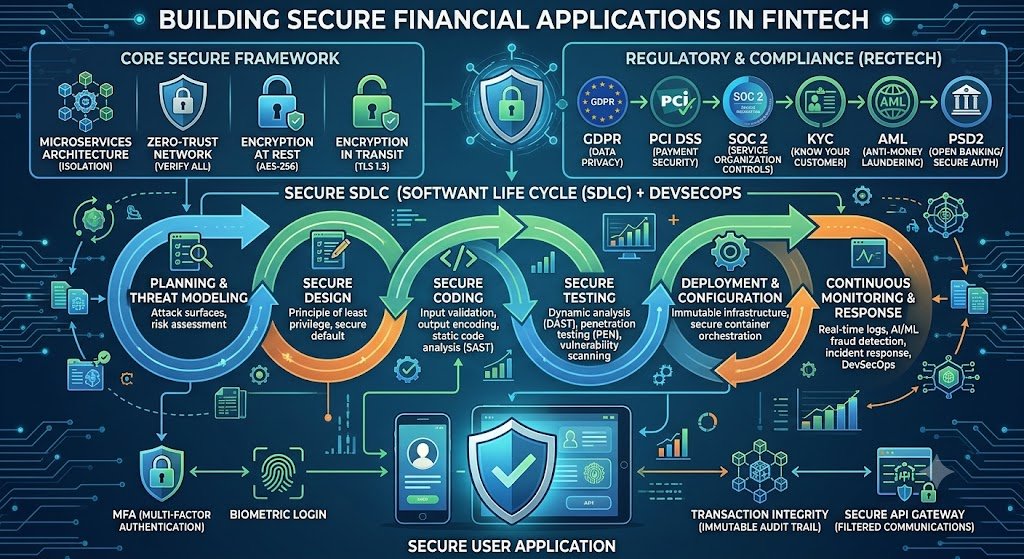
Secure development lifecycle (threat modelling, code review, dependency scanning) is standard practice.
2. Compliance Shapes the Architecture
Regulatory requirements are not add-ons applied at the end. They shape the architecture:
KYC requirements determine the identity verification flow and the data retained.
Data localisation requirements determine where data is stored and processed.
Audit requirements determine what must be logged and for how long.
Consent requirements determine how data sharing is captured and enforced.
3. Money Movement Requires Atomicity and Reconciliation
Every financial transaction must be atomic—either it completes fully or it does not complete at all. Partial transactions (money debited but not credited) are unacceptable. This requires:
Transaction integrity: database transactions, idempotency keys, and reconciliation.
Double-entry accounting: every movement has a corresponding entry.
Reconciliation: daily matching of internal records against bank and payment partner records.
4. Regulatory Reporting Is Continuous
FinTech companies must report to regulators continuously: transaction reports, suspicious activity reports, KYC records, and audit trails. The software must support this reporting, not just the customer-facing flow.
FinTech vs General Software Table
| Dimension | General Software | FinTech Software |
|---|---|---|
| Security | Feature | Core requirement |
| Compliance | Add-on | Architectural driver |
| Transaction integrity | Important | Mandatory (atomicity) |
| Audit logging | Optional | Regulatory requirement |
| Testing | Functional | Functional + security + compliance |
| Timeline | Faster | Longer (compliance review) |
For teams building the secure integration layer and AI features that FinTech requires, our AI Development and Custom Software Development practices cover the full stack.
Secure Architecture: The Patterns That Work
The Layered Security Model
A FinTech application should be built in layers, each with its own security controls.
Layer 1: Client (Mobile/Web). The customer-facing app. Security controls: secure storage (keychain/keystore), certificate pinning, jailbreak/root detection, obfuscation, and session management.
Layer 2: API Gateway. The entry point for all requests. Security controls: authentication (OAuth 2.0, JWT), rate limiting, input validation, and WAF (web application firewall).
Layer 3: Application Services. The business logic. Security controls: authorisation (RBAC/ABAC), service-to-service authentication (mTLS), and secrets management.
Layer 4: Data Layer. The databases and storage. Security controls: encryption at rest, access control, audit logging, and backup encryption.
Layer 5: Key Management. The HSM or KMS that manages encryption keys. Security controls: key rotation, access separation, and audit.
Identity and Authentication
Identity is the foundation of FinTech security. The architecture must support:
Multi-factor authentication: OTP, biometric, device binding.
Device fingerprinting: to detect account takeover.
Session management: timeouts, re-authentication for sensitive actions.
KYC integration: Aadhaar-based eKYC, PAN verification, video KYC.
Transaction Integrity
Every money movement must be atomic and idempotent.
Idempotency keys: every transaction request carries a unique key. Duplicate requests return the same result rather than creating a second transaction.
Double-entry ledger: every debit has a corresponding credit. The ledger is the source of truth.
Reconciliation: daily matching of internal ledger against bank statements and payment partner records.
Saga pattern: for multi-step transactions across services, with compensating actions for failures.
Data Localisation
RBI mandates that payment system data be stored in India. For FinTech companies, this means:
Primary data storage in Indian data centres (AWS Mumbai, Azure India, GCP Mumbai).
Processing in India for payment data.
Cross-border transfer only for permitted purposes and with compliance.
The Architecture at a Glance
| Layer | Components | Security Controls |
|---|---|---|
| Client | Mobile app, web app | Secure storage, certificate pinning, obfuscation |
| API Gateway | Authentication, rate limiting, WAF | OAuth 2.0, JWT, input validation |
| Application | Business logic, services | RBAC/ABAC, mTLS, secrets management |
| Data | Databases, storage | Encryption at rest, access control, audit |
| Key Management | HSM/KMS | Key rotation, access separation |
| Ledger | Double-entry ledger, reconciliation | Atomicity, idempotency, audit |
Build vs Buy: The FinTech Stack
Most FinTech companies do not build everything. The pragmatic approach is to build the differentiated core and buy the commodity infrastructure.
| Component | Build vs Buy | Rationale |
|---|---|---|
| Core ledger | Build | Differentiated, must be owned |
| KYC | Buy (API) | Commodity, regulated vendors |
| Payment rails | Buy (gateway/partner) | Licensed infrastructure |
| Fraud detection | Build or buy | Build for unique patterns, buy for baseline |
| Card issuing | Buy (partner) | Licensed infrastructure |
| Lending engine | Build | Differentiated |
| Compliance reporting | Build or configure | Company-specific |
India-Specific Compliance: RBI, DPDPA, PCI DSS and Account Aggregator
RBI Guidelines
RBI governs FinTech through multiple frameworks. The key ones:
1. KYC Master Directions. Customer identification requirements: Aadhaar-based eKYC, PAN verification, video KYC, and periodic re-KYC.
2. Payment System Data Localisation. Payment system data must be stored in India. This applies to payment aggregators, payment gateways, and wallet issuers.
3. Digital Lending Guidelines. For lending platforms: transparent pricing, no unauthorised data access, direct disbursement to borrower's account, and grievance redressal.
4. Outsourcing Guidelines. For regulated entities: due diligence on service providers, no outsourcing of core functions, and regulatory access to outsourced data.
5. Cyber Security Framework. For banks and regulated entities: security controls, incident reporting, and business continuity.
DPDPA: Financial Personal Data
Financial data is among the most sensitive personal data. Under the DPDP Act:
Consent: must be free, specific, informed, and unambiguous. Bundled consent is not valid.
Purpose limitation: data collected for KYC should not be used for marketing without separate consent.
Data minimisation: collect only what is needed for the financial service.
Retention: financial records have statutory retention requirements, but other data should be purged per policy.
Breach notification: to CERT-In within six hours and to affected individuals.
PCI DSS
Any system that stores, processes, or transmits card data must comply with PCI DSS. The practical approach for most FinTech companies is to use a PCI DSS-compliant payment gateway and never store card data directly.
Account Aggregator Framework
The Account Aggregator (AA) framework allows consented sharing of financial data between institutions. For FinTech companies:
Consent artefact: the user grants consent via an AA, specifying purpose, duration, and data types.
Data flow: the AA fetches data from the user's financial information providers (FIPs) and delivers it to the financial information user (FIU).
Compliance: the FinTech company must be registered as an FIU and comply with AA technical specifications.
Compliance Checklist
| Requirement | Implementation | Priority |
|---|---|---|
| KYC (Aadhaar/PAN/video) | Integrate KYC APIs, store records | High |
| Payment data localisation | Indian data centre storage | High |
| Digital lending disclosure | Transparent pricing, grievance officer | High |
| DPDPA consent | Granular, purpose-specific | High |
| PCI DSS | Use compliant gateway, no card storage | High |
| Account Aggregator | FIU registration, consent artefacts | Medium (if applicable) |
| AML/CFT | Transaction monitoring, STR filing | High |
| Audit logging | All transactions logged, retained | High |
Real Costs in India (2026)
FinTech software costs are higher than general software because of security, compliance, and the complexity of money movement.
Build Costs by Application Type
| Application Type | Build Cost (₹) | Build Cost ($ approx.) | Timeline | Scope |
|---|---|---|---|---|
| Digital wallet MVP | ₹15–35 lakh | $18,000–$42,000 | 12–20 weeks | Wallet, KYC, UPI, basic ledger |
| Lending platform (NBFC) | ₹30–70 lakh | $36,000–$84,000 | 20–32 weeks | Loan origination, KYC, underwriting, disbursement, collections |
| Payment aggregator | ₹50 lakh–₹1.5 crore | $60,000–$1,80,000 | 28–40 weeks | Merchant onboarding, settlement, reconciliation, compliance |
| Wealth management platform | ₹40–90 lakh | $48,000–$1,08,000 | 24–36 weeks | Portfolio, KYC, transactions, reporting |
| Banking app (co-branded) | ₹1–3 crore+ | $1,20,000–$3,60,000+ | 36–52+ weeks | Full banking features, regulatory approval |
Note: USD conversions at ₹83/$. These ranges include design, development, security testing, and basic compliance implementation. They exclude regulatory licensing, partner integration fees, and ongoing compliance audits.
Security and Compliance Costs
| Item | Cost (₹) | Cost ($ approx.) | Notes |
|---|---|---|---|
| Penetration testing | ₹1.5–5 lakh | $1,800–$6,000 | Pre-launch and annual |
| Security audit | ₹1–3 lakh | $1,200–$3,600 | Independent review |
| Compliance consulting | ₹2–8 lakh | $2,400–$9,600 | RBI, DPDPA, PCI DSS |
| KYC API costs | ₹5–20 per verification | $0.06–$0.24 | Per-customer cost |
| Account Aggregator integration | ₹3–10 lakh | $3,600–$12,000 | FIU registration and integration |
Running Costs
| Cost Component | Monthly Range (₹) | Monthly Range ($ approx.) | Notes |
|---|---|---|---|
| Hosting and infrastructure | ₹30,000–₹2,00,000 | $360–$2,400 | Indian data centres |
| KYC and verification APIs | ₹20,000–₹1,50,000 | $240–$1,800 | Scales with customer volume |
| Payment partner fees | Per transaction | — | Varies by partner |
| Security monitoring | ₹20,000–₹80,000 | $240–$960 | SIEM, monitoring |
| Compliance and audit | ₹50,000–₹2,00,000 | $600–$2,400 | Ongoing review |
| Maintenance | ₹50,000–₹2,00,000 | $600–$2,400 | 15–25% of build annually |
The Hidden Costs
Regulatory licensing. For payment aggregators, NBFCs, and wallets, regulatory licensing is a separate, lengthy process with its own costs.
Partner integrations. Banks, payment networks, and KYC providers have their own integration requirements and timelines.
Compliance audits. Ongoing audits (security, compliance, financial) are recurring costs.
Customer support. Financial customers expect responsive support. A support team is a significant ongoing cost.
Implementation Framework: A Phased Approach With Cost Gates
Phase 1: Regulatory Scoping and Architecture (Week 1–4)
Objective: Understand the regulatory requirements and design the secure architecture.
Activities:
Identify the regulatory category: payment aggregator, NBFC, wallet, investment platform, or other.
Map regulatory requirements: RBI guidelines, DPDPA, PCI DSS, AA framework.
Design the architecture: layers, security controls, data flows.
Select partners: KYC provider, payment gateway, bank partner.
Threat model: identify the key security risks.
Cost: ₹2–8 lakh ($2,400–$9,600) for scoping and architecture.
Go/No-Go: Regulatory requirements understood. Architecture approved. Partners identified.
Phase 2: Core Build (Week 5–16)
Objective: Build the core application with security and ledger.
Activities:
Identity and authentication: MFA, device binding, KYC integration.
Core ledger: double-entry, idempotency, reconciliation.
Core business logic: wallet, lending, or payment flow.
API gateway and security controls.
Audit logging.
Cost: ₹15–40 lakh ($18,000–$48,000) depending on application type.
Go/No-Go: Core flows work. Ledger is atomic. Security controls in place.
Phase 3: Partner Integration (Week 17–24)
Objective: Integrate with banks, payment networks, and KYC providers.
Activities:
Payment gateway integration (UPI, cards, net banking).
Bank partner integration for disbursement and settlement.
KYC API integration (Aadhaar, PAN, video KYC).
Account Aggregator integration (if applicable).
Reconciliation with partners.
Cost: ₹10–30 lakh ($12,000–$36,000) depending on integrations.
Go/No-Go: End-to-end transaction works. Reconciliation matches partner records.
Phase 4: Security and Compliance Testing (Week 25–30)
Objective: Validate security and compliance before launch.
Activities:
Penetration testing.
Security audit.
Compliance review: RBI, DPDPA, PCI DSS.
AML/CFT transaction monitoring setup.
Incident response plan.
Cost: ₹3–10 lakh ($3,600–$12,000).
Go/No-Go: Penetration test passes. Compliance review passes.
Phase 5: Pilot and Scale (Month 8–12)
Objective: Pilot with limited customers and scale.
Activities:
Pilot with a limited cohort.
Monitor fraud, errors, and reconciliation.
Fix issues.
Scale to full customer base.
Cost: Running costs plus governance.
Go/No-Go: Pilot meets security, compliance, and operational criteria.
Phase Summary Table
| Phase | Duration | Key Deliverable | Cost (₹) | Go/No-Go Criteria |
|---|---|---|---|---|
| 1. Regulatory Scoping | 3–4 weeks | Architecture, partner selection | 2–8 lakh | Requirements understood |
| 2. Core Build | 10–12 weeks | Identity, ledger, core logic | 15–40 lakh | Core flows work |
| 3. Partner Integration | 6–8 weeks | Payment, bank, KYC integrations | 10–30 lakh | End-to-end works |
| 4. Security Testing | 4–6 weeks | Pen test, compliance review | 3–10 lakh | Tests pass |
| 5. Pilot & Scale | 6 months | Pilot results, scaling | Running costs | Pilot meets criteria |
Risks, Pitfalls, and Governance
The Most Common FinTech Failures
Security breach. A single breach can end a FinTech company. Mitigation: Threat modelling, pen testing, encryption, monitoring, incident response.
Compliance gap. Missing a regulatory requirement can result in penalties or licence revocation. Mitigation: Regulatory scoping in phase one, compliance review before launch.
Reconciliation failure. Mismatched records between internal ledger and partner records cause customer disputes and regulatory issues. Mitigation: Daily reconciliation, automated alerts, exception handling.
Fraud. Financial fraud is sophisticated and evolving. Mitigation: Transaction monitoring, ML-based fraud detection, velocity checks, device fingerprinting.
Vendor dependency. Dependence on a single KYC or payment partner creates risk. Mitigation: Multiple partners, abstraction layer, fallback.
Data localisation failure. Storing payment data outside India violates RBI requirements. Mitigation: Indian data centres, data flow mapping.
Risk Summary Table
| Risk | Likelihood | Impact | Mitigation |
|---|---|---|---|
| Security breach | Medium | Critical | Encryption, pen testing, monitoring |
| Compliance gap | Medium | Critical | Regulatory scoping, compliance review |
| Reconciliation failure | High | High | Daily reconciliation, alerts |
| Fraud | High | High | Fraud detection, monitoring |
| Vendor dependency | Medium | Medium | Multiple partners, abstraction |
| Data localisation failure | Medium | High | Indian data centres |
Benchmark Summary and Decision Framework
Decision Matrix: Build vs Buy
| Factor | Build Custom | Buy Platform |
|---|---|---|
| Differentiation | Core product value | Commodity feature |
| Regulatory control | Full control | Vendor-dependent |
| Speed | Slower | Faster |
| Cost | Higher upfront | Subscription |
| Best for | Core banking/lending logic | KYC, payments, card issuing |
Compliance Priority Table
| Requirement | Impact | Effort | Priority |
|---|---|---|---|
| KYC | Very High | Medium | 1 |
| Data localisation | Very High | Medium | 2 |
| Encryption | Very High | Medium | 3 |
| Audit logging | High | Medium | 4 |
| Reconciliation | High | High | 5 |
| DPDPA consent | High | Medium | 6 |
| AML monitoring | High | High | 7 |
| Account Aggregator | Medium | High | 8 |
The One-Paragraph Decision Rule
If you are building a FinTech application, start with regulatory scoping—understand what RBI, DPDPA, and PCI DSS require before writing code. Build the core ledger and identity with security and atomicity as first principles. Buy commodity infrastructure (KYC, payments, card issuing) from regulated partners. Test security before launch, not after. And build reconciliation from day one—it is the operational foundation of trust.
Frequently Asked Questions
1. How much does FinTech software development cost in India?
A digital wallet MVP costs ₹15–35 lakh ($18,000–$42,000). A lending platform costs ₹30–70 lakh ($36,000–$84,000). A payment aggregator costs ₹50 lakh–₹1.5 crore ($60,000–$1,80,000). A banking app costs ₹1–3 crore+ ($1,20,000–$3,60,000+).
2. What RBI requirements apply to FinTech software?
KYC Master Directions, Payment System Data Localisation, Digital Lending Guidelines, Outsourcing Guidelines, and Cyber Security Framework. The specific requirements depend on the regulatory category.
3. How does DPDPA affect FinTech applications?
Financial data is sensitive personal data. Consent must be specific and informed, purpose limitation applies, data minimisation is required, and breach notification to CERT-In within six hours is mandatory.
4. What is PCI DSS and do I need it?
PCI DSS is the standard for handling card data. If you store, process, or transmit card data, you must comply. The practical approach is to use a PCI DSS-compliant gateway and never store card data directly.
5. What is the Account Aggregator framework?
The AA framework allows consented sharing of financial data between institutions. FinTech companies must register as Financial Information Users (FIUs) and comply with AA technical specifications.
6. How do I ensure transaction integrity?
Use double-entry ledger, idempotency keys for every transaction, saga pattern for multi-step transactions, and daily reconciliation against partner records.
7. How do I prevent fraud in my FinTech app?
Transaction monitoring, ML-based fraud detection, velocity checks, device fingerprinting, and real-time alerting. Fraud detection is an ongoing investment, not a one-time feature.
8. Do I need to store data in India?
RBI mandates that payment system data be stored in India. Other financial data may also be subject to localisation requirements depending on the category. Use Indian data centres (AWS Mumbai, Azure India, GCP Mumbai).
9. How long does FinTech software development take?
A wallet MVP takes 12–20 weeks. A lending platform takes 20–32 weeks. A payment aggregator takes 28–40 weeks. A banking app takes 36–52+ weeks. Timeline depends on regulatory scope and integrations.
10. What are the biggest risks in FinTech development?
Security breaches, compliance gaps, reconciliation failures, fraud, vendor dependency, and data localisation failures. All require dedicated attention from the architecture phase.
11. Should I build or buy KYC?
Buy KYC from a regulated vendor. KYC is a commodity infrastructure with regulatory requirements that are expensive to build and maintain. Integrate via API.
12. How can Innovative AI Solutions help?
Innovative AI Solutions builds secure FinTech applications for Indian companies—secure architecture, KYC integration, payment rails, ledger design, RBI and DPDPA compliance, and AI features like fraud detection. Our Delhi-based team handles regulatory scoping, development, and security testing. Visit https://innovativeais.com to discuss your requirements.
Contact Innovative AI Solutions
Ready to build a financial application that earns and keeps customer trust?
[One-line supporting sentence.]
Contact Information
Innovative AI Solutions
📍 Netaji Subhash Place, Pitampura, Delhi – 110034
🌐 Website: https://innovativeaislabs.com 📧 Email: info@innovativeais.com
📞 Phone: +91 7464 099 059 / +91 96899 67356
Business Services
AI Automation
AI Development
AI Consulting
Machine Learning Solutions
Deep Learning Solutions
Generative AI Services
NLP Solutions
AI Agents
AI Chatbots
Voice AI
CRM Development
Custom Software Development
Website Development
Mobile App Development
About the Author
Abhishek Kumar
Founder & CEO, Innovative AI Solutions
5+ years building production AI systems for Indian businesses. Based in Delhi, serving clients across India.
Ready to build AI solutions for your business?
Innovative AI Solutions — Delhi's leading AI development company. Free consultation available.
Get Free Consultation →
A practical 2026 guide for Indian FinTech builders—secure architecture, RBI and DPDPA compliance, real rupee costs, and a phased framework that puts security and reconciliation before features.
#FinTech #FinTechSoftware #SecureFinancialApps #RBI #DPDPA #PCIDSS #KYC #AML #UPI #LendingPlatform #NBFC #AccountAggregator #FraudDetection #RegTech #FinTechIndia #DelhiNCR #InnovativeAISolutions
Copyright ©️ 2015–2026 Innovative AI Solutions. All Rights Reserved. | Privacy Policy | Terms & Conditions