The Framework Decision That Outlives the Launch Party
A business app launches. The team celebrates. Eighteen months later, the real question arrives: can we still hire developers for this framework, does the app still perform on the latest OS versions, and how much does it cost to keep it running?
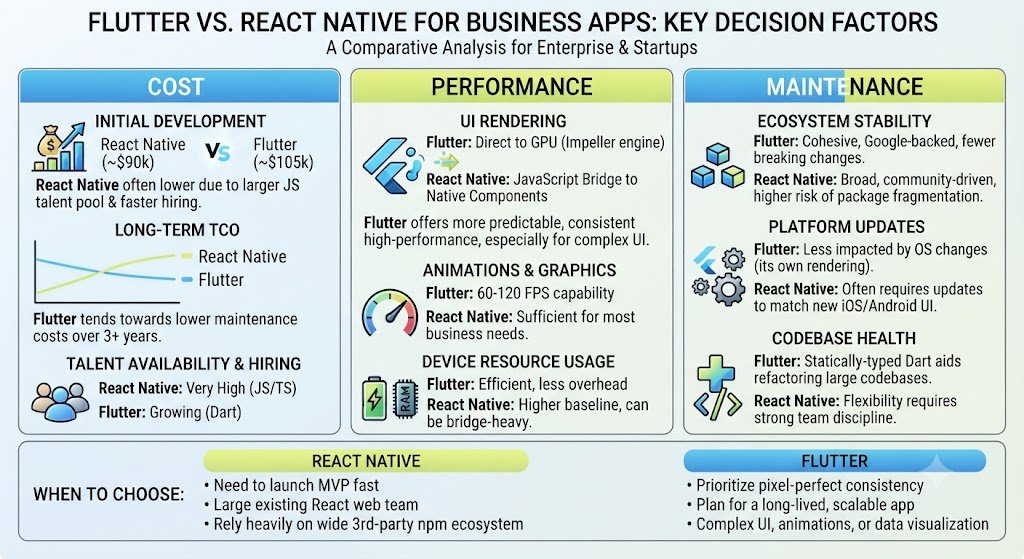
This is the decision most Indian businesses make too casually. Flutter vs React Native is often framed as a technical preference—which framework the developer likes, which has better tutorials, which is trending on social media. But for a business app that will be maintained for years, the framework choice is a long-term cost and capability decision. It determines hiring pools, maintenance costs, performance ceilings, and how quickly you can adopt new platform features.
Both frameworks are mature in 2026. Both build iOS and Android apps from a single codebase. Both are used in production by large companies. The question is not which is "better" in the abstract. It is which is better for your specific business app, your team, and your five-year maintenance horizon.
The cost difference between the two frameworks is often overstated. Both are significantly cheaper than building two native apps. The real differences lie in:
Performance characteristics for specific use cases (animation-heavy vs data-heavy apps).
Hiring availability and cost in the Indian market.
Maintenance burden as OS versions and dependencies change.
Ecosystem maturity for the integrations your app needs.
Compliance tooling for DPDPA and security requirements.
This guide is written for Indian founders, CTOs, product managers, and business leaders choosing between Flutter and React Native for a business app. We will compare development costs, performance, hiring, maintenance, and compliance considerations in rupees and dollars, and provide a decision framework that goes beyond framework preference.
The Fundamentals: What Each Framework Actually Is
Flutter: Google's UI Toolkit
Flutter is an open-source UI toolkit developed by Google. It uses the Dart programming language and compiles to native machine code for iOS, Android, web, and desktop. Flutter renders its own UI using a graphics engine (Skia, and increasingly Impeller), which means the UI looks identical across platforms.
Key characteristics:
Language: Dart (typed, object-oriented).
Rendering: Custom rendering engine, consistent UI across platforms.
Performance: Near-native, especially for animation-heavy interfaces.
Ecosystem: Growing, backed by Google, strong for UI-heavy apps.
React Native: Meta's JavaScript Framework
React Native is an open-source framework developed by Meta. It uses JavaScript (or TypeScript) and React, and renders using native platform components. The New Architecture (Fabric and TurboModules) has improved performance and interoperability with native code.
Key characteristics:
Language: JavaScript/TypeScript (widely known).
Rendering: Native components, closer to platform look and feel.
Performance: Good for most business apps, with native modules for heavy lifting.
Ecosystem: Large, backed by Meta and a huge JavaScript community.
Framework Fundamentals Table
| Dimension | Flutter | React Native |
|---|---|---|
| Language | Dart | JavaScript/TypeScript |
| Backed by | Meta | |
| Rendering | Custom engine (Skia/Impeller) | Native components |
| UI consistency | Identical across platforms | Platform-native look |
| Code sharing | ~95%+ | ~85–90% |
| Learning curve | Moderate (Dart is new to most) | Low for React developers |
| Best for | UI-heavy, animation-rich apps | Data-heavy, business workflow apps |
For teams building business apps with AI features, our Mobile App Development and AI Development practices cover both frameworks.
Cost Comparison: Development, Hiring and Maintenance in India The most common question about Flutter vs React Native is cost. The honest answer is that development cost is similar for comparable apps—but hiring and maintenance costs diverge.
Development Cost
For the same app scope, Flutter and React Native development costs are broadly comparable. Both are cross-platform frameworks that share code between iOS and Android, reducing cost versus building two native apps.
| App Complexity | Flutter Build Cost (₹) | React Native Build Cost (₹) | Build Cost ($ approx.) |
|---|---|---|---|
| Simple (5–10 screens) | ₹3–8 lakh | ₹3–8 lakh | $3,600–$9,600 |
| Medium (15–25 screens) | ₹8–20 lakh | ₹8–20 lakh | $9,600–$24,000 |
| Complex (30+ screens) | ₹20–50 lakh | ₹20–50 lakh | $24,000–$60,000 |
Note: USD conversions at ₹83/$. These ranges are indicative for Indian development teams. The framework choice does not significantly change the build cost for comparable scope—the team's expertise matters more.
Hiring Cost and Availability
This is where the frameworks diverge in the Indian market.
React Native hiring: JavaScript is the most widely known programming language in India. React Native developers are abundant, and many web developers can transition to React Native. The hiring pool is large, and salaries are competitive.
Flutter hiring: Dart is less widely known. Flutter developers are available but fewer in number. Salaries may be slightly higher for experienced Flutter developers, and the hiring pool is smaller.
| Role | Flutter Salary (₹/year) | React Native Salary (₹/year) | Salary ($ approx.) |
|---|---|---|---|
| Junior developer | ₹3–6 lakh | ₹3–6 lakh | $3,600–$7,200 |
| Mid-level developer | ₹6–12 lakh | ₹6–12 lakh | $7,200–$14,400 |
| Senior developer | ₹12–25 lakh | ₹12–25 lakh | $14,400–$30,000 |
| Hiring pool | Smaller | Larger | — |
| Transition from web | Harder (Dart is new) | Easier (JavaScript) | — |
Sources: Synthesised from Indian IT salary surveys, 2026.
Maintenance Cost
Maintenance is where the framework choice has the largest long-term impact. Both frameworks require updates as OS versions change, dependencies evolve, and security patches are released.
| Maintenance Factor | Flutter | React Native |
|---|---|---|
| OS update handling | Google updates Flutter for new OS versions | Meta and community update React Native |
| Dependency churn | Moderate (pub packages) | Higher (npm ecosystem churn) |
| Breaking changes | Occasional, documented | More frequent (New Architecture migration) |
| Annual maintenance cost | 15–20% of build cost | 15–25% of build cost |
Note: React Native's New Architecture migration (Fabric, TurboModules) has required significant effort for some apps in 2024–2025. Apps that depend heavily on older native modules have faced higher migration costs.
Total Cost of Ownership: 3-Year View
| Cost Component | Flutter (₹) | React Native (₹) |
|---|---|---|
| Initial build (medium app) | 8–20 lakh | 8–20 lakh |
| Annual maintenance (3 years) | 3.6–12 lakh | 3.6–15 lakh |
| Hiring premium (if any) | Slight | Lower |
| Total 3-year TCO | 12–32 lakh | 12–35 lakh |
The bottom line: For most Indian business apps, the cost difference between Flutter and React Native is not the deciding factor. The decision should be driven by performance requirements, team expertise, and long-term maintenance considerations.
Performance Comparison: Where Each Framework Excels
Performance is the most debated dimension. The honest answer is that both frameworks are fast enough for most business apps—but they differ in specific scenarios.
Flutter Performance
Flutter compiles to native machine code and renders its own UI. This gives it consistent performance across platforms and excellent animation performance.
Strengths:
Animation-heavy interfaces: Flutter's rendering engine handles complex animations smoothly.
Consistent UI: No platform-specific rendering differences.
Startup time: Generally fast, especially with Impeller.
Complex custom UI: Flutter's widget system makes custom UI easier to build and performant.
Weaknesses:
App size: Flutter apps tend to be larger than React Native apps due to the embedded rendering engine.
Native integration: Platform-specific features require platform channels, which add complexity.
React Native Performance
React Native uses native components and the JavaScript bridge (now replaced by the New Architecture's JSI). Performance is good for most business apps.
Strengths:
Native look and feel: Uses platform-native components, so the app feels native.
Data-heavy apps: Lists, forms, and business workflows perform well.
Native module access: Easier integration with platform-specific features.
App size: Generally smaller than Flutter.
Weaknesses:
Animation performance: Historically weaker than Flutter for complex animations, though the New Architecture has improved this.
Bridge overhead: Older architecture had bridge overhead; the New Architecture addresses this.
Performance Comparison Table
| Scenario | Flutter | React Native | Winner |
|---|---|---|---|
| Complex animations | Excellent | Good (improved with New Architecture) | Flutter |
| Data-heavy lists/forms | Good | Excellent | React Native |
| Native look and feel | Consistent (custom) | Native | React Native |
| App size | Larger | Smaller | React Native |
| Startup time | Fast | Fast (New Architecture) | Tie |
| Custom UI | Excellent | Good | Flutter |
| Native module integration | Moderate (platform channels) | Easier | React Native |
For business apps: Most business apps are data-heavy (forms, lists, dashboards, workflows) rather than animation-heavy. React Native performs well in these scenarios. Flutter excels when the app has complex custom UI or animations.
Ecosystem and Integration: What Your App Needs to Connect To
Business apps rarely stand alone. They integrate with payment gateways, CRMs, analytics, push notifications, maps, and backend APIs. The ecosystem maturity for these integrations matters.
Flutter Ecosystem
Packages: pub.dev has a growing package ecosystem. Most common integrations are covered.
Payment gateways: Razorpay, PayU, and Stripe have Flutter SDKs.
Analytics: Firebase, Mixpanel, and others support Flutter.
Push notifications: Firebase Cloud Messaging works well.
Maps: Google Maps Flutter plugin is mature.
React Native Ecosystem
Packages: npm has a massive ecosystem. Almost every service has a React Native library.
Payment gateways: Razorpay, PayU, and Stripe have React Native SDKs.
Analytics: Firebase, Mixpanel, and others support React Native.
Push notifications: Firebase Cloud Messaging works well.
Maps: react-native-maps is mature.
Ecosystem Comparison Table
| Integration | Flutter | React Native |
|---|---|---|
| Payment gateways (Razorpay, PayU) | Good | Excellent |
| CRM SDKs | Limited | Better |
| Analytics | Good | Excellent |
| Push notifications | Good | Excellent |
| Maps | Good | Excellent |
| Third-party SDKs | Growing | Mature |
For Indian business apps: React Native has a slight edge in ecosystem maturity, especially for enterprise integrations. Flutter is catching up quickly.
Maintenance and Long-Term Support
The framework you choose will be maintained for years. The maintenance burden depends on how actively the framework is developed, how often breaking changes occur, and how easy it is to find developers.
Flutter Maintenance
Backed by Google: Active development, regular releases.
Stable releases: Flutter has a stable channel with predictable releases.
Breaking changes: Occasional, documented in release notes.
Developer availability: Smaller pool, but growing.
React Native Maintenance
Backed by Meta: Active development, community contributions.
New Architecture: The migration to Fabric and TurboModules has required effort for some apps.
Breaking changes: More frequent, especially in the ecosystem (npm packages).
Developer availability: Large pool, easier to hire.
Maintenance Considerations Table
| Factor | Flutter | React Native |
|---|---|---|
| Framework stability | High | High (post New Architecture) |
| Breaking change frequency | Low-Medium | Medium |
| Dependency churn | Moderate | Higher |
| Hiring ease | Moderate | Easy |
| Long-term support | Strong (Google) | Strong (Meta) |
India-Specific Considerations
DPDPA Compliance
Both Flutter and React Native can implement DPDPA-compliant apps. The framework does not determine compliance—the architecture and implementation do. Key considerations:
Secure storage: Both frameworks have secure storage plugins (flutter_secure_storage, react-native-keychain).
Consent capture: Both can implement consent screens and store consent records.
Data minimisation: Both can be implemented with minimal data collection.
Audit logging: Both can log data access for accountability.
MeitY AI Governance
If the app includes AI features (chatbots, recommendations), both frameworks can integrate with AI APIs. The governance requirements (transparency, accountability) apply regardless of framework.
Indian Language Support
Both frameworks support Indian languages through localization. Flutter's approach is more consistent across platforms; React Native relies on platform localization.
Device Fragmentation
Indian Android fragmentation is significant. Both frameworks handle it, but testing on real devices is essential regardless of framework.
Implementation Framework: Making the Decision
Decision Framework Table
| Your Situation | Recommended Framework | Why |
|---|---|---|
| Team knows JavaScript/React | React Native | Lower learning curve, faster start |
| Team knows Dart/Flutter | Flutter | Leverage existing expertise |
| Animation-heavy app | Flutter | Better animation performance |
| Data-heavy business app | React Native | Better for forms, lists, workflows |
| Native look and feel required | React Native | Uses native components |
| Consistent UI across platforms | Flutter | Custom rendering |
| Tight hiring market | React Native | Larger talent pool |
| Custom complex UI | Flutter | Widget system flexibility |
| Enterprise integrations | React Native | Mature ecosystem |
Cost Gates for the Decision
| Phase | Activity | Cost (₹) | Decision Gate |
|---|---|---|---|
| Assessment | Team skills audit, requirements | 0–50,000 | Which framework fits team and app? |
| Prototype | Build a small feature in both | 1–3 lakh | Which performs better for your use case? |
| Decision | Choose framework | — | Commit to one |
Recommendation: For most Indian business apps, the decision should be driven by team expertise and app requirements, not framework trends. If the team knows JavaScript, React Native is the pragmatic choice. If the app is UI-heavy or animation-rich, Flutter may be better.
Benchmark Summary and Decision Framework
Comparison Summary Table
| Dimension | Flutter | React Native |
|---|---|---|
| Development cost | Similar | Similar |
| Hiring pool (India) | Smaller | Larger |
| Performance (business apps) | Good | Good |
| Performance (animations) | Excellent | Good |
| App size | Larger | Smaller |
| Ecosystem | Growing | Mature |
| Maintenance | Moderate | Moderate-Higher |
| Best for | UI-heavy, custom UI | Data-heavy, native feel |
The One-Paragraph Decision Rule
If your team knows JavaScript or React, choose React Native. If your app is animation-heavy or requires complex custom UI, choose Flutter. If you need to hire quickly in India, React Native has a larger pool. If you want consistent UI across platforms, Flutter delivers it. Do not choose based on trend—choose based on team expertise, app requirements, and long-term maintenance capacity.
Frequently Asked Questions
1. Is Flutter or React Native better for business apps in 2026?
Both are mature and suitable. React Native is better for data-heavy business apps and teams with JavaScript expertise. Flutter is better for UI-heavy, animation-rich apps and teams that want consistent UI across platforms. The decision depends on your team and app requirements.
2. Is Flutter cheaper than React Native?
Development costs are similar for comparable scope. Hiring costs may be slightly higher for Flutter due to a smaller talent pool. Maintenance costs are comparable. The cost difference is usually not the deciding factor.
3. Which framework has better performance?
Flutter has better animation performance and consistent UI rendering. React Native has better native look and feel and is excellent for data-heavy apps. For most business apps, both are fast enough.
4. Which framework is easier to hire for in India?
React Native. JavaScript is widely known, and many web developers can transition to React Native. Flutter developers are available but fewer in number.
5. Can I use Flutter or React Native for an app with AI features?
Yes. Both frameworks can integrate with AI APIs (chatbots, recommendations, document processing). The AI features are typically backend services called via API, so the framework choice does not restrict AI capabilities.
6. How does DPDPA affect the framework choice?
It does not. Both frameworks can implement DPDPA-compliant apps with secure storage, consent capture, and audit logging. Compliance depends on implementation, not framework.
7. Which framework is better for enterprise integrations?
React Native has a slight edge due to a more mature ecosystem for enterprise SDKs. Flutter is catching up.
8. What about app size?
Flutter apps tend to be larger due to the embedded rendering engine. React Native apps are generally smaller. For most business apps, this is not a deciding factor.
9. How long does it take to build a business app in Flutter or React Native? A simple app takes 6–10 weeks. A medium app takes 10–16 weeks. A complex app takes 16–28 weeks. Timeline is similar for both frameworks.
10. What is the maintenance cost for Flutter vs React Native?
Both require 15–25% of build cost annually for maintenance. React Native may have slightly higher dependency churn due to the npm ecosystem.
11. Can I switch frameworks later?
Switching is expensive and rarely justified. Choose carefully upfront based on team expertise and app requirements.
12. How can Innovative AI Solutions help?
Innovative AI Solutions builds business apps in both Flutter and React Native for Indian companies—with AI features, DPDPA compliance, and long-term maintenance. Our Delhi-based team helps you choose the right framework and build for the long term. Visit https://innovativeais.com to discuss your requirements.
Contact Innovative AI Solutions
Ready to choose the right framework and build a business app you can maintain for years?
[One-line supporting sentence.]
Contact Information
Innovative AI Solutions
📍 Netaji Subhash Place, Pitampura, Delhi – 110034
🌐 Website: https://innovativeaislabs.com 📧 Email: info@innovativeais.com
📞 Phone: +91 7464 099 059 / +91 96899 67356
Business Services
AI Automation
AI Development
AI Consulting
Machine Learning Solutions
Deep Learning Solutions
Generative AI Services
NLP Solutions
AI Agents
AI Chatbots
Voice AI
CRM Development
Custom Software Development
Website Development
Mobile App Development
About the Author
Abhishek Kumar
Founder & CEO, Innovative AI Solutions
5+ years building production AI systems for Indian businesses. Based in Delhi, serving clients across India.
Ready to build AI solutions for your business?
Innovative AI Solutions — Delhi's leading AI development company. Free consultation available.
Get Free Consultation →
A practical 2026 comparison of Flutter and React Native for Indian business apps—real rupee costs, performance trade-offs, hiring pools, maintenance burden, and a decision framework based on team expertise rather than framework trends.
#Flutter #ReactNative #CrossPlatformDevelopment #AppDevelopmentIndia #MobileApps #Dart #JavaScript #BusinessApps #AppPerformance #AppMaintenance #DeveloperHiring #DPDPA #MeitY #DelhiNCR #InnovativeAISolutions
Copyright ©️ 2015–2026 Innovative AI Solutions. All Rights Reserved. | Privacy Policy | Terms & Conditions