


The Recovery Plan That Existed Only on Paper
A cloud provider experiences a regional outage. An Indian e-commerce company's primary region goes down. The team opens the disaster recovery runbook—and discovers it was written 18 months ago, references infrastructure that has since been changed, and has never been tested. The secondary region exists, but the database replication was broken three months ago and no one noticed. The company is down for 14 hours.
This is the most common failure in disaster recovery: the plan exists, but it has never been validated. A DR plan that has never been tested is not a capability. It is a hope.
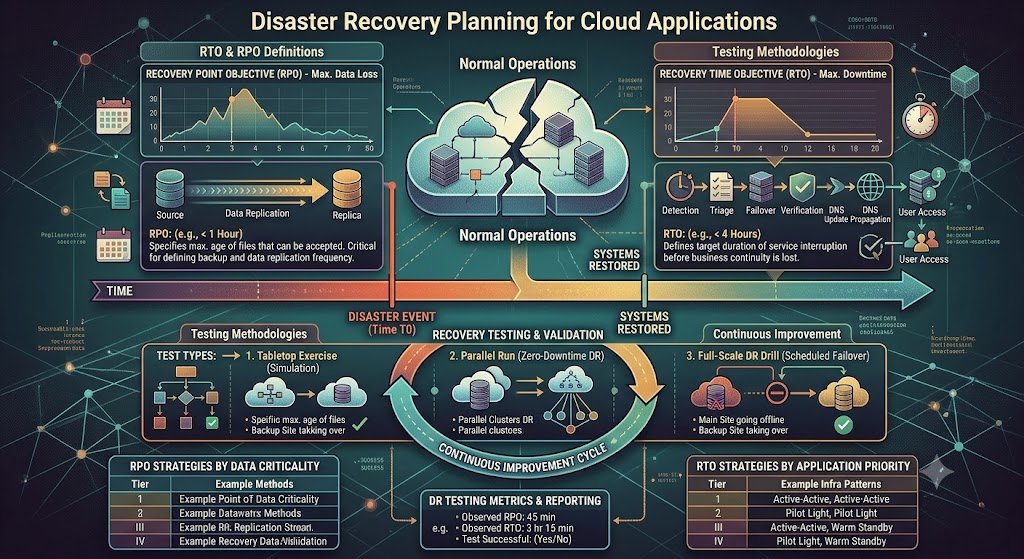
Disaster recovery planning for cloud applications is the discipline of designing, implementing, and testing systems that can recover from failures—region outages, data corruption, ransomware, human error, and service failures. It is built on two fundamental metrics: RTO (Recovery Time Objective)—how long the application can be down—and RPO (Recovery Point Objective)—how much data can be lost.
For Indian businesses, disaster recovery is no longer optional. Cloud providers have outages. Ransomware attacks are increasing. Regulatory frameworks—RBI for financial services, CERT-In for cyber incidents, and DPDPA for personal data—impose recovery and notification obligations. And customers expect their data to be safe.
India adds specific considerations. Data localisation may require backup and DR infrastructure in India for regulated sectors. DPDPA imposes obligations on data availability and breach notification. CERT-In requires incident reporting within six hours. And cloud provider regional architecture in India (AWS Mumbai, Azure Pune, GCP Mumbai) shapes the DR options available.
This guide is written for Indian CTOs, infrastructure leads, DevOps engineers, and compliance officers planning disaster recovery. We will cover RTO and RPO definitions, the DR strategies available in cloud environments, the testing framework that validates recovery, real costs in rupees and dollars, and DPDPA/CERT-In compliance obligations.
RTO and RPO: The Two Numbers That Define Everything
RTO and RPO are the foundation of disaster recovery planning. Every architectural decision flows from these two numbers.
Recovery Time Objective (RTO)
RTO is the maximum acceptable time between a disaster and restoration of service. If RTO is four hours, the application must be back online within four hours.
RTO determines the DR strategy: a four-hour RTO requires a warm standby; a 24-hour RTO may allow backup and restore; a near-zero RTO requires active-active multi-region.
Recovery Point Objective (RPO)
RPO is the maximum acceptable amount of data loss, measured in time. If RPO is 15 minutes, the application can lose up to 15 minutes of data.
RPO determines the replication strategy: continuous replication for near-zero RPO; periodic backups for hours or days of RPO.
The Cost Curve
RTO and RPO are directly tied to cost. As RTO approaches zero and RPO approaches zero, cost increases dramatically.
| RTO | RPO | Typical Strategy | Relative Cost |
|---|---|---|---|
| Hours to days | Hours | Backup and restore | Low |
| 1–4 hours | Minutes | Pilot light / warm standby | Medium |
| Minutes | Seconds | Hot standby | High |
| Near-zero | Near-zero | Active-active multi-region | Very high |
Defining RTO and RPO for Business Applications
The right RTO and RPO depend on the business impact of downtime and data loss.
| Application Type | Typical RTO | Typical RPO | Rationale |
|---|---|---|---|
| Payment processing | Minutes | Zero | Direct revenue, regulatory |
| E-commerce storefront | 1–2 hours | Minutes | Revenue loss per hour |
| Internal CRM | 4–8 hours | Hours | Productivity loss |
| Reporting/analytics | 24 hours | Hours | Delayed decisions |
| Development/test | Days | Days | Non-critical |
For teams building the applications and infrastructure that DR protects, our Custom Software Development and AI Development practices cover the full stack.
DR Strategies: From Backup to Active-Active
Cloud environments offer a spectrum of DR strategies, each with different RTO/RPO characteristics and costs.
1. Backup and Restore
The simplest strategy: take regular backups, store them in a separate location, and restore when needed.
How it works: Backups are taken (daily or hourly), stored in object storage or a backup service, and restored to the primary region when it recovers or to a secondary region if needed.
RTO: Hours to days (restore time depends on data volume). RPO: Hours (depends on backup frequency). Cost: Lowest. Best for: Non-critical applications, reporting systems, development environments.
2. Pilot Light
A minimal version of the environment is always running in the secondary region. The database replicates continuously; the application servers are dormant and can be scaled up when needed.
How it works: Core data (database) is replicated; application infrastructure is defined as code and can be deployed quickly; load balancers and DNS are pre-configured for failover.
RTO: 1–4 hours (time to scale up and switch traffic). RPO: Minutes (continuous replication). Cost: Medium (small standby infrastructure). Best for: Business-critical applications with moderate RTO.
3. Warm Standby
A scaled-down but fully functional version of the application runs in the secondary region. It can handle traffic immediately, though at reduced capacity.
How it works: All components run in the secondary region at reduced scale; database replicates continuously; failover is a matter of scaling up and switching DNS.
RTO: Minutes to an hour. RPO: Seconds to minutes. Cost: High (duplicate infrastructure at reduced scale). Best for: High-availability applications with strict RTO.
4. Active-Active (Multi-Region)
The application runs in multiple regions simultaneously, with traffic distributed across them. If one region fails, traffic routes to the other.
How it works: All regions are active; traffic is routed via global load balancer or DNS; data is replicated bidirectionally (or partitioned by region).
RTO: Near-zero (automatic failover). RPO: Near-zero (continuous replication, though consistency challenges exist). Cost: Highest (full infrastructure in multiple regions). Best for: Mission-critical, global applications.
DR Strategy Comparison Table
| Strategy | RTO | RPO | Cost | Complexity | Best For |
|---|---|---|---|---|---|
| Backup and restore | Hours–days | Hours | Low | Low | Non-critical |
| Pilot light | 1–4 hours | Minutes | Medium | Medium | Business-critical |
| Warm standby | Minutes–1 hour | Seconds | High | High | High availability |
| Active-active | Near-zero | Near-zero | Very high | Very high | Mission-critical |
Cloud-Specific DR Considerations for India
Region and Availability Zone Architecture
Indian cloud providers offer multiple regions and availability zones:
AWS: Mumbai (ap-south-1), Hyderabad (ap-south-2).
Azure: Pune (Central India), Chennai (South India), Mumbai (West India).
GCP: Mumbai (asia-south1), Delhi NCR (asia-south2).
DR design implications:
Multi-AZ within a region: Protects against AZ failure but not region failure.
Multi-region within India: Protects against region failure while maintaining data localisation.
Cross-border DR: May violate data localisation for regulated sectors.
Data Localisation
RBI mandates that payment system data be stored in India. For DR, this means:
Primary and DR both in India for payment data.
Cross-border replication only for permitted purposes.
Database Replication
Database replication is the backbone of DR. Options:
Synchronous replication: Zero data loss, higher latency, requires low-latency links.
Asynchronous replication: Near-zero data loss, lower latency, but some data loss possible.
Managed replication: Cloud provider services (AWS RDS Multi-AZ, Azure SQL geo-replication).
Infrastructure as Code for DR
DR infrastructure should be defined as code (Terraform, CloudFormation) so it can be deployed consistently and quickly. This is essential for pilot light and warm standby strategies.
DNS and Traffic Failover
DNS failover routes traffic to the DR region when the primary fails. Options:
Route 53 health checks with failover routing.
Global load balancers (AWS Global Accelerator, Azure Traffic Manager).
CDN failover for static content.
TTL considerations: DNS TTL determines how quickly failover takes effect. Low TTL (60 seconds) enables faster failover but increases DNS query volume.
Cloud DR Considerations Table
| Consideration | India-Specific Impact |
|---|---|
| Region selection | Multiple Indian regions available |
| Data localisation | Primary and DR both in India for regulated data |
| Replication | Synchronous vs asynchronous trade-offs |
| IaC | Essential for fast DR deployment |
| DNS failover | Low TTL for fast failover |
Testing: The Only Way to Know DR Works
A DR plan that has not been tested is not a plan. Testing validates that the plan works, identifies gaps, and builds team confidence.
Types of DR Tests
1. Tabletop exercise. The team walks through the DR plan verbally, discussing roles, steps, and decisions. No systems are changed.
2. Component test. Test individual components (database failover, DNS switch, backup restore) in isolation.
3. Partial failover test. Fail over a non-critical component or a subset of traffic to the DR region.
4. Full failover test. Fail over the entire application to the DR region and run production traffic.
5. Chaos engineering. Deliberately inject failures (kill instances, simulate region outage) to test resilience continuously.
The DR Testing Framework
| Test Type | Frequency | Effort | What It Validates |
|---|---|---|---|
| Tabletop | Quarterly | Low | Plan, roles, communication |
| Component | Monthly | Medium | Individual failover mechanisms |
| Partial failover | Quarterly | High | Partial DR capability |
| Full failover | Annually | Very high | Complete DR capability |
| Chaos engineering | Continuous | Medium | Ongoing resilience |
What to Measure in DR Tests
Actual RTO: How long did recovery actually take?
Actual RPO: How much data was lost?
Issues discovered: What broke? What was undocumented?
Team readiness: Did the team know what to do?
Common DR Test Failures
Untested backups: Backups exist but cannot be restored.
Broken replication: Replication stopped months ago and no one noticed.
Missing dependencies: DR region lacks a critical service.
DNS failover failure: TTL too high, failover takes hours.
Runbook outdated: References infrastructure that no longer exists.
DR Testing Checklist
| Item | Check |
|---|---|
| Runbook current | Updated within last 6 months |
| Backups tested | Restore tested within last quarter |
| Replication monitored | Alerts on replication lag/failure |
| DNS failover works | TTL low, failover tested |
| Team trained | On-call knows DR process |
| Communication plan | Stakeholders informed during test |
Real Costs in India (2026)
DR costs depend on the strategy, the RTO/RPO requirements, and the scale of the application.
Infrastructure Costs by Strategy
| Strategy | Monthly DR Infrastructure Cost (₹) | Monthly DR Infrastructure Cost ($ approx.) | Notes |
|---|---|---|---|
| Backup and restore | ₹5,000–₹30,000 | $60–$360 | Storage + backup service |
| Pilot light | ₹30,000–₹1,50,000 | $360–$1,800 | Minimal standby + replication |
| Warm standby | ₹1,00,000–₹5,00,000 | $1,200–$6,000 | Scaled-down duplicate |
| Active-active | ₹3,00,000–₹15,00,000+ | $3,600–$18,000+ | Full duplicate |
Implementation Costs
| Scope | Cost (₹) | Cost ($ approx.) | Timeline |
|---|---|---|---|
| Backup strategy | ₹50,000–₹2 lakh | $600–$2,400 | 2–4 weeks |
| Pilot light DR | ₹3–8 lakh | $3,600–$9,600 | 4–8 weeks |
| Warm standby DR | ₹8–20 lakh | $9,600–$24,000 | 8–16 weeks |
| Active-active | ₹20–50 lakh | $24,000–$60,000 | 16–24 weeks |
Testing Costs
| Test Type | Cost (₹) | Cost ($ approx.) | Notes |
|---|---|---|---|
| Tabletop exercise | ₹0–₹50,000 | $0–$600 | Internal time |
| Component test | ₹10,000–₹50,000 | $120–$600 | Engineering time |
| Full failover test | ₹50,000–₹2 lakh | $600–$2,400 | Engineering + potential downtime |
The Cost of Not Having DR
A single extended outage can cost:
Revenue loss: For e-commerce, ₹10–50 lakh per hour during peak.
Customer churn: Lost customers who switch to competitors.
Regulatory penalties: For regulated sectors.
Reputation damage: Long-term brand impact.
For most Indian businesses, the cost of DR is a fraction of the cost of a single serious outage.
India-Specific Compliance: CERT-In, RBI and DPDPA
CERT-In Incident Reporting
CERT-In requires reporting of cyber security incidents within six hours of detection. For DR, this means:
Incident detection: Monitoring that detects outages and attacks.
Reporting process: A documented process for reporting to CERT-In.
Log retention: 180 days of logs for investigation.
RBI Guidelines
For financial services, RBI mandates:
Business continuity plan: Documented and tested.
DR site: Within India, with periodic testing.
RTO/RPO: Defined and met for critical systems.
DPDPA
The DPDP Act imposes obligations on data availability and breach notification:
Data availability: Personal data must be available and recoverable.
Breach notification: To CERT-In within six hours and to affected individuals.
Retention: Data retention policies must account for DR backups.
Compliance Checklist
| Requirement | Implementation | Priority |
|---|---|---|
| CERT-In reporting | Incident response plan | High |
| Log retention (180 days) | Centralised logging | High |
| DR site in India | Region selection | High (regulated) |
| BCP documented | DR plan document | High |
| DR tested | Regular testing | High |
| DPDPA breach notification | Incident response | High |
Implementation Framework: A Phased Approach With Cost Gates
Phase 1: Business Impact Analysis (Week 1–2)
Objective: Define RTO and RPO for each application.
Activities:
Inventory applications and their business criticality.
Define RTO and RPO for each application.
Assess current DR capability.
Identify compliance requirements (CERT-In, RBI, DPDPA).
Cost: ₹50,000–₹1.5 lakh ($600–$1,800).
Go/No-Go: RTO/RPO defined. Gaps identified.
Phase 2: Backup Strategy (Week 3–6)
Objective: Implement reliable backups for all data.
Activities:
Define backup schedule and retention.
Implement automated backups.
Test backup restore.
Set up monitoring for backup failures.
Cost: ₹50,000–₹2 lakh ($600–$2,400).
Go/No-Go: Backups run. Restore tested.
Phase 3: DR Infrastructure (Week 7–14)
Objective: Implement DR strategy (pilot light or warm standby).
Activities:
Define DR infrastructure as code.
Set up database replication.
Set up DNS failover.
Deploy DR region.
Cost: ₹3–8 lakh ($3,600–$9,600) for pilot light.
Go/No-Go: DR region deployed. Replication working.
Phase 4: Testing and Runbook (Week 15–20)
Objective: Test DR and document the runbook.
Activities:
Conduct tabletop exercise.
Conduct component tests.
Conduct partial failover test.
Document the runbook.
Train the team.
Cost: ₹50,000–₹2 lakh ($600–$2,400).
Go/No-Go: Tests pass. Runbook current. Team trained.
Phase 5: Continuous Improvement (Ongoing)
Objective: Regular testing and improvement.
Activities:
Quarterly tabletop exercises.
Annual full failover test.
Monitor replication and backups.
Update runbook as infrastructure changes.
Cost: Ongoing engineering time.
Phase Summary Table
| Phase | Duration | Key Deliverable | Cost (₹) | Go/No-Go Criteria |
|---|---|---|---|---|
| 1. Business Impact | 2 weeks | RTO/RPO defined | 50,000–1.5 lakh | RTO/RPO set |
| 2. Backup Strategy | 4 weeks | Automated backups | 50,000–2 lakh | Restore tested |
| 3. DR Infrastructure | 8 weeks | DR region, replication | 3–8 lakh | DR deployed |
| 4. Testing | 6 weeks | Tested runbook | 50,000–2 lakh | Tests pass |
| 5. Continuous Improvement | Ongoing | Regular testing | Ongoing | DR stays current |
Risks, Pitfalls, and Governance
The Most Common DR Failures
Untested backups. Backups exist but cannot be restored. Mitigation: Test restore quarterly.
Broken replication. Replication stops and no one notices. Mitigation: Monitor replication lag and failure.
Outdated runbook. Runbook references infrastructure that no longer exists. Mitigation: Review runbook quarterly, update after changes.
No team training. On-call does not know DR process. Mitigation: Train team, include DR in onboarding.
DNS failover too slow. High TTL causes hours of delay. Mitigation: Low TTL, test failover.
Missing dependencies. DR region lacks a critical service. Mitigation: Full application inventory, test dependencies.
Risk Summary Table
| Risk | Likelihood | Impact | Mitigation |
|---|---|---|---|
| Untested backups | High | Critical | Quarterly restore tests |
| Broken replication | High | Critical | Monitoring, alerts |
| Outdated runbook | High | High | Quarterly review |
| No team training | High | High | Training, onboarding |
| DNS failover slow | Medium | High | Low TTL, testing |
| Missing dependencies | Medium | High | Full inventory, testing |
Benchmark Summary and Decision Framework
Decision Matrix: DR Strategy Selection
| Application Criticality | RTO | RPO | Recommended Strategy |
|---|---|---|---|
| Mission-critical | < 15 min | Near-zero | Active-active |
| Business-critical | 1–4 hours | Minutes | Warm standby |
| Important | 4–8 hours | Minutes | Pilot light |
| Non-critical | 24 hours+ | Hours | Backup and restore |
DR Testing Schedule Table
| Test Type | Frequency | Owner |
|---|---|---|
| Backup restore | Monthly | Infrastructure team |
| Replication check | Weekly (automated) | Monitoring |
| Tabletop | Quarterly | CTO/ops lead |
| Partial failover | Quarterly | Infrastructure team |
| Full failover | Annually | Cross-functional |
The One-Paragraph Decision Rule
If you are planning DR, start with a business impact analysis to define RTO and RPO for each application. Implement backups and test restore first—untested backups are worse than no backups because they create false confidence. Add replication and DR infrastructure for business-critical applications. Test the plan regularly: tabletop quarterly, full failover annually. Keep the runbook current. And monitor replication and backups continuously—the most common DR failure is a silent break that no one notices until the real disaster.
Frequently Asked Questions
1. What is the difference between RTO and RPO?
RTO (Recovery Time Objective) is the maximum acceptable downtime. RPO (Recovery Point Objective) is the maximum acceptable data loss. RTO is about time to recover; RPO is about data loss.
2. What DR strategy should I choose for my application?
Depends on RTO and RPO. Backup and restore for non-critical (hours/days). Pilot light for business-critical (1–4 hours). Warm standby for high availability (minutes). Active-active for mission-critical (near-zero).
3. How much does disaster recovery cost in India?
Backup strategy costs ₹50,000–₹2 lakh ($600–$2,400) to implement plus ₹5,000–₹30,000/month. Pilot light costs ₹3–8 lakh ($3,600–$9,600) plus ₹30,000–₹1,50,000/month. Warm standby costs ₹8–20 lakh ($9,600–$24,000) plus ₹1–5 lakh/month.
4. How often should I test DR?
Backup restore monthly, replication checks weekly (automated), tabletop exercises quarterly, partial failover quarterly, full failover annually.
5. What is the most common DR failure?
Untested backups and broken replication. Backups that cannot be restored and replication that stopped silently are the most common causes of DR failure.
6. Do I need DR in a different region in India?
For data localisation (RBI, regulated sectors), primary and DR should both be in India. For most applications, a different Indian region provides protection against region outages.
7. How does CERT-In affect DR planning?
CERT-In requires incident reporting within six hours. DR plans must include detection and reporting processes, and log retention of 180 days.
8. What is the difference between pilot light and warm standby?
Pilot light has minimal standby infrastructure (database replication, dormant app servers) that scales up on failover. Warm standby has a scaled-down but fully functional application that can handle traffic immediately.
9. What is chaos engineering and should I use it?
Chaos engineering deliberately injects failures (killing instances, simulating outages) to test resilience continuously. It is valuable for mature teams with strong observability, but requires careful scoping to avoid causing real incidents.
10. How do I keep my DR runbook current?
Review quarterly, update after any infrastructure change, and include runbook review in the change management process. Test the runbook during DR exercises.
11. What about DPDPA and DR?
Personal data in backups and DR must be protected with the same controls. Breach notification applies if DR data is compromised. Retention policies must account for backup copies.
12. How can Innovative AI Solutions help?
Innovative AI Solutions builds disaster recovery capabilities for Indian cloud applications—RTO/RPO definition, backup strategy, DR infrastructure as code, testing frameworks, and CERT-In/DPDPA compliance. Our Delhi-based team handles assessment, implementation, and testing. Visit https://innovativeais.com to discuss your requirements.
Contact Innovative AI Solutions
Ready to build a disaster recovery plan you have actually tested?
[One-line supporting sentence.]
Contact Information
Innovative AI Solutions
📍 Netaji Subhash Place, Pitampura, Delhi – 110034
🌐 Website: https://innovativeaislabs.com 📧 Email: info@innovativeais.com
📞 Phone: +91 7464 099 059 / +91 96899 67356
Business Services
AI Automation
AI Development
AI Consulting
Machine Learning Solutions
Deep Learning Solutions
Generative AI Services
NLP Solutions
AI Agents
AI Chatbots
Voice AI
CRM Development
Custom Software Development
Website Development
Mobile App Development
About the Author
Abhishek Kumar
Founder & CEO, Innovative AI Solutions
5+ years building production AI systems for Indian businesses. Based in Delhi, serving clients across India.
Ready to build AI solutions for your business?
Innovative AI Solutions — Delhi's leading AI development company. Free consultation available.
Get Free Consultation →
A practical 2026 guide for Indian engineering teams planning cloud disaster recovery—RTO and RPO definitions, DR strategies from backup to active-active, testing frameworks, real rupee costs, and CERT-In/DPDPA compliance.
#DisasterRecovery #CloudDR #RTO #RPO #BackupStrategy #MultiRegion #PilotLight #WarmStandby #FailoverTesting #ChaosEngineering #BusinessContinuity #CERTIn #DPDPA #MeitY #CloudResilience #DelhiNCR #InnovativeAISolutions
Copyright ©️ 2015–2026 Innovative AI Solutions. All Rights Reserved. | Privacy Policy | Terms & Conditions