The Outage That Wasn't an Attack
A growing Indian SaaS platform launches a new mobile app version. Within minutes, its API starts returning timeouts. The infrastructure dashboard shows CPU at 100%, database connections exhausted, and error rates climbing. The team assumes a DDoS attack. It is not. One client's mobile app, running on thousands of devices, has a retry bug: when a request times out, it retries immediately, three times, with no backoff. The retry storm saturated the API within minutes.
This is the most common cause of high-scale API outages: not malicious attacks, but unmanaged traffic. A retry storm, a misconfigured client, a viral moment, a partner integration running wild, or an AI agent making thousands of calls per minute. Without rate limiting and traffic management, a single misbehaving client can degrade service for everyone.
API rate limiting is the practice of controlling how many requests a client can make in a given time period. Traffic management is the broader discipline of ensuring that the API remains available and responsive under varying load conditions—through rate limiting, throttling, load shedding, circuit breaking, and prioritisation.
For Indian businesses running high-scale applications, these are not academic concerns. Payment APIs, e-commerce platforms, logistics systems, and AI-powered services all face traffic spikes—during festive sales, at month-end, during viral campaigns, or when an AI agent is deployed without limits. The difference between a resilient API and a fragile one is the traffic management architecture.
India adds specific considerations. DPDPA applies to API traffic that carries personal data, and rate limiting is a security control that supports compliance. Cost management matters because cloud infrastructure scales with traffic, and unmanaged traffic means unmanaged costs. AI agents introduce new traffic patterns—automated, high-volume, and often bursty—that require new approaches to rate limiting.
This guide is written for Indian CTOs, backend engineers, platform teams, and DevOps leads building high-scale APIs. We will cover the rate limiting algorithms, the traffic management architecture, real costs in rupees and dollars, DPDPA compliance considerations, and a phased implementation framework with clear go/no-go gates.
Why Rate Limiting Matters at Scale
The Failure Modes Without Rate Limiting
Retry storms. When a service degrades, clients retry. Without backoff and limits, retries amplify the load, making the degradation worse. This is the most common cause of cascading failures.
Abuse and scraping. Competitors, scrapers, and malicious actors can overwhelm an API with requests. Rate limiting is the first line of defence.
Noisy neighbours. One client's heavy usage can degrade service for all other clients. Rate limiting enforces fair sharing.
Cost explosion. In cloud environments, unmanaged traffic means unmanaged costs. Autoscaling without limits can scale to expensive infrastructure.
AI agent traffic. AI agents can make thousands of API calls per minute. Without limits, a single agent can consume capacity intended for human users.
The Business Case for Rate Limiting
| Benefit | Impact |
|---|---|
| Availability | Prevents one client from degrading service for all |
| Cost control | Caps infrastructure spend during spikes |
| Security | Blocks abuse, scraping, and credential stuffing |
| Fairness | Ensures equitable resource sharing |
| Predictability | Makes capacity planning possible |
| Compliance | Supports DPDPA security obligations |
For teams building the APIs and AI services that need this protection, our Custom Software Development and AI Development practices cover the full stack.
Rate Limiting Algorithms: The Core Mechanisms
The algorithm determines how rate limiting behaves. Each has trade-offs in accuracy, memory, and burst handling.
1. Fixed Window Counter
The simplest approach: count requests in fixed time windows (e.g., per minute). If the count exceeds the limit, reject.
Pros: Simple, low memory. Cons: Boundary problem—a client can make 2x the limit by sending requests at the end of one window and the start of the next.
2. Sliding Window Log
Store timestamps of each request. Count requests in the last N seconds.
Pros: Accurate, no boundary problem. Cons: High memory (stores every timestamp).
3. Sliding Window Counter
A hybrid: count requests in the current window and weight the previous window.
Pros: Accurate enough, low memory. Cons: Approximation.
4. Token Bucket
A bucket holds tokens (capacity). Each request consumes a token. Tokens refill at a fixed rate. If the bucket is empty, reject.
Pros: Allows bursts up to bucket size, smooth average rate. Cons: Slightly more complex.
5. Leaky Bucket
Requests enter a queue (bucket) and are processed at a fixed rate. If the queue is full, reject.
Pros: Smooths traffic to a constant rate. Cons: Does not allow bursts.
Algorithm Comparison Table
| Algorithm | Accuracy | Memory | Burst Handling | Best For |
|---|---|---|---|---|
| Fixed window | Low (boundary issue) | Low | No | Simple rate limiting |
| Sliding window log | High | High | No | Low-volume, precise |
| Sliding window counter | Medium | Low | Partial | General purpose |
| Token bucket | High | Low | Yes | APIs allowing bursts |
| Leaky bucket | High | Medium | No (smooths) | Steady-rate APIs |
Recommendation for most APIs: Token bucket. It allows legitimate bursts (a user opening multiple tabs) while enforcing a sustainable average rate. It is the algorithm used by most API gateways.
Distributed Rate Limiting
In a multi-server environment, rate limiting must be shared across servers. A client's limit cannot be per-server; it must be global.
Approaches:
Centralised store (Redis): All servers check and update counters in Redis. Accurate but adds latency and a single point of failure.
Local counters with sync: Each server tracks locally and periodically syncs. Lower latency, less accurate.
Sticky sessions: Route a client to the same server. Simple but fragile.
Hybrid: Local token bucket with periodic Redis reconciliation.
Recommendation: Redis-based distributed rate limiting with local caching. Use Redis for accuracy, local cache for performance, and handle Redis failures gracefully (fail open or fail closed based on risk).
Key Design Decisions
| Decision | Options | Recommendation |
|---|---|---|
| Limit dimension | Per IP, per user, per API key, per endpoint | Per API key + per endpoint |
| Algorithm | Fixed, sliding, token, leaky | Token bucket |
| Storage | Local, Redis, hybrid | Redis with local cache |
| Failure mode | Fail open, fail closed | Fail open for read APIs, fail closed for auth |
| Response | 429 with Retry-After | 429 with Retry-After header |
Traffic Management Architecture: Beyond Rate Limiting
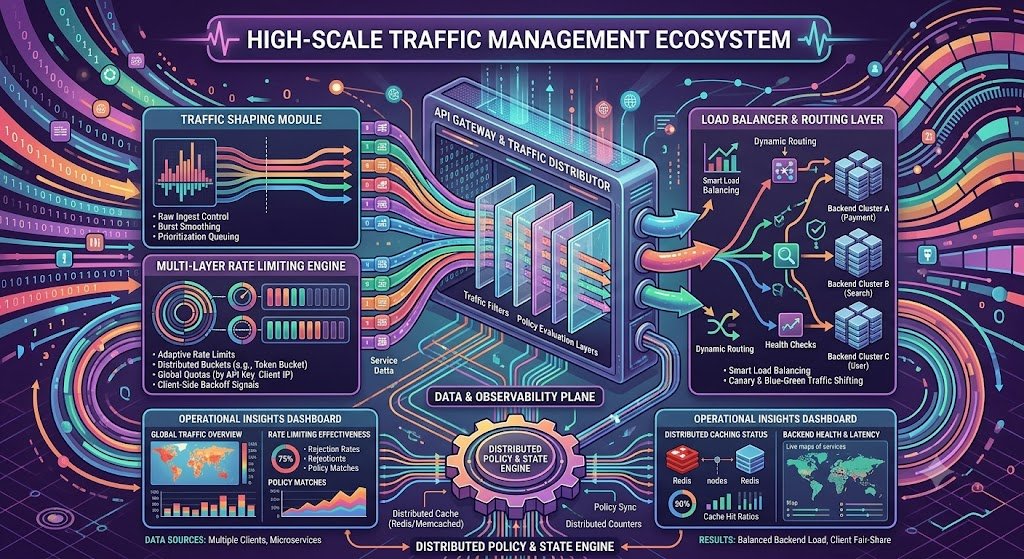
Rate limiting is one component of traffic management. A complete architecture includes multiple layers of protection.
The Layers of Traffic Management
1. Edge protection (CDN/WAF). The first line of defence: DDoS protection, bot detection, IP blocking. Cloudflare, AWS Shield, and similar services handle volumetric attacks before they reach your infrastructure.
2. API gateway. The central enforcement point: authentication, rate limiting, quota management, request validation. Kong, Apigee, AWS API Gateway, or a custom gateway.
3. Service-level protection. Circuit breakers, bulkheads, and timeouts within services to prevent cascading failures.
4. Load shedding. When capacity is exceeded, deliberately reject low-priority requests to protect high-priority ones.
5. Backpressure. Signal upstream systems to slow down when downstream systems are saturated.
Circuit Breaker
A circuit breaker monitors calls to a downstream service. If failures exceed a threshold, the circuit opens and calls fail fast (without attempting the downstream call). After a timeout, the circuit half-opens to test recovery.
Why it matters: Prevents cascading failures. If a payment gateway is down, the circuit breaker stops the API from waiting on timeouts and exhausting resources.
Load Shedding
When the system is at capacity, load shedding rejects requests based on priority. High-priority requests (payments, authenticated users) are served; low-priority requests (health checks, unauthenticated traffic) are rejected.
Why it matters: Protects critical functionality during overload. Better to serve 80% of users well than 100% poorly.
Backpressure
Backpressure is a mechanism for downstream systems to signal upstream systems to slow down. In async systems (queues, streams), it prevents the queue from growing unbounded.
Why it matters: Prevents memory exhaustion and cascading failures in event-driven architectures.
Traffic Management Layers Table
| Layer | Component | Protects Against |
|---|---|---|
| Edge | CDN, WAF, DDoS protection | Volumetric attacks, bots |
| Gateway | Rate limiting, quotas, auth | Abuse, overuse |
| Service | Circuit breaker, timeout, bulkhead | Cascading failures |
| System | Load shedding, backpressure | Overload |
Architecture at a Glance
text Client → CDN/WAF → API Gateway (rate limit, auth) → Load Balancer → Services (circuit breaker, timeout) → Backend
Real Costs in India (2026)
Traffic management costs depend on the scale, the tooling chosen, and whether it is built or bought.
Tooling Costs
| Component | Monthly Cost (₹) | Monthly Cost ($ approx.) | Notes |
|---|---|---|---|
| CDN/WAF (Cloudflare, AWS) | ₹10,000–₹1,00,000 | $120–$1,200 | Scales with traffic |
| API gateway (managed) | ₹15,000–₹1,50,000 | $180–$1,800 | AWS API Gateway, Apigee |
| API gateway (self-hosted) | ₹10,000–₹60,000 | $120–$720 | Kong, Nginx (infra cost) |
| Redis (rate limit store) | ₹5,000–₹40,000 | $60–$480 | Managed Redis |
| Observability | ₹10,000–₹60,000 | $120–$720 | Metrics, logs, traces |
| Load testing tools | ₹5,000–₹30,000 | $60–$360 | k6, Loader.io |
Implementation Costs
| Scope | Cost (₹) | Cost ($ approx.) | Timeline |
|---|---|---|---|
| Basic rate limiting (per-key, single algorithm) | ₹1–3 lakh | $1,200–$3,600 | 2–4 weeks |
| Distributed rate limiting + gateway | ₹3–8 lakh | $3,600–$9,600 | 4–8 weeks |
| Full traffic management (circuit breaker, load shedding, observability) | ₹8–20 lakh | $9,600–$24,000 | 8–16 weeks |
The Cost of Not Doing It
A single outage caused by unmanaged traffic can cost:
Lost revenue: During the outage and in customer churn.
Engineering time: Hours or days of incident response.
Reputation: Customers who experience outages consider alternatives.
For an application generating ₹1 crore/month in revenue, one hour of downtime costs roughly ₹14,000—plus the downstream impact. The cost of traffic management is usually far less than the cost of one serious outage.
India-Specific Compliance: DPDPA and MeitY
DPDPA and API Traffic
API traffic carries personal data. Under the DPDP Act:
Rate limiting is a security control: It supports the obligation to implement reasonable security safeguards.
Logging: API logs that contain personal data must be redacted and retained per policy.
Access control: API keys and tokens must be managed securely.
Breach response: If an API is compromised, breach notification applies.
MeitY AI Governance
If AI agents use your APIs, MeitY's guidelines on transparency and accountability apply. AI agents should be identifiable, and their traffic should be subject to the same limits as human users.
Compliance Checklist
| Requirement | Implementation | Priority |
|---|---|---|
| API authentication | Keys, OAuth, JWT | High |
| Rate limiting | Per-key, per-endpoint | High |
| PII redaction in logs | Redact before storage | High |
| Secure key storage | Secrets manager, rotation | High |
| Audit logging | API access logged | Medium |
| Breach response | Incident response plan | High |
Implementation Framework: A Phased Approach With Cost Gates
Phase 1: Assessment and Baseline (Week 1–2)
Objective: Understand current traffic patterns and identify risks.
Activities:
Analyse traffic: peak volumes, client distribution, endpoint usage.
Identify risks: retry storms, abusive clients, AI agent traffic.
Define limits: what rate is acceptable per client, per endpoint?
Choose algorithm and storage: token bucket, Redis.
Assess DPDPA exposure in API logs.
Cost: ₹50,000–₹1.5 lakh ($600–$1,800).
Go/No-Go: Traffic patterns understood. Limits defined. Tooling chosen.
Phase 2: Basic Rate Limiting (Week 3–6)
Objective: Implement per-client rate limiting.
Activities:
Implement token bucket algorithm.
Store counters in Redis.
Return 429 with Retry-After header.
Add rate limit headers (limit, remaining, reset).
Monitor rate limit hits.
Cost: ₹1–3 lakh ($1,200–$3,600).
Go/No-Go: Rate limiting works. Legitimate traffic unaffected. Abusive traffic blocked.
Phase 3: Gateway and Distributed Limiting (Week 7–12)
Objective: Centralise traffic management at the gateway.
Activities:
Deploy API gateway (Kong, AWS API Gateway).
Implement distributed rate limiting across servers.
Add authentication and quota management.
Implement IP-based and user-based limits.
Add observability for rate limiting.
Cost: ₹3–8 lakh ($3,600–$9,600).
Go/No-Go: Distributed limiting works. Gateway handles scale.
Phase 4: Resilience Patterns (Week 13–20)
Objective: Add circuit breakers, timeouts, and load shedding.
Activities:
Implement circuit breakers for downstream calls.
Add timeouts to all external calls.
Implement load shedding for low-priority traffic.
Add backpressure for async systems.
Test failure scenarios.
Cost: ₹3–8 lakh ($3,600–$9,600).
Go/No-Go: Cascading failures prevented. System degrades gracefully.
Phase 5: Continuous Improvement (Ongoing)
Objective: Monitor, tune, and improve.
Activities:
Monitor rate limit effectiveness.
Tune limits based on traffic patterns.
Review incidents for traffic-related causes.
Update limits for new clients and AI agents.
Cost: Ongoing observability and engineering time.
Phase Summary Table
| Phase | Duration | Key Deliverable | Cost (₹) | Go/No-Go Criteria |
|---|---|---|---|---|
| 1. Assessment | 2 weeks | Limits defined, tooling chosen | 50,000–1.5 lakh | Traffic understood |
| 2. Basic Limiting | 4 weeks | Per-client rate limiting | 1–3 lakh | Limits work |
| 3. Gateway & Distributed | 6 weeks | Centralised gateway | 3–8 lakh | Distributed works |
| 4. Resilience | 8 weeks | Circuit breakers, load shedding | 3–8 lakh | Graceful degradation |
| 5. Continuous Improvement | Ongoing | Tuning, monitoring | Ongoing | Stable, tuned |
Risks, Pitfalls, and Governance
The Most Common Traffic Management Failures
Limits too strict. Legitimate users are blocked. Mitigation: Start with generous limits, monitor, and tune based on data.
Limits too loose. Abuse goes undetected. Mitigation: Monitor traffic patterns, use anomaly detection.
No retry guidance. Clients retry without backoff, causing storms. Mitigation: Return 429 with Retry-After, document backoff requirements.
Single point of failure. Redis failure breaks rate limiting. Mitigation: Local caching, graceful degradation.
Inconsistent limits. Different servers enforce different limits. Mitigation: Centralised store, consistent configuration.
No observability. Cannot see who is hitting limits or why. Mitigation: Log rate limit events, dashboard them.
Risk Summary Table
| Risk | Likelihood | Impact | Mitigation |
|---|---|---|---|
| Limits too strict | High | High (blocked users) | Start generous, tune |
| Limits too loose | Medium | High (abuse) | Anomaly detection |
| Retry storms | High | High (outage) | Retry-After, backoff docs |
| Redis failure | Medium | High (limiting breaks) | Local cache, fail open/closed |
| Inconsistent limits | Medium | Medium | Centralised store |
| No observability | High | Medium | Log and dashboard |
Benchmark Summary and Decision Framework
Decision Matrix: Algorithm Selection
| Requirement | Recommended Algorithm |
|---|---|
| Simple rate limiting | Fixed window |
| Allow bursts | Token bucket |
| Smooth traffic | Leaky bucket |
| High accuracy, low volume | Sliding window log |
| General purpose | Sliding window counter or token bucket |
Traffic Management Priority Table
| Component | Impact | Effort | Priority |
|---|---|---|---|
| API authentication | Very High | Medium | 1 |
| Rate limiting (token bucket) | Very High | Medium | 2 |
| 429 with Retry-After | High | Low | 3 |
| Circuit breaker | High | Medium | 4 |
| Timeouts | High | Low | 5 |
| Load shedding | Medium-High | Medium | 6 |
| Backpressure | Medium | High | 7 |
The One-Paragraph Decision Rule
If you are building a high-scale API, start with authentication and token bucket rate limiting per API key and per endpoint. Return 429 with Retry-After so clients know how to back off. Add circuit breakers and timeouts for downstream calls. Add load shedding when you have priority tiers. Use Redis for distributed limits with local caching. Monitor rate limit events. And treat AI agent traffic as a first-class concern—agents need their own limits.
Frequently Asked Questions
1. What is API rate limiting?
Rate limiting controls how many requests a client can make in a given time period. It prevents any single client from overwhelming the API, supports fair usage, and protects against abuse.
2. Which rate limiting algorithm should I use?
Token bucket for most APIs. It allows legitimate bursts while enforcing a sustainable average rate. Fixed window is simplest but has a boundary problem. Sliding window log is accurate but memory-heavy.
3. What is the difference between rate limiting and throttling?
Rate limiting rejects requests that exceed the limit. Throttling slows down requests (queues them) rather than rejecting. Rate limiting is more common; throttling is used when requests must not be lost.
4. How do I implement distributed rate limiting?
Use a centralised store (Redis) for counters, with local caching for performance. Handle Redis failures gracefully—fail open for read APIs, fail closed for authentication.
5. What is a circuit breaker?
A circuit breaker stops calls to a failing downstream service, failing fast instead of waiting on timeouts. It prevents cascading failures and allows the downstream service to recover.
6. What is load shedding?
Load shedding deliberately rejects low-priority requests when the system is at capacity, protecting high-priority requests. It is better to serve 80% of users well than 100% poorly.
7. How do I handle retry storms?
Return 429 with a Retry-After header, document backoff requirements for clients, and use circuit breakers to stop retries from reaching a failing service.
8. How does DPDPA affect API traffic management?
Rate limiting is a security control that supports DPDPA obligations. API logs containing personal data must be redacted and retained per policy. Breach notification applies if the API is compromised.
9. How do I rate limit AI agents?
Treat AI agents as a distinct client category with their own limits. Require API keys for agents, set per-agent limits, and monitor agent traffic for anomalies.
10. How much does rate limiting implementation cost in India?
Basic rate limiting costs ₹1–3 lakh ($1,200–$3,600). Distributed rate limiting with a gateway costs ₹3–8 lakh ($3,600–$9,600). Full traffic management with circuit breakers and load shedding costs ₹8–20 lakh ($9,600–$24,000).
11. How do I choose limits?
Start with generous limits based on expected usage, monitor actual traffic, and tune. Analyze peak usage per client and set limits above the 95th percentile to avoid blocking legitimate users.
12. How can Innovative AI Solutions help?
Innovative AI Solutions builds traffic management systems for Indian high-scale applications—API gateways, distributed rate limiting, circuit breakers, load shedding, and observability. Our Delhi-based team handles architecture, implementation, and tuning. Visit https://innovativeais.com to discuss your requirements.
Contact Innovative AI Solutions
Ready to protect your API from the traffic that will inevitably hit it?
[One-line supporting sentence.]
Contact Information
Innovative AI Solutions
📍 Netaji Subhash Place, Pitampura, Delhi – 110034
🌐 Website: https://innovativeaislabs.com 📧 Email: info@innovativeais.com
📞 Phone: +91 7464 099 059 / +91 96899 67356
Business Services
AI Automation
AI Development
AI Consulting
Machine Learning Solutions
Deep Learning Solutions
Generative AI Services
NLP Solutions
AI Agents
AI Chatbots
Voice AI
CRM Development
Custom Software Development
Website Development
Mobile App Development
About the Author
Abhishek Kumar
Founder & CEO, Innovative AI Solutions
5+ years building production AI systems for Indian businesses. Based in Delhi, serving clients across India.
Ready to build AI solutions for your business?
Innovative AI Solutions — Delhi's leading AI development company. Free consultation available.
Get Free Consultation →
A practical 2026 guide for Indian engineering teams building API rate limiting and traffic management—algorithm selection, distributed limiting, circuit breakers, load shedding, real rupee costs, and DPDPA-compliant observability.
#APIRateLimiting #TrafficManagement #APIGateway #TokenBucket #CircuitBreaker #LoadShedding #Backpressure #DistributedLimiting #Redis #APIScaling #DPDPA #MeitY #APIObservability #HighScale #DelhiNCR #InnovativeAISolutions
Copyright ©️ 2015–2026 Innovative AI Solutions. All Rights Reserved. | Privacy Policy | Terms & Conditions