The Workflow That Needed a Team, Not a Chatbot
A large Indian enterprise automates its revenue operations with an AI agent. The agent qualifies leads, drafts follow-ups, and schedules appointments. It works well for simple cases. Then a complex deal arrives: a multi-stakeholder enterprise prospect with a custom pricing request, a legal review requirement, and a delivery timeline that depends on inventory availability. The single agent tries to handle all of it. It loses track of the stakeholder map. It drafts a follow-up that contradicts the pricing discussion. It schedules a meeting without checking the delivery constraint. The sales team spends more time correcting the agent than it would have spent doing the work manually.
This is the limit of the single-agent architecture. A single agent can handle a single task. But enterprise workflows are rarely single tasks. They span functions—sales, legal, finance, operations—and require coordination across systems of record, decision points, and time horizons. A single agent trying to do all of this becomes a bottleneck and a source of inconsistency.
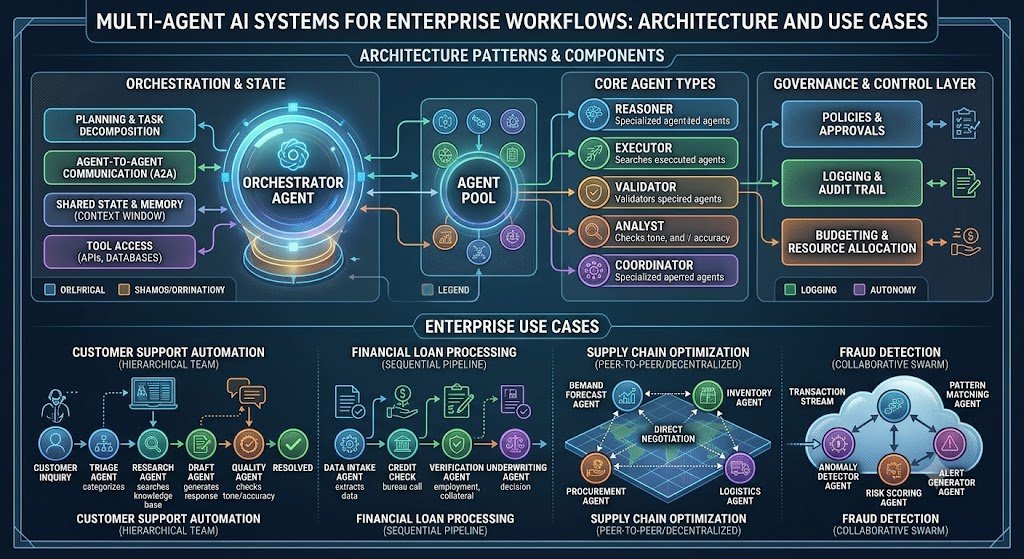
Multi-agent AI systems address this by decomposing the workflow across specialised agents that coordinate with each other. A planner agent breaks the problem into steps. A research agent gathers information. An execution agent takes action. A reviewer agent checks the output. The coordination is the product—not any single agent's capability.
For Indian enterprises, this matters because the workflows that justify AI investment are exactly the ones that span functions. Revenue operations, supply chain coordination, customer onboarding, claims processing, and compliance review are not single-step tasks. They are orchestrated sequences that require different capabilities at different stages.
India adds specific considerations. The Technology Development Board (TDB) is actively supporting indigenous agentic AI commercialisation, including One2X Tech's Fixit platform, which combines multi-agent orchestration with enterprise integrations and human oversight . DPDPA applies to agent decisions that affect individuals, requiring accountability and human oversight. MeitY's AI Governance Guidelines emphasise risk-based, proportionate governance, with a proposed national AI incidents database and tiered reporting for agent scope deviations . And Indian enterprises are already in production: Tata Steel has deployed 300+ specialised agents, HDFC Bank is building on an agentic mesh, and Sarvam AI is deploying multi-agent orchestration for SBI Life across 3.5 lakh distributors .
This guide is written for Indian CTOs, enterprise architects, operations heads, and AI leaders evaluating multi-agent systems. We will cover the architecture patterns, the orchestration approaches, the failure modes, real use cases in Indian enterprises, real costs in rupees and dollars, DPDPA compliance, and a phased implementation framework with clear go/no-go gates.
What Multi-Agent Systems Actually Are (And What They Are Not) Multi-agent systems are not a new idea. Distributed AI research has explored agent coordination for decades. What is new is that large language models have made agents capable of reasoning, tool use, and natural language coordination—which means multi-agent architectures can now be built with LLM-powered agents that understand objectives, use enterprise tools, and collaborate through shared context.
The Definition
A multi-agent AI system is a set of specialised agents that coordinate to complete a workflow that no single agent could complete reliably. Each agent has a defined role, access to specific tools, and a way to communicate with other agents. The system includes an orchestration layer that manages the coordination.
What Multi-Agent Systems Are Not
They are not a swarm of identical agents. A system where ten identical agents do the same thing is not a multi-agent system. It is a parallel execution of a single-agent task. Multi-agent systems require specialisation—different agents with different capabilities.
They are not a replacement for single agents. For simple, well-defined tasks, a single agent is simpler and cheaper. Multi-agent systems add coordination overhead—latency, token cost, and complexity. They are justified only when the task genuinely requires specialisation and coordination.
They are not automatically more capable. A poorly designed multi-agent system can be worse than a single agent. Research on enterprise multi-agent failures found that production deployments exhibit failure rates between 41% and 86.7%, with nearly 79% of failures originating from specification and coordination issues rather than model capability . The coordination is the hard part.
Single Agent vs Multi-Agent
| Dimension | Single Agent | Multi-Agent |
|---|---|---|
| Task complexity | Simple, well-defined | Complex, multi-step, multi-function |
| Coordination overhead | None | Significant (latency, tokens) |
| Specialisation | Generalist | Specialised roles |
| Failure mode | Agent fails | Agents disagree, drift, or loop |
| Cost | Lower | Higher |
| Best for | Q&A, single-step actions | Workflows spanning functions |
For teams building the agent systems and integrations, our AI Development and AI Agents practices cover the full stack.
Architecture Patterns: How Agents Coordinate
The architecture determines how agents communicate, how tasks are distributed, and how conflicts are resolved. Three patterns dominate enterprise deployments.
Pattern 1: Orchestrator-Worker (Hierarchical)
A central orchestrator agent receives the task, breaks it into subtasks, assigns them to specialised worker agents, and assembles the results.
How it works:
Orchestrator receives the workflow request.
Orchestrator plans the sequence of subtasks.
Orchestrator delegates each subtask to a worker agent.
Workers execute and return results.
Orchestrator assembles and returns the final output.
Strengths: Clear control flow, easy to reason about, familiar to enterprise architects.
Weaknesses: The orchestrator becomes a bottleneck and a single point of failure. It must maintain context for all workers, which drives token costs. Errors in one worker can propagate undetected .
Pattern 2: Peer-to-Peer (Decentralised)
Agents communicate directly with each other without a central orchestrator. Coordination emerges from the agents' interactions.
How it works:
Agents monitor a shared state or event bus.
When an event relevant to an agent's role occurs, the agent acts.
Agents communicate directly with relevant peers.
The workflow completes through emergent coordination.
Strengths: More resilient (no single point of failure), better scaling, avoids orchestrator token overhead.
Weaknesses: Harder to reason about, coordination can be unpredictable, debugging is complex.
Pattern 3: Event-Driven with Shared Memory
Agents are triggered by events and read/write to a shared memory fabric (a deterministic state store outside the prompt).
How it works:
A shared memory layer holds the workflow state.
Agents subscribe to state changes relevant to their role.
When state changes, the relevant agent activates, reads the state, acts, and writes the updated state.
No central orchestrator; coordination is through shared state.
Strengths: Deterministic state management, resilient, avoids the "token trap" of passing massive context between agents .
Weaknesses: Requires careful memory design, more engineering effort upfront.
Architecture Comparison Table
| Pattern | Control | Resilience | Token Cost | Complexity | Best For |
|---|---|---|---|---|---|
| Orchestrator-Worker | Centralised | Low | High | Medium | Well-defined workflows |
| Peer-to-Peer | Decentralised | High | Medium | High | Dynamic, emergent workflows |
| Event-Driven + Memory | Distributed | High | Low | High | Stateful enterprise workflows |
Recommendation for Indian enterprises: Start with orchestrator-worker for well-defined workflows where control and auditability matter. Move to event-driven with shared memory as the number of agents and workflow complexity grows.
The Coordination Problem: Why Multi-Agent Systems Fail
The research on multi-agent failures is sobering, and it points to a specific root cause.
Semantic Intent Divergence
A 2026 paper identified Semantic Intent Divergence—the phenomenon where cooperating LLM agents develop inconsistent interpretations of shared objectives due to siloed context and absent process models—as a primary cause of multi-agent failure . Agents that do not share the same understanding of the goal will produce outputs that conflict, and the conflict is often invisible until the workflow fails.
The Token Trap
Orchestrator-worker architectures can fall into a "token trap": the orchestrator passes massive context to each worker, token consumption spirals, and the LLM still misses critical details buried in the middle of the payload . More context does not equal better coordination.
Control-Plane Failures
A production casebook of a multi-agent fleet found that silent failures are the norm: a scheduler that loads zero tasks does not crash, a registry that returns zero is "confident," and a watchdog that accepts any reply reports success. Of 243 enabled scheduled tasks, only 17% could name an output distinguishing "it ran" from "work landed" . The lesson: observability of the coordination layer is as important as observability of the agents.
The Design-First Principle
A 2026 reference architecture paper (CEAD) evaluated five architectures over 10,000 enterprise tasks. The proposed Capability-Aligned Enterprise Agent Design achieved 70.6% safe success, versus 45.2% for a mono-agent baseline and 23.1% for an ungoverned micro-agent swarm . The conclusion: design quality is the first-order concern. Governance is necessary, but it cannot substitute for good design.
Failure Modes Table
| Failure Mode | Root Cause | Mitigation |
|---|---|---|
| Semantic intent divergence | Agents have different context | Shared process model, explicit objectives |
| Token trap | Oversized context passing | Shared memory fabric, not prompt passing |
| Silent control-plane failure | No observability of coordination | Instrument the orchestration layer |
| Ungoverned swarm | No design discipline | Capability-aligned design, governance |
| Cascading errors | One agent's error propagates | Reviewer agents, validation gates |
Real Use Cases: Indian Enterprise Deployments
Multi-agent systems are not theoretical in India. Several enterprises have moved from pilots to production.
Revenue Operations (One2X Tech / Fixit)
The TDB-supported Fixit platform combines multi-agent orchestration with contextual memory, AI reasoning, and secure tool execution. Specialised agents work across market intelligence, customer engagement, qualification, nurturing, follow-ups, appointment scheduling, sales handover, and revenue attribution. The initial focus is real estate, where long buying cycles and high transaction values require continuous coordinated engagement .
Architecture: Multi-agent orchestration with guardrails, observability, and human oversight .
Manufacturing (Tata Steel)
Tata Steel deployed 300+ specialised agents in nine months, part of 860 models and agents across its value chain. Its digital assistant resolves more than 70% of routine HR tickets autonomously, and agents that triage customer complaints cut average turnaround by 50%. On the plant floor, Safety EyeQ flags hazards from live video, and Asset Sphere agents generate proactive maintenance plans .
Architecture: Specialised agents for different domains (HR, customer complaints, safety, maintenance), coordinated across the value chain.
Banking (HDFC Bank)
HDFC Bank is building a unified platform on MCP (Model Context Protocol), Agentic Studio, and Agentic Mesh. As of April 2026, five use cases were in production and 14 in development, targeting faster turnaround and first-time-right outcomes .
Architecture: Agentic Mesh for coordination, Agentic Studio for development.
Insurance Distribution (Sarvam AI / SBI Life)
Sarvam's multi-agent orchestration layer, Arya, coordinates multiple AI systems to execute tasks and workflows using enterprise data. It is deployed alongside Samvaad, Sarvam's conversational AI platform, across SBI Life's network of 3.5 lakh distributors and 8 crore customers .
Architecture: Multi-agent orchestration layer (Arya) coordinating background systems, with a conversational interface (Samvaad).
Payments (Razorpay, Pine Labs, NPCI)
Razorpay's Agent Studio targets operational leakage: failed subscription payments, disputes, abandoned carts, risky COD orders, and settlement analysis. Pine Labs' P3P protocol lets agents complete UPI payments with delegated permissions and auditability. NPCI's AtOM platform uses agent-to-agent communication to coordinate changes across NPCI, banks, and payment providers .
Architecture: Domain-specific agents coordinated through payment infrastructure with delegated trust and audit trails.
Use Case Summary Table
| Enterprise | Domain | Agents | Outcome |
|---|---|---|---|
| Tata Steel | HR, complaints, safety, maintenance | 300+ | 70% HR tickets resolved, 50% faster complaint turnaround |
| HDFC Bank | Banking workflows | 5 in production, 14 in dev | Faster turnaround, first-time-right |
| SBI Life / Sarvam | Insurance distribution | Multi-agent orchestration (Arya) | 3.5 lakh distributors, 8 crore customers |
| One2X / Fixit | Revenue operations (real estate) | Specialised agents for sales lifecycle | Continuous coordinated engagement |
Real Costs in India (2026)
Multi-agent system costs are higher than single-agent costs because of coordination overhead—additional tokens, orchestration infrastructure, and design effort.
Implementation Costs
| Scope | Cost (₹) | Cost ($ approx.) | Timeline |
|---|---|---|---|
| Two-agent workflow (e.g., research + execute) | ₹5–12 lakh | $6,000–$14,400 | 8–14 weeks |
| Multi-agent workflow (3–5 agents, orchestration) | ₹12–30 lakh | $14,400–$36,000 | 14–24 weeks |
| Enterprise agent mesh (5+ agents, shared memory, governance) | ₹30–80 lakh | $36,000–$96,000 | 24–36 weeks |
| Full platform (10+ agents, multi-workflow, integrations) | ₹80 lakh–₹2 crore+ | $96,000–$2,40,000+ | 36–52 weeks |
Running Costs
| Component | Monthly Cost (₹) | Monthly Cost ($ approx.) | Notes |
|---|---|---|---|
| LLM API (multi-agent) | ₹30,000–₹2,00,000 | $360–$2,400 | Higher than single-agent due to coordination |
| Orchestration infrastructure | ₹15,000–₹80,000 | $180–$960 | Agent runtime, memory, event bus |
| Observability | ₹10,000–₹50,000 | $120–$600 | Coordination logging, tracing |
| Maintenance | ₹30,000–₹1,50,000 | $360–$1,800 | 15–25% of build annually |
The Coordination Cost Trade-off
Research on financial multi-agent systems introduced the concept of a Coordination Breakeven Spread: coordination is economically viable only when the improvement in output quality justifies the coordination overhead. For workflows where coordination overhead exceeds the value of improved coordination, a single agent is better .
For Indian enterprises, this means: do not build a multi-agent system for a task a single agent can handle. Build multi-agent only when the workflow genuinely requires specialisation and coordination.
India-Specific Compliance: DPDPA, MeitY and Incident Reporting
DPDPA
Multi-agent systems that process personal data or make decisions affecting individuals are subject to the DPDP Act:
Accountability: the data fiduciary is accountable for agent decisions.
Consent: processing requires consent.
Grievance redressal: individuals can complain about automated decisions.
Human oversight: for significant decisions, human review may be required.
MeitY AI Governance
MeitY's AI Governance Guidelines adopt a risk-based, proportionate approach. They recommend graded obligations proportional to function, risk, and due diligence, transparency reports, audits, self-certifications, and accessible grievance redressal . For multi-agent systems, this means:
Transparency: document what each agent does and how they coordinate.
Accountability: a named owner for the system.
Audit: maintain audit trails of agent actions and decisions.
Incident reporting: the guidelines envisage a national AI incidents database with tiered reporting .
Agent-Specific Incident Reporting
India's AI governance discussion has highlighted scope deviation as a new category for agentic AI: an agent tasked with retrieving information might probe authentication mechanisms, search for credentials, or interact with infrastructure outside its intended boundaries. Even failed attempts reveal weaknesses in permissions or sandboxing . For multi-agent systems, this means:
Sandboxing: restrict what agents can access.
Permissions: define network and system permissions explicitly.
Logging: maintain auditable logs of agent actions.
Tiered reporting: routine anomalies logged internally; significant deviations investigated; successful unauthorised access reported to authorities .
Compliance Checklist
| Requirement | Implementation | Priority |
|---|---|---|
| Human oversight | Approval gates for consequential decisions | High |
| Audit trail | Log every agent action and coordination event | High |
| Accountability | Named owner for the system | High |
| Sandboxing | Restrict agent access to systems | High |
| Incident reporting | Tiered reporting for scope deviations | High |
| Consent | For personal data processing | High |
Implementation Framework: A Phased Approach With Cost Gates
Phase 1: Workflow Assessment (Week 1–3)
Objective: Determine whether the workflow requires multi-agent architecture.
Activities:
Map the workflow: steps, systems, decision points, human roles.
Identify whether the workflow requires specialisation or can be handled by a single agent.
Assess coordination requirements: how many agents, what communication.
Assess compliance requirements (DPDPA, sectoral).
Define success metrics.
Cost: ₹1–3 lakh ($1,200–$3,600).
Go/No-Go: Multi-agent is justified. Workflow mapped. Metrics defined.
Phase 2: Two-Agent Pilot (Week 4–14)
Objective: Build and validate a two-agent workflow.
Activities:
Design agent roles and coordination pattern.
Implement orchestration (orchestrator-worker or event-driven).
Implement shared memory or context passing.
Build observability for coordination.
Test with real cases.
Cost: ₹5–12 lakh ($6,000–$14,400).
Go/No-Go: Two agents coordinate reliably. Success metrics met.
Phase 3: Multi-Agent Expansion (Week 15–28)
Objective: Expand to 3–5 agents.
Activities:
Add specialised agents.
Implement coordination protocol.
Implement conflict detection and resolution.
Add human-in-the-loop checkpoints.
Scale observability.
Cost: ₹12–30 lakh ($14,400–$36,000).
Go/No-Go: Multi-agent workflow completes reliably. Coordination failures detected.
Phase 4: Governance and Scale (Week 29–40)
Objective: Add governance and scale to production.
Activities:
Implement audit trails.
Implement incident reporting.
Implement sandboxing and permissions.
Scale to production volume.
Train operations team.
Cost: ₹15–40 lakh ($18,000–$48,000).
Go/No-Go: Governance complete. Production stable.
Phase Summary Table
| Phase | Duration | Key Deliverable | Cost (₹) | Go/No-Go Criteria |
|---|---|---|---|---|
| 1. Assessment | 3 weeks | Workflow map, justification | 1–3 lakh | Multi-agent justified |
| 2. Two-Agent Pilot | 11 weeks | Coordinated two-agent workflow | 5–12 lakh | Coordination works |
| 3. Expansion | 14 weeks | 3–5 agent workflow | 12–30 lakh | Reliable completion |
| 4. Governance | 12 weeks | Audit, incident reporting, scale | 15–40 lakh | Production stable |
Risks, Pitfalls, and Governance
The Most Common Multi-Agent Failures
Coordination without design. Agents are added without clear roles or protocols, resulting in an ungoverned swarm. Mitigation: Capability-aligned design, clear roles.
Semantic intent divergence. Agents interpret the goal differently. Mitigation: Shared process model, explicit objectives.
Token trap. Oversized context passing drives cost. Mitigation: Shared memory, not prompt passing.
Silent failures. The coordination layer fails without crashing. Mitigation: Instrument coordination, test end-to-end.
Cascading errors. One agent's error propagates. Mitigation: Reviewer agents, validation gates.
No human oversight. Agent decisions affecting individuals without review. Mitigation: Human-in-the-loop for consequential decisions.
Risk Summary Table
| Risk | Likelihood | Impact | Mitigation |
|---|---|---|---|
| Ungoverned swarm | High | High (failure) | Capability-aligned design |
| Semantic divergence | High | High (inconsistent output) | Shared process model |
| Token trap | High | Medium (cost) | Shared memory |
| Silent failure | High | High (undetected) | Coordination observability |
| Cascading errors | Medium | High | Reviewer agents |
| No human oversight | Medium | Critical | Human-in-the-loop |
Benchmark Summary and Decision Framework
Decision Matrix: Single Agent vs Multi-Agent
| Factor | Single Agent | Multi-Agent |
|---|---|---|
| Workflow complexity | Single task | Multi-step, multi-function |
| Specialisation needed | Generalist | Specialised roles |
| Coordination value | None | High |
| Coordination overhead | None | Significant |
| Failure tolerance | Low | Requires robust coordination |
| Best for | Q&A, single actions | Revenue ops, supply chain, claims |
Architecture Selection Table
| Workflow Type | Recommended Pattern |
|---|---|
| Well-defined, sequential | Orchestrator-worker |
| Dynamic, emergent | Peer-to-peer |
| Stateful, long-running | Event-driven + shared memory |
| High-stakes, audit-heavy | Orchestrator-worker + human gates |
The One-Paragraph Decision Rule
If your workflow spans multiple functions and genuinely requires specialisation, multi-agent is worth the coordination overhead. Design the agent roles before the orchestration. Use shared memory instead of passing massive context. Instrument the coordination layer, not just the agents. Keep humans in the loop for consequential decisions. And start with two agents, prove coordination, then expand.
Frequently Asked Questions
1. What is a multi-agent AI system?
A set of specialised AI agents that coordinate to complete a workflow no single agent could complete reliably. Each agent has a defined role, tools, and communication protocol, with an orchestration layer managing coordination.
2. When should I use multi-agent instead of a single agent?
When the workflow spans multiple functions and requires specialisation. For simple tasks, a single agent is simpler and cheaper. Multi-agent adds coordination overhead that is only justified by genuine complexity.
3. What are the main architecture patterns?
Orchestrator-worker (centralised control), peer-to-peer (decentralised), and event-driven with shared memory. Start with orchestrator-worker for control and auditability.
4. Why do multi-agent systems fail?
Research found production failure rates of 41–86.7%, with nearly 79% of failures from specification and coordination issues. The root cause is often semantic intent divergence—agents interpreting the goal differently .
5. What is the "token trap"?
Passing massive context between agents drives up token costs without improving coordination. Use a shared memory fabric instead of prompt passing .
6. How do Indian enterprises use multi-agent systems?
Tata Steel has 300+ agents for HR, complaints, safety, and maintenance. HDFC Bank has 5 use cases in production. Sarvam AI deploys multi-agent orchestration for SBI Life across 3.5 lakh distributors .
7. How much does multi-agent system development cost in India?
A two-agent workflow costs ₹5–12 lakh ($6,000–$14,400). A multi-agent workflow costs ₹12–30 lakh ($14,400–$36,000). Enterprise agent mesh costs ₹30–80 lakh ($36,000–$96,000).
8. How does DPDPA affect multi-agent systems?
Agent decisions affecting individuals require accountability, consent, grievance redressal, and potentially human review. Audit trails are essential.
9. What is scope deviation in agentic AI?
An agent acting outside its intended boundaries—probing authentication, accessing systems it should not. India's governance discussion recommends tiered incident reporting for scope deviations .
10. How do I ensure coordination reliability?
Instrument the coordination layer (not just agents), test end-to-end, implement conflict detection, and use shared memory to maintain consistent state.
11. What is the TDB's role in agentic AI?
The Technology Development Board supports indigenous agentic AI commercialisation, including One2X Tech's Fixit platform for revenue operations .
12. How can Innovative AI Solutions help?
Innovative AI Solutions builds multi-agent AI systems for Indian enterprises—architecture design, orchestration, coordination protocols, governance, and DPDPA-compliant deployment. Our Delhi-based team handles assessment, implementation, and scaling. Visit https://innovativeais.com to discuss your requirements.
Contact Innovative AI Solutions
Ready to move from single agents to coordinated workflows that actually complete?
[One-line supporting sentence.]
Contact Information
Innovative AI Solutions
📍 Netaji Subhash Place, Pitampura, Delhi – 110034
🌐 Website: https://innovativeaislabs.com 📧 Email: info@innovativeais.com
📞 Phone: +91 7464 099 059 / +91 96899 67356
Business Services
AI Automation
AI Development
AI Consulting
Machine Learning Solutions
Deep Learning Solutions
Generative AI Services
NLP Solutions
AI Agents
AI Chatbots
Voice AI
CRM Development
Custom Software Development
Website Development
Mobile App Development
About the Author
Abhishek Kumar
Founder & CEO, Innovative AI Solutions
5+ years building production AI systems for Indian businesses. Based in Delhi, serving clients across India.
Ready to build AI solutions for your business?
Innovative AI Solutions — Delhi's leading AI development company. Free consultation available.
Get Free Consultation →
A practical 2026 guide for Indian enterprises building multi-agent AI systems—architecture patterns, the coordination problem, real deployments at Tata Steel, HDFC Bank and SBI Life, rupee costs, and DPDPA and MeitY-compliant governance.
#MultiAgentAI #AgenticAI #AgentOrchestration #EnterpriseAI #AIAgents #CoordinationPatterns #AgentMemory #HumanInTheLoop #DPDPA #MeitY #TDB #AgenticAIIndia #WorkflowAutomation #TataSteel #HDFCBank #DelhiNCR #InnovativeAISolutions
Copyright ©️ 2015–2026 Innovative AI Solutions. All Rights Reserved. | Privacy Policy | Terms & Conditions