The Shipment That Was Already Late When the Alert Fired
An Indian manufacturer sources components from East Asia. The shipment is scheduled to arrive in three weeks. The control tower dashboard shows the container sitting at a port. On day fourteen, the dashboard finally flags a delay. By then, the production line has already been idled for four days, and the company is air-freighting components at five times the sea freight cost to meet a festive season deadline .
The dashboard worked. It showed the container was stuck. But it showed it too late—after the disruption had already cascaded into production, cost, and customer commitments.
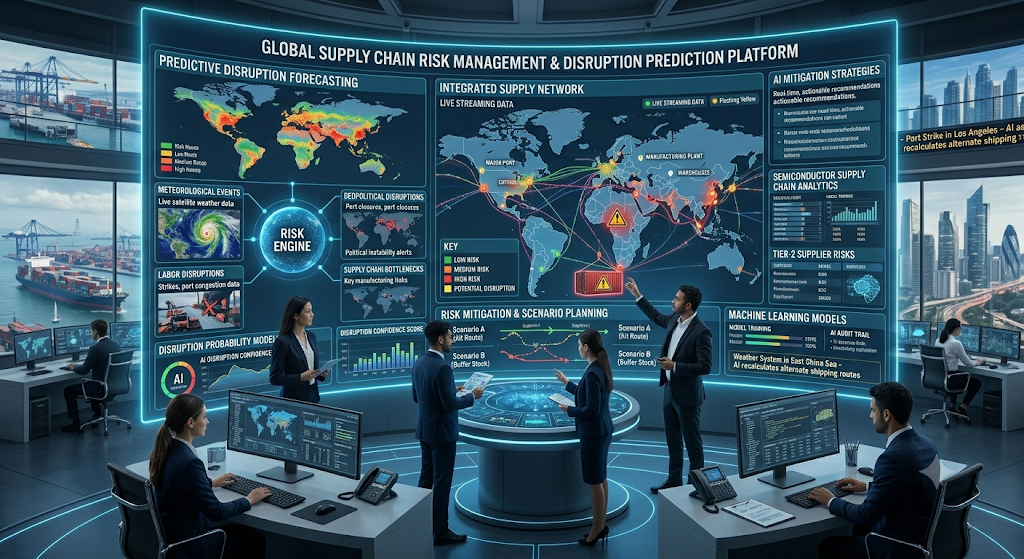
This is the gap that AI-powered supply chain risk management addresses. Visibility is not prediction. A control tower that shows where things are is useful. A system that predicts where things will fail—and tells you what to do about it—is transformative.
The Indian context makes this urgent. The Red Sea crisis has crossed 1,000 days, forcing rerouting around the Cape of Good Hope, raising freight, insurance, and working-capital costs, and hitting MSME exporters hardest . Monsoon volatility and El Niño forecasts add agricultural and rural demand risk . Vendor failures, port congestion, and geopolitical chokepoints—Hormuz, Bab el-Mandeb, Suez—are not edge cases. They are the operating environment .
The technology has matured. Indian enterprises are moving from digital visibility to predictive action and, eventually, autonomous decision-making . Tata Motors has integrated 5G connectivity for OTA and diagnostics. Tech Mahindra has partnered with ParkourSC to offer AI-native decision intelligence for pharmaceutical and cold chain supply chains, with digital twins, track-and-trace, and disruption response . And research on agentic AI for supply chains shows a four-layer multi-agent architecture that fuses global news, shipping records, sensor feeds, and financial indicators to generate early warnings with confidence and provenance—not just alerts, but evidence-linked hypotheses grounded in the supply network .
This guide is written for Indian supply chain leaders, procurement heads, logistics managers, and CTOs evaluating AI risk management. We will cover the predictive analytics, the agentic AI approach, the digital twin, the DPDPA vendor governance requirements, real costs in rupees, and a phased implementation framework with clear go/no-go gates.
From Visibility to Prediction: The Three Stages
Supply chain AI evolves through three stages. Most Indian enterprises are at stage one. The value is at stage three.
Stage 1: Visibility (Control Towers)
Control towers aggregate data from ERPs, logistics providers, and suppliers into a single dashboard. They answer: where is everything right now?
Limitation: Visibility is retrospective. By the time a delay appears on the dashboard, the disruption has already happened. And dashboards do not decide—they inform humans who may not act in time .
Stage 2: Predictive Analytics
Predictive models forecast disruptions before they occur. They answer: what is likely to go wrong, and when?
Techniques: Time-series forecasting, classification models, anomaly detection, and NLP for news and social media signals . Models ingest weather data, geopolitical events, port congestion, supplier financial health, and historical disruption patterns.
Example: A model that detects ship traffic density at a port—if cargo ships are queued, something is wrong—and issues a warning before the delay hits the customer .
Stage 3: Prescriptive and Agentic Action
Agentic systems do not just predict—they recommend or execute responses. They answer: what should we do about it?
The agentic AI approach: A four-layer multi-agent architecture fuses heterogeneous data streams with supply-network context. Reinforcement-learning agents actively acquire evidence under a bounded budget. Schema-constrained LLM agents synthesize weak signals into disruption hypotheses grounded in supply-chain entities, with confidence and provenance. Coordination agents aggregate evidence into risk assessments and early warnings .
The key difference: Instead of a dashboard that says "port congested," the system says "shipment X will miss delivery date Y because of congestion at port Z; recommend rerouting via air freight at additional cost ₹A, or accepting delay of B days."
The Three Stages Table
| Stage | Question | Output | Limitation |
|---|---|---|---|
| Visibility | Where is it? | Dashboard | Retrospective |
| Prediction | What will go wrong? | Early warning | No action |
| Prescriptive | What should we do? | Recommendation/action | Requires trust |
For teams building the data pipelines and AI models, our AI Development and Machine Learning Solutions practices cover the full stack.
The Agentic AI Architecture for Disruption Prediction
The research architecture for proactive disruption identification is the most concrete blueprint available for Indian teams building this capability.
The Four Layers
1. Data fusion. Continuous monitoring of heterogeneous structured and unstructured streams: global news, social media, shipping and logistics records, sensor feeds, and financial indicators .
2. Evidence acquisition. Reinforcement-learning agents guide evidence gathering across sources under a bounded probing budget. Instead of querying everything, the system learns which sources are most informative for which types of risk .
3. Hypothesis generation. Schema-constrained LLM agents synthesize weak signals into disruption hypotheses grounded in supply-network entities and flows. The output is not a generic alert—it is a hypothesis linked to specific suppliers, routes, or SKUs .
4. Risk assessment and warning. Coordination agents aggregate evidence into risk assessments and generate early warnings with confidence scores and provenance .
Why This Matters for India
Indian supply chains face exactly the kind of weak-signal disruptions this architecture is designed for: a tariff change, a port strike, a monsoon forecast shift, a supplier's financial distress. These signals are scattered across news, filings, and social media. The agentic approach fuses them into actionable intelligence.
The Architecture Table
| Layer | Function | Input | Output |
|---|---|---|---|
| Data fusion | Monitor streams | News, shipping, sensors, financial | Unified evidence pool |
| Evidence acquisition | Guide probing | Evidence pool | Focused evidence |
| Hypothesis generation | Synthesize signals | Evidence | Disruption hypothesis |
| Risk assessment | Aggregate and warn | Hypotheses | Early warning with provenance |
Digital Twins: The Flight Simulator for Supply Chains
A digital twin is a virtual replica of the supply network. It allows teams to stress-test scenarios before disruptions occur.
What It Does
Venkatraghavan Padmanabhan of McCain Foods described digital twins as a "flight simulator" for supply chains—allowing teams to run "what-if" analysis on commodity price volatility, supply shocks, and route disruptions . Tech Mahindra and ParkourSC use digital twins to map assets, flows, and conditions across networks so companies can monitor events in near real time and test responses to potential disruptions .
Where It Works—and Where It Doesn't
Digital twins are best suited for strategic decisions: capacity planning, supplier diversification, route optimisation under different scenarios.
They are less effective at day-to-day execution variability: vendor failures, operational exceptions, and granular disruptions where human intervention is still critical .
The Indian use case: A manufacturer can use a digital twin to simulate the impact of a Red Sea closure on delivery timelines and costs, then decide whether to pre-book air freight capacity or diversify to a domestic supplier. The twin does not run the operation. It informs the strategic decision.
The Digital Twin Table
| Use Case | Suitability | Why |
|---|---|---|
| Route disruption simulation | High | Strategic, scenario-based |
| Capacity planning | High | Long-term decisions |
| Supplier diversification | High | What-if analysis |
| Day-to-day exceptions | Low | Needs human judgment |
Real Costs in India (2026)
AI supply chain risk management costs depend on the scope: predictive analytics only, agentic system, or full digital twin platform.
Build Costs
| Scope | Build Cost (₹) | Build Cost ($ approx.) | Timeline |
|---|---|---|---|
| Predictive analytics (disruption forecasting) | ₹15–35 lakh | $18,000–$42,000 | 12–20 weeks |
| Agentic early warning (multi-source, hypotheses) | ₹30–70 lakh | $36,000–$84,000 | 20–32 weeks |
| Digital twin + decision intelligence | ₹50 lakh–₹1.5 crore | $60,000–$1,80,000 | 28–44 weeks |
| Full platform (predict + simulate + prescriptive) | ₹1.5–4 crore+ | $1,80,000–$4,80,000+ | 40–60+ weeks |
Note: USD conversions at ₹83/$. Ranges are indicative for Indian enterprises. Data integration, vendor contracts, and ongoing model maintenance are additional.
Running Costs
| Component | Monthly Cost (₹) | Monthly Cost ($ approx.) | Notes |
|---|---|---|---|
| Data subscriptions (shipping, news, financial) | ₹30,000–₹2,00,000 | $360–$2,400 | Third-party data |
| Cloud compute | ₹20,000–₹1,50,000 | $240–$1,800 | Model inference, simulation |
| Model maintenance | ₹20,000–₹1,00,000 | $240–$1,200 | Retraining, tuning |
| Vendor data governance | ₹10,000–₹50,000 | $120–$600 | DPDPA compliance |
The ROI Case
For an Indian manufacturer with ₹100 crore annual procurement:
A single disruption that delays production by one week can cost ₹50 lakh–₹1 crore in lost sales, expediting costs, and penalties.
A system that predicts one major disruption per quarter and enables mitigation saves ₹2–4 crore annually.
Payback: 3–9 months on a ₹30–70 lakh implementation.
The ROI is not theoretical. Air-freighting components during the West Asia crisis cost multiples of sea freight. Early warning allows pre-emptive booking, alternative sourcing, or customer communication .
India-Specific Compliance: DPDPA and Vendor Data Governance
Supply chain AI depends on data from vendors: supplier contacts, logistics partners, and service providers. Under the DPDP Act, the business remains accountable for personal data processed by vendors.
The DPDPA Vendor Obligations
The DPDP Act and Rules impose specific requirements on vendor data sharing :
Data Processing Agreements (DPAs). Every vendor that processes personal data must have a valid contract covering purpose limitation, security measures, sub-processing restrictions, breach notification (typically 24–48 hours), and erasure obligations.
Security safeguards. The business must ensure vendors implement reasonable security—encryption, access controls, logging—and conduct due diligence before onboarding.
Breach notification. The Fiduciary must notify the Data Protection Board and affected individuals. The clock starts when the Fiduciary becomes aware, so vendor contracts must compel rapid notification.
Cross-border transfers. Section 16 adopts a negative-list approach. Contracts should anticipate potential restrictions.
What This Means for Supply Chain AI
Supply chain data includes vendor personnel data, driver data, and warehouse worker data. The AI system that ingests this data must:
Map what personal data flows to which vendors.
Execute DPAs with all data processors.
Ensure the AI platform itself (cloud, LLM providers) has DPAs.
Implement access controls so personal data is not exposed in dashboards.
The DPDPA Checklist for Supply Chain AI
| Requirement | Implementation | Priority |
|---|---|---|
| Vendor inventory | Map all vendors processing personal data | High |
| DPAs | Contracts with all processors | High |
| Breach notification | Vendor 24–48 hour notification clause | High |
| Access control | Role-based access to personal data | High |
| Cross-border review | Section 16 compliance | Medium |
| Retention | Defined periods for vendor data | Medium |
Implementation Framework: A Phased Approach With Cost Gates
Phase 1: Risk Mapping and Data Audit (Week 1–3)
Objective: Identify the highest-risk disruption categories and available data.
Activities:
Map the supply network: suppliers, routes, ports, lead times.
Identify historical disruptions and their cost.
Assess data availability: ERP, logistics, news, financial.
Prioritise risk categories (geopolitical, weather, supplier, logistics).
Assess DPDPA vendor obligations.
Cost: ₹1–3 lakh ($1,200–$3,600).
Go/No-Go: Risks mapped. Data sources identified.
Phase 2: Predictive Analytics (Week 4–16)
Objective: Build disruption forecasting models.
Activities:
Ingest historical disruption data and external signals.
Build forecasting models for priority risk categories.
Validate against historical events.
Build early warning dashboard.
Cost: ₹15–35 lakh ($18,000–$42,000).
Go/No-Go: Models predict historical disruptions with acceptable accuracy.
Phase 3: Agentic Early Warning (Week 17–30)
Objective: Add multi-source evidence fusion and hypothesis generation.
Activities:
Implement data fusion across news, shipping, sensors.
Implement evidence acquisition and hypothesis generation.
Implement confidence scoring and provenance.
Integrate with operational workflows.
Cost: ₹20–40 lakh ($24,000–$48,000).
Go/No-Go: Warnings are actionable and evidence-linked.
Phase 4: Digital Twin and Prescriptive (Week 31–44)
Objective: Add simulation and recommendation.
Activities:
Build digital twin of supply network.
Implement scenario simulation.
Implement prescriptive recommendations.
Train supply chain team.
Cost: ₹30–60 lakh ($36,000–$72,000).
Go/No-Go: Team uses simulation for decisions.
Phase Summary Table
| Phase | Duration | Key Deliverable | Cost (₹) | Go/No-Go Criteria |
|---|---|---|---|---|
| 1. Risk Mapping | 3 weeks | Risk map, data audit | 1–3 lakh | Mapped |
| 2. Predictive | 12 weeks | Forecasting models | 15–35 lakh | Validated |
| 3. Agentic | 14 weeks | Early warning system | 20–40 lakh | Actionable |
| 4. Digital Twin | 14 weeks | Simulation, recommendations | 30–60 lakh | Used by team |
Risks, Pitfalls, and Governance
The Most Common Supply Chain AI Failures
Data silos. Predictive models fail because data is fragmented across ERP, logistics, and supplier systems. Mitigation: Data integration before modeling.
Alert fatigue. Too many warnings cause teams to ignore them. Mitigation: Confidence scoring, prioritisation, human-in-the-loop.
No action path. The system predicts disruption but does not recommend action. Mitigation: Prescriptive layer, playbooks.
Vendor data compliance gaps. Personal data shared with vendors without DPAs. Mitigation: Vendor inventory, DPAs.
Over-reliance on digital twin. Simulation is mistaken for operational reality. Mitigation: Human judgment for execution.
Trust deficit. Teams do not trust machine recommendations. Mitigation: Start in recommend mode, build confidence .
Risk Summary Table
| Risk | Likelihood | Impact | Mitigation |
|---|---|---|---|
| Data silos | High | High (weak models) | Integration first |
| Alert fatigue | High | Medium | Confidence, prioritisation |
| No action path | High | High | Prescriptive layer |
| Vendor DPDPA gaps | Medium | Critical | DPAs, inventory |
| Twin over-reliance | Medium | Medium | Human judgment |
| Trust deficit | High | High | Recommend mode first |
Benchmark Summary and Decision Framework
Decision Matrix: Build vs Partner
| Your Situation | Recommended Path |
|---|---|
| Standard supply chain, no data team | Partner (Tech Mahindra/ParkourSC, SAP, etc.) |
| Unique network, data team | Build custom |
| Cold chain / pharma | Partner with validated platform |
| Strategic resilience focus | Digital twin + predictive |
Priority Table
| Priority | Capability | Why |
|---|---|---|
| 1 | Data integration | Foundation |
| 2 | Predictive analytics | Early warning |
| 3 | Action playbooks | Mitigation |
| 4 | Agentic evidence fusion | Weak signals |
| 5 | Digital twin | Strategic simulation |
The One-Paragraph Decision Rule
If you are building AI for supply chain risk, start with data integration, not models. Map the supply network and the data sources. Build predictive models for the highest-cost disruption categories first. Add agentic evidence fusion when you need to catch weak signals. Build the digital twin for strategic decisions, not daily execution. Start in recommend mode, build trust, then expand autonomy. And ensure DPDPA vendor governance—DPAs, breach notification, access control—before you process personal data from partners.
Frequently Asked Questions
1. How much does AI supply chain risk management cost in India?
Predictive analytics costs ₹15–35 lakh ($18,000–$42,000). Agentic early warning costs ₹30–70 lakh ($36,000–$84,000). Digital twin and full platform costs ₹50 lakh–₹4 crore+.
2. What is the difference between visibility and prediction?
Visibility shows where things are now. Prediction forecasts what will go wrong. Visibility is retrospective; prediction enables mitigation before impact .
3. What is agentic AI in supply chain?
Multi-agent systems that fuse data, acquire evidence, generate disruption hypotheses, and issue early warnings with confidence and provenance—not just alerts .
4. What is a supply chain digital twin?
A virtual replica of the supply network used to simulate scenarios and stress-test decisions before disruptions occur .
5. How does DPDPA affect supply chain AI?
Vendor personnel and driver data is personal data. The business remains accountable for vendor processing. DPAs, breach notification clauses, and access controls are required .
6. Can AI predict Red Sea-type disruptions?
Agentic systems can monitor shipping records, news, and financial signals to flag emerging chokepoint risks. They cannot predict a specific attack, but they can detect patterns and issue early warnings .
7. What data sources are needed for disruption prediction?
Historical disruption data, shipping records, port congestion, weather, news, social media, supplier financial health, and sensor feeds .
8. Should I build or partner for supply chain AI?
Partner if you lack a data team or need a validated platform (especially cold chain/pharma). Build if you have a unique network and data capability.
9. How do I avoid alert fatigue?
Use confidence scoring, prioritise by business impact, and route high-confidence warnings to action while low-confidence signals stay in a monitoring queue.
10. What is the biggest risk in supply chain AI?
Data silos. Models fail when data is fragmented. Integration comes before modeling.
11. How long does implementation take?
Predictive analytics takes 12–20 weeks. Agentic early warning takes 20–32 weeks. Full platform takes 40–60+ weeks.
12. How can Innovative AI Solutions help?
Innovative AI Solutions builds AI supply chain risk management for Indian enterprises—predictive analytics, agentic early warning, digital twin simulation, DPDPA-compliant vendor data governance, and integration with ERP and logistics systems. Our Delhi-based team handles risk mapping, implementation, and optimization. Visit https://innovativeais.com to discuss your requirements.
Contact Innovative AI Solutions
Ready to predict the disruption before it hits production?
[One-line supporting sentence.]
Contact Information
Innovative AI Solutions
📍 Netaji Subhash Place, Pitampura, Delhi – 110034
🌐 Website: https://innovativeaislabs.com 📧 Email: info@innovativeais.com
📞 Phone: +91 7464 099 059 / +91 96899 67356
Business Services
AI Automation
AI Development
AI Consulting
Machine Learning Solutions
Deep Learning Solutions
Generative AI Services
NLP Solutions
AI Agents
AI Chatbots
Voice AI
CRM Development
Custom Software Development
Website Development
Mobile App Development
About the Author
Abhishek Kumar
Founder & CEO, Innovative AI Solutions
5+ years building production AI systems for Indian businesses. Based in Delhi, serving clients across India.
Ready to build AI solutions for your business?
Innovative AI Solutions — Delhi's leading AI development company. Free consultation available.
Get Free Consultation →
A practical 2026 guide for Indian supply chain leaders—predictive analytics, agentic early warning, digital twins, DPDPA vendor governance, real rupee costs, and a phased rollout that moves from visibility to prediction to action.
#AISupplyChain #SupplyChainRisk #DisruptionPrediction #PredictiveAnalytics #AgenticAI #DigitalTwin #ControlTower #ColdChain #DPDPAVendorCompliance #MeitY #SupplyChainResilience #GeopoliticalRisk #PredictiveMaintenance #SupplierRisk #IndiaSupplyChain #DelhiNCR #InnovativeAISolutions
Copyright ©️ 2015–2026 Innovative AI Solutions. All Rights Reserved. | Privacy Policy | Terms & Conditions